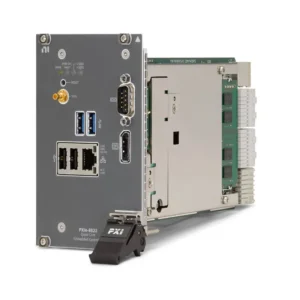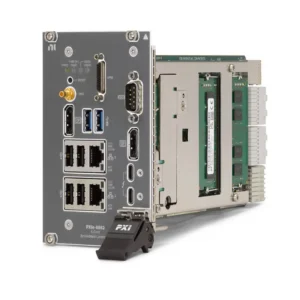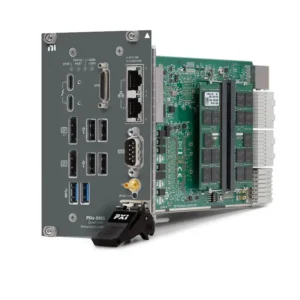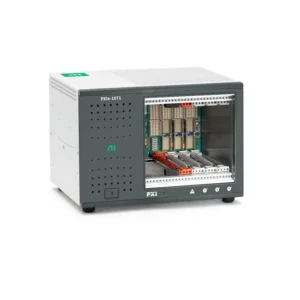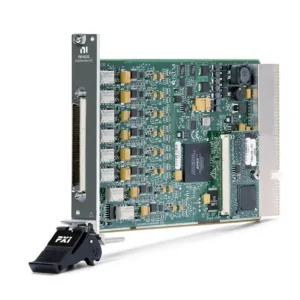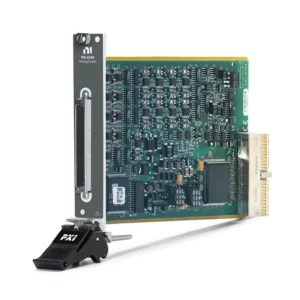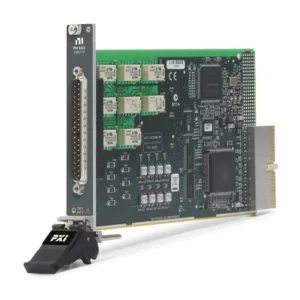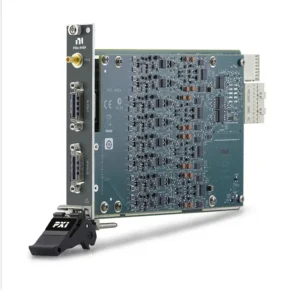





Product Introduction
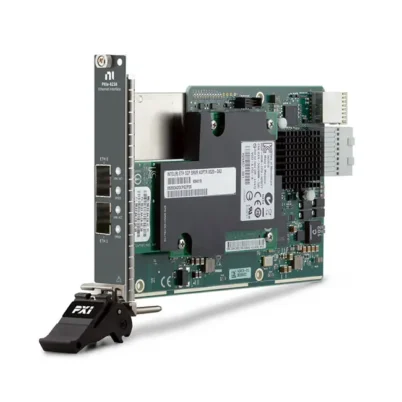
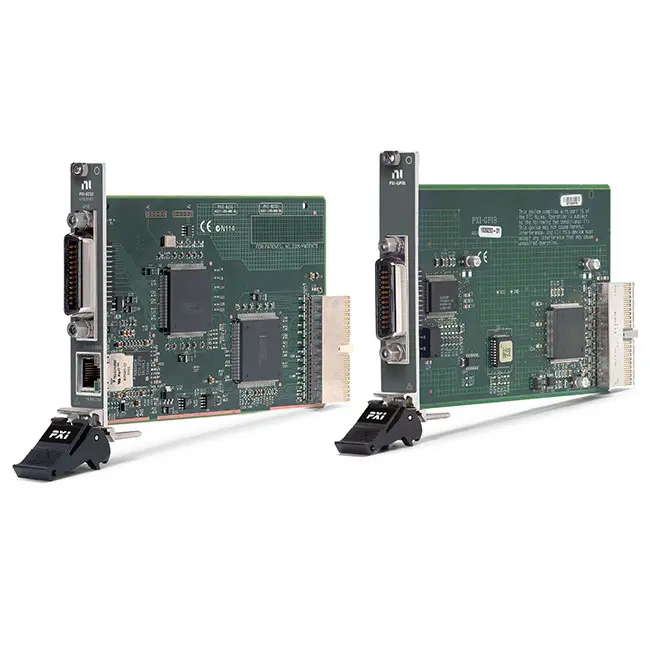
The NI PXI-8232 is a Gigabit Ethernet and IEEE 488 GPIB instrument control module designed to integrate Ethernet and GPIB instruments into PXI automated test systems.
The PXI-8232 combines a high-performance GPIB controller and a Gigabit Ethernet interface within a single-slot PXI module. This dual-interface architecture allows engineers to connect traditional IEEE 488 instruments and modern Ethernet-based instruments to the same PXI test platform.
The module provides a maximum Gigabit Ethernet transfer rate of 1,000 Mbit/s while maintaining compatibility with 10BASE-T and 100BASE-TX Ethernet networks. Its GPIB interface supports IEEE 488 instrument communication with maximum transfer rates of approximately 7.8 MB/s.
In addition to standard Ethernet instrument communication, the PXI-8232 Ethernet interface can be configured as an EtherCAT master using compatible NI Industrial Communications for EtherCAT software.
Product Overview
The National Instruments PXI-8232 is designed for automated test systems that need to integrate external instruments and Ethernet devices with PXI measurement hardware.
Many automated test systems contain a combination of:
- PXI measurement modules
- GPIB benchtop instruments
- Ethernet/LAN instruments
- Industrial Ethernet devices
- EtherCAT devices
The PXI-8232 provides both GPIB and Ethernet connectivity in a single module, helping reduce the number of separate interface cards required in the PXI chassis.
Key Features
Integrated GPIB and Gigabit Ethernet
The primary advantage of the PXI-8232 is the integration of two important instrument-control interfaces within one PXI module.
The front panel provides:
- 1 × IEEE 488 GPIB interface
- 1 × RJ45 Gigabit Ethernet interface
This architecture allows a PXI system to communicate with both GPIB and Ethernet instruments without requiring two separate interface modules.
1000 Mbit/s Gigabit Ethernet
The PXI-8232 provides a maximum Ethernet transfer rate of 1,000 Mbit/s.
The module uses the Intel 82540EM Gigabit Ethernet controller and supports Gigabit Ethernet communication over standard copper Ethernet infrastructure.
Gigabit Ethernet provides significantly higher theoretical bandwidth than traditional 100 Mbit/s Fast Ethernet and is useful for applications involving:
- LAN instrument control
- Network-connected measurement devices
- High-volume data transfer
- Automated test equipment
- Industrial communication
10BASE-T and 100BASE-TX Compatibility
Although the PXI-8232 supports 1000BASE-T Gigabit Ethernet, it remains compatible with 10BASE-T and 100BASE-TX networks.
This backward compatibility allows the module to communicate with both newer Gigabit Ethernet equipment and older Ethernet instruments.
IEEE 488 GPIB Instrument Control
The PXI-8232 includes a high-performance IEEE 488 GPIB controller for connecting traditional test and measurement instruments to a PXI system.
GPIB remains widely used with:
- Digital multimeters
- Oscilloscopes
- Spectrum analyzers
- Signal generators
- Power supplies
- LCR meters
- Electronic loads
- RF test instruments
Up to Approximately 7.8 MB/s GPIB Transfer Rate
The GPIB interface supports high-performance instrument communication with maximum transfer rates of approximately 7.8 MB/s under supported operating conditions.
Actual communication performance depends on the connected instrument, GPIB implementation, cable configuration, software, and overall system architecture.
NI-488.2 Driver Software
The PXI-8232 includes a license for NI-488.2 driver software.
NI-488.2 provides the software infrastructure required to communicate with compatible IEEE 488 instruments.
The driver can be integrated with automated test applications to:
- Detect GPIB instruments
- Configure GPIB communication
- Send instrument commands
- Read measurement results
- Automate instrument sequences
- Troubleshoot instrument communication
EtherCAT Master Capability
The Ethernet interface on the PXI-8232 can also be used as an EtherCAT master.
Using compatible NI Industrial Communications for EtherCAT software and LabVIEW, engineers can incorporate EtherCAT devices into compatible PXI control and test systems.
This capability can be useful for:
- Industrial automation
- Distributed I/O
- Motion and control systems
- Hardware-in-the-loop systems
- Automated test equipment
Single-Slot PXI Module
The PXI-8232 integrates GPIB and Gigabit Ethernet functionality into a compact single-slot PXI module.
Combining two communication interfaces within one module helps preserve chassis slots for other PXI instrumentation.
PXI Hybrid Bus Compatibility
The PXI-8232 uses a PXI Hybrid-compatible bus connection, allowing it to be installed in an appropriate compatible PXI chassis slot.
Chassis and slot compatibility should always be verified before installation.
Windows and Real-Time OS Support
The PXI-8232 supports compatible Windows and Real-Time operating system environments.
This makes the module suitable for both conventional automated test systems and deterministic PXI Real-Time applications where supported software and system configurations are used.
Technical Specifications
| Parameter | Description |
|---|---|
| Product Type | PXI GPIB and Gigabit Ethernet Instrument Control Module |
| Model | NI PXI-8232 |
| Part Number | 781753-01 |
| Bus Connection | PXI Hybrid |
| Slots Required | 1 |
| GPIB Interface | IEEE 488 |
| GPIB Ports | 1 |
| Maximum GPIB Transfer Rate | Approximately 7.8 MB/s |
| Ethernet Ports | 1 |
| Ethernet Connector | RJ45 |
| Maximum Ethernet Transfer Rate | 1,000 Mbit/s |
| Ethernet Standards | 10BASE-T / 100BASE-TX / 1000BASE-T |
| Ethernet Controller | Intel 82540EM |
| Auto MDI-X | Supported |
| EtherCAT Master | Supported with Compatible Software |
| GPIB Driver | NI-488.2 |
| Supported OS | Windows / Compatible Real-Time OS |
| Operating Temperature | 0 °C to 55 °C |
| Primary Applications | Instrument Control, Automated Test, GPIB Integration and Ethernet Instrument Communication |
What Is the PXI-8232 Used For?
The PXI-8232 is primarily used to connect non-PXI instruments and network devices to a PXI test system.
A PXI system may contain modular instruments for high-speed measurements while also relying on external benchtop instruments for specialized functions.
The PXI-8232 provides communication interfaces that allow these devices to operate within the same automated test environment.
A typical architecture can be represented as:
PXI Controller → PXI-8232 → GPIB / Ethernet → External Instruments
GPIB Instrument Integration
One of the primary applications of the PXI-8232 is integrating traditional GPIB instruments into a PXI automated test platform.
A typical configuration is:
PXI Controller → PXI-8232 → GPIB Cable → External Instrument
The PXI controller can send commands to the instrument and retrieve measurement data programmatically.
This architecture is particularly useful when an existing laboratory or production system already contains valuable GPIB instruments that need to be integrated into a newer PXI platform.
Ethernet Instrument Integration
The Gigabit Ethernet port can be used to communicate with compatible LAN-connected instruments and network devices.
A typical architecture is:
PXI Controller → PXI-8232 → Ethernet → LAN Instrument
Ethernet connectivity can be useful for instruments supporting compatible TCP/IP or VISA-based communication.
Using GPIB and Ethernet in the Same PXI System
A major advantage of the PXI-8232 is the ability to support mixed instrument-control architectures.
For example:
PXI-8232 GPIB Port → Legacy Test Instruments
PXI-8232 Ethernet Port → LAN Instruments / Network Devices
This allows engineers to preserve existing GPIB instrumentation while gradually incorporating newer Ethernet-enabled instruments.
What Is GPIB?
GPIB stands for General Purpose Interface Bus and is based on the IEEE 488 instrument communication standard.
GPIB has been widely used for decades in electronic test and measurement systems because it provides standardized communication between computers and programmable instruments.
Common GPIB instruments include:
- Digital multimeters
- Oscilloscopes
- Signal generators
- Spectrum analyzers
- Network analyzers
- Power supplies
- Electronic loads
- Frequency counters
Why GPIB Is Still Used in Automated Test
Although Ethernet and USB are common in modern instruments, many laboratories and production facilities continue to operate high-value GPIB instruments.
Replacing these instruments solely to change the communication interface may not be economical.
A GPIB interface such as the PXI-8232 allows existing equipment to remain part of a modern PXI automated test platform.
What Is Gigabit Ethernet?
Gigabit Ethernet provides network communication at theoretical data rates up to 1,000 Mbit/s.
The PXI-8232 supports 1000BASE-T while remaining compatible with lower-speed 10BASE-T and 100BASE-TX equipment.
This flexibility allows the same interface to communicate with a broad range of network equipment.
Auto MDI-X Support
The copper Ethernet interface on the PXI-8232 supports Auto MDI-X.
Auto MDI-X automatically determines the required transmit and receive wiring configuration, eliminating the traditional requirement to select between straight-through and crossover Ethernet cables for many direct connections.
This can simplify direct Ethernet connections between the PXI-8232 and compatible devices.
Ethernet Cabling Requirements
For 1000BASE-T Gigabit Ethernet operation, a suitable four-pair Category 5 or better Ethernet cable should be used.
The maximum standard copper Ethernet cable length is approximately 100 meters.
Cable quality, wiring, connected equipment, and network configuration can affect actual communication performance.
PXI-8232 as an EtherCAT Master
The PXI-8232 Ethernet port can be configured as an EtherCAT master using compatible NI Industrial Communications for EtherCAT software.
A typical architecture can be represented as:
PXI Controller → PXI-8232 → EtherCAT Network → Distributed Devices
This enables PXI systems to combine test and measurement hardware with compatible industrial communication and distributed control devices.
Automated Test Applications
The PXI-8232 is particularly useful in automated test equipment where multiple types of instruments must be coordinated by one software application.
A typical automated test sequence may include:
- Configure the DUT operating conditions.
- Send commands to a GPIB power supply.
- Configure an Ethernet-connected instrument.
- Acquire measurements from PXI modules.
- Read results from external instruments.
- Analyze measurement data.
- Determine pass/fail status.
- Store test results.
Legacy Instrument Integration
Many automated test systems contain older instruments that remain technically capable but use GPIB as their primary remote-control interface.
The PXI-8232 provides a practical method for integrating these instruments into a newer PXI architecture.
This can help extend the useful life of existing equipment while allowing the rest of the test platform to migrate toward PXI and Ethernet technologies.
PXI-8232 in a Complete PXI System
The PXI-8232 can function as the external instrument-control interface within a complete PXI test platform.
A typical system may include:
- PXI Chassis
- PXI Controller
- PXI-8232 instrument control module
- PXI Modules
- PXI oscilloscopes and digitizers
- PXI digital multimeters
- PXI switching modules
- PXI data acquisition modules
- External GPIB instruments
- External Ethernet instruments
This architecture allows modular PXI hardware and external instruments to operate together under common automated test software.
PXI-8232 with PXI Real-Time Systems
The PXI-8232 can be used in compatible PXI Real-Time environments.
In a Real-Time PXI system, the additional Ethernet interface can be configured separately from the controller’s primary network interface.
This can be useful when the test system needs a dedicated network for instruments, industrial devices, or other test equipment.
Dedicated Instrument Network
A separate PXI-8232 Ethernet interface can help isolate instrument traffic from the PXI controller’s primary network connection.
For example:
Controller Ethernet → Corporate / Host Network
PXI-8232 Ethernet → Dedicated Instrument Network
This architecture can simplify IP addressing and help separate test-instrument communication from general network traffic.
NI-488.2 Software
The PXI-8232 includes NI-488.2 software support for GPIB communication.
NI-488.2 provides APIs and configuration tools for controlling compatible IEEE 488 instruments.
Typical software operations include:
- Instrument discovery
- GPIB address configuration
- Command transmission
- Measurement data retrieval
- Communication troubleshooting
- Automated instrument control
VISA Instrument Communication
The PXI-8232 can be incorporated into test applications that use VISA-based instrument communication.
VISA provides a common programming approach for communicating with instruments over interfaces such as GPIB and TCP/IP.
This allows automated test software to control different instrument types using a more consistent software architecture.
PXI-8232 vs PCI-8232
Although the model names are similar, the PXI-8232 and PCI-8232 are different products.
| Feature | PXI-8232 | PCI-8232 |
|---|---|---|
| Platform | PXI | PCI |
| GPIB | Yes | Yes |
| Gigabit Ethernet | Yes | No Integrated Gigabit Ethernet |
| Primary Application | PXI Instrument Control | PC GPIB Instrument Control |
| PXI Chassis Installation | Yes | No |
When purchasing replacement hardware, users should verify whether the required model is PXI-8232 or PCI-8232, because they are not interchangeable.
PXI-8232 vs PXI-8231
The PXI-8231 and PXI-8232 belong to NI’s PXI Ethernet interface family, but the PXI-8232 adds integrated GPIB instrument-control functionality.
| Feature | PXI-8232 | PXI-8231 |
|---|---|---|
| Gigabit Ethernet | Yes | Yes |
| GPIB Interface | Yes | No |
| RJ45 Ethernet | Yes | Yes |
| Instrument Control | GPIB + Ethernet | Ethernet |
| Best Application | Mixed GPIB/Ethernet Test Systems | Ethernet Expansion |
PXI-8232 vs USB-GPIB Adapter
| Feature | PXI-8232 | USB-GPIB Adapter |
|---|---|---|
| Installation | Inside PXI Chassis | External USB Device |
| GPIB | Yes | Yes |
| Gigabit Ethernet | Yes | Typically No |
| External USB Cable Required | No | Yes |
| PXI System Integration | Native | External |
| Best Application | Integrated Automated PXI Systems | Portable or General GPIB Connectivity |
Industries
- Automated Test Equipment
- Electronic Manufacturing
- Aerospace and Defense
- Automotive Electronics
- Semiconductor Test
- Industrial Automation
- Research Laboratories
- Electronic Validation
- Production Test
Applications
GPIB Instrument Control
The PXI-8232 can connect GPIB-based oscilloscopes, digital multimeters, power supplies, signal generators, analyzers, and other IEEE 488 instruments to a PXI system.
Ethernet Instrument Control
The Gigabit Ethernet interface can provide dedicated network connectivity for compatible LAN-based instruments and test equipment.
Legacy Instrument Integration
Existing GPIB instruments can be incorporated into newer PXI automated test platforms without replacing otherwise functional equipment.
EtherCAT Master Applications
The Ethernet interface can be configured as an EtherCAT master when used with compatible NI software and system configurations.
Automated Production Test
The module allows PXI instruments, GPIB instruments, and Ethernet equipment to be coordinated within a common automated production test system.
Dedicated Instrument Networks
The additional Ethernet interface can provide a separate network path for test instruments in compatible PXI and PXI Real-Time systems.
Recommended Related Products
| NI PXI-8232 | Combined Gigabit Ethernet and IEEE 488 GPIB PXI instrument control module for mixed-interface automated test systems. |
| NI PXI-8231 | PXI Gigabit Ethernet interface for systems requiring additional network connectivity without integrated GPIB. |
| NI PXIe-8238 | PXI Express Ethernet interface module for applications requiring newer high-performance network connectivity. |
| NI PXI Modules | PXI and PXI Express modules for instrument control, data acquisition, switching, waveform measurement, RF test, and automated test systems. |
Why Choose NI PXI-8232?
- Integrated Gigabit Ethernet and GPIB interfaces
- 1,000 Mbit/s Gigabit Ethernet
- IEEE 488 instrument control
- Approximately 7.8 MB/s maximum GPIB transfer rate
- Compatible with 10BASE-T and 100BASE-TX networks
- Intel 82540EM Gigabit Ethernet controller
- Auto MDI-X support
- EtherCAT master capability with compatible software
- NI-488.2 software license included
- Single-slot PXI architecture
- Windows and Real-Time system support
- Suitable for legacy GPIB instrument integration
- Suitable for dedicated instrument networks
- Designed for automated test systems
Frequently Asked Questions
What is the NI PXI-8232?
The NI PXI-8232 is a single-slot PXI instrument control module that combines a high-performance IEEE 488 GPIB controller with a Gigabit Ethernet interface.
What is the part number of the PXI-8232?
The NI ordering part number for the PXI-8232 is 781753-01.
Does the PXI-8232 have GPIB?
Yes. The PXI-8232 includes one IEEE 488 GPIB interface for controlling compatible test and measurement instruments.
Does the PXI-8232 have Ethernet?
Yes. The module includes one RJ45 Gigabit Ethernet port with transfer rates up to 1,000 Mbit/s.
What Ethernet standards does the PXI-8232 support?
The PXI-8232 supports Gigabit Ethernet while maintaining compatibility with 10BASE-T and 100BASE-TX networks.
What is the maximum GPIB transfer rate of the PXI-8232?
NI specifies a maximum transfer rate of approximately 7.8 MB/s for the GPIB interface under supported operating conditions.
Can the PXI-8232 be used as an EtherCAT master?
Yes. The Ethernet port can be used as an EtherCAT master when programmed using compatible NI Industrial Communications for EtherCAT software and LabVIEW.
Does the PXI-8232 include NI-488.2?
Yes. The PXI-8232 includes a license for NI-488.2 driver software for GPIB instrument communication.
Can the PXI-8232 control third-party instruments?
Yes. It is specifically designed to integrate compatible third-party GPIB and Ethernet instruments into PXI automated test systems.
Does the PXI-8232 support Auto MDI-X?
Yes. The copper Ethernet interface supports Auto MDI-X, allowing compatible Ethernet devices to be connected without manually selecting straight-through or crossover cabling.
Can the PXI-8232 be used with PXI Real-Time?
Yes. NI lists Real-Time OS support for the PXI-8232. In compatible PXI Real-Time systems, its Ethernet interface can be configured as an additional network interface.
What is the difference between PXI-8232 and PCI-8232?
The PXI-8232 is a PXI module combining GPIB and Gigabit Ethernet. The PCI-8232 is a PCI GPIB interface for desktop PCs and does not provide the same integrated Gigabit Ethernet functionality.
What is the difference between PXI-8232 and PXI-8231?
Both provide Gigabit Ethernet connectivity, but the PXI-8232 additionally includes an integrated IEEE 488 GPIB controller, making it better suited for systems that need both Ethernet and GPIB instrument communication.
Can the PXI-8232 connect old GPIB instruments to a PXI system?
Yes. This is one of the primary applications of the PXI-8232. Existing GPIB instruments can be integrated into a modern PXI automated test system and controlled through NI-488.2 or compatible VISA-based software.
What is the operating temperature range of the PXI-8232?
NI specifies an operating temperature range of 0 °C to 55 °C.
What should I check before purchasing a PXI-8232?
Before purchasing a PXI-8232, verify the required GPIB and Ethernet interfaces, PXI chassis and slot compatibility, operating system support, NI-488.2 compatibility, Ethernet network configuration, EtherCAT software requirements if applicable, and the required GPIB and Ethernet cables.
Conclusion
The NI PXI-8232 Gigabit Ethernet and IEEE 488 GPIB Instrument Control Module combines two important communication interfaces in a compact single-slot PXI module. With 1,000 Mbit/s Gigabit Ethernet, high-performance IEEE 488 GPIB communication, NI-488.2 support, Auto MDI-X, and optional EtherCAT master functionality, the PXI-8232 is particularly well suited for automated test systems that need to integrate PXI hardware with legacy GPIB instruments, Ethernet test equipment, and industrial communication devices.