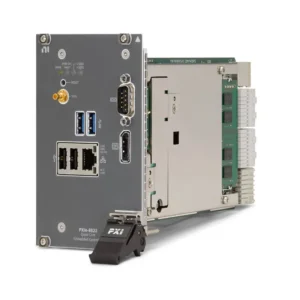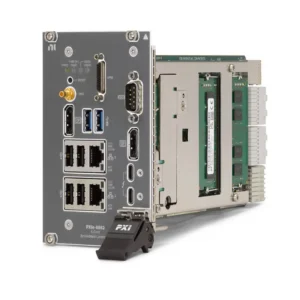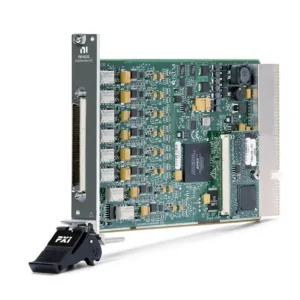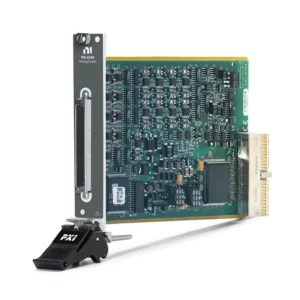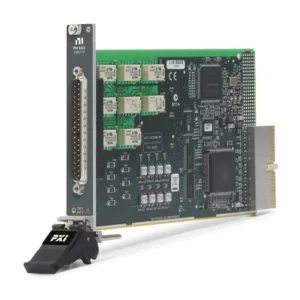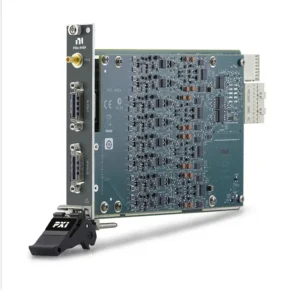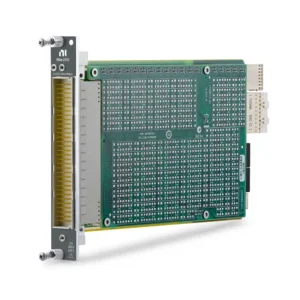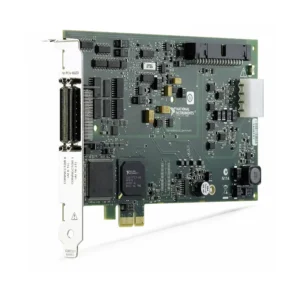




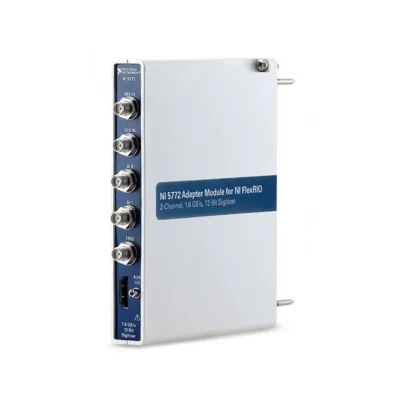
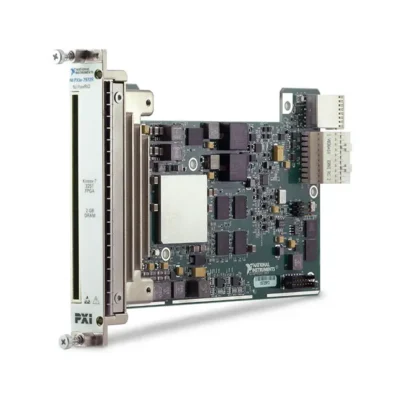
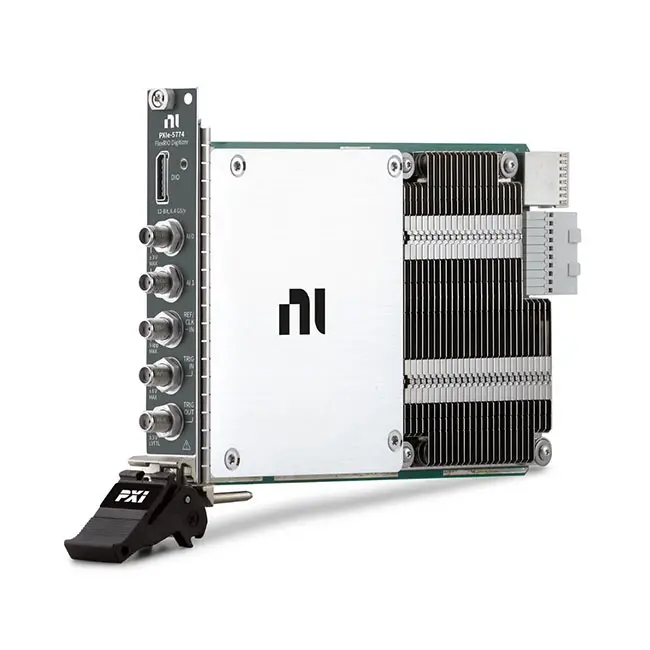
The PXIe-5774 is a two-channel, 12-bit, DC-coupled PXI FlexRIO digitizer designed for high-speed time-domain acquisition and real-time FPGA processing. It supports dual-channel simultaneous sampling at 3.2 GS/s per channel or single-channel interleaved sampling at up to 6.4 GS/s.
Available with 1.6 GHz or 3 GHz bandwidth and a Xilinx Kintex UltraScale KU040 or KU060 FPGA, the PXIe-5774 is suitable for scientific instrumentation, medical imaging, particle physics, high-speed event detection, LIDAR and custom wideband test systems.
Key Features of the PXIe-5774
- Two simultaneously sampled analog input channels
- 3.2 GS/s sampling rate per channel in dual-channel mode
- 6.4 GS/s sampling rate in single-channel interleaved mode
- 12-bit analog-to-digital resolution
- DC-coupled analog inputs
- 1.6 GHz and 3 GHz bandwidth configurations
- Software-selectable 200 mVpk-pk and 1 Vpk-pk input ranges
- Selectable vertical offset of ±0.5 full scale
- 50 Ω analog input impedance
- Kintex UltraScale KU040 or KU060 FPGA
- 4 GB onboard DRAM
- Eight bidirectional digital I/O channels
- Eight multi-gigabit serial transceiver channels
- Analog input and digital output trigger connectors
- Optional CableSense technology on selected KU060 models
- PCI Express Gen 3 x8 interface
- Support for peer-to-peer data streaming
- NI-TClk multidevice synchronization
PXIe-5774 Technical Specifications
| Product Model | PXIe-5774 |
|---|---|
| Product Type | PXI FlexRIO Digitizer |
| Analog Input Channels | 2, simultaneously sampled |
| Maximum Sample Rate | 6.4 GS/s in single-channel mode |
| Dual-Channel Sample Rate | 3.2 GS/s per channel |
| Resolution | 12 bits |
| ADC | Texas Instruments ADC12DJ3200 |
| Input Type | Single-ended |
| Input Coupling | DC |
| Input Impedance | 50 Ω nominal |
| Analog Connectors | SMA |
| Input Ranges | 200 mVpk-pk and 1 Vpk-pk |
| Vertical Offset Range | ±0.5 full scale nominal |
| 3 GHz Variant Bandwidth | 3.00 GHz on the 200 mV range; 2.85 GHz on the 1 V range |
| 1.6 GHz Variant Bandwidth | 1.63 GHz on the 200 mV range; 1.62 GHz on the 1 V range |
| FPGA Options | Xilinx Kintex UltraScale KU040 or KU060 |
| Onboard DRAM | 4 GB, arranged as two 2 GB banks |
| Digital I/O | 8 bidirectional single-ended channels |
| Digital Voltage Families | 1.2 V, 1.5 V, 1.8 V, 2.5 V and 3.3 V |
| High-Speed Serial I/O | 4 transmit and 4 receive channels |
| Serial Data Rate | 500 Mb/s to 16.375 Gb/s nominal |
| DMA Channels | 59 |
| External Reference Clock | 10 MHz |
| External Sample Clock | 3.2 GHz |
| Bus Interface | PCI Express Gen 3 x8 |
| Maximum Power Requirement | 58 W |
| Operating Temperature | 0°C to 55°C with sufficient chassis slot cooling |
| Dimensions | 2.0 cm × 13.0 cm × 21.6 cm, excluding connectors |
| Weight | 500 g |
PXIe-5774 Part Numbers and Configurations
| Part Number | Bandwidth | FPGA | DRAM | CableSense |
|---|---|---|---|---|
| 785646-01 | 3 GHz | Kintex UltraScale KU040 | 4 GB | No |
| 785647-01 | 3 GHz | Kintex UltraScale KU060 | 4 GB | No |
| 785646-02 | 1.6 GHz | Kintex UltraScale KU040 | 4 GB | No |
| 785647-02 | 1.6 GHz | Kintex UltraScale KU060 | 4 GB | No |
| 785647-11 | 3 GHz | Kintex UltraScale KU060 | 4 GB | Yes |
| 785647-12 | 1.6 GHz | Kintex UltraScale KU060 | 4 GB | Yes |
All PXIe-5774 configurations provide two DC-coupled analog inputs, 12-bit resolution, 3.2 GS/s dual-channel sampling and 6.4 GS/s single-channel interleaved sampling. Bandwidth, FPGA capacity and CableSense support are the main differences between part numbers.
Dual-Channel and Single-Channel Sampling Modes
In dual-channel mode, the PXIe-5774 simultaneously samples both analog inputs at 3.2 GS/s per channel. This mode preserves timing relationships between two signals and is suitable for phase comparison, differential analysis and synchronized transient capture.
In single-channel mode, the ADC cores are interleaved to provide an aggregate sampling rate of 6.4 GS/s. This mode is useful when maximum time resolution is more important than acquiring two channels simultaneously.
1.6 GHz and 3 GHz Bandwidth Options
The 3 GHz version provides a typical −3 dB bandwidth of 3.00 GHz on the 200 mVpk-pk range and 2.85 GHz on the 1 Vpk-pk range.
The 1.6 GHz version provides a typical −3 dB bandwidth of 1.63 GHz on the 200 mVpk-pk range and 1.62 GHz on the 1 Vpk-pk range.
Select the 3 GHz version for faster edges and wider-bandwidth signals. The 1.6 GHz version is appropriate when the application does not require the full 3 GHz signal path.
DC-Coupled Analog Inputs
The PXIe-5774 provides a DC-coupled signal path, allowing it to measure waveform content extending to DC. This makes the module particularly suitable for pulses, transients, scientific instrumentation and time-domain measurements.
Each input has a fixed 50 Ω impedance and selectable full-scale ranges of 200 mVpk-pk and 1 Vpk-pk. The smaller range improves sensitivity for low-amplitude signals, while the 1 V range supports larger input amplitudes.
Selectable Vertical Offset
The PXIe-5774 provides a nominal vertical offset range of ±0.5 full scale. This allows the measurement range to be positioned around signals that are not centered at zero volts.
Correctly configuring the input range and offset helps maximize ADC utilization and improves the visibility of small signal variations.
12-Bit High-Speed Acquisition
The 12-bit ADC provides greater amplitude resolution than conventional 8-bit high-speed digitizers while maintaining sampling rates up to 6.4 GS/s.
This combination is useful for capturing fast transient signals while retaining sufficient vertical resolution for waveform characterization, event detection and spectral processing.
Kintex UltraScale FPGA Options
The PXIe-5774 is available with a Xilinx Kintex UltraScale KU040 or KU060 FPGA. Both options support custom acquisition, triggering, filtering, signal processing and high-speed data transfer.
| FPGA | Lookup Tables | DSP48 Slices | Block RAM | DRAM |
|---|---|---|---|---|
| KU040 | 242,200 | 1,920 | 21.1 Mb | 4 GB |
| KU060 | 331,680 | 2,760 | 38.0 Mb | 4 GB |
Choose the KU040 for moderate FPGA resource requirements. Choose the KU060 for demanding FFT processing, digital downconversion, channelization, event detection or multiple parallel signal-processing algorithms.
Onboard DRAM and Data Streaming
Every PXIe-5774 configuration includes 4 GB of onboard DRAM arranged as two 2 GB banks. The memory provides a maximum theoretical aggregate data rate of 17 GB/s.
Onboard DRAM can be used for waveform buffering, temporary data storage and custom FPGA processing. The PCI Express Gen 3 x8 interface supports high-throughput transfer to the system controller and peer-to-peer streaming between compatible PXI Express modules.
Analog Input and Digital Output Triggers
The PXIe-5774 includes a dedicated analog input trigger connector with DC coupling, 50 Ω impedance and a ±5 V input range. The comparator provides 12-bit threshold resolution and supports a minimum pulse width of 5 ns.
A separate digital output trigger provides 3.3 V CMOS signaling, an update-rate resolution of 5 ns and measured jitter of 3.2 ps RMS.
Engineers can also implement custom trigger conditions directly in the FPGA, including amplitude, timing, frequency and pattern-based events.
Digital I/O and Serial Connectivity
The digital connector provides eight bidirectional single-ended channels supporting 1.2 V, 1.5 V, 1.8 V, 2.5 V and 3.3 V logic families.
The module also provides four transmit and four receive high-speed serial transceiver channels with nominal data rates from 500 Mb/s to 16.375 Gb/s. These interfaces can be used to communicate with compatible FPGA devices or custom digital hardware.
CableSense Technology
Selected KU060 configurations support NI CableSense technology. CableSense uses time-domain reflectometry to help detect and locate cable faults, open connections and impedance discontinuities.
CableSense is available on part numbers 785647-11 and 785647-12. Compatible NI-FlexRIO driver support is required.
Clocking and Synchronization
The PXIe-5774 can use its onboard reference, the PXI 10 MHz backplane clock or an external 10 MHz reference. A 3.2 GHz external sample clock can also be supplied through the REF/CLK IN connector.
NI-TClk can synchronize multiple supported PXI modules through the chassis backplane. Identical PXIe-5774 modules can achieve measured skew of 10 ps or less after manual adjustment under the specified conditions.
Custom FPGA Signal Processing
Engineers can use LabVIEW FPGA and the Instrument Design Libraries for FlexRIO to implement custom processing directly on the Kintex UltraScale FPGA.
- Digital downconversion
- Real-time FFT processing
- Wideband channelization
- Pulse detection and classification
- Custom triggering
- Signal averaging
- Filtering and decimation
- Event detection
- Data reduction
- Deterministic data streaming
FPGA processing can reduce host-system workload and PCI Express traffic while providing low-latency responses to acquired signals.
Typical PXIe-5774 Applications
- High-speed time-domain measurements
- Scientific instrumentation
- Medical imaging
- Particle physics experiments
- LIDAR signal acquisition
- Wideband communications research
- Radar and electronic warfare prototyping
- High-speed pulse analysis
- Transient event detection
- Ultrafast optical measurements
- Custom FPGA-based instruments
- High-speed automated test systems
Software Support
The PXIe-5774 is supported by the NI FlexRIO driver and LabVIEW Instrument Design Libraries for FlexRIO. These libraries provide programming interfaces, documentation and sample projects for configuring the digitizer and developing FPGA-based instruments.
- NI FlexRIO driver
- LabVIEW
- LabVIEW FPGA Module
- Instrument Design Libraries for FlexRIO
- NI-TClk synchronization driver
NI-FlexRIO 20.1 or later is required for CableSense support. Verify software and operating-system compatibility before installing the module.
PXI Express Chassis Requirements
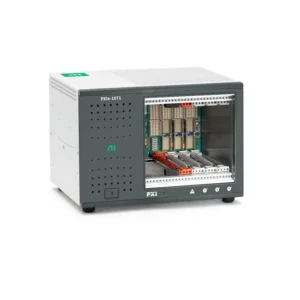
The PXIe-5774 requires a compatible PXI Express chassis, system controller and Gen 3 x8-capable slot. The selected slot must provide at least 58 W of cooling capacity.
High FPGA utilization can increase module power consumption. Maintain proper chassis airflow by following fan-setting recommendations and installing filler panels and slot blockers in unused positions.
Browse compatible NI PXI modules and system components when configuring a complete high-speed acquisition platform.
PXIe-5774 Troubleshooting
Why can only one channel operate at 6.4 GS/s?
The 6.4 GS/s rate is achieved by interleaving the ADC cores in single-channel mode. When both channels are enabled, each channel operates at 3.2 GS/s.
Why is the bandwidth lower than expected?
Confirm whether the installed part number is a 1.6 GHz or 3 GHz configuration. Also note that bandwidth varies slightly between the 200 mV and 1 V input ranges.
Why is the measured amplitude incorrect?
Verify that the signal source and cables are designed for a 50 Ω signal path. Confirm the selected 200 mVpk-pk or 1 Vpk-pk input range and check the configured vertical offset.
Why is CableSense unavailable?
CableSense is supported only on selected KU060 configurations, including part numbers 785647-11 and 785647-12. Compatible NI-FlexRIO software is also required.
Why does the FPGA compilation fail?
Confirm that the FPGA design fits within the selected KU040 or KU060 resources. Verify compatible LabVIEW, LabVIEW FPGA and Instrument Design Libraries versions.
Why does the module revert to its default FPGA personality?
A demanding FPGA design can exceed the available slot power. Confirm that the chassis slot supports the PXIe-5774 power and cooling requirements.
Why do synchronized modules show timing differences?
Use NI-TClk, a shared reference clock and identical acquisition settings. Manual timing adjustment may be required to minimize module-to-module skew.
PXIe-5774 Comparison
| Model | Channels | Maximum Sample Rate | Resolution | Bandwidth | Primary Difference |
|---|---|---|---|---|---|
| PXIe-5774 | 2 | 6.4 GS/s interleaved | 12-bit | Up to 3 GHz | DC-coupled input for high-speed time-domain measurements |
| PXIe-5775 | 2 | 6.4 GS/s interleaved | 12-bit | 6 GHz | AC-coupled signal path with wider frequency-domain bandwidth |
| PXIe-5764 | 4 | 1 GS/s | 16-bit | Up to 1.15 GHz small signal | Higher resolution and channel density at a lower sample rate |
| PXIe-5763 | 4 | 500 MS/s | 16-bit | 225 MHz | Wide-dynamic-range acquisition for lower-frequency signals |
| PCIe-5774 | 2 | 6.4 GS/s interleaved | 12-bit | Up to 3.2 GHz | Similar acquisition capabilities for desktop PCI Express systems |
Recommended Related Products
- PXIe-5775 – Recommended for AC-coupled frequency-domain acquisition requiring bandwidth up to 6 GHz.
- PXIe-5764 – Suitable when four simultaneous channels and 16-bit resolution are more important than maximum sample rate.
- PXIe-5763 – A four-channel, 500 MS/s, 16-bit alternative for signals within 225 MHz bandwidth.
- PCIe-5774 – Provides similar high-speed DC-coupled acquisition in a PCI Express card format.
How to Select the Right PXIe-5774 Configuration
- Choose a 3 GHz model for the widest signal bandwidth and fastest edge capture.
- Choose a 1.6 GHz model when the application does not require the full 3 GHz analog path.
- Choose the KU040 FPGA for moderate real-time processing requirements.
- Choose the KU060 FPGA for complex filters, FFTs, channelization and parallel processing.
- Choose part number 785647-11 or 785647-12 when CableSense functionality is required.
Why Choose the PXIe-5774?
The PXIe-5774 combines DC coupling, up to 6.4 GS/s sampling, 12-bit resolution and programmable FPGA processing in one PXI Express module. Its dual-channel and interleaved modes provide flexibility for both synchronized measurements and maximum-speed single-channel acquisition.
Multiple bandwidth, FPGA and CableSense configurations allow the module to be selected according to the measurement and processing requirements of the application.
Frequently Asked Questions
What is the PXIe-5774?
The PXIe-5774 is a two-channel, 12-bit, DC-coupled PXI FlexRIO digitizer with up to 6.4 GS/s sampling and 3 GHz analog bandwidth.
Can both channels sample at 6.4 GS/s?
No. Both channels operate simultaneously at 3.2 GS/s per channel. The 6.4 GS/s rate is available in single-channel interleaved mode.
What input ranges are available?
The PXIe-5774 provides software-selectable 200 mVpk-pk and 1 Vpk-pk full-scale input ranges.
Does the PXIe-5774 support DC coupling?
Yes. All PXIe-5774 configurations use DC-coupled analog inputs.
Which FPGA options are available?
The PXIe-5774 is available with a Xilinx Kintex UltraScale KU040 or KU060 FPGA.
How much onboard memory is included?
Every configuration includes 4 GB of onboard DRAM arranged as two 2 GB banks.
Which configurations support CableSense?
CableSense is available on selected KU060 versions, including part numbers 785647-11 and 785647-12.
Can multiple PXIe-5774 modules be synchronized?
Yes. Multiple supported modules can be synchronized using NI-TClk, shared reference clocks and PXI backplane timing resources.
What is the difference between the PXIe-5774 and PXIe-5775?
The PXIe-5774 provides DC coupling and bandwidth up to 3 GHz for time-domain measurements. The PXIe-5775 provides AC coupling and bandwidth up to 6 GHz for high-frequency applications.
Can the PXIe-5774 operate independently?
No. It requires a compatible PXI Express chassis, system controller and NI FlexRIO software environment.
Request a Quote for the PXIe-5774
Contact us for current availability, lead time and project pricing for the PXIe-5774 PXI FlexRIO Digitizer. Please provide the required bandwidth, FPGA option, CableSense requirement and part number so we can confirm the correct configuration.