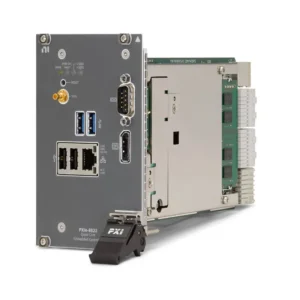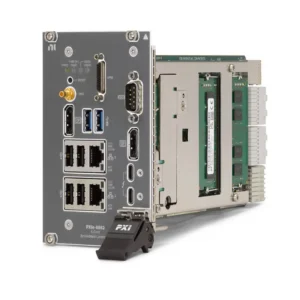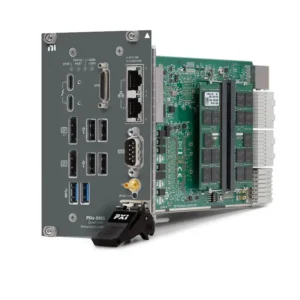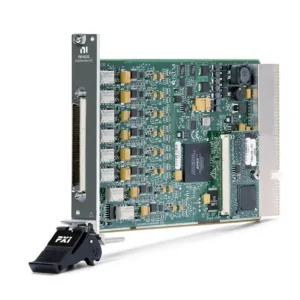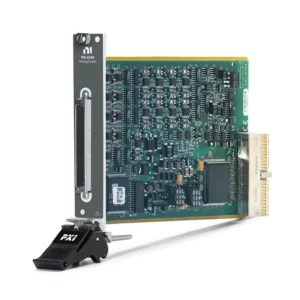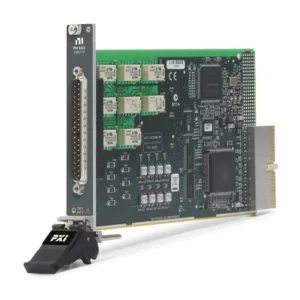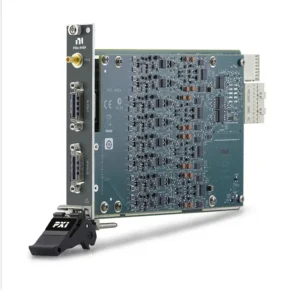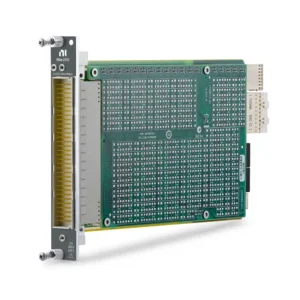




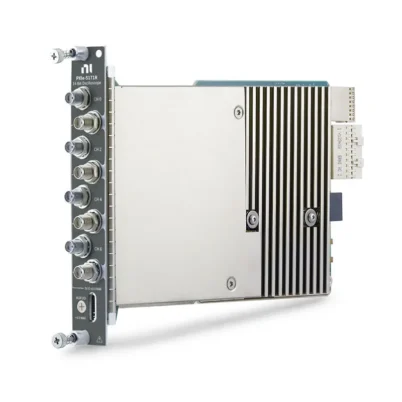
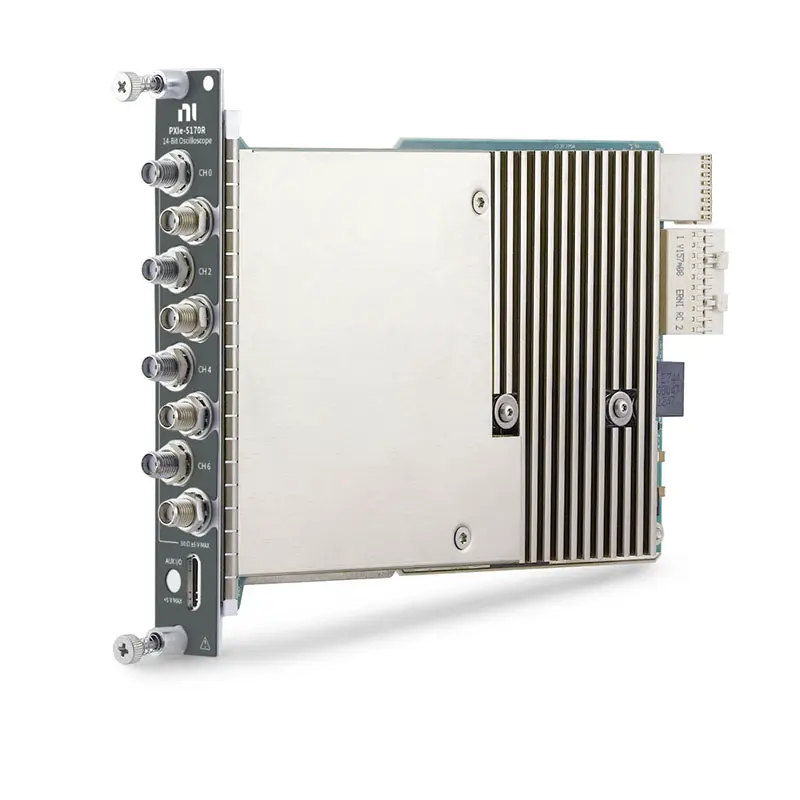
The PXIe-5170 is a high-density, reconfigurable PXI Express oscilloscope available with four or eight simultaneously sampled analog input channels. It combines 100 MHz analog bandwidth, sampling rates up to 250 MS/s per channel and 14-bit vertical resolution.
A user-programmable Xilinx Kintex-7 325T FPGA enables engineers to implement custom triggering, inline signal processing, data reduction and streaming functions. The PXIe-5170 is suitable for high-channel-count automated testing and applications requiring signal processing directly on the measurement hardware.
Key Features of the PXIe-5170
- Four or eight simultaneously sampled analog input channels
- 100 MHz analog bandwidth
- Up to 250 MS/s sampling per channel
- 14-bit vertical resolution
- Xilinx Kintex-7 XC7K325T user-programmable FPGA
- 50 Ω analog input impedance
- AC and DC input coupling
- Full-scale input ranges from 0.2 Vpp to 5 Vpp
- 0.75 GB or 1.5 GB onboard memory
- Eight bidirectional PFI lines
- External sample clock and reference clock support
- Edge, window, hysteresis, digital and software triggering
- Custom FPGA triggering and signal processing
- High-speed PXI Express Gen 2 ×8 interface
- NI-TClk multi-instrument synchronization
- Compatible with NI-SCOPE and InstrumentStudio
PXIe-5170 Technical Specifications
| Product Model | PXIe-5170 |
|---|---|
| Product Type | Reconfigurable PXI Express Oscilloscope |
| Channel Options | 4 or 8 simultaneously sampled channels |
| Analog Bandwidth | 100 MHz |
| Maximum Sample Rate | 250 MS/s per channel |
| Real-Time Sample Rate Range | Approximately 3.815 kS/s to 250 MS/s |
| Vertical Resolution | 14 bits |
| FPGA | Xilinx Kintex-7 XC7K325T |
| Input Configuration | Referenced single-ended |
| Input Impedance | 50 Ω |
| Input Coupling | AC or DC |
| Full-Scale Input Ranges | 0.2, 0.4, 1, 2 and 5 Vpp |
| Maximum Input Overload | Signal peaks must not exceed ±5 V |
| Onboard Memory | 0.75 GB for 4-channel version; 1.5 GB for 8-channel version |
| Internal Timebase | 250 MHz |
| Internal Timebase Accuracy | ±25 ppm |
| External Sample Clock | 150 MHz to 250 MHz |
| Analog Input Connectors | 4 or 8 × SMA |
| Auxiliary Connector | MHDMR AUX I/O connector |
| Digital PFI Lines | 8 bidirectional lines |
| Bus Interface | PXI Express Gen 2 ×8 |
| Form Factor | 3U, one-slot PXI Express module |
| Operating Temperature | 0°C to 55°C |
PXIe-5170 Part Numbers and Configurations
| Part Number | Analog Channels | Onboard Memory | FPGA |
|---|---|---|---|
| 783690-01 | 4 | 0.75 GB | Kintex-7 325T |
| 783691-01 | 8 | 1.5 GB | Kintex-7 325T |
Choose part number 783690-01 when four analog channels are sufficient. Select 783691-01 for eight-channel applications and additional onboard waveform memory.
Four or Eight Simultaneously Sampled Channels
The PXIe-5170 is available with four or eight independent analog input channels. Every enabled channel can sample simultaneously at up to 250 MS/s, preserving phase and timing relationships between signals.
This architecture is useful for multi-phase power measurements, parallel sensor acquisition, semiconductor testing and other applications where multiple signals must be captured at the same instant.
100 MHz Bandwidth and 250 MS/s Sampling
The PXIe-5170 provides 100 MHz warranted analog bandwidth and a maximum sampling rate of 250 MS/s per channel. The sample rate can be reduced for lower-frequency signals and longer acquisition durations.
An external sample clock from 150 MHz to 250 MHz can be imported through the AUX I/O connector. The module can also use PXI backplane timing resources for synchronized multi-instrument systems.
14-Bit Vertical Resolution
The PXIe-5170 provides 14-bit vertical resolution, representing 16,384 quantization levels across the selected input range. This provides substantially more amplitude detail than conventional 8-bit oscilloscopes.
The combination of high resolution, low noise and multi-channel simultaneous sampling is suitable for detecting smaller waveform variations, distortion and transient characteristics.
Programmable Kintex-7 FPGA
The integrated Xilinx Kintex-7 XC7K325T FPGA can be programmed to perform hardware-level operations directly on acquired data. Custom FPGA functions can include:
- Application-specific triggering
- Real-time filtering
- Fast Fourier transform processing
- Pulse and event detection
- Data reduction and decimation
- Channel combination and mathematical processing
- Closed-loop measurement response
- High-speed data streaming control
FPGA processing can reduce the amount of data transferred to the controller and provide deterministic response times that are difficult to achieve using host software alone.
PXIe-5170 FPGA Resources
| FPGA Device | Xilinx Kintex-7 XC7K325T |
|---|---|
| Slice Registers | 407,600 |
| Lookup Tables | 203,800 |
| DSP Slices | 840 |
| 18 Kb Block RAMs | 890 |
Some FPGA resources are reserved for device operation, calibration and software integration. The resources available to a custom design depend on the selected instrument design and supporting IP.
Flexible Input Ranges and Coupling
Each analog input supports full-scale ranges of 0.2, 0.4, 1, 2 and 5 Vpp. Selecting the smallest range that contains the complete waveform makes better use of the 14-bit ADC resolution.
DC coupling preserves both AC and DC waveform components. AC coupling removes the DC component and has a specified cutoff frequency of approximately 120 kHz.
The analog inputs have a fixed 50 Ω impedance and use SMA connectors. Signals that exceed the supported ranges may require external attenuation or signal conditioning.
Deep Onboard Waveform Memory
The four-channel PXIe-5170 includes 0.75 GB of onboard memory, while the eight-channel version includes 1.5 GB. Memory is shared among enabled channels.
Deep memory supports long waveform records and multi-record acquisition. Pretrigger and post-trigger sample positions can be configured according to the event being captured.
Advanced Triggering Options
When controlled with NI-SCOPE, the PXIe-5170 supports standard trigger modes including:
- Edge triggering
- Window triggering
- Hysteresis triggering
- Digital triggering
- Immediate triggering
- Software triggering
Trigger sources include the analog input channels, eight PFI lines, PXI backplane triggers and software. Custom FPGA designs can implement additional trigger logic beyond the standard NI-SCOPE trigger modes.
AUX I/O and Programmable Digital Lines
The front-panel AUX I/O connector provides access to external sample and reference clocks, reference clock output, eight bidirectional PFI lines and a 3.3 V power output.
The AUX I/O connector resembles an HDMI Type-C connector but is not an HDMI interface. Only compatible NI cables and accessories should be connected to this port.
High-Speed Data Streaming
The PXIe-5170 uses a PXI Express Gen 2 ×8 interface for high-throughput communication with the system controller. The FPGA can process or reduce data before transferring it through the PXI Express bus.
This combination supports continuous processing, long-duration acquisition and applications that require selected waveform information to be streamed to the host computer.
PXI Timing and NI-TClk Synchronization
The PXIe-5170 can synchronize with other supported PXI instruments using backplane clocks, triggers and NI-TClk. Multiple modules can be combined to create systems with more than eight synchronized channels.
With NI-TClk manual adjustment, identical PXIe-5170 modules can achieve module-to-module skew of 10 ps or less under the specified conditions.
Typical PXIe-5170 Applications
- High-channel-count automated testing
- Custom real-time waveform processing
- Semiconductor component characterization
- Multi-phase power electronics testing
- Radar and pulse signal analysis
- Custom protocol and event detection
- Hardware-in-the-loop testing
- Physics and scientific research
- Production-line functional testing
- Synchronized multi-instrument measurement systems
NI-SCOPE and FPGA Software Support
The PXIe-5170 can be operated as a standard oscilloscope through the NI-SCOPE instrument driver. NI-SCOPE provides channel configuration, triggering, waveform acquisition, data transfer, measurement and calibration functions.
InstrumentStudio provides an interactive interface for standard oscilloscope measurements. Supported NI-SCOPE programming environments include LabVIEW, LabWindows/CVI, Measurement Studio, C/C++ and .NET.
Custom FPGA development uses the LabVIEW Instrument Design Libraries for Reconfigurable Oscilloscopes and the required LabVIEW FPGA development tools. Software and driver compatibility should be verified before selecting the system configuration.
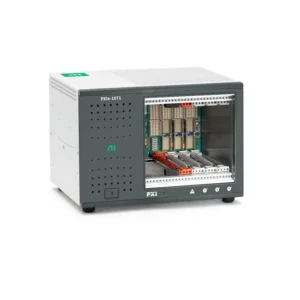
PXI Express Chassis Integration
The PXIe-5170 is a one-slot, 3U PXI Express Gen 2 ×8 module. It requires a chassis slot capable of providing the necessary PXI Express bandwidth, power and cooling.
Allow at least 15 minutes of warm-up time before precision measurements. The chassis fan should be configured correctly, and appropriate slot blockers and filler panels should be installed when required.
PXIe-5170 Troubleshooting
Why is the PXIe-5170 not detected?
Confirm that the module is installed in a compatible PXI Express slot. Install a supported NI-SCOPE driver, restart the system and check the module in NI Measurement & Automation Explorer.
Why does the waveform appear clipped?
Select a larger input range or reduce the signal amplitude with a suitable attenuator. Signal peaks must remain within the ±5 V maximum overload limit.
Why does the measured amplitude appear incorrect?
The analog inputs have a fixed 50 Ω impedance. Confirm that the signal source, cables and adapters are compatible with a 50 Ω load and that the correct full-scale range is selected.
Why is the available memory per channel lower than expected?
Onboard memory is shared among enabled channels. Reducing the number of active channels or the number of records increases the memory available for each waveform.
Why does a custom FPGA bitfile fail to run?
Confirm that the FPGA design was compiled for the PXIe-5170 and uses compatible instrument design libraries and driver versions. Also verify that required calibration IP is included and used correctly.
Why are synchronized modules not aligned?
Verify the shared reference clock, trigger routing and NI-TClk configuration. Run self-calibration after warm-up and keep identical modules within the specified temperature range.
Can an HDMI device be connected to the AUX I/O port?
No. The connector is not an HDMI interface even though it has a similar physical form. Connecting an HDMI device may damage the equipment.
PXIe-5170 Comparison with Similar PXI Oscilloscopes
| Model | Channels | Bandwidth | Sample Rate | Resolution | FPGA |
|---|---|---|---|---|---|
| PXIe-5170 | 4 or 8 | 100 MHz | 250 MS/s | 14-bit | Kintex-7 325T |
| PXIe-5171 | 8 | 250 MHz | 250 MS/s | 14-bit | Kintex-7 410T |
| PXIe-5172 | 4 or 8 | 100 MHz | 250 MS/s | 14-bit | Kintex-7 FPGA |
| PXIe-5164 | 2 | 400 MHz | 1 GS/s | 14-bit | Kintex-7 410T |
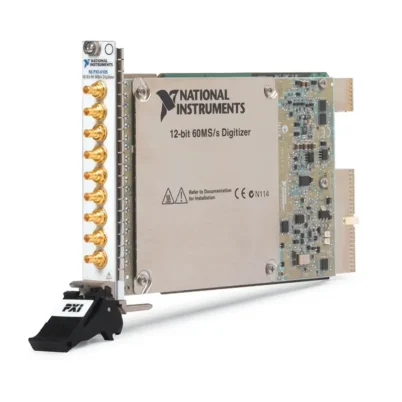
| PXIe-5105 | 8 | 60 MHz | 60 MS/s | 12-bit | No user-programmable FPGA |
Recommended Related Products
- PXIe-5171 – Recommended when eight channels, 250 MHz bandwidth and a larger Kintex-7 410T FPGA are required.
- PXIe-5172 – Suitable for high-resolution reconfigurable measurements requiring additional input flexibility.
- PXIe-5164 – A two-channel reconfigurable option with 400 MHz bandwidth and sampling up to 1 GS/s.
- PXIe-5105 – A conventional eight-channel oscilloscope for applications that do not require FPGA programming.
How to Select the Right PXIe-5170 Configuration
Choose part number 783690-01 for four-channel systems requiring 0.75 GB of onboard memory. Select part number 783691-01 when eight simultaneous channels and 1.5 GB of memory are required.
Consider the PXIe-5171 for higher analog bandwidth or the PXIe-5164 for faster two-channel acquisition. Select the conventional PXIe-5105 when FPGA processing is unnecessary and 60 MHz bandwidth is sufficient.
Why Choose the PXIe-5170?
- Provides four or eight simultaneously sampled channels
- Combines 100 MHz bandwidth with 250 MS/s sampling
- Offers 14-bit resolution for detailed waveform measurement
- Includes a user-programmable Kintex-7 FPGA
- Supports custom triggering and real-time processing
- Provides deep onboard waveform memory
- Supports high-speed PXI Express data streaming
- Integrates with PXI timing and NI-TClk synchronization
Frequently Asked Questions
What is the PXIe-5170?
The PXIe-5170 is a four- or eight-channel, 14-bit reconfigurable PXI Express oscilloscope with 100 MHz bandwidth, 250 MS/s sampling and a Kintex-7 325T FPGA.
What part numbers are available?
Part number 783690-01 provides four channels, while part number 783691-01 provides eight channels.
Are all channels sampled simultaneously?
Yes. All four or eight analog input channels can be sampled simultaneously at up to 250 MS/s per channel.
How much onboard memory does the PXIe-5170 provide?
The four-channel version provides 0.75 GB, while the eight-channel version provides 1.5 GB of memory shared among enabled channels.
Which FPGA is installed?
The PXIe-5170 includes a Xilinx Kintex-7 XC7K325T FPGA.
Can the FPGA be programmed by the user?
Yes. Engineers can create custom FPGA functions using compatible LabVIEW FPGA and reconfigurable oscilloscope instrument design tools.
What input impedance does the PXIe-5170 use?
All analog input channels use a fixed 50 Ω input impedance.
What is the maximum full-scale input range?
The maximum full-scale input range is 5 Vpp. Input signal peaks must not exceed ±5 V.
Does the PXIe-5170 support AC coupling?
Yes. Each analog input supports AC and DC coupling.
Can the PXIe-5170 be used without FPGA programming?
Yes. It can operate as a standard oscilloscope through NI-SCOPE without requiring the user to develop a custom FPGA design.
Can the PXIe-5170 operate independently?
No. It must be installed in a compatible PXI Express chassis and used with an embedded controller or externally connected computer.
Is the PXIe-5170 suitable for automated testing?
Yes. Its simultaneous channels, high resolution, FPGA processing, advanced triggering and PXI synchronization make it suitable for automated validation and production testing.
Request a Quote for the PXIe-5170
Contact us for current availability, lead time and project pricing for the PXIe-5170 Reconfigurable PXI Express Oscilloscope. Please specify whether the four-channel or eight-channel version is required. We can also help verify compatible PXI chassis, controllers, cables, software and synchronized instrumentation.