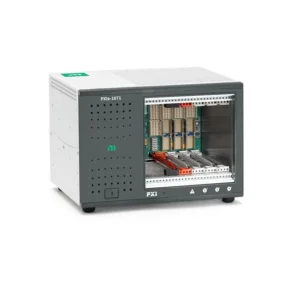


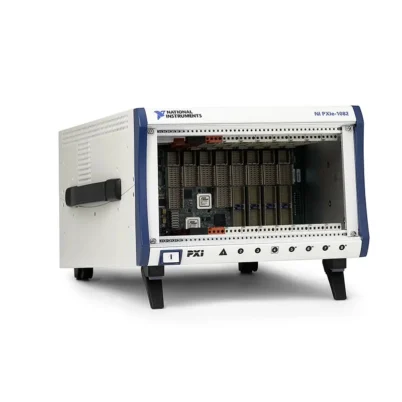
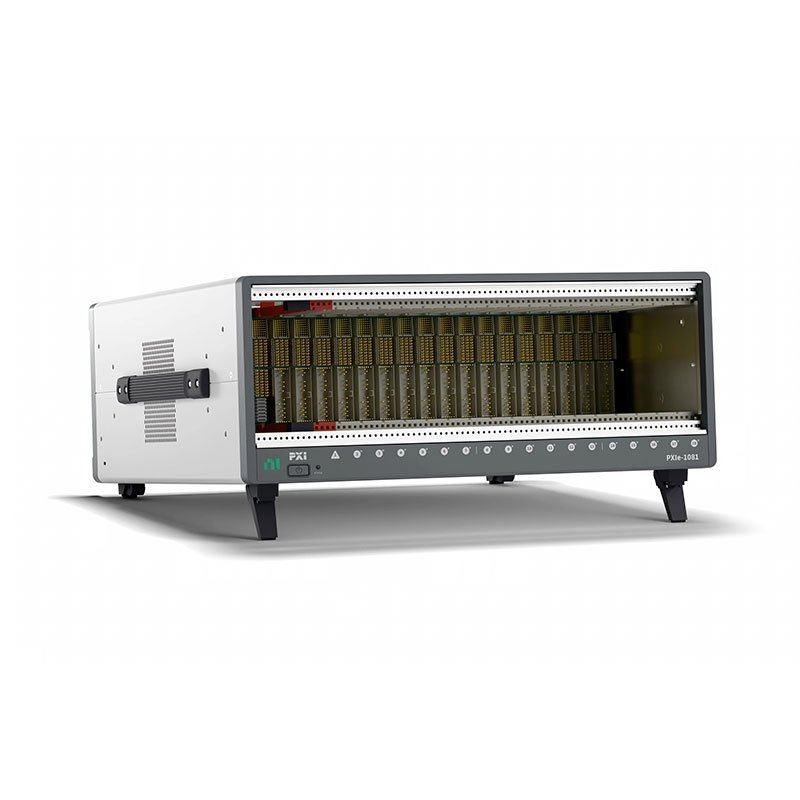
PXIe-1081 18-Slot PXI Express Chassis
Земля NI PXIe-1081 is an 18-slot PXI Express chassis designed for high-density automated test, measurement and control systems. It provides one system controller slot and 17 гибридных периферийных слотов, allowing engineers to combine PXI Express modules with compatible PXI and CompactPCI instruments in the same chassis.
With up to 2 GB/s aggregate system bandwidth, 650 W of usable DC power and cooling support for modules dissipating as much as 58 W per peripheral slot, the PXIe-1081 provides a practical platform for production testing, electronic validation, data acquisition, hardware-in-the-loop testing and laboratory automation.
The chassis is particularly useful when an application requires a large number of instruments but does not require the substantially higher data bandwidth of newer 12 GB/s or 24 GB/s PXI Express chassis.
Key Features of the PXIe-1081
- PXI Express шасси на 18 слотов
- One system controller slot
- 17 PXI hybrid peripheral slots
- Up to 2 GB/s aggregate system bandwidth
- Compatible with PXI Express and compatible PXI modules
- 650 W maximum usable DC output power
- Up to 58 W cooling capacity per peripheral slot
- Up to 140 W cooling capacity for the system controller
- Three 210 CFM main cooling fans
- Automatic and high fan-speed modes
- Standard PXI 10 MHz and PXI Express 100 MHz clocks
- 100–240 VAC, 50/60 Hz input support
- 100–120 VAC, 400 Hz input support
- Wide 47–440 Hz operating input-frequency range
- Rack-mountable 4U-height mechanical format
- Replaceable fan assemblies
- Designed for high-density automated test systems
18-Slot High-Density Architecture
The PXIe-1081 provides 18 total chassis slots. One position is reserved for the PXI Express system controller, while the remaining 17 positions are available for peripheral instruments.
This high slot count allows a single chassis to accommodate a broad collection of digitizers, digital multimeters, data acquisition devices, switch modules, programmable power supplies, RF instruments and FPGA-based I/O modules.
The system controller position also includes three system expansion positions required by wider embedded controllers and remote-control modules. The exact number of usable peripheral slots remains 17.
17 Hybrid Peripheral Slots
All 17 peripheral positions are PXI hybrid-compatible slots. A hybrid slot is designed to accept PXI Express modules as well as compatible conventional PXI or CompactPCI instruments.
This flexibility helps organizations preserve investments in existing PXI instrumentation while adding newer PXI Express devices. Legacy measurement modules can remain in service while high-speed instruments are added as application requirements evolve.
Before installing an older PXI module, verify that its rear connector is physically compatible with a PXI hybrid slot. Some early PXI modules use connector arrangements that require an adapter or hardware modification.
Cost-Effective PXI Express Expansion
The PXIe-1081 is positioned for applications that need high channel density and modular flexibility without requiring the maximum peer-to-peer or streaming bandwidth available from premium chassis.
Its 2 GB/s system bandwidth is suitable for many automated switching, source-measurement, moderate-speed data acquisition, industrial communication and functional test applications.
Applications involving multiple high-speed digitizers, vector signal transceivers or continuous multichannel streaming should calculate their aggregate data rate before selecting the chassis.
PXIe-1081 Technical Specifications
| Product Model | PXIe-1081 |
|---|---|
| Part Number | 790631-01 |
| Product Type | PXI Express chassis |
| Общее количество слотов | 18 |
| System Controller Slots | 1 system slot with 3 system expansion positions |
| Peripheral Slots | 17 |
| Peripheral Slot Type | 17 PXI hybrid slots |
| Maximum System Bandwidth | Up to 2 GB/s aggregate |
| Dedicated System Timing Slot | No |
| Maximum Usable DC Power | 650 W |
| Maximum Peripheral-Slot Dissipation | 58 W per slot |
| Maximum Controller Dissipation | 140 W |
| Main Cooling Fans | 3 × 210 CFM fans |
| Secondary Cooling Fan | 1 × 70 CFM fan |
| Fan Modes | Auto and High |
| AC Input | 100–240 VAC, 50/60 Hz, 10–5 A |
| 400 Hz AC Input | 100–120 VAC, 400 Hz, 10 A |
| Operating Input Range | 90–264 VAC, 47–440 Hz |
| Typical Power-Supply Efficiency | 85% |
| PXI_CLK10 Accuracy | ±25 ppm maximum |
| PXI_CLK10 Maximum Slot-to-Slot Skew | 250 ps |
| PXIe_CLK100 Maximum Slot-to-Slot Skew | 100 ps |
| Operating Temperature | 0°C to 50°C with modules requiring no more than 38 W cooling per slot |
| High-Power Operating Temperature | 0°C to 40°C when any module requires more than 38 W and up to 58 W cooling |
| Operating Humidity | 10% to 90%, noncondensing |
| Storage Temperature | -40°C to 71°C |
| Maximum Operating Altitude | 2,000 m at 25°C with High fan mode |
| Dimensions | 177.1 × 445.5 × 463.6 mm |
| Dimensions in Inches | 6.97 × 17.54 × 18.25 in. |
| Width | 21-slot-wide chassis |
| Weight | 13.5 kg |
2 GB/s System Bandwidth
The PXIe-1081 provides up to 2 GB/s of aggregate system bandwidth between the system controller and the PXI Express peripheral slots.
This bandwidth supports common automated test workloads such as multichannel data acquisition, switching, digital multimeter measurements, programmable power control, industrial communications and moderate-speed waveform acquisition.
The available bandwidth is shared across the chassis architecture. System designers should calculate the total simultaneous throughput required by all installed instruments, particularly when several modules stream acquired data to the controller at the same time.
650 W Usable DC Power
The integrated power supply provides as much as 650 W of usable DC output power for the system controller and installed peripheral modules.
The chassis distributes power across the +12 V, +5 V, +3.3 V, -12 V and +5 V auxiliary rails. Power consumption must be evaluated both as a total and on an individual voltage-rail basis.
| Power Rail | Maximum Available Current |
|---|---|
| +12 V | 54.1 A |
| +5 V | 51.1 A |
| +3.3 V | 60 A |
| -12 V | 4.25 A |
| +5 V Auxiliary | 4.1 A |
| Total Usable Power | 650 W maximum |
A configuration can remain below 650 W total while exceeding the limit of a particular power rail. Review the power requirements of every controller and peripheral module before finalizing the system configuration.
58 W Peripheral-Slot Cooling
The PXIe-1081 can cool modules that dissipate up to 58 W per peripheral slot when the chassis is operated within the applicable temperature and airflow limits.
When every installed module requires 38 W or less of cooling, the specified operating-temperature range extends from 0°C to 50°C. If one or more modules require more than 38 W and up to 58 W, the maximum ambient operating temperature is reduced to 40°C.
High-power modules should be distributed according to their installation instructions. Cable bundles, rack panels and nearby equipment must not obstruct the chassis air intake or exhaust.
High-Capacity Cooling System
The main cooling system uses three 210 CFM fans to move air from the bottom of the chassis toward the top. A secondary 70 CFM fan provides additional lateral airflow through the chassis.
The power supply uses separate integrated cooling fans. This multi-zone cooling architecture helps remove heat from densely populated systems containing controllers, FPGA modules, high-speed digitizers and other power-intensive instruments.
NI specifies minimum clearances of approximately 44.45 mm above the chassis, 101.60 mm behind it and 44.45 mm on each side. Greater clearance may be beneficial in enclosed racks or high-temperature environments.
Auto and High Fan Modes
The rear-panel fan selector allows the chassis to operate in automatic or high-speed fan mode. Auto mode adjusts airflow according to internal temperature, while High mode provides maximum cooling continuously.
Auto mode is useful in laboratories where acoustic noise matters and installed modules have moderate cooling requirements. High mode is recommended for high-power configurations, elevated ambient temperatures and installations where maximum thermal margin is required.
Fan noise increases significantly in High mode. The chassis should be positioned with appropriate consideration for operators, microphones and noise-sensitive laboratory environments.
PXI and PXI Express Timing
The PXIe-1081 distributes the standard 10 MHz PXI reference clock and the 100 MHz PXI Express reference clock across compatible slots. These backplane resources allow supported modules to coordinate timing and triggering without requiring separate external cabling for every instrument.
The maximum specified slot-to-slot skew is 250 ps for PXI_CLK10 and 100 ps for PXIe_CLK100. The clocks have a maximum frequency accuracy of ±25 ppm.
The PXIe-1081 does not include a dedicated system timing slot. Applications requiring advanced external clock routing, GPS synchronization, IRIG timing or multi-chassis synchronization can add a compatible PXI Express timing module.
400 Hz AC Power Compatibility
In addition to conventional 50 Hz and 60 Hz mains input, the PXIe-1081 supports 400 Hz operation when the input voltage is between 100 and 120 VAC.
This capability can simplify deployment in aerospace, defense and specialized mobile test environments where 400 Hz AC power is commonly available.
At other supported input voltages, confirm the applicable frequency and current requirements before connecting the chassis to the power source.
Power and Fault Protection
The chassis power supply includes short-circuit and overload protection with automatic recovery. The principal positive voltage rails also include overvoltage protection.
These functions protect the chassis during abnormal electrical conditions, but they do not replace correct system-level power calculations, grounding, ventilation or maintenance.
If the chassis repeatedly shuts down or restarts, disconnect power and verify the installed-module configuration before attempting continued operation.
PXIe-1081 Part Number and Accessories
| Item | Part Number or Model | Описание |
|---|---|---|
| PXIe-1081 | 790631-01 | 18-slot PXI Express chassis with 17 hybrid peripheral slots |
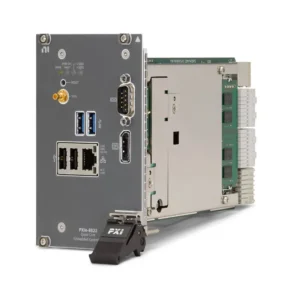
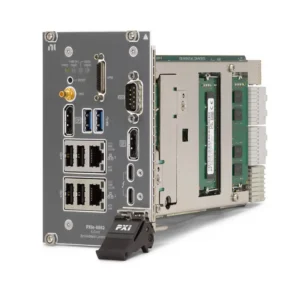
| Embedded Controller | PXIe-8822 | PXI Express embedded controller for general automated test applications |
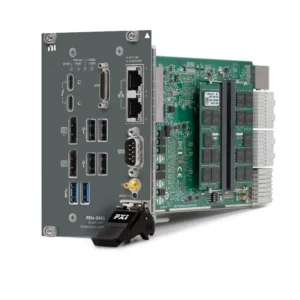
| High-Performance Controller | PXIe-8862 | High-performance embedded controller for computation-intensive systems |
| Remote-Control Module | Configuration dependent | Connects the chassis to an external desktop computer or workstation |
| Rack-Mount Kit | Configuration dependent | Mounts the chassis in a compatible 19-inch equipment rack |
| Slot Filler Panels | Configuration dependent | Covers unused slots and helps maintain correct airflow |
| Replacement Fan Assembly | Configuration dependent | Service component for maintaining the chassis cooling system |
| Power Cord | Region dependent | Selected according to installation country and AC outlet type |
Accessory part numbers can vary by region and configuration. Confirm the required power cord, controller, remote-control interface, rack hardware and filler panels before ordering.
Choosing an Embedded Controller
An embedded controller installs directly into the system slot and creates a self-contained PXI Express test system. This configuration reduces external cabling and is convenient for rack-mounted production and laboratory systems.
Земля PXIe-8822 is suitable for general-purpose automated testing, while the PXIe-8862 provides greater processing capability for demanding analysis and high-throughput applications.
Controller selection should consider processor performance, memory, storage, operating-system support, required software and the number of available controller expansion positions.
Remote-Control Configuration
A remote-control configuration allows the PXIe-1081 to be operated from an external desktop computer or workstation. The system normally requires a host-side PCI Express interface, a compatible cable and a PXI Express remote-control module.
This architecture is useful when the application needs specialized graphics hardware, large-capacity storage, a particular workstation configuration or easy computer replacement.
Verify that every component belongs to a compatible remote-control generation. Host adapters, cables and PXI Express interface modules should not be combined solely because their connectors appear similar.
Rack-Mounting Accessories
The PXIe-1081 can be incorporated into a standard test rack using compatible mounting hardware. The chassis height is approximately 4U, although its internal PXI modules use the 3U Eurocard format.
Rack installation must preserve the airflow clearances above, behind and beside the chassis. Avoid placing solid shelves directly against the intake or exhaust openings.
Filler Panels and Airflow
Unused peripheral slots should be covered with compatible filler panels. These panels help maintain the designed airflow path, reduce recirculation and prevent foreign objects from entering the chassis.
Operating a partially populated chassis with open front slots can change airflow around adjacent instruments and reduce cooling efficiency.
PXIe-1081 Applications
- Automated production testing
- Electronic functional testing
- Design verification and validation
- Multichannel data acquisition
- Симуляция с аппаратным входом
- Power electronics testing
- Semiconductor test development
- Industrial controller validation
- Automotive ECU testing
- Aerospace and defense test systems
- RF and wireless test integration
- Laboratory automation
- High-channel-count switching systems
- Mixed PXI and PXI Express systems
Automated Production Testing
The PXIe-1081 provides enough slots to consolidate many production-test functions into one chassis. A system can include switching, stimulus generation, digital multimeters, data acquisition, programmable power and communication interfaces.
Centralized software control reduces manual connection changes and enables consistent test procedures across multiple production stations.
Multichannel Data Acquisition
The chassis can host multiple PXI and PXI Express data acquisition modules for voltage, current, temperature, strain, vibration and digital measurements.
Its 17 peripheral slots allow systems to scale to a large number of channels. Engineers should verify aggregate bandwidth when several high-speed acquisition devices need to stream continuously.
Hardware-in-the-Loop Testing
HIL systems can combine analog I/O, digital I/O, FPGA modules, vehicle networks, fault insertion switches and programmable loads inside the PXIe-1081.
The hybrid-slot design is valuable when an existing HIL system includes conventional PXI cards that must operate alongside newer PXI Express modules.
Electronic Device Validation
Design-verification systems often need several types of stimulus and measurement hardware. The PXIe-1081 provides a common platform for power supplies, switch matrices, digitizers, waveform generators and precision measurement instruments.
Its large slot count can reduce the need for multiple chassis when bandwidth requirements remain within the 2 GB/s system limit.
Switching and Signal Routing Systems
A high-density chassis is useful for systems containing matrix switches, multiplexers, general-purpose relays and RF switching modules.
Switch-heavy systems frequently require many slots but generate relatively modest backplane traffic, making the PXIe-1081 an efficient platform for automated signal routing.
Aerospace and Defense Testing
The 400 Hz AC input capability supports specialized aerospace and defense environments. The chassis can integrate avionics interfaces, data acquisition hardware, switching modules and timing instruments.
The complete system must still satisfy the environmental, safety, electromagnetic compatibility and qualification requirements of the final application.
Laboratory Automation
Research laboratories can use the PXIe-1081 to combine multiple measurement functions under a common software interface. Instruments can be reconfigured as projects change without replacing an entire standalone test platform.
Automatic fan control can reduce acoustic noise in moderate-power bench applications, while High mode is available when additional thermal margin is needed.
PXIe-1081 Installation Workflow
Step 1: Review the Module Configuration
List every planned controller and peripheral module. Record the slot type, width, power consumption, voltage-rail current, heat dissipation and expected data-transfer rate of each device.
Step 2: Calculate Power Requirements
Confirm that total module consumption remains below the chassis’s 650 W usable-power rating. Also compare the combined demand on each power rail with its individual current limit.
Step 3: Calculate Bandwidth Requirements
Estimate the simultaneous data throughput of all modules. Pay particular attention to digitizers, FPGA instruments and acquisition devices that stream continuously to the controller.
If the application can exceed 2 GB/s, consider a higher-bandwidth chassis such as the PXIe-1085 or PXIe-1095.
Step 4: Prepare the Installation Area
Place the chassis on a stable bench or install it with compatible rack-mount hardware. Preserve the specified clearance above, behind and on both sides of the enclosure.
Step 5: Install the System Controller
Power off and unplug the chassis before installing hardware. Insert the embedded controller or remote-control interface into the designated system controller position and secure its retaining screws.
Step 6: Install Peripheral Modules
Install each peripheral instrument into a compatible hybrid slot. Seat each module fully into the backplane connector and tighten its front-panel screws.
Use filler panels over every unused slot to maintain the intended airflow path.
Step 7: Configure the Fan Mode
Select Auto mode for ordinary configurations or High mode when maximum cooling is required. Use High mode for modules above 38 W, elevated ambient temperatures or installations at higher altitude.
Step 8: Connect AC Power
Verify that the supply voltage and frequency fall within the supported range. Use an approved grounded power cord and ensure that the AC inlet remains accessible because the power cord serves as the primary disconnect.
Step 9: Install Drivers and Software
Install the appropriate NI platform services and individual instrument drivers. Start the controller and confirm that the chassis and installed modules appear correctly in NI Measurement & Automation Explorer.
Step 10: Validate the Completed System
Run self-tests for the controller and each instrument. Verify triggering, clock distribution, signal cabling and software communication before connecting valuable devices under test.
PXIe-1081 Troubleshooting
The PXIe-1081 Does Not Power On
Confirm that the AC source is active, the power cord is fully connected and the chassis power switch is enabled. Verify that the source voltage and frequency fall within the supported range.
If the chassis still does not start, disconnect all peripheral modules and test the chassis with only the controller installed. A module or system configuration may be overloading one of the power rails.
The Controller Does Not Start
Power down the chassis and confirm that the controller is fully seated in the system slot. Check memory, storage devices and required controller expansion positions.
For a remote-control system, verify the host adapter, interface cable, power-up sequence and compatibility of all MXI components.
Peripheral Modules Are Not Detected
Check that each module is installed in a compatible slot and is fully engaged with the backplane connector. Confirm that the correct instrument driver is installed.
Older conventional PXI modules may not be physically compatible with a hybrid slot unless they have a hybrid-compatible connector.
The Chassis Reports Excessive Temperature
Inspect the air intake, exhaust openings, fan operation and rack clearance. Confirm that unused slots have filler panels and that cables are not blocking the vents.
Use High fan mode when high-power modules are installed. If any peripheral module dissipates more than 38 W, keep the ambient temperature at or below 40°C.
Fan Noise Is Higher Than Expected
Check whether the fan selector is set to High. In Auto mode, fan speed can still increase when internal temperature rises or when the chassis contains high-power modules.
Clean the surrounding area, improve rack ventilation and confirm that the chassis is not drawing warm exhaust air from adjacent equipment.
The System Restarts Under Load
Calculate total DC consumption and individual rail currents. The system may exceed a rail limit even when total consumption remains below 650 W.
Temporarily remove high-power instruments to identify whether the problem is associated with a particular module or combination of modules.
Data Throughput Is Lower Than Expected
Review the bandwidth requirements of every actively streaming module. The PXIe-1081 provides up to 2 GB/s aggregate system bandwidth, which is shared across the chassis architecture.
Also check controller performance, memory, storage speed, driver configuration and application software. The chassis backplane is only one component of the complete data path.
Measurements Are Not Synchronized
Verify the trigger routes, reference-clock configuration and timing settings of each instrument. Confirm that the modules support the selected PXI or PXI Express backplane resource.
Applications requiring external clock inputs, GPS, IRIG or precise multi-chassis synchronization may require a dedicated timing module.
A Conventional PXI Module Will Not Fit
Not every older PXI module can be inserted into a PXI hybrid slot. Inspect the module’s rear connector and confirm hybrid-slot compatibility in its documentation.
Do not force a module into the slot. Physical incompatibility can damage both the instrument and chassis backplane connectors.
PXIe-1081 Comparison
| Модель | Slot Configuration | Maximum System Bandwidth | Cooling per Slot | Best Suited For |
|---|---|---|---|---|
| PXIe-1081 | 18 total, 17 hybrid peripheral slots | Up to 2 GB/s | Up to 58 W | Cost-effective, high-density mixed PXI systems |
| PXIe-1084 | 18 total, 17 hybrid peripheral slots | Up to 4 GB/s | Up to 58 W | Higher-throughput 18-slot systems |
| PXIe-1085 | 18-slot high-performance chassis | Up to 24 GB/s | Up to 38 W | High-bandwidth acquisition and RF systems |
| PXIe-1086 | 18-slot redundant chassis | Up to 12 GB/s | Up to 38 W | Mission-critical systems requiring redundancy |
| PXIe-1095 | 18-slot high-performance chassis | Up to 24 GB/s | Up to 82 W | High-power, high-bandwidth instrumentation |
| PXIe-1088 | 9 total, 8 hybrid peripheral slots | Up to 8 GB/s | Up to 58 W | Smaller systems requiring higher bandwidth |
PXIe-1081 vs PXIe-1084
Both chassis provide 18 total slots, 17 hybrid peripheral positions, 650 W usable power and cooling for modules requiring up to 58 W per slot.
The primary difference is system bandwidth. The PXIe-1081 provides up to 2 GB/s, while the PXIe-1084 supports up to 4 GB/s. Choose the PXIe-1081 for switching, source-measurement and moderate-speed acquisition systems. Select the PXIe-1084 when installed instruments require additional throughput.
PXIe-1081 vs PXIe-1085
The PXIe-1085 provides substantially greater system bandwidth, reaching as much as 24 GB/s in supported configurations. It is better suited to high-speed digitizers, vector signal transceivers and FPGA systems that continuously transfer large data streams.
The PXIe-1081 is a more economical choice when slot density and hybrid compatibility are more important than maximum backplane throughput.
PXIe-1081 vs PXIe-1095
The PXIe-1095 combines up to 24 GB/s system bandwidth with cooling for instruments dissipating as much as 82 W per slot. It is designed for newer high-performance and high-power PXI Express modules.
The PXIe-1081 supports up to 58 W per peripheral slot and 2 GB/s aggregate bandwidth. It remains appropriate for conventional automated test systems that do not require the PXIe-1095’s additional power and throughput.
PXIe-1081 vs PXIe-1088
The PXIe-1081 provides 17 peripheral slots, while the PXIe-1088 provides eight. The PXIe-1081 is preferable for systems requiring a large number of instruments in one enclosure.
The PXIe-1088 provides higher bandwidth in a smaller chassis and may be better for compact systems containing fewer high-speed instruments.
Recommended Related Products
- PXIe-1084 18-Slot PXI Express Chassis
- PXIe-1085 High-Bandwidth PXI Express Chassis
- PXIe-1086 Redundant PXI Express Chassis
- PXIe-1095 High-Power PXI Express Chassis
- PXIe-1088 9-Slot PXI Express Chassis
- Встроенный контроллер PXIe-8822
- PXIe-8862 High-Performance Embedded Controller
- View More NI PXI and PXI Express Chassis
Selecting the Right PXI Express Chassis
Choose the PXIe-1081 when the system requires 17 peripheral slots, compatibility with both PXI Express and hybrid-compatible PXI instruments, up to 58 W cooling per slot and moderate aggregate bandwidth.
Choose a higher-bandwidth chassis when several high-speed instruments must transfer data simultaneously. Select a higher-power chassis when individual modules require more than 58 W of cooling.
System selection should account for slot count, module compatibility, controller width, total power, individual power rails, airflow, aggregate bandwidth, timing requirements and future expansion.
Why Choose the PXIe-1081?
- Provides 17 peripheral slots in one chassis
- Accepts PXI Express and compatible conventional PXI modules
- Supports up to 2 GB/s aggregate system bandwidth
- Provides 650 W of usable DC power
- Cools modules dissipating up to 58 W per slot
- Supports a system controller dissipating up to 140 W
- Includes automatic and maximum-speed fan modes
- Supports standard PXI and PXI Express timing resources
- Operates from conventional and 400 Hz AC power
- Suitable for high-density automated test systems
- Allows existing PXI instruments to be combined with PXI Express hardware
PXIe-1081 Frequently Asked Questions
What is the PXIe-1081?
The PXIe-1081 is an 18-slot PXI Express chassis for automated test, measurement and control applications. It provides one system controller position and 17 hybrid peripheral slots.
How many peripheral slots does the PXIe-1081 provide?
The chassis provides 17 peripheral slots. All 17 are PXI hybrid-compatible positions.
Is the PXIe-1081 a five-slot chassis?
No. The current PXIe-1081 is an 18-slot chassis with 17 hybrid peripheral slots and one system controller slot.
What is the PXIe-1081 part number?
The standard product part number is 790631-01.
What is the maximum system bandwidth?
The PXIe-1081 provides up to 2 GB/s of aggregate system bandwidth.
Can the PXIe-1081 accept conventional PXI modules?
Yes. Its hybrid peripheral slots accept PXI Express modules and compatible conventional PXI or CompactPCI modules. Verify the rear-connector compatibility of older instruments before installation.
How much power does the PXIe-1081 provide?
The chassis provides up to 650 W of usable DC output power. The total load and the current drawn from each individual voltage rail must remain within specification.
What is the maximum cooling capacity per slot?
The chassis can cool a peripheral module dissipating up to 58 W when operated within the applicable ambient-temperature and airflow requirements.
What is the operating-temperature range?
The operating range is 0°C to 50°C when all installed modules require no more than 38 W of cooling per slot. The upper limit becomes 40°C when any module requires more than 38 W and up to 58 W.
Does the PXIe-1081 have a dedicated timing slot?
No. It provides standard PXI and PXI Express backplane timing resources but does not include a dedicated system timing slot.
Can the PXIe-1081 operate from 400 Hz AC power?
Yes. It supports 400 Hz AC input when operated from a 100–120 VAC source.
Can the cooling fans be replaced?
Yes. The chassis supports replacement of its fan assemblies as a service operation. Follow the applicable maintenance instructions and disconnect AC power before servicing.
Can the PXIe-1081 use an external computer?
Yes. A compatible remote-control interface, host adapter and cable can connect the chassis to an external desktop computer or workstation.
When should I select a higher-bandwidth chassis?
Choose a higher-bandwidth chassis when multiple high-speed digitizers, FPGA modules, RF instruments or waveform generators need to transfer more than 2 GB/s of aggregate data.
Request a Quote for the PXIe-1081
Contact us for current availability, lead time and project pricing for the PXIe-1081 18-Slot PXI Express Chassis. We can also help select compatible embedded controllers, remote-control interfaces, rack-mounting accessories, filler panels and PXI instrumentation for your automated test system.