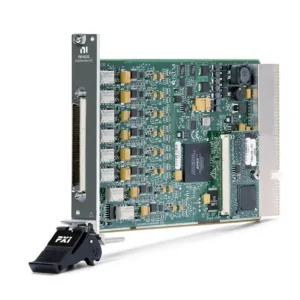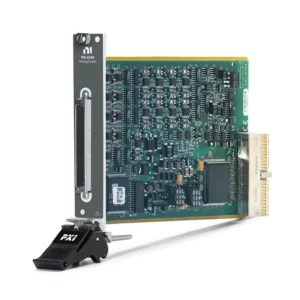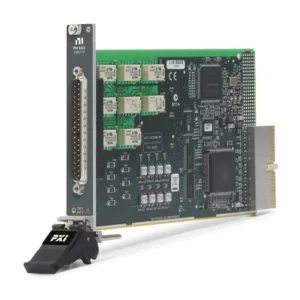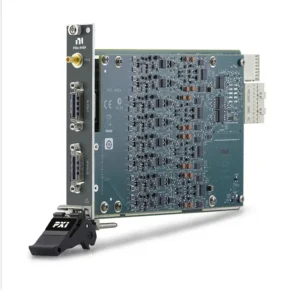





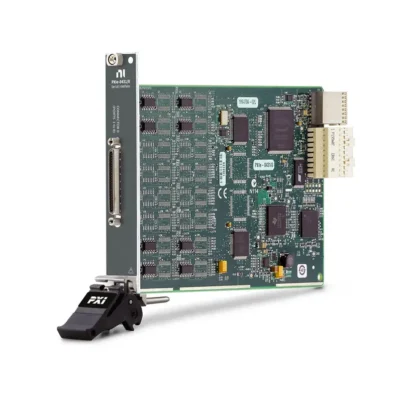

PXIe-8430/8 8-Port RS-232 PXI Express Serial Interface Module
The PXIe-8430/8 is an eight-port PXI Express serial interface module designed to connect RS-232 instruments, controllers, sensors and other serial devices to an automated test system. Each serial channel appears as a standard COM port, allowing engineers to integrate existing serial applications and equipment into a PXI Express platform.
The module supports baud rates up to 1 Mbit/s and uses direct memory access transfers to reduce processor involvement during serial communication. Multithreading and multiprocessor support help improve performance when several ports are communicating simultaneously.
Key Features of the PXIe-8430/8
- Eight independent RS-232 serial ports
- Maximum baud rate of 1 Mbit/s per port
- Supports baud rates from 2 baud to 1 Mbit/s
- Direct memory access data transfers
- Multithreading and multiprocessor support
- Standard operating-system COM-port compatibility
- 68-pin VHDCI front-panel connector
- Includes a 1 m VHDCI-to-eight-DB-9 breakout cable
- Eight male 9-pin D-Sub serial connectors through the cable
- Nonisolated RS-232 interfaces
- PXI Express bus interface
- Compatible with serial instruments and legacy devices
- Suitable for automated test and industrial communication systems
- 3U single-slot PXI Express module
PXIe-8430/8 Technical Specifications
| Product Model | PXIe-8430/8 |
|---|---|
| Part Number | 781472-01 |
| Product Type | PXI Express serial interface module |
| Serial Interface | RS-232 |
| Number of Ports | 8 |
| Maximum Baud Rate | 1 Mbit/s per port |
| Supported Baud-Rate Range | 2 baud to 1 Mbit/s |
| Standard Baud-Rate Accuracy | Within 0.015% |
| Nonstandard Baud-Rate Accuracy | Within 0.5% |
| Electrical Isolation | Nonisolated |
| Data Transfer | Direct memory access |
| Operating-System Interface | Standard COM ports |
| Front-Panel Connector | 68-pin VHDCI |
| Breakout Connectors | 8 × 9-pin D-Sub RS-232 connectors |
| Included Cable Length | 1 m |
| Bus Interface | PXI Express |
| Module Format | 3U PXI Express |
| Dimensions | 100 mm × 160 mm |
| Weight | 143 g |
| Operating Temperature | 0°C to 55°C |
| Typical +12 VDC Current | 220 mA |
| Maximum +12 VDC Current | 250 mA |
| Typical +3.3 VDC Current | 200 mA |
| Maximum +3.3 VDC Current | 750 mA |
PXIe-8430/8 Part Number and Included Cable
| Item | Part Number | Description |
|---|---|---|
| PXIe-8430/8 | 781472-01 | Eight-port, nonisolated RS-232 PXI Express serial interface module |
| Serial Breakout Cable | Included with module | 1 m, 68-pin VHDCI to eight 9-pin D-Sub RS-232 connectors |
The PXIe-8430/8 requires its VHDCI breakout cable to provide the eight individual RS-232 connections. When purchasing a replacement module or used unit, verify that the correct cable is included and inspect the VHDCI and D-Sub connectors for damage.
Eight Independent RS-232 Ports
The PXIe-8430/8 provides eight RS-232 interfaces from one PXI Express slot. Each port can communicate with a separate serial device, allowing a single module to replace several individual serial adapters in an automated test rack.
Test software can configure each port independently with the baud rate, data bits, parity, stop bits and flow-control settings required by the connected device. This makes it possible to operate equipment using different communication configurations from the same module.
1 Mbit/s Maximum Baud Rate
Each PXIe-8430/8 port supports communication speeds up to 1 Mbit/s. The higher data rate can reduce command and data-transfer time when communicating with compatible serial instruments and controllers.
The connected device, cable and software must support the selected baud rate. Long cables, electrical noise and grounding differences may reduce reliable communication speed, particularly when operating near the maximum rate.
Flexible Baud-Rate Configuration
The module supports baud rates ranging from 2 baud to 1 Mbit/s. This wide range allows it to communicate with both modern high-speed serial devices and older equipment that uses slow or nonstandard baud rates.
Standard baud rates are generated with accuracy within 0.015%, while nonstandard rates are supported within 0.5%. Both devices must be configured for sufficiently compatible rates to prevent framing and data errors.
DMA Serial Data Transfers
The PXIe-8430/8 uses direct memory access to transfer serial data. DMA allows data to move between the serial interface and system memory with less continuous processor involvement than conventional programmed input and output transfers.
This architecture is useful when several ports receive or transmit data simultaneously. It helps the PXI controller maintain predictable performance while running measurements, analysis, logging and other test operations.
Multithreading and Multiprocessor Support
The PXIe-8430/8 supports multithreaded and multiprocessor applications. Separate software threads can manage different serial ports, allowing independent instruments and devices to communicate concurrently.
In a production test system, one thread can monitor a device under test while other threads control environmental equipment, barcode readers, programmable instruments or diagnostic interfaces.
Standard COM-Port Compatibility
Installed PXIe-8430/8 channels appear to the operating system as standard COM ports. Existing applications that communicate through conventional serial-port functions can often use the module without requiring a proprietary communication protocol.
Each connected device should be assigned the correct COM port in the application. Record the port-to-device mapping during installation because operating-system configuration changes can affect assigned COM-port numbers.
68-Pin VHDCI Breakout Connection
The module uses a high-density 68-pin VHDCI front-panel connector. The included one-meter breakout cable converts this connector into eight conventional 9-pin D-Sub RS-232 connections.
This design provides eight ports while minimizing front-panel space. Secure the VHDCI connector properly and provide cable strain relief so movement of the breakout assembly does not place unnecessary force on the module.
Nonisolated RS-232 Architecture
The PXIe-8430/8 provides nonisolated RS-232 ports. The serial interfaces therefore share an electrical relationship with the PXI system ground and do not provide galvanic isolation between the test system and connected devices.
Before connecting equipment with different ground references, verify that the resulting ground current and common-mode conditions are acceptable. External isolated converters may be required in electrically noisy systems or installations with significant ground-potential differences.
Concurrent Device Communication
All eight ports can be used to communicate with separate serial devices in the same test system. This is useful when a test sequence must control multiple instruments or monitor several device-under-test interfaces at once.
Software should use appropriate buffers, timeouts and error handling for each port. A slow or unresponsive device should not be allowed to block communication with the remaining serial channels.
Typical PXIe-8430/8 Applications
- Automated test equipment
- Production functional testing
- Serial instrument control
- Device-under-test communication
- Industrial controller configuration
- Embedded-system validation
- Legacy equipment integration
- Barcode-reader and scanner connections
- Environmental chamber control
- Power-supply and load communication
- Laboratory automation
- Multichannel serial data logging
- Firmware download and diagnostic access
- Manufacturing-line equipment communication
Automated Test Equipment
The PXIe-8430/8 can connect a PXI Express test system to as many as eight RS-232 devices. Automated test software can send configuration commands, collect status information and record diagnostic data without requiring external USB serial adapters.
Integrating the serial interfaces into the PXI chassis simplifies system wiring and provides a consistent software environment for production, validation and laboratory test stations.
Serial Instrument Control
Many laboratory instruments, programmable power supplies, environmental chambers and industrial devices continue to use RS-232 communication. The PXIe-8430/8 allows these devices to operate alongside modern PXI Express measurement instruments.
Before developing the communication sequence, confirm the instrument’s command syntax, termination characters, baud rate and handshake configuration. Serial parameters must match on both ends of the connection.
Production Functional Testing
Production systems can use different ports for the device under test, barcode reader, fixture controller, programmable load and other support equipment. Consolidating these connections into one module reduces the number of separate interface devices installed in the test rack.
Applications should include timeouts and recovery procedures so a disconnected or unresponsive device does not stop the entire production sequence.
Legacy Equipment Integration
The PXIe-8430/8 helps retain instruments and controllers that use conventional RS-232 interfaces when a test platform is upgraded to PXI Express. Standard COM-port operation can reduce the software changes required to migrate existing applications.
Compatibility still depends on the legacy device’s cable wiring, connector gender, baud rate, flow control and command protocol. Null-modem or custom serial wiring may be required for certain equipment.
Multichannel Serial Data Logging
The eight ports can collect text, status messages or measurement data from multiple devices. Each serial stream can be recorded with timestamps and associated with the corresponding device or test channel.
For continuous logging applications, configure adequate receive buffers and ensure that the software reads each port frequently enough to prevent buffer overflow.
PXI Express System Integration
The PXIe-8430/8 occupies one slot in a compatible PXI Express chassis. It can operate alongside digital multimeters, oscilloscopes, data acquisition modules, programmable power supplies and other PXI instruments.
Before installation, verify chassis compatibility, available slot space, airflow and controller support. The front-panel area must also provide enough clearance for the VHDCI breakout cable.
Software and Driver Integration
The module is supported by NI serial-interface software and exposes its channels as standard COM ports. Applications can communicate through conventional serial APIs or compatible instrument-control software.
LabVIEW applications can assign separate communication loops to different ports. Text-based applications can use the operating system’s serial functions or compatible serial libraries to send commands and receive responses.
Serial Communication Configuration
Reliable communication requires both ends of the connection to use matching serial parameters. Confirm the baud rate, number of data bits, parity setting, stop bits and hardware or software flow-control mode.
The correct command termination character is also important. Some devices expect carriage return, line feed or a combination of both before processing a command.
Cable and Grounding Considerations
Use properly wired RS-232 cables and avoid unnecessary cable length. Route serial cables away from high-current wiring, switching power supplies, motors and other sources of electromagnetic interference.
Because the PXIe-8430/8 is not isolated, verify the grounding relationship between the PXI chassis and every connected device. External isolation can help protect communication interfaces in demanding industrial environments.
PXIe-8430/8 Troubleshooting
The module is not detected in NI MAX
Confirm that the PXIe-8430/8 is fully seated in a compatible PXI Express slot. Check chassis power, controller communication and the installed serial driver, then restart the chassis and rescan the hardware.
The COM ports do not appear
Check the operating system’s device manager and confirm that the module driver installed successfully. Reinstall or repair the compatible serial driver if the hardware appears without its individual COM ports.
The connected device does not respond
Verify that the application is using the correct COM port. Confirm the baud rate, parity, data bits, stop bits, flow control and command termination. Also check whether the device requires a straight-through, null-modem or custom cable.
Received data is corrupted
Confirm that both devices use identical communication settings. Reduce the baud rate, shorten the cable and inspect the installation for electrical noise or grounding problems.
Communication stops during large transfers
Review receive-buffer handling, application read frequency and flow-control settings. Make sure the software continues to service every active port and does not leave unread data in the buffer.
The system cannot communicate at 1 Mbit/s
Verify that the connected device supports 1 Mbit/s RS-232 operation. Use a short, correctly wired cable and test at progressively lower baud rates to determine whether cable length or signal quality is limiting communication.
A port number changed
Check the operating system’s COM-port assignments and update the application configuration. Recording the module channel and assigned COM-port mapping can simplify system maintenance.
Communication is intermittent
Inspect the VHDCI connector, breakout cable and individual D-Sub connectors. Secure loose connections and provide strain relief. Also check for intermittent device power and inadequate grounding.
Grounding causes communication errors
Measure the ground-potential difference between the PXI system and connected equipment. If the installation requires galvanic isolation, add an external isolated RS-232 interface or select an isolated serial module.
PXIe-8430/8 Comparison with Related Serial Modules
| Model | Serial Interface | Ports | Maximum Baud Rate | Best Suited For |
|---|---|---|---|---|
| PXIe-8430/8 | RS-232, nonisolated | 8 | 1 Mbit/s | Eight-port RS-232 communication in PXI Express systems |
| PXIe-8430/16 | RS-232, nonisolated | 16 | 1 Mbit/s | Higher-density RS-232 communication |
| PXIe-8431/8 | RS-485 and RS-422, nonisolated | 8 | 3 Mbit/s | Differential serial networks and longer cable runs |
| PXIe-8431/16 | RS-485 and RS-422, nonisolated | 16 | 3 Mbit/s | High-density differential serial communication |
| PXI-8430/8 | RS-232, nonisolated | 8 | 1 Mbit/s | Maintaining legacy PXI serial systems |
PXIe-8430/8 vs PXIe-8430/16
Both models provide nonisolated RS-232 communication at up to 1 Mbit/s. The PXIe-8430/8 provides eight ports, while the PXIe-8430/16 doubles the port count to sixteen.
Choose the PXIe-8430/8 when eight ports meet the system requirements or when front-panel cable density should be minimized. Select the PXIe-8430/16 when the application must connect a larger number of RS-232 devices.
PXIe-8430/8 vs PXIe-8431/8
The PXIe-8430/8 provides eight RS-232 ports with a maximum rate of 1 Mbit/s. The PXIe-8431/8 provides eight RS-485 and RS-422 ports with communication speeds up to 3 Mbit/s.
Select the PXIe-8430/8 for equipment using point-to-point RS-232 communication. Choose the PXIe-8431/8 for differential RS-485 or RS-422 devices, multidrop applications or installations that require greater noise immunity and longer cable distances.
Recommended Related Products
- PXIe-8430/16 16-Port RS-232 Serial Interface Module
- PXIe-8431/8 8-Port RS-485/RS-422 Serial Interface Module
- PXIe-8431/16 16-Port RS-485/RS-422 Serial Interface Module
- PXI-8430/8 8-Port RS-232 Serial Interface Module
- View More NI PXI and PXI Express Modules
Selecting the Right PXI Serial Interface
Choose the PXIe-8430/8 when the test system requires eight nonisolated RS-232 ports, PXI Express integration and communication speeds up to 1 Mbit/s. It is particularly useful for controlling several serial instruments from one PXI chassis.
Select the 16-port version when greater RS-232 channel density is required. For equipment using differential RS-485 or RS-422 communication, choose a PXIe-8431 series module instead.
If connected devices operate with different ground references or in electrically harsh environments, consider an isolated interface or external serial isolation solution.
Why Choose the PXIe-8430/8?
- Adds eight RS-232 ports to one PXI Express slot
- Supports communication speeds up to 1 Mbit/s
- Handles standard and nonstandard baud rates
- Uses DMA transfers to reduce processor involvement
- Supports multithreaded and multiprocessor applications
- Appears as standard COM ports
- Includes a VHDCI-to-eight-DB-9 breakout cable
- Integrates legacy serial equipment into modern PXI systems
- Supports automated test and multichannel data-logging applications
Frequently Asked Questions
What is the PXIe-8430/8?
The PXIe-8430/8 is an eight-port, nonisolated RS-232 serial interface module for PXI Express systems.
What is the PXIe-8430/8 part number?
The standard NI part number for the PXIe-8430/8 is 781472-01.
How many serial ports does it provide?
The module provides eight independently configurable RS-232 ports through its included breakout cable.
What is its maximum baud rate?
Each port supports communication speeds up to 1 Mbit/s.
Does the PXIe-8430/8 support slow or nonstandard baud rates?
Yes. It supports rates from 2 baud to 1 Mbit/s, including standard and nonstandard baud-rate configurations.
Does the module appear as standard COM ports?
Yes. Its serial channels appear to the operating system as conventional COM ports.
Is the PXIe-8430/8 isolated?
No. The eight RS-232 interfaces are nonisolated. Check system grounding carefully before connecting equipment with different ground references.
Which connector is installed on the module?
The front panel uses a 68-pin VHDCI connector.
Is a breakout cable included?
Yes. The module is supplied with a one-meter cable that converts the VHDCI connection into eight 9-pin D-Sub RS-232 connectors.
Does it support DMA transfers?
Yes. The PXIe-8430/8 uses direct memory access transfers to support efficient multichannel serial communication.
Can all eight ports communicate simultaneously?
Yes. Software can manage the ports concurrently, subject to controller performance, application design and the communication requirements of the connected devices.
Can the PXIe-8430/8 communicate with RS-485 equipment?
No. It is an RS-232 module. Use a PXIe-8431 series interface or an appropriate external converter for RS-485 and RS-422 devices.
What is the difference between PXIe-8430/8 and PXI-8430/8?
Both provide eight RS-232 ports, but the PXIe-8430/8 uses the PXI Express platform while the PXI-8430/8 is designed for legacy PXI systems.
Request a Quote for the PXIe-8430/8
Contact us for current availability, lead time and project pricing for the PXIe-8430/8 8-Port RS-232 PXI Express Serial Interface Module. We can also help confirm the included VHDCI breakout cable, chassis compatibility and alternative RS-232, RS-485 or RS-422 interface modules for your test system.