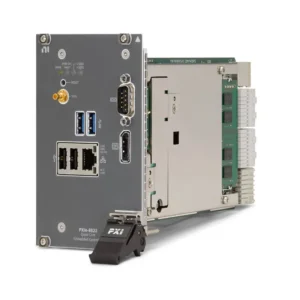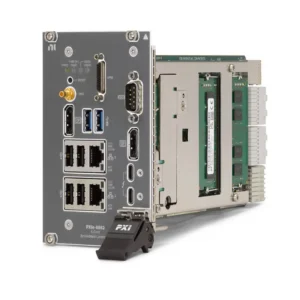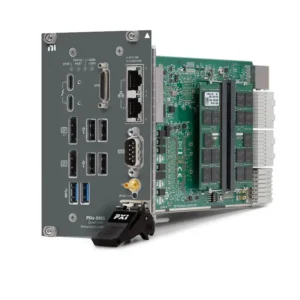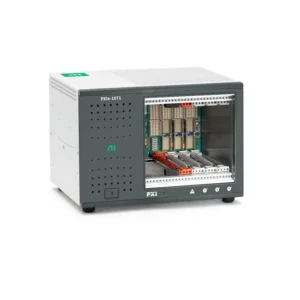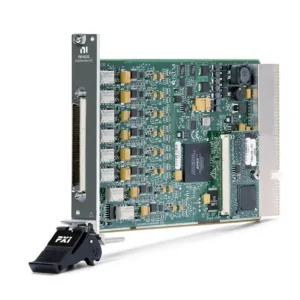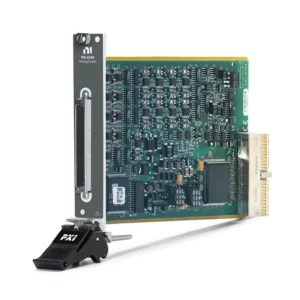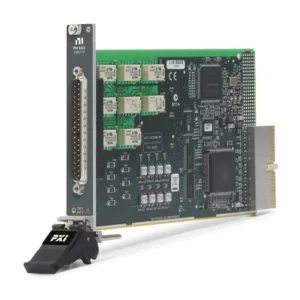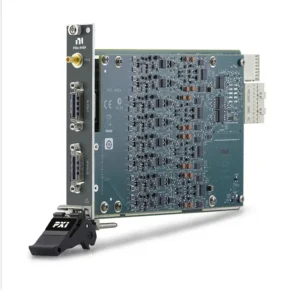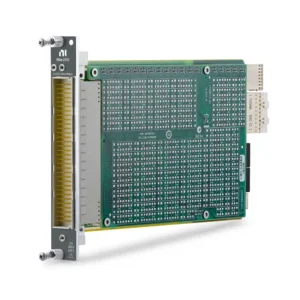




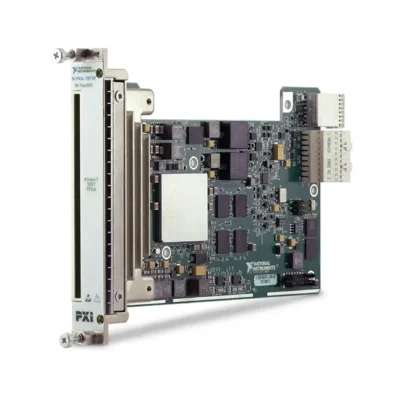
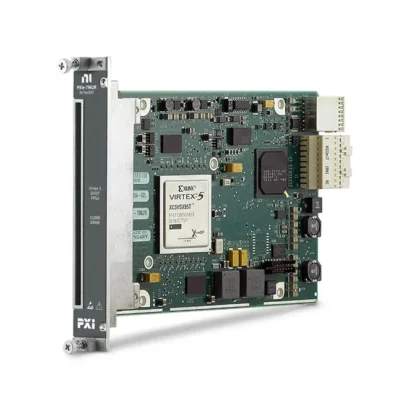
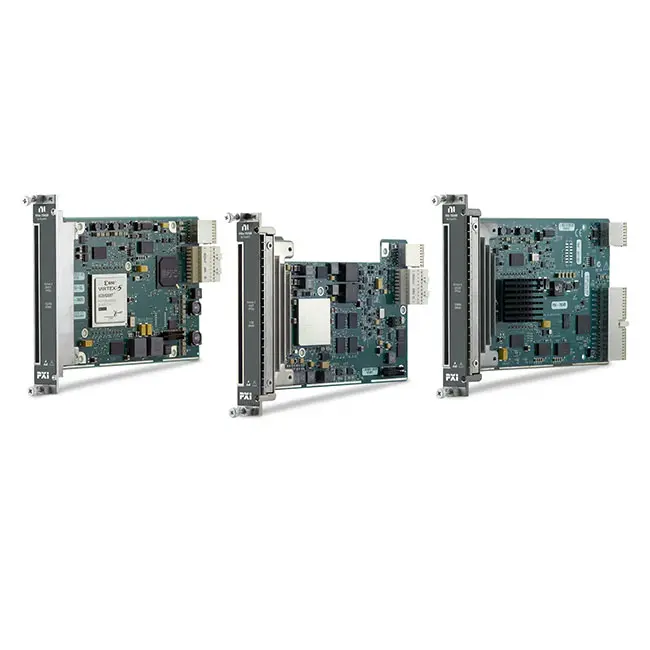
PXIe-7965R Virtex-5 SX95T FlexRIO FPGA Module
The PXIe-7965R, also identified as the PXIe-7965, is a PXI Express FPGA module for NI FlexRIO modular I/O systems. It provides a user-programmable Xilinx Virtex-5 SX95T FPGA for implementing custom high-speed signal processing, digital logic, triggering, control and data-streaming functions.
The module includes 58,880 lookup tables and flip-flops, 640 DSP48 slices, 8,784 kbits of embedded block RAM and 512 MB of onboard DRAM. Its signal-processing-oriented FPGA architecture is suitable for real-time filtering, fast Fourier transforms, channelization, image processing and custom digital protocols.
The PXIe-7965R must be combined with a compatible FlexRIO adapter module to provide application-specific analog, digital, RF, camera or communication I/O. The adapter module determines the external connector, channel count, signal range, sampling rate and electrical characteristics of the completed system.
Key Features of the PXIe-7965R
- Xilinx Virtex-5 SX95T FPGA
- -1 FPGA speed grade
- 58,880 FPGA lookup tables and flip-flops
- 14,720 FPGA slices
- 640 DSP48 signal-processing slices
- 8,784 kbits of embedded block RAM
- 512 MB onboard DRAM
- Two independent 256 MB DRAM banks
- Up to 1.6 GB/s theoretical DRAM bandwidth per bank
- 132 configurable single-ended I/O lines
- Up to 66 differential I/O pairs
- High-density FlexRIO adapter-module connector
- 16 DMA data channels
- 32 DMA interrupt channels
- PXI Express Gen 1 x4 bus interface
- Peer-to-peer streaming support
- More than 800 MB/s supported peer-to-peer streaming
- PXI Express triggering and synchronization
- Programmable with the LabVIEW FPGA Module
PXIe-7965R Technical Specifications
| Product Model | PXIe-7965R / PXIe-7965 |
|---|---|
| Part Number | 781207-01 |
| Product Family | NI FlexRIO with Modular I/O |
| Product Type | PXI Express FPGA module for FlexRIO |
| FPGA Manufacturer | Xilinx |
| FPGA Model | Virtex-5 SX95T |
| FPGA Speed Grade | -1 |
| FPGA Slices | 14,720 |
| Lookup Tables / Flip-Flops | 58,880 |
| DSP48 Slices | 640 |
| Embedded Block RAM | 8,784 kbits |
| Default FPGA Timebase | 40 MHz |
| Timebase Reference | PXIe_CLK100 |
| Onboard DRAM | 512 MB total |
| DRAM Organization | 2 independent banks, 256 MB per bank |
| Theoretical DRAM Bandwidth | Up to 1.6 GB/s per bank |
| Single-Ended FPGA I/O | Up to 132 lines |
| Differential FPGA I/O | Up to 66 pairs |
| Maximum Differential Data Rate | Up to 1 Gb/s, adapter and design dependent |
| Maximum Single-Ended Data Rate | Up to 400 Mb/s, adapter and design dependent |
| DMA Channels | 16 |
| DMA Interrupt Channels | 32 |
| Peer-to-Peer Streaming | Supported |
| Supported Peer-to-Peer Rate | More than 800 MB/s with a suitable system configuration |
| Bus Interface | PXI Express Gen 1 x4 |
| Slot Compatibility | x4, x8 and x16 PXI Express or PXI Express hybrid slots |
| Front I/O Connector | High-density FlexRIO card-edge connector |
| Dimensions | 16.1 cm × 10.8 cm |
| Weight | Approximately 213 g |
| Maximum Power Requirement | 3 A at +3.3 VDC and 2 A at +12 VDC |
| Operating Temperature | 0°C to 55°C |
| Storage Temperature | -20°C to 70°C |
| Programming Software | LabVIEW FPGA Module and NI FlexRIO driver |
| Availability Status | Legacy FlexRIO FPGA module |
PXIe-7965R Part Number and Compatible Hardware
| Item | Part Number | Description |
|---|---|---|
| PXIe-7965R | 781207-01 | Virtex-5 SX95T PXI Express FPGA module for FlexRIO |
| NI 5733 | Verify configuration | High-speed analog input FlexRIO adapter module |
| NI 5752B | Verify configuration | Multi-channel high-speed digitizer adapter module |
| NI 5772 | Verify configuration | High-speed digitizer adapter for transient acquisition |
| NI 5782 | Verify configuration | Baseband transceiver adapter module |
| NI 6583 | 781320 series | Single-ended and differential digital I/O adapter module |
| NI 6589 | Verify configuration | High-speed digital adapter module |
| PXIe-7975R | Verify configuration | Newer Kintex-7 K410T FlexRIO FPGA module with 2 GB DRAM |
The PXIe-7965R does not provide usable external measurement channels by itself. A compatible FlexRIO adapter module must be installed on the high-density front connector.
Confirm adapter compatibility, driver version, LabVIEW version and required FPGA resources before ordering. Some high-performance adapter designs can be difficult to compile for the PXIe-7965R because of its FPGA size and -1 speed grade.
FlexRIO Modular I/O Architecture
FlexRIO separates the user-programmable FPGA from the application-specific analog or digital front end. The PXIe-7965R supplies processing, memory, timing and data-transfer resources, while the adapter module supplies external I/O.
This architecture allows one FPGA platform to support digitizers, signal generators, digital interfaces, baseband transceivers, camera connections and custom-designed adapter modules.
The exact performance of a complete FlexRIO system depends on both parts. The PXIe-7965R specifications should therefore be evaluated together with the selected adapter module’s specifications.
Virtex-5 SX95T FPGA
The PXIe-7965R uses a Xilinx Virtex-5 SX95T FPGA. The SX family is optimized for digital signal-processing applications and provides a large number of dedicated multiplier and accumulator resources.
FPGA logic executes in hardware rather than through a conventional operating-system instruction sequence. Independent processes can operate in parallel with deterministic timing.
Custom FPGA code can perform filtering, decimation, interpolation, FFT processing, pulse detection, event qualification, triggering and digital protocol handling before transferring results to the host.
640 DSP48 Slices
The FPGA provides 640 DSP48 slices for multiplication, accumulation and other arithmetic operations. These dedicated resources are valuable for implementing high-throughput signal-processing algorithms.
DSP slices can support finite impulse response filters, digital downconversion, complex multiplication, channelization and other functions that would consume substantial general FPGA logic if implemented without dedicated arithmetic blocks.
8,784 kbits of Block RAM
Embedded FPGA block RAM provides low-latency storage for lookup tables, filters, delay lines, state machines and local data buffers.
Block RAM is located within the FPGA fabric and is accessed more quickly and deterministically than external DRAM. It is appropriate for smaller buffers that must interact directly with parallel processing logic.
Large datasets and long acquisitions should normally use the module’s onboard DRAM or stream data across the PXI Express bus.
512 MB Onboard DRAM
The PXIe-7965R includes two independent 256 MB DRAM banks. Each bank can be controlled separately from the FPGA, permitting one memory resource to buffer incoming data while the other supports processing or output generation.
Onboard DRAM is useful when the adapter produces data faster than the host can accept continuously, when an acquisition must retain pretrigger samples or when an algorithm requires a large working buffer.
Theoretical memory bandwidth is up to 1.6 GB/s per bank. Actual usable performance depends on memory-controller configuration, access pattern, FPGA clocking and competing operations.
Pretrigger and Post-Trigger Buffering
FPGA logic can continuously write data into a circular DRAM buffer. When a trigger occurs, the system can retain samples from before the event and continue recording a configured amount of post-trigger data.
This approach is useful for capturing intermittent faults, transient signals and communication events that cannot be predicted precisely.
132 Configurable FPGA I/O Lines
The FlexRIO front connector provides access to as many as 132 single-ended FPGA I/O signals. These signals can alternatively be organized as up to 66 differential pairs or as a combination of single-ended and differential channels.
The adapter module determines which lines are used and how they connect to ADCs, DACs, digital transceivers, clocks and control devices.
Users should not connect external signals directly to the bare FPGA connector without a properly designed adapter module. Incorrect voltage levels or signal routing can damage the FPGA module.
High-Speed Digital Operation
When used with an appropriate adapter module, the FPGA interface can support differential data rates up to 1 Gb/s and single-ended rates up to 400 Mb/s.
These values depend on adapter design, signal standard, FPGA timing closure, cabling and the compiled FPGA application. They do not represent a guaranteed rate for every channel or adapter configuration.
16 DMA Data Channels
The PXIe-7965R provides 16 DMA channels for transferring data between FPGA logic and the host controller. Multiple streams can be used to separate channels, acquisition paths, processed results and control information.
DMA FIFOs reduce host-processor intervention and support sustained block transfers. Proper FIFO sizing helps absorb short differences between the FPGA production rate and host software consumption rate.
32 DMA Interrupt Channels
The module includes 32 DMA interrupt channels that can notify host software of events generated by the FPGA.
Interrupts can indicate completed acquisitions, threshold crossings, buffer states, hardware faults or other application-defined conditions. This allows host software to respond without constantly polling every FPGA status register.
PXI Express Gen 1 x4 Interface
The PXIe-7965R uses a four-lane first-generation PXI Express interface. It installs in compatible x4, x8 or x16 PXI Express peripheral or hybrid slots.
The bus supports high-throughput communication between the FPGA module, system controller and other PXI Express instruments. Chassis topology and controller bandwidth can affect the performance available to an individual slot.
Peer-to-Peer Streaming
Peer-to-peer streaming allows the PXIe-7965R to transfer data directly to or from another compatible PXI Express instrument without routing every sample through host software.
Supported configurations can exceed 800 MB/s. Applications include streaming digitizer data to an FPGA for processing or sending FPGA-generated data directly to another instrument.
The total route bandwidth must remain within the PXI Express link and chassis-switch capacity. Simultaneously streaming to multiple destinations can exceed the available Gen 1 x4 bandwidth if not planned carefully.
Real-Time FPGA Signal Processing
The FPGA can process acquired data before transferring it to the host. This reduces the bandwidth and processor resources required by the application.
For example, the FPGA can average samples, detect peaks, apply digital filters, calculate spectral information or transmit only records that satisfy an event condition.
FPGA processing is deterministic because logic executes from hardware clocks without operating-system scheduling delays.
Custom Triggering
Users can implement trigger conditions that are more complex than conventional edge or level triggers. Logic can combine multiple channels, timing windows, digital states and calculated values.
A trigger can start an acquisition, mark a sample, freeze a circular buffer or initiate a response through the adapter module. Latency depends on the implemented FPGA pipeline.
PXI Express Synchronization
The module can use PXI Express backplane clocks and trigger resources to coordinate its FPGA logic with other instruments. The PXIe_CLK100 signal provides a reference for module timing.
Synchronization can align multiple acquisition or generation modules, coordinate FPGA processing with a real-time controller and distribute triggers without extensive external wiring.
The precision of final channel alignment also depends on the adapter module, clock routing and FPGA implementation.
LabVIEW FPGA Programming
The PXIe-7965R is programmed using the LabVIEW FPGA Module and the applicable NI FlexRIO driver. Developers create graphical FPGA code, compile it into a bitfile and deploy it to the module.
Host applications communicate with the compiled FPGA design through controls, indicators, interrupts and DMA FIFOs. LabVIEW Real-Time can be used on a compatible PXI controller for deterministic system-level control.
FPGA compilation can require substantial time and compatible compilation tools. Legacy FlexRIO systems should preserve verified source code, bitfiles, software installers and development-environment versions.
Component-Level IP
FlexRIO adapter modules commonly include component-level intellectual property that exposes clocks, data channels and configuration controls to LabVIEW FPGA.
The adapter-specific component-level IP must match the hardware and software version. Using an incompatible implementation can cause compilation errors or incorrect hardware operation.
Custom FlexRIO Adapter Development
The FlexRIO Adapter Module Development Kit allows experienced hardware developers to create custom front-end modules for specialized signals and interfaces.
A custom design must follow NI mechanical, power, timing, signal-integrity and FPGA I/O requirements. It should also include appropriate protection and voltage translation for external signals.
Typical PXIe-7965R Applications
- High-speed data acquisition
- Real-time digital signal processing
- Digital filtering and FFT processing
- RF and baseband signal processing
- Custom digital protocol interfaces
- High-speed digital pattern testing
- Transient and event capture
- Machine vision and image processing
- Hardware-in-the-loop testing
- Physics and scientific instrumentation
- Custom triggering and data reduction
- Peer-to-peer PXI Express streaming
High-Speed Digitizer Processing
When paired with a compatible digitizer adapter, the PXIe-7965R can acquire high-speed analog data and process it directly in the FPGA.
Processing may include decimation, averaging, peak detection, filtering and event classification. Only the required results or selected records need to be sent to the host.
Digital Interface Testing
A compatible digital adapter can connect FPGA logic to LVDS, single-ended or other supported digital standards. Custom logic can generate patterns, validate received data and implement protocol timing.
The parallel FPGA architecture is useful for testing several digital channels simultaneously with deterministic timing.
RF and Baseband Applications
Baseband and RF adapter modules can use the PXIe-7965R for modulation, demodulation, digital downconversion, channel filtering and spectrum-related processing.
The large number of DSP slices supports parallel arithmetic, while DRAM provides buffering for waveform generation and acquisition.
PXIe-7965R Troubleshooting
The module is not detected in NI MAX
Confirm that the PXIe-7965R is fully installed in a compatible PXI Express or hybrid slot. Check chassis power, controller communication and installation of a FlexRIO driver version that supports the module.
The adapter module is not recognized
Verify that the adapter is compatible with the PXIe-7965R and fully seated on the front connector. Check the adapter-specific driver, component-level IP and LabVIEW version.
The FPGA VI does not compile
Review FPGA resource utilization, timing constraints and unsupported functions. Reduce parallel logic, pipeline long paths or lower clock rates if the design cannot meet timing on the -1 speed-grade FPGA.
A project compiles for the PXIe-7966R but not the PXIe-7965R
The PXIe-7966R uses a faster -2 speed-grade FPGA. A design meeting timing on that module may require additional pipelining or lower clock rates on the PXIe-7965R.
DMA data overflows
Increase FIFO depth, read data more frequently or reduce the acquisition rate. Confirm that the PXI Express controller and chassis route provide sufficient sustained bandwidth.
DRAM throughput is lower than expected
Use long sequential bursts and avoid inefficient random access. Check memory arbitration, FPGA clock rate and whether several processes are competing for the same bank.
Peer-to-peer streaming cannot be configured
Verify that both modules support peer-to-peer transfers and that the chassis topology provides a valid route. Check driver compatibility and available PCI Express bandwidth.
Data is corrupted at high digital rates
Review adapter timing, clock relationship, signal standard, cable quality and FPGA input/output constraints. Reduce the data rate to determine whether the problem is related to timing closure or signal integrity.
The host cannot open the FPGA reference
Confirm that the bitfile was compiled for the exact target and that the host application uses matching FPGA interface definitions. Restart the hardware and redeploy the verified bitfile.
PXIe-7965R Comparison with Similar FlexRIO FPGA Modules
| Model | FPGA and Memory | Best Suited For |
|---|---|---|
| PXIe-7962R | Virtex-5 SX50T, 512 MB DRAM | Moderate FPGA processing requirements |
| PXIe-7965R | Virtex-5 SX95T -1, 512 MB DRAM | DSP-intensive legacy FlexRIO applications |
| PXIe-7966R | Virtex-5 SX95T -2, 512 MB DRAM | Similar resources with faster FPGA timing |
| PXIe-7972R | Kintex-7 K325T, 2 GB DRAM | Newer high-throughput FPGA processing |
| PXIe-7976R | Kintex-7 K410T, 2 GB DRAM | Maximum legacy modular FlexRIO performance |
PXIe-7965R vs PXIe-7962R
The PXIe-7965R uses a larger Virtex-5 SX95T FPGA with 640 DSP slices, while the PXIe-7962R uses an SX50T FPGA with 288 DSP slices.
Both modules provide two 256 MB DRAM banks. Choose the PXIe-7965R when the FPGA design requires more logic, block RAM or parallel signal-processing resources.
PXIe-7965R vs PXIe-7966R
The PXIe-7965R and PXIe-7966R use the same Virtex-5 SX95T FPGA family and provide the same general resource counts and DRAM capacity.
The PXIe-7965R uses a -1 speed-grade FPGA, while the PXIe-7966R uses the faster -2 grade. The PXIe-7966R is preferable for FPGA designs with demanding clock rates or tight timing constraints.
PXIe-7965R vs PXIe-7975R
The PXIe-7975R uses a newer Kintex-7 K410T FPGA and provides 2 GB of onboard DRAM. It also supports greater host and peer-to-peer streaming performance.
Choose the PXIe-7965R for maintaining a validated Virtex-5 FlexRIO system. Select the PXIe-7975R when newer FPGA resources, larger memory and higher bandwidth are required and the adapter and software are compatible.
Recommended Related Products
- PXIe-7962R Virtex-5 SX50T FlexRIO FPGA Module
- PXIe-7966R Virtex-5 SX95T FlexRIO FPGA Module
- PXIe-7972R Kintex-7 FlexRIO FPGA Module
- PXIe-7975R Kintex-7 K410T FlexRIO FPGA Module
- PXIe-7976R High-Performance FlexRIO FPGA Module
- NI-6583 FlexRIO Digital Adapter Module
- NI-5752B FlexRIO Digitizer Adapter Module
- View More NI PXI and PXI Express Modules
Selecting the Right FlexRIO FPGA Module
Choose the PXIe-7965R when an existing application requires a Virtex-5 SX95T FPGA, 640 DSP slices, 512 MB of DRAM and compatibility with a validated first-generation FlexRIO adapter system.
Select the PXIe-7966R when the same FPGA resources are required with a faster speed grade. Consider the PXIe-7972R, PXIe-7975R or PXIe-7976R when newer FPGA architecture, larger DRAM and higher PXI Express bandwidth are priorities.
Why Choose the PXIe-7965R?
- Provides a large signal-processing-oriented FPGA
- Includes 640 dedicated DSP48 slices
- Provides 8,784 kbits of embedded block RAM
- Includes two independent 256 MB DRAM banks
- Supports 132 single-ended or 66 differential I/O signals
- Provides 16 DMA data channels
- Supports high-speed peer-to-peer streaming
- Works with a wide range of FlexRIO adapter modules
- Supports deterministic custom signal processing
- Integrates with LabVIEW FPGA and PXI Express systems
Frequently Asked Questions
What is the PXIe-7965R?
The PXIe-7965R is a PXI Express FlexRIO FPGA module that provides a user-programmable Virtex-5 SX95T FPGA, onboard DRAM and a high-density interface for adapter modules.
Is the PXIe-7965 the same as the PXIe-7965R?
Yes. The hardware is commonly listed as PXIe-7965, PXIe-7965R or NI PXIe-7965R. The R suffix identifies its reconfigurable FPGA functionality.
What is the PXIe-7965R part number?
The standard NI part number for the PXIe-7965R is 781207-01.
Which FPGA does it use?
The module uses a Xilinx Virtex-5 SX95T FPGA with a -1 speed grade.
How much onboard DRAM is provided?
The PXIe-7965R provides 512 MB of DRAM organized as two independently accessible 256 MB banks.
How many DSP slices are available?
The Virtex-5 SX95T FPGA provides 640 DSP48 slices for high-throughput arithmetic and signal-processing operations.
Does the PXIe-7965R include analog inputs?
Not by itself. Analog or digital channels are provided by a compatible FlexRIO adapter module installed on the FPGA module.
How many FPGA I/O lines are available?
The front interface supports up to 132 single-ended lines or 66 differential pairs, depending on the adapter module and FPGA design.
Does it support peer-to-peer streaming?
Yes. Suitable PXI Express systems can stream data directly between compatible modules at rates exceeding 800 MB/s.
Which software programs the module?
The PXIe-7965R is programmed with the LabVIEW FPGA Module and a compatible NI FlexRIO driver.
What is the difference between the PXIe-7965R and PXIe-7966R?
They use the same SX95T FPGA family and have the same memory capacity, but the PXIe-7966R uses a faster -2 speed-grade FPGA while the PXIe-7965R uses the -1 grade.
Request a Quote for the PXIe-7965R
Contact us for current availability, condition, lead time and project pricing for the PXIe-7965R Virtex-5 SX95T FlexRIO FPGA Module. We can also help identify compatible FlexRIO adapter modules, PXI Express chassis and alternative Kintex-7 FPGA modules.