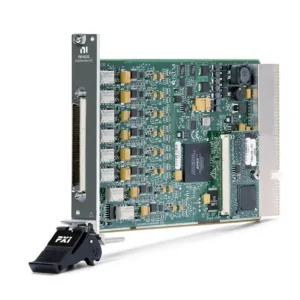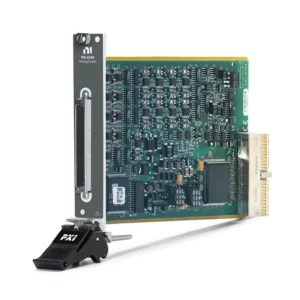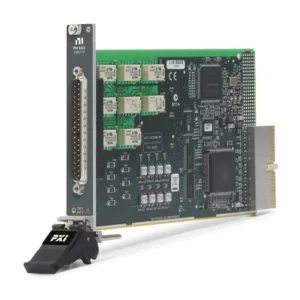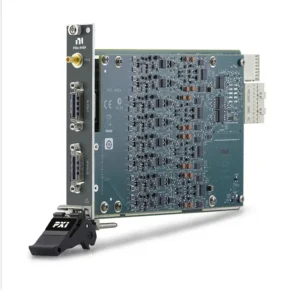





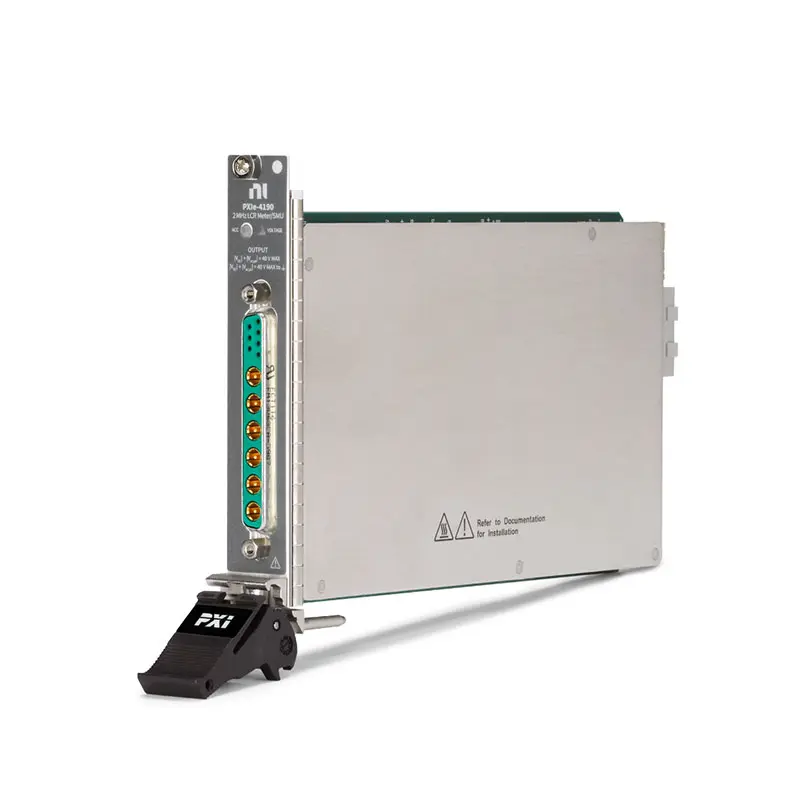
Product Introduction
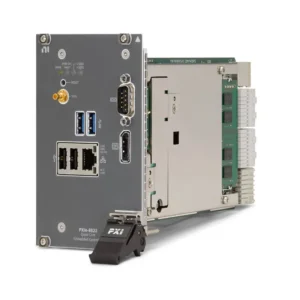
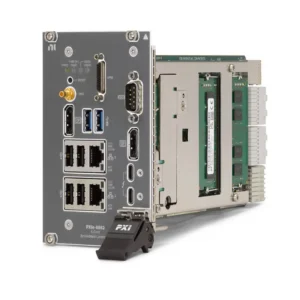
The NI PXIe-4190 is a high-performance PXI Express LCR meter and precision source measure unit (SMU) designed for automated characterization and test of electronic components, semiconductor devices, passive components, MEMS devices, and other applications requiring precise impedance and DC measurements.
The PXIe-4190 combines LCR measurement and precision SMU functionality in a single PXI Express module. Depending on the selected version, it provides AC stimulus frequencies up to 2 MHz, DC bias and SMU voltage capability up to ±40 V, DC current up to ±100 mA, femtofarad-class capacitance measurements, and femtoamp-class current measurement capability.
By integrating both AC impedance measurement and precision DC sourcing and measurement into one instrument, the PXIe-4190 is particularly well suited for capacitance-voltage (C-V), current-voltage (I-V), LCR, impedance, and parametric test applications.
Product Overview
The National Instruments PXIe-4190 is designed for engineers who need both precision LCR measurements and high-sensitivity SMU functionality within an automated PXI test platform.
Typical applications include:
- Inductance measurement
- Capacitance measurement
- Resistance measurement
- Complex impedance measurement
- C-V characterization
- I-V characterization
- Semiconductor parametric testing
- MLCC characterization
- Integrated passive device testing
- MEMS characterization
- Wafer-level research and test
- Automated component testing
PXIe-4190 Ordering Options
The PXIe-4190 is available in two primary performance configurations. The correct part number should be selected according to the required AC stimulus frequency, DC bias voltage, SMU voltage range, and impedance measurement accuracy.
| Specification | PXIe-4190 788088-01 | PXIe-4190 788101-01 |
|---|---|---|
| Maximum AC Stimulus Frequency | 2 MHz | 500 kHz |
| AC Stimulus Frequency Range | 40 Hz to 2 MHz | 40 Hz to 500 kHz |
| Maximum DC Bias Voltage | 40 V | 10 V |
| SMU Voltage Range | -40 V to +40 V | -10 V to +10 V |
| DC Current Range | -100 mA to +100 mA | -100 mA to +100 mA |
| Basic Impedance Accuracy | 0.05% | 0.1% |
| Maximum AC Stimulus Voltage | 7.07 Vrms | 7.07 Vrms |
| Platform | PXI Express | PXI Express |
Key Features
Integrated LCR Meter and Precision SMU
One of the most important features of the PXIe-4190 is the integration of an LCR meter and precision SMU within a single instrument.
Traditional component characterization systems may require separate instruments for AC impedance measurements and DC I-V measurements.
The PXIe-4190 can perform both functions within one PXI module, helping simplify test-system architecture and signal connectivity.
A typical workflow can include:
LCR Measurement → C-V Measurement → I-V Measurement → Parametric Analysis
Up to 2 MHz AC Stimulus Frequency
The 788088-01 version of the PXIe-4190 supports AC stimulus frequencies from 40 Hz to 2 MHz.
This wide frequency range enables engineers to characterize the impedance behavior of electronic components across different operating frequencies.
The 788101-01 configuration supports frequencies from 40 Hz to 500 kHz.
0.05% Basic Impedance Accuracy
The 2 MHz PXIe-4190 configuration provides basic impedance measurement accuracy as low as 0.05%.
High measurement accuracy is particularly important for component characterization, semiconductor research, passive component testing, and production applications where small changes in impedance must be detected reliably.
Femtofarad-Class Capacitance Measurements
The PXIe-4190 is designed for femtofarad-class capacitance measurements, making it suitable for devices and structures with extremely small capacitance values.
This capability is particularly useful for:
- Semiconductor devices
- MEMS structures
- Integrated passive devices
- Wafer-level testing
- Sensor characterization
- Advanced materials research
Femtoamp-Class Current Measurements
The integrated precision SMU provides femtoamp-class current measurement capability.
The high current sensitivity enables characterization of devices with extremely low leakage currents and is particularly valuable in semiconductor and parametric test applications.
Up to ±40 V SMU Capability
The high-performance PXIe-4190 configuration can source and measure voltage over a range of up to -40 V to +40 V.
This capability allows the integrated SMU to apply programmable DC bias conditions while simultaneously supporting precision electrical characterization.
Up to ±100 mA DC Current
The PXIe-4190 provides a DC current operating range of up to -100 mA to +100 mA.
This allows the module to perform precision sourcing and measurement functions across a broad range of semiconductor and component characterization applications.
Up to 7.07 Vrms AC Stimulus
The PXIe-4190 provides AC stimulus amplitude capability up to 7.07 Vrms.
The programmable AC stimulus can be combined with frequency sweeps and DC bias conditions to characterize impedance under different electrical operating conditions.
Complex Impedance Measurements
In addition to basic inductance, capacitance, and resistance measurements, the PXIe-4190 can be used for complex impedance characterization.
This allows engineers to evaluate both the magnitude and phase characteristics of a device under test.
Typical parameters can include:
- Impedance magnitude
- Phase angle
- Capacitance
- Inductance
- Resistance
- Conductance
- Susceptance
- Related derived impedance parameters
Technical Specifications
| Parameter | Description |
|---|---|
| Product Type | PXI LCR Meter and Precision SMU |
| Model | NI PXIe-4190 |
| Part Numbers | 788088-01 / 788101-01 |
| Platform | PXI Express |
| Maximum AC Stimulus Frequency | Up to 2 MHz |
| AC Stimulus Frequency Range | 40 Hz to 2 MHz (Version Dependent) |
| Maximum AC Stimulus Voltage | 7.07 Vrms |
| Maximum DC Bias Voltage | Up to ±40 V |
| SMU Voltage Range | Up to -40 V to +40 V |
| DC Current Range | -100 mA to +100 mA |
| Basic Impedance Accuracy | As Low as 0.05% |
| Capacitance Measurement | Femtofarad-Class |
| Current Measurement | Femtoamp-Class |
| Primary Measurement Functions | LCR, Impedance, C-V, I-V and Parametric Measurements |
| Driver | NI-DCPower |
| Module Size | 3U, 1-Slot PXI Express |
| Primary Applications | Semiconductor Test, Passive Component Characterization, MEMS, MLCC and Parametric Test |
What Is an LCR Meter?
An LCR meter is an electronic test instrument used to measure inductance (L), capacitance (C), and resistance (R).
Unlike a basic resistance or capacitance meter, an LCR meter applies an AC stimulus to the device under test and measures its impedance response.
This allows engineers to characterize how components behave at different frequencies.
Typical devices tested with an LCR meter include:
- Capacitors
- Inductors
- Resistors
- Transformers
- MEMS devices
- Semiconductor structures
- Passive components
- Sensors
What Is an SMU?
A Source Measure Unit combines precision sourcing and measurement capabilities within one instrument.
An SMU can typically source voltage while measuring current or source current while measuring voltage.
The precision SMU integrated into the PXIe-4190 allows DC electrical characterization to be performed alongside LCR measurements.
This is particularly useful for semiconductor devices that require both AC impedance and DC I-V characterization.
LCR Meter and SMU in One Instrument
Combining LCR and SMU functionality can significantly simplify automated characterization systems.
A conventional system might require:
LCR Meter + SMU + Switching Hardware + Cabling
The PXIe-4190 integrates both LCR and precision SMU capabilities into a single PXI Express module, reducing the need to switch the DUT between separate instruments for compatible measurements.
This can help reduce:
- External switching requirements
- Cabling complexity
- Test-system footprint
- Measurement transition time
- Automation complexity
Capacitance-Voltage C-V Measurements
The PXIe-4190 is particularly well suited for capacitance-voltage (C-V) characterization.
During a C-V measurement, the instrument applies different DC bias voltages while measuring capacitance or impedance.
A simplified measurement sequence is:
Set DC Bias → Apply AC Stimulus → Measure Capacitance → Change Bias → Repeat
C-V measurements are widely used for:
- Semiconductor characterization
- MOS structures
- MEMS devices
- Integrated passive devices
- Capacitor characterization
- Wafer parametric test
Current-Voltage I-V Measurements
The integrated precision SMU enables current-voltage (I-V) measurements without requiring a separate standalone SMU for many applications.
The instrument can apply a programmed voltage and measure the resulting current response.
A typical I-V sweep can be represented as:
Voltage Sweep → DUT → Current Measurement → I-V Curve
I-V measurements can be used to characterize:
- Leakage current
- Device conduction
- Electrical thresholds
- Component behavior
- Semiconductor parameters
Semiconductor Parametric Testing
The combination of fF-class capacitance measurements, fA-class current measurements, programmable DC bias, and precision impedance measurement makes the PXIe-4190 particularly suitable for semiconductor parametric testing.
Typical semiconductor applications include:
- Wafer-level characterization
- Device parametric testing
- C-V measurements
- I-V measurements
- Leakage current measurements
- Impedance characterization
- Process development
- Research and development
MLCC Testing
The PXIe-4190 can be used for characterization and automated testing of multilayer ceramic capacitors (MLCCs).
Capacitance characteristics can change according to frequency, AC stimulus amplitude, DC bias, and other operating conditions.
The PXIe-4190 can automate these measurement sweeps to evaluate component behavior across different test conditions.
Integrated Passive Device Testing
Integrated passive devices can contain resistive, capacitive, and inductive structures that require precise impedance characterization.
The PXIe-4190 provides LCR measurement capability together with programmable DC bias and SMU functionality, making it suitable for automated IPD characterization.
MEMS Characterization
MEMS structures can exhibit very small capacitance values and may require sensitive electrical characterization.
The femtofarad-class capacitance capability of the PXIe-4190 makes it suitable for compatible MEMS research, characterization, and production test applications.
Frequency Sweep Measurements
The programmable AC stimulus frequency allows engineers to characterize how DUT impedance changes across frequency.
A typical automated sweep may operate as:
- Configure the DUT and measurement range.
- Set the starting AC stimulus frequency.
- Perform the impedance measurement.
- Increase the stimulus frequency.
- Repeat the measurement.
- Continue until the required frequency range is complete.
- Analyze impedance versus frequency.
The 2 MHz version provides a particularly broad range for component and semiconductor characterization.
DC Bias Sweep Measurements
Many capacitive and semiconductor devices exhibit electrical characteristics that vary with applied DC voltage.
The PXIe-4190 can combine AC impedance measurements with programmable DC bias to characterize these effects automatically.
This capability is particularly important for C-V measurements and voltage-dependent capacitor characterization.
PXIe-4190 Connectivity
The PXIe-4190 uses a specialized front-panel connector and supports low-noise breakout cables for different measurement setups.
Compatible connectivity options include:
- DSUB-to-BNC low-noise cable
- DSUB-to-Triaxial low-noise cable
- DSUB-to-DSUB low-noise cable
- Low-leakage BNC breakout cable
The appropriate cable should be selected according to the measurement type, DUT interface, current sensitivity, and leakage requirements.
Why Low-Leakage Cabling Matters
When measuring extremely small currents or capacitances, cables and connectors can significantly affect measurement accuracy.
Leakage current, cable capacitance, shielding, grounding, and environmental noise can become significant compared with the DUT signal.
For sensitive PXIe-4190 measurements, engineers should therefore carefully consider:
- Low-leakage cabling
- Shielding
- Guarding
- Grounding
- DUT fixture design
- Cable compensation
- Environmental noise
PXIe-4190 in a Complete PXI System
The PXIe-4190 can be integrated into a complete PXI Express automated test system alongside other measurement and stimulus instruments.
A typical system may include:
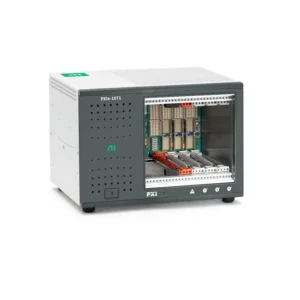
- PXI Chassis
- PXI Controller
- PXIe-4190 LCR meter and SMU
- PXI Modules
- Additional source measurement units
- PXI switch modules
- Digital instruments
- Oscilloscopes or digitizers
- RF signal generators and analyzers
This modular architecture allows LCR, DC parametric, digital, RF, and mixed-signal measurements to be integrated within one automated test platform.
Multi-Site and Parallel Test Systems
The compact one-slot PXI Express architecture makes it possible to integrate multiple instruments within a single chassis.
This can be advantageous for semiconductor and production applications where multiple devices must be tested in parallel to increase system throughput.
PXI modularity allows engineers to scale the number and type of instruments according to the number of DUT sites and required measurements.
Software and Driver Support
The PXIe-4190 is supported by the NI-DCPower instrument driver.
NI provides APIs for multiple programming environments, including:
- LabVIEW
- C
- C# .NET
- Python
- Other compatible programming environments
This makes the PXIe-4190 suitable for both interactive laboratory measurements and fully automated test systems.
InstrumentStudio Integration
The PXIe-4190 can be used with NI InstrumentStudio for interactive instrument configuration and measurement.
InstrumentStudio can help engineers configure the instrument, perform measurements, evaluate DUT behavior, and develop test configurations before moving to fully automated test software.
PXIe-4190 2 MHz vs 500 kHz Version
| Requirement | 788088-01 | 788101-01 |
|---|---|---|
| Maximum Frequency | 2 MHz | 500 kHz |
| Maximum DC Bias | 40 V | 10 V |
| SMU Voltage Range | ±40 V | ±10 V |
| Basic Impedance Accuracy | 0.05% | 0.1% |
| Best Application | Higher-Performance Characterization | Lower-Frequency / Lower-Voltage Characterization |
Choose 788088-01 when the application requires frequencies above 500 kHz, DC bias above 10 V, ±40 V SMU capability, or higher basic impedance accuracy.
Choose 788101-01 when the required measurement frequency is 500 kHz or below and the application operates within the ±10 V range.
Physical Characteristics
| Parameter | Specification |
|---|---|
| Module Format | 3U PXI Express |
| Slots Required | 1 |
| Dimensions | Approximately 2.0 × 13.0 × 21.6 cm |
| Weight | Approximately 481 g |
| Maximum Operating Altitude | 2,000 m |
Industries
- Semiconductor Test
- Electronic Component Manufacturing
- MEMS Research and Production
- Automotive Electronics
- Consumer Electronics
- Electronic Validation
- Materials Research
- Automated Test Equipment
- Research and Development
Applications
LCR Measurements
The PXIe-4190 can measure inductance, capacitance, resistance, and complex impedance for electronic component characterization.
C-V Characterization
Programmable DC bias combined with precision capacitance measurement enables automated capacitance-voltage characterization.
I-V Characterization
The integrated precision SMU can source voltage or current and perform sensitive DC measurements for automated I-V characterization.
Semiconductor Parametric Test
The combination of fF-class capacitance and fA-class current measurement capability makes the PXIe-4190 suitable for demanding semiconductor parametric applications.
MLCC Characterization
The instrument can characterize multilayer ceramic capacitor behavior across frequency, AC stimulus, and DC bias conditions.
MEMS Testing
Sensitive capacitance and current measurement capabilities support compatible MEMS device research, characterization, and automated test.
Integrated Passive Device Testing
The PXIe-4190 can characterize resistance, capacitance, inductance, impedance, and DC electrical behavior of compatible integrated passive devices.
Why Choose NI PXIe-4190?
- Integrated LCR meter and precision SMU
- AC stimulus frequency up to 2 MHz
- 40 Hz minimum AC stimulus frequency
- Up to ±40 V DC bias and SMU capability
- Up to ±100 mA DC current range
- Up to 7.07 Vrms AC stimulus
- Basic impedance accuracy as low as 0.05%
- Femtofarad-class capacitance measurements
- Femtoamp-class current measurements
- Supports LCR and complex impedance measurements
- Suitable for C-V measurements
- Suitable for I-V measurements
- Optimized for semiconductor parametric test
- Compact one-slot PXI Express architecture
- NI-DCPower driver support
- LabVIEW, C, C# .NET and Python APIs
Frequently Asked Questions
What is the NI PXIe-4190?
The NI PXIe-4190 is a PXI Express LCR meter with an integrated precision SMU. It is designed for automated inductance, capacitance, resistance, impedance, C-V, I-V, and semiconductor parametric measurements.
What are the part numbers for the PXIe-4190?
NI currently lists two PXIe-4190 ordering configurations: 788088-01 and 788101-01.
What is the difference between 788088-01 and 788101-01?
The 788088-01 configuration supports AC stimulus frequencies up to 2 MHz, DC bias and SMU voltage up to ±40 V, and 0.05% basic impedance accuracy. The 788101-01 configuration supports up to 500 kHz, ±10 V, and 0.1% basic impedance accuracy.
What is the maximum frequency of the PXIe-4190?
The highest-performance PXIe-4190 configuration supports AC stimulus frequencies up to 2 MHz. The alternative configuration supports up to 500 kHz.
What is the basic impedance accuracy of the PXIe-4190?
The 2 MHz PXIe-4190 configuration provides basic impedance accuracy as low as 0.05%, while the 500 kHz configuration is specified at 0.1%.
Does the PXIe-4190 include an SMU?
Yes. The PXIe-4190 combines LCR measurement functionality with a precision source measure unit in the same PXI Express instrument.
What is the maximum DC voltage of the PXIe-4190?
The 788088-01 configuration supports up to ±40 V, while the 788101-01 configuration supports up to ±10 V.
What is the maximum DC current range?
Both primary PXIe-4190 configurations provide a DC current range of up to -100 mA to +100 mA.
Can the PXIe-4190 perform C-V measurements?
Yes. The combination of precision capacitance measurement and programmable DC bias makes the PXIe-4190 suitable for automated capacitance-voltage characterization.
Can the PXIe-4190 perform I-V measurements?
Yes. Its integrated precision SMU supports current-voltage characterization and other DC parametric measurements.
Can the PXIe-4190 measure very small capacitances?
Yes. NI describes the PXIe-4190 as providing femtofarad-class capacitance measurement capability.
Can the PXIe-4190 measure very small currents?
Yes. The integrated SMU provides femtoamp-class current measurement capability for sensitive semiconductor and component characterization applications.
Can the PXIe-4190 test MLCC capacitors?
Yes. NI specifically identifies multilayer ceramic capacitor characterization as an application for the PXIe-4190.
Can the PXIe-4190 be used for semiconductor testing?
Yes. Semiconductor testing is one of the primary applications of the PXIe-4190, including C-V, I-V, wafer parametric, IPD, MEMS, and other characterization applications.
What driver does the PXIe-4190 use?
The PXIe-4190 is supported by the NI-DCPower instrument driver.
Does the PXIe-4190 support Python?
Yes. NI-DCPower provides API support for Python as well as LabVIEW, C, C# .NET, and other compatible programming environments.
How many PXI slots does the PXIe-4190 require?
The PXIe-4190 is a 3U, one-slot PXI Express module.
What should I check before purchasing a PXIe-4190?
Before purchasing a PXIe-4190, verify the required part number, maximum stimulus frequency, DC bias voltage, SMU voltage and current requirements, impedance accuracy, expected capacitance and current measurement levels, DUT fixture, cable type, leakage requirements, PXI Express chassis compatibility, and NI-DCPower software compatibility.
Conclusion
The NI PXIe-4190 PXI LCR Meter and Precision SMU combines high-accuracy impedance measurement with sensitive DC sourcing and measurement in a compact one-slot PXI Express module. With AC stimulus frequencies up to 2 MHz, up to ±40 V DC capability, ±100 mA current range, 0.05% basic impedance accuracy, femtofarad-class capacitance measurements, and femtoamp-class current measurements, the PXIe-4190 is particularly well suited for semiconductor parametric test, C-V and I-V characterization, MLCC testing, MEMS characterization, integrated passive device testing, and automated electronic component validation.