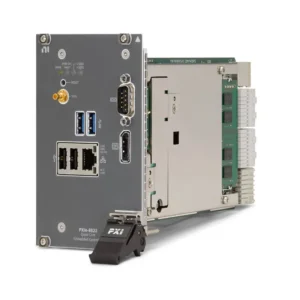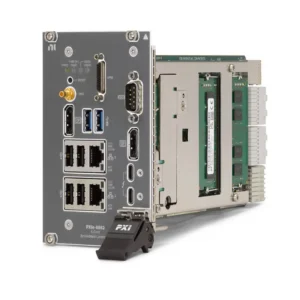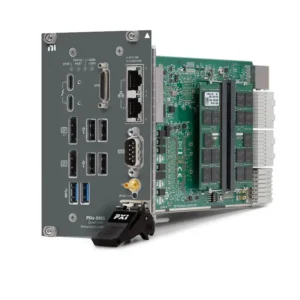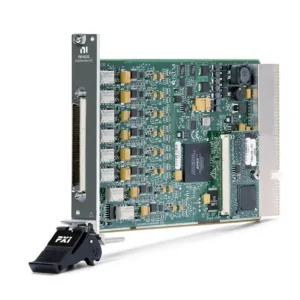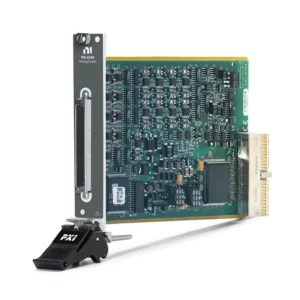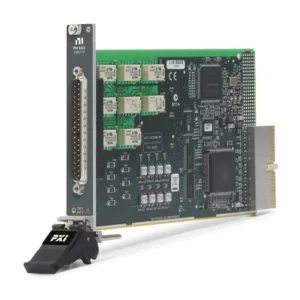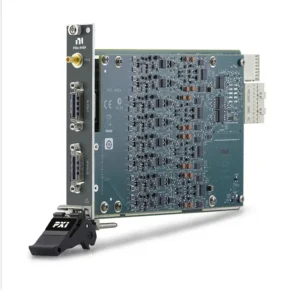




PXIe-5840 6 GHz Vector Signal Transceiver
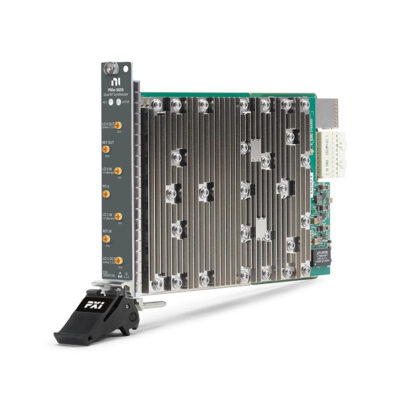
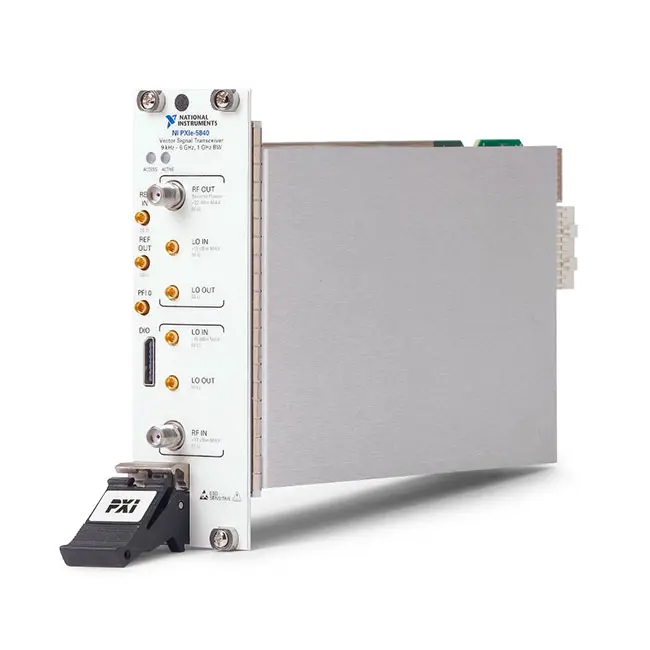
The PXIe-5840 is a second-generation PXI Express vector signal transceiver that combines a vector signal generator, vector signal analyzer, high-speed digital interfaces and user-programmable FPGA processing in one compact RF instrument.
With a frequency range from 9 kHz to 6 GHz and as much as 1 GHz of instantaneous bandwidth, the PXIe-5840 supports wideband wireless communications, RF semiconductor testing, spectrum monitoring, radar research and software-defined radio applications. Its two-slot PXI Express form factor makes it suitable for scalable multichannel and MIMO test systems.
The PXIe-5840 is no longer available as a new product from NI, but it remains valuable for maintaining existing automated RF test platforms. Confirm the assembly revision, calibration condition, included cables and software compatibility when purchasing a replacement or refurbished module.
Key Features of the PXIe-5840
- 9 kHz to 6 GHz RF frequency range
- Up to 1 GHz instantaneous bandwidth
- Integrated vector signal generator and analyzer
- Xilinx Virtex-7 VX690T user-programmable FPGA
- FPGA-based real-time signal processing and control
- High-speed parallel and serial digital interfaces
- Internal and external local-oscillator operation
- Separate LO connections for RF input and RF output
- PXIe-5653 external LO compatibility
- Two 2 GB waveform-memory banks
- Fast frequency tuning for production-test applications
- RF input and output reference-clock connections
- Programmable trigger and digital I/O resources
- NI-RFmx, NI-RFSA and NI-RFSG software support
- Two-slot PXI Express module
PXIe-5840 Technical Specifications
| Product Model | PXIe-5840 |
|---|---|
| Product Type | PXI Express vector signal transceiver |
| Frequency Range | 9 kHz to 6 GHz |
| Instantaneous Bandwidth | Up to 1 GHz |
| Integrated Instruments | Vector signal generator, vector signal analyzer, digital interface and FPGA processor |
| RF Input Impedance | 50 Ω nominal |
| RF Output Impedance | 50 Ω nominal |
| RF Input Maximum Safe Power | +33 dBm |
| RF Output Maximum Reverse Power | +24 dBm below 120 MHz; +33 dBm from 120 MHz to 6 GHz |
| Specified CW Output Range | Up to +5 dBm below 120 MHz, +18 dBm from 120 MHz to 4 GHz and +15 dBm above 4 GHz, depending on bandwidth configuration |
| FPGA | Xilinx Virtex-7 VX690T |
| FPGA Logic Slices | 108,300 |
| Waveform Memory | 2 × 2 GB DRAM banks |
| FPGA Image Memory | 32 MB SDRAM |
| LO Output Frequency Range | 120 MHz to 6 GHz |
| LO Output Level | 0 dBm ±2 dB typical |
| LO Connectors | Female MMPX |
| Reference Connections | REF IN and REF OUT |
| Trigger Connection | PFI 0 |
| Digital Interface | High-speed parallel and high-speed serial interfaces |
| Software | NI-RFmx, NI-RFSA, NI-RFSG and LabVIEW FPGA |
| Bus Interface | PXI Express |
| Module Width | Two adjacent PXI Express slots |
| Operating Temperature | 0°C to 45°C |
| Operating Humidity | 10% to 90%, noncondensing |
| Maximum Operating Altitude | 2,000 m |
| Product Status | Discontinued by NI; available through secondary and refurbished-equipment channels |
PXIe-5840 Assembly Numbers and Included Items
| Item | Assembly Number | Description |
|---|---|---|
| PXIe-5840 | 158395-01L | 6 GHz VST with 1 GHz bandwidth |
| PXIe-5840 Screened Version | 158395-11L | Screened 6 GHz VST with 1 GHz bandwidth |
| PXIe-5840 Revision-Controlled Version | 158395-51L | Revision-controlled 6 GHz VST with 1 GHz bandwidth |
| AST-1000 Configuration | 158395-04L | Application-specific 6 GHz VST configuration |
| Screwdriver | 772006-01 | Installation accessory included with the original kit |
| SMA Driver Bit | 780895-01 | Torque-driver accessory for compatible RF connections |
| PXI Chassis Slot Blocker Kit | 199198-01 | Optional accessory for improving chassis airflow |
The numbers above are hardware assembly identifiers rather than a guarantee of a specific commercial orderable configuration. Verify the complete label, revision suffix, calibration data and option configuration before ordering a replacement module.
Integrated Vector Signal Generator
The PXIe-5840 includes a vector signal generator capable of producing continuous-wave and modulated RF signals across its operating range. It can generate wideband test waveforms for receiver testing, component characterization and wireless-device validation.
Specified maximum CW output depends on frequency and configured bandwidth. The output range reaches +5 dBm below 120 MHz, +18 dBm between 120 MHz and 4 GHz, and +15 dBm above 4 GHz under applicable narrowband operating conditions. Wider-bandwidth configurations may have different available output levels.
NI-RFSG provides control over center frequency, power level, generation mode, waveform data, triggering and synchronization. When generating signals near the maximum level, account for waveform peak-to-average ratio and avoid exceeding the permitted peak or reverse-power limits.
Integrated Vector Signal Analyzer
The vector signal analyzer acquires RF signals and converts them into I/Q data for spectral, modulation and time-domain analysis. Its 1 GHz instantaneous bandwidth allows engineers to capture wide channels, multiple carriers and short-duration RF events without sweeping across the signal.
NI-RFSA can return calibrated I/Q data for custom measurements, while NI-RFmx provides higher-level measurements such as channel power, occupied bandwidth, adjacent-channel power, spectrum, error vector magnitude and supported wireless-standard analysis.
Set the RF input reference level close to the expected signal peak to balance dynamic range and overload margin. Excessively high settings reduce sensitivity, while settings below the actual signal level may overload the input path.
1 GHz Instantaneous Bandwidth
The PXIe-5840 provides as much as 1 GHz of instantaneous analysis and generation bandwidth. This allows a single instrument to test wideband waveforms that would require sweeping or signal stitching on narrower-band RF instruments.
The wide bandwidth is useful for IEEE 802.11ax research, multicarrier signals, radar pulses, spectrum monitoring, channel sounding and digital predistortion development. Actual usable bandwidth and flatness depend on center frequency, equalization, signal level and configured acquisition or generation settings.
9 kHz to 6 GHz Frequency Coverage
The PXIe-5840 covers frequencies from 9 kHz to 6 GHz, enabling measurements from low-frequency and baseband-adjacent applications through common cellular, WLAN, Bluetooth, GNSS and sub-6 GHz RF bands.
The module uses a low-frequency subsystem for signals below 120 MHz and an RF conversion architecture above that frequency. Performance specifications such as output power, noise, distortion and reverse-power tolerance vary between these operating regions.
Virtex-7 FPGA Processing
A Xilinx Virtex-7 VX690T FPGA provides real-time signal processing and instrument control. It can be used for low-latency decision making, hardware-timed test sequences, digital predistortion, channelization, custom triggering and closed-loop control.
The FPGA contains 108,300 logic slices and substantially more processing resources than the FPGA used in earlier NI vector signal transceivers. Supported workflows can use precompiled RF instrument FPGA extensions or custom LabVIEW FPGA designs.
FPGA customization requires appropriate software, compatible bitfiles and careful management of timing, memory and host-transfer resources. Confirm driver and LabVIEW FPGA version compatibility before rebuilding an existing application.
Waveform Memory and Data Streaming
The PXIe-5840 provides two 2 GB DRAM banks for waveform storage. This memory supports extended RF acquisitions, waveform generation and FPGA-based processing without requiring every sample to be transferred immediately to the host controller.
For continuous or long-duration streaming, total throughput depends on the selected sample rate, data type, PXI Express chassis, controller, storage system and processing performed on the FPGA. Reducing data before transferring it to the host can improve sustained system performance.
Internal and External Local-Oscillator Operation
The PXIe-5840 can use its internal local oscillator or operate with external LO signals. Separate LO input and output connections are provided for the RF input and RF output sections, supporting phase-coherent and multichannel system architectures.
The MMPX LO outputs cover 120 MHz to 6 GHz and provide a nominal 0 dBm level. External LO integration requires the correct signal level, frequency, cables and reference-clock configuration.
Use low-loss phase-stable cables and avoid unnecessary adapters in coherent measurement systems. Cable phase variation, connection torque and temperature changes can reduce channel-to-channel phase repeatability.
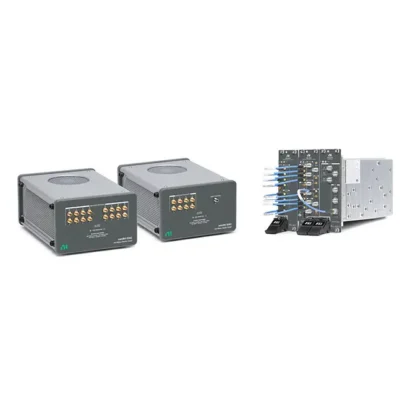
PXIe-5840 with PXIe-5653 External LO
The PXIe-5840 can be combined with the PXIe-5653 RF analog signal generator as an external local-oscillator source. This configuration can improve phase-noise and modulation-performance characteristics for demanding WLAN and RF semiconductor measurements.
When using the PXIe-5653, the reference-clock and LO connections must match the supported NI configuration. The PXIe-5653 reference output, PXI chassis reference and PXIe-5840 reference input may need to be connected and configured according to the selected RFmx, NI-RFSA or NI-RFSG clocking mode.
Perform the required external LO alignment after changing modules, cabling or system configuration. Unlike newer composite VST configurations, the PXIe-5840 and PXIe-5653 workflow may require the user to initiate additional alignment procedures.
High-Speed Digital Interfaces
In addition to its RF generator and analyzer, the PXIe-5840 provides high-speed parallel and serial digital interfaces. These connections allow the FPGA to exchange low-latency data and control signals with devices under test or other compatible instruments.
Potential applications include protocol-aware triggering, device control, power-level servoing, real-time pass/fail decisions and synchronization with external digital hardware. The supported electrical levels, data rates and cable requirements should be verified before connecting custom fixtures.
Fast Automated RF Testing
The PXIe-5840 was designed for both research-grade measurements and high-throughput production testing. Fast frequency changes, FPGA processing and hardware triggering can reduce the time required for repeated transmitter and receiver test sequences.
Test throughput depends on more than RF tuning speed. Waveform download time, device-under-test settling, trigger configuration, measurement duration, averaging and result transfer should all be optimized when building a production test application.
Multichannel and MIMO Systems
The two-slot PXI Express form factor allows multiple PXIe-5840 modules to be installed in a suitable chassis for MIMO, beamforming and multichannel RF applications. Shared reference clocks, triggers and external LO signals can improve synchronization between channels.
Chassis slot count, power delivery and cooling capacity must be evaluated before selecting the number of channels. Phase-coherent applications also require controlled cable lengths, repeatable connector torque and an appropriate calibration procedure.
Wireless Communications Testing
The PXIe-5840 can generate and analyze wideband modulated signals for wireless research, validation and production test. Typical applications include WLAN, cellular, Bluetooth, GNSS, IoT and proprietary radio systems operating within its 6 GHz range.
Its 1 GHz bandwidth is particularly valuable when testing aggregated carriers, wide WLAN channels or multiple signals simultaneously. NI-RFmx personalities can provide standard-oriented physical-layer measurements when the appropriate software license is installed.
RF Semiconductor Testing
The integrated generator and analyzer can characterize RF amplifiers, transceivers, front-end modules and other semiconductor devices. FPGA-based control enables fast power sweeps, real-time servo loops and low-latency interaction with external switching or digital-control hardware.
When testing high-power devices, place appropriately rated attenuators, couplers or protection components between the device and the PXIe-5840. The +33 dBm safe-input marking is a damage limit and should not be treated as a normal calibrated measurement level.
Radar, Electronic Warfare and Spectrum Monitoring
The wide instantaneous bandwidth supports radar waveform generation, pulse acquisition, spectral monitoring and record-and-playback research. FPGA processing can perform real-time triggering, pulse detection, channelization or data reduction before transferring results to the host.
The PXIe-5840 can also be combined with external frequency converters for applications outside its direct 6 GHz range. Overall frequency coverage and calibration accuracy then depend on the converter, local oscillator, cabling and system-level correction process.
Digital Predistortion and Power-Amplifier Research
With wideband generation, acquisition and FPGA resources in one module, the PXIe-5840 can support digital predistortion development and power-amplifier characterization. Engineers can generate a waveform, measure the amplifier output and update predistortion coefficients within an automated test sequence.
A complete DPD system may require external attenuation, amplification, couplers and synchronization hardware. Verify that all components preserve the required bandwidth and linearity.
NI-RFmx Software Support
NI-RFmx provides measurement-oriented APIs for the PXIe-5840. Available personalities can perform spectrum analysis, demodulation, EVM, channel-power and supported communications-standard measurements.
RFmx instrument FPGA extensions can also use supported precompiled bitfiles to add real-time processing behavior without requiring every user to develop a complete FPGA design.
NI-RFSA and NI-RFSG Support
NI-RFSA controls the vector signal analyzer and provides access to calibrated I/Q acquisitions. NI-RFSG controls signal generation, including continuous-wave and arbitrary modulated waveforms.
These IVI-based drivers are suitable for custom RF applications developed in LabVIEW, C, C++ and supported .NET environments. Existing applications should be checked against the installed driver version and operating-system support.
PXI Express Chassis Requirements
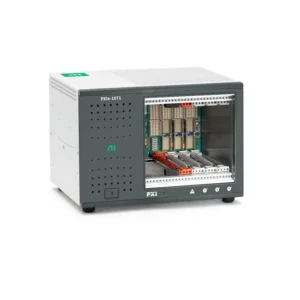
The PXIe-5840 occupies two adjacent slots and must be installed in compatible PXI Express or hybrid-compatible peripheral slots. The chassis must provide adequate power, airflow and backplane connectivity for both positions.
Install the required software before installing the hardware. Power off the chassis during module installation, use ESD protection and set adjustable chassis fans to the recommended high-performance setting.
Blocked vents or insufficient airflow can cause excessive internal temperature, thermal shutdown or reduced measurement stability. Slot blockers may be used where appropriate to improve directed airflow through the chassis.
Typical PXIe-5840 Applications
- Wireless transmitter and receiver testing
- IEEE 802.11ax WLAN analysis
- Cellular and IoT device validation
- RF semiconductor production testing
- Power-amplifier characterization
- Digital predistortion development
- Software-defined radio prototyping
- Spectrum monitoring and signal recording
- Radar waveform generation and analysis
- Electronic warfare research
- Channel sounding and channel emulation
- MIMO and beamforming test systems
- Real-time spectral analysis
- FPGA-based RF control and triggering
PXIe-5840 Troubleshooting
The PXIe-5840 Does Not Appear in NI MAX
Confirm that the module is fully seated in two compatible adjacent PXI Express slots. Check chassis power, controller communication and installation of NI-RFmx, NI-RFSA and NI-RFSG. Power-cycle the chassis after completing the software installation.
The ACCESS Indicator Is Off
Verify that the chassis is powered and that both backplane connectors are correctly engaged. Inspect the chassis slot for damage and confirm that the selected slots support PXI Express peripheral modules.
The RF Input Reports an Overload
Disconnect the signal and verify its power with suitable external equipment. Add attenuation where required and configure the reference level above the expected waveform peak. Do not rely on the absolute maximum input rating as an operating target.
The Generated Output Level Is Incorrect
Check the configured center frequency, bandwidth, power-level type and waveform peak-to-average ratio. Inspect the RF cable and external attenuation, then allow the module to warm up and perform self-calibration.
The Measurement Noise Floor Is Too High
Reduce the RF input reference level when the signal permits, enable the appropriate preamplifier path and confirm that no external source is overloading the receiver. Also inspect grounding, shielding and nearby RF leakage.
Wideband Measurements Are Not Flat
Confirm that equalization is enabled and that the requested signal remains inside the available instantaneous bandwidth. Cable loss, fixture response and external amplifiers or attenuators may require additional system-level correction.
External LO Operation Does Not Lock
Verify the LO frequency, level, connector selection and reference-clock configuration. Confirm that the RF input and RF output LO cables are connected to the corresponding ports and that the PXIe-5653 is configured according to the supported composite setup.
Channels Are Not Phase Coherent
Check that all modules share the intended reference clock and triggering arrangement. Use phase-stable matched cables, repeatable connector torque and a defined alignment or calibration process after changing the hardware.
The Module Reports a Thermal Condition
Stop the test and check chassis fan settings, ambient temperature and airflow. Confirm that adjacent modules or unused slots are not disrupting cooling and that the chassis vents remain unobstructed.
Streaming Cannot Maintain the Required Rate
Reduce acquisition bandwidth or record length, perform data reduction on the FPGA, or improve the PXI Express controller and storage configuration. Confirm that other modules are not competing for the same backplane or host resources.
PXIe-5840 Comparison with Related VST Models
| Model | Frequency Range | Instantaneous Bandwidth | Best Suited For |
|---|---|---|---|
| PXIe-5820 | Baseband to 500 MHz class | Up to 1 GHz | Baseband and IF generation, acquisition and FPGA processing |
| PXIe-5840 | 9 kHz to 6 GHz | Up to 1 GHz | Maintaining first-generation 1 GHz-bandwidth VST systems |
| PXIe-5841 | 9 kHz to 6 GHz | Up to 1 GHz | Newer sub-6 GHz wireless and semiconductor test systems |
| PXIe-5842 | Extends into higher RF frequency ranges | Wideband VST architecture | Modern RF validation requiring expanded frequency coverage |
| PXIe-5860 | 50 MHz to 8.5 GHz | Up to 1 GHz | RF testing requiring coverage beyond 6 GHz |
PXIe-5840 vs PXIe-5841
The PXIe-5841 is the newer migration option for many PXIe-5840 applications. Both instruments provide sub-6 GHz operation, as much as 1 GHz instantaneous bandwidth, integrated generation and analysis, and FPGA-based signal processing.
Migration is not necessarily a direct hardware swap. Differences can include automatic frequency-offset behavior, specifications, bitfiles, self-calibration and external-LO procedures. Applications using a PXIe-5840 with PXIe-5653 require particular attention because the corresponding newer configuration uses different LO hardware and alignment behavior.
PXIe-5840 vs PXIe-5860
The PXIe-5840 covers frequencies through 6 GHz, while the PXIe-5860 extends direct RF operation to 8.5 GHz. Both provide up to 1 GHz of instantaneous bandwidth.
Choose the PXIe-5840 when maintaining an existing validated system or matching installed test stations. Consider the PXIe-5860 when additional frequency coverage and a current-generation platform are required.
PXIe-5840 vs PXIe-5820
The PXIe-5820 is intended primarily for baseband and intermediate-frequency applications, while the PXIe-5840 integrates RF conversion through 6 GHz. Both use a software-defined instrument architecture with wide bandwidth and FPGA processing.
Select the PXIe-5820 when external frequency conversion or direct baseband access is preferred. Select the PXIe-5840 when an integrated RF generator and analyzer is required.
Recommended Related Products
- PXIe-5841 6 GHz Vector Signal Transceiver
- PXIe-5842 Wideband Vector Signal Transceiver
- PXIe-5860 8.5 GHz Vector Signal Transceiver
- PXIe-5820 Baseband Vector Signal Transceiver
- PXIe-5653 RF Analog Signal Generator and External LO
- View More NI PXI and PXI Express Modules
Selecting the Right Vector Signal Transceiver
Choose the PXIe-5840 when the application requires compatibility with an existing 6 GHz NI VST platform, 1 GHz instantaneous bandwidth and Virtex-7 FPGA processing. It is especially relevant when replacing a failed module in a previously validated test station.
For a new system, compare the PXIe-5841, PXIe-5842 and PXIe-5860 for current software support, frequency range, modulation performance and long-term availability. Confirm whether external LO operation, custom FPGA code or validated calibration procedures must be migrated.
Why Choose the PXIe-5840?
- Combines RF generation and analysis in one module
- Covers signals from 9 kHz to 6 GHz
- Provides up to 1 GHz instantaneous bandwidth
- Supports user-programmable FPGA processing
- Includes high-speed digital interfaces
- Supports internal and external LO architectures
- Fits into two adjacent PXI Express slots
- Scales to synchronized multichannel systems
- Integrates with NI-RFmx, NI-RFSA and NI-RFSG
- Supports existing wireless and semiconductor test platforms
Frequently Asked Questions
What is the PXIe-5840?
The PXIe-5840 is a second-generation PXI Express vector signal transceiver that combines an RF vector signal generator, vector signal analyzer, digital interfaces and a user-programmable FPGA.
What is the PXIe-5840 frequency range?
The RF frequency range is 9 kHz to 6 GHz.
What is its instantaneous bandwidth?
The PXIe-5840 provides as much as 1 GHz of instantaneous generation and analysis bandwidth.
Which FPGA does the PXIe-5840 use?
It uses a Xilinx Virtex-7 VX690T FPGA with 108,300 logic slices.
How much waveform memory is installed?
The module contains two 2 GB DRAM waveform-memory banks, providing 4 GB in total across the two banks.
Can the PXIe-5840 use an external local oscillator?
Yes. It provides separate LO inputs and outputs for the RF input and RF output paths and can be configured with a PXIe-5653 external LO source.
How many PXI Express slots does it occupy?
The PXIe-5840 occupies two adjacent PXI Express chassis slots.
Which software controls the PXIe-5840?
Supported software includes NI-RFmx, NI-RFSA and NI-RFSG. FPGA customization can use supported RF instrument FPGA extensions and LabVIEW FPGA workflows.
Is the PXIe-5840 still available from NI?
No. NI identifies the PXIe-5840 as no longer available. Replacement, used and refurbished modules may still be available from specialized test-equipment suppliers.
What is the replacement for the PXIe-5840?
The PXIe-5841 is a common migration option for sub-6 GHz applications. Migration requirements should be reviewed carefully when the original system uses custom FPGA code or a PXIe-5653 external LO.
What should be checked when buying a used PXIe-5840?
Verify the complete assembly number, hardware revision, calibration status, connector condition, self-test results, included accessories and compatibility with the installed NI software version.
Request a Quote for the PXIe-5840
Contact us for current availability, calibration options and project pricing for the PXIe-5840 6 GHz Vector Signal Transceiver. We can also help identify compatible PXI Express chassis, RF cables, PXIe-5653 external LO hardware and newer PXIe-5841, PXIe-5842 or PXIe-5860 migration options.