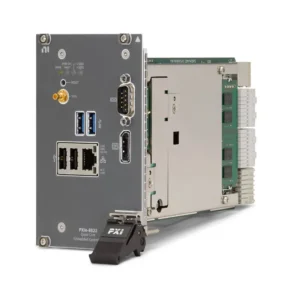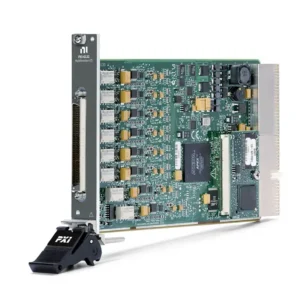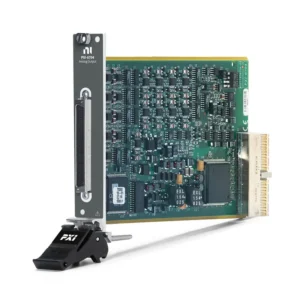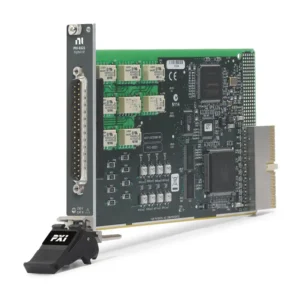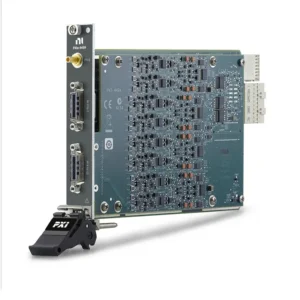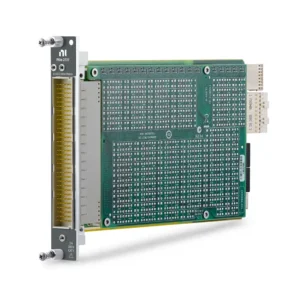


PXIe-4136 ±200 V ±1 A 20 W Precision System SMU
The PXIe-4136 is a single-channel precision PXI Express system source measure unit designed for semiconductor characterization, board-level testing, power-device validation and automated production systems. It combines programmable voltage sourcing, current sourcing and precision voltage and current measurement in one module.
The PXIe-4136 provides a bipolar ±200 V voltage range, a ±1 A DC current range and four-quadrant operation. It can source up to 20 W of DC power and sink up to 12 W, allowing the channel to function as both a precision power source and an electronic load within its specified operating boundaries.
With 1 pA current sensitivity, four-wire remote sensing, hardware-timed sequencing and DMA measurement streaming, the module supports precision DC characterization and high-speed dynamic measurements.
Key Features of the PXIe-4136
- Single-channel precision system SMU
- ±200 V voltage source and measurement range
- ±1 A DC current source and measurement range
- 20 W maximum DC sourcing power
- 12 W maximum DC sinking power
- Four-quadrant source and sink operation
- 1 pA current sensitivity
- Four-wire remote sensing
- High-speed voltage and current acquisition
- Hardware-timed source and measurement sequencing
- DMA waveform and measurement streaming
- Programmable voltage and current compliance
- PXI hardware triggering and synchronization
- NI-DCPower software-driver support
- Suitable for high-voltage semiconductor testing
PXIe-4136 Technical Specifications
| Product Model | PXIe-4136 |
|---|---|
| Part Number | 783760-01 |
| Product Type | Precision PXI Express system source measure unit |
| Number of SMU Channels | One |
| Operating Quadrants | Four-quadrant operation |
| Voltage Range | −200 V to +200 V |
| DC Current Range | −1 A to +1 A |
| Maximum DC Source Power | 20 W |
| Maximum DC Sink Power | 12 W |
| Current Sensitivity | 1 pA |
| Remote Sense | Four-wire sensing |
| Sequencing | Hardware-timed source and measure sequencing |
| Data Transfer | DMA waveform and measurement streaming |
| SourceAdapt | Not supported |
| Triggering | PXI hardware trigger support |
| Bus Interface | PXI Express |
| Software Driver | NI-DCPower |
| Supported Platform | PXI |
| Operating Temperature | 0°C to 55°C |
PXIe-4136 Part Number and Included Items
| Item | Part Number or Type | Description |
|---|---|---|
| PXIe-4136 | 783760-01 | ±200 V, ±1 A DC, 20 W precision PXI Express system SMU |
| PXIe-4136/4137 Connector and Backshell Kit | Included item | Connector hardware for building a compatible SMU cable or test fixture |
| Two-Position Connector Plug | Included item | 3.5 mm pitch, two-position, 8 A, 160 V spring-cage connector plug |
| LabVIEW Professional | 784584-35 | Optional LabVIEW Professional Development System subscription for Windows |
| InstrumentStudio Professional | 789987-35 | Optional interactive instrument configuration and automation software |
The standard package includes the module, the applicable PXIe-4136/4137 connector and backshell kit, a two-position spring-cage connector plug and safety, environmental and regulatory documentation.
The test fixture and finished force-and-sense cable must be designed for the maximum voltage, current and measurement sensitivity of the application. Verify the rating and intended function of every included connector before using it on a high-voltage circuit.
What Is the PXIe-4136?
The PXIe-4136 is a system SMU that combines several functions traditionally performed by separate instruments. It can act as a programmable voltage source, current source, voltmeter, ammeter and four-quadrant electronic load.
The module is optimized for applications that require a wider voltage range than typical high-density semiconductor SMUs. Its ±200 V capability supports high-voltage device characterization while its 1 pA sensitivity enables low-current measurements.
Multiple PXIe-4136 modules can be installed and synchronized when the DUT requires several high-voltage SMU channels.
±200 V Voltage Range
The PXIe-4136 can source and measure voltage from −200 V to +200 V. This bipolar range supports both forward-bias and reverse-bias characterization without mechanically reversing the DUT connections.
Typical applications include high-voltage diode testing, transistor characterization, breakdown measurements, insulation evaluation, sensor testing and board-level power validation.
The maximum ±200 V voltage is available only at current levels that keep the channel within its specified 20 W sourcing and 12 W sinking operating envelopes.
±1 A DC Current Range
The channel supports DC current from −1 A to +1 A. It can deliver current to a device under test or absorb current returned by the device.
The full 1 A current is not available at 200 V because that operating point would greatly exceed the 20 W power rating. At higher voltages, the maximum available current is correspondingly lower.
Always evaluate the programmed voltage and current as a combined operating point rather than treating the maximum voltage and current values independently.
20 W DC Source Power
The PXIe-4136 can provide up to 20 W of DC sourcing power. This capability allows it to energize integrated circuits, circuit boards, optical devices and discrete semiconductors directly within the supported operating area.
At a 200 V output, a 20 W source-power limit corresponds to approximately 100 mA. At lower output voltages, higher current may be available up to the 1 A current limit.
The exact allowed operating area should be confirmed using the official quadrant diagrams and applicable ambient-temperature conditions.
12 W DC Sink Power
The PXIe-4136 can absorb as much as 12 W while operating as an electronic load. Sinking capability is useful for discharging DUT capacitance, loading power supplies and testing circuits that return energy.
The 12 W sinking limit is lower than the 20 W sourcing limit. Source and sink operating points must therefore be evaluated separately.
If the application requires as much as 20 W of DC sinking power, consider the related PXIe-4137 high-sink-power system SMU.
Four-Quadrant Operation
Four-quadrant operation allows the PXIe-4136 to source or sink current at either positive or negative voltage. The module can therefore operate as a bipolar source and electronic load.
| Quadrant | Voltage | Current | Typical Function |
|---|---|---|---|
| Quadrant I | Positive | Positive | Sources positive power to the DUT |
| Quadrant II | Positive | Negative | Sinks current at positive voltage |
| Quadrant III | Negative | Negative | Sources power with negative polarity |
| Quadrant IV | Negative | Positive | Sinks current at negative voltage |
This architecture supports bipolar voltage sweeps, reverse-bias characterization, controlled discharge and devices that alternately consume and return current.
1 pA Current Sensitivity
The PXIe-4136 provides current sensitivity down to 1 pA while also supporting current up to 1 A. This wide dynamic range allows one module to perform leakage measurements and higher-current functional tests.
Picoampere-level measurements require careful fixture construction. Contamination, humidity, cable leakage, electrostatic interference and insufficient settling time can introduce measurement errors.
Use clean, low-leakage insulation materials and shielded connections for sensitive measurements. Allow the system to settle after changing voltage or current ranges.
Four-Wire Remote Sensing
Four-wire remote sensing uses separate force and sense leads. The force conductors carry current, while the sense conductors measure voltage at the DUT terminals.
The PXIe-4136 can compensate for voltage drop across cables, switching relays, connectors and fixture contacts. Remote sensing is particularly useful when operating at higher current or when accurate voltage regulation at the DUT is required.
Connect the sense leads close to the DUT. Incorrect or open sense wiring can cause output errors or unstable operation.
High-Voltage Safety
The PXIe-4136 can generate hazardous voltage. The test fixture should prevent users from touching energized conductors, connectors or DUT terminals.
Use insulation, enclosures, safety interlocks, warning labels and appropriately rated switching components. The system should discharge stored energy before the fixture can be opened or the DUT can be handled.
Only trained personnel should install, operate or service high-voltage test equipment. Follow the safety requirements in the PXIe-4136 documentation and applicable local standards.
High-Voltage Cable and Fixture Design
Every conductor, connector, relay and terminal in the test path must be rated for the maximum applied voltage and expected current. Maintain suitable spacing and insulation between high-voltage conductors and low-voltage signals.
Keep sensitive current-measurement paths away from noisy switching circuits. Contamination on fixture surfaces can create leakage paths that affect low-current results.
A connector included for an auxiliary or specific-purpose connection must not be assumed to support the full ±200 V output. Follow the official pinout and connector instructions.
Voltage and Current Compliance
When sourcing voltage, the current compliance setting limits the amount of current the SMU can deliver. When sourcing current, voltage compliance limits the maximum voltage applied to the DUT.
If the device attempts to exceed the programmed compliance, the requested source value may not be maintained. Compliance protects the DUT but does not replace appropriate external protection.
Save compliance status with the measurement results because a measurement collected in compliance may not represent the intended test condition.
High-Speed Sampling
The PXIe-4136 supports high-speed voltage and current acquisition for capturing transient behavior. It can measure startup current, pulsed loads, breakdown events and changes between DUT operating modes.
Measurement speed, noise and accuracy depend on the selected aperture and range. Shorter apertures increase speed, while longer apertures generally improve noise rejection and measurement stability.
DMA Measurement Streaming
The module supports direct memory access transfers between the SMU and host computer. DMA enables large waveform and measurement records to be streamed with less processor and software-command overhead.
This capability is useful for long current waveforms, dynamic power measurements and automated characterization containing many data points.
The controller memory, software buffers and storage destination must be able to process the incoming data without interruption.
Hardware-Timed Sequence Engine
The onboard sequence engine can execute a programmed list of source and measurement operations without requiring a software command for every step.
Sequences can contain voltage levels, current levels, compliance settings, delays and measurements. Hardware timing improves repeatability and reduces test time during I-V sweeps and production testing.
Provide sufficient delay for the source, DUT and fixture to settle before acquiring a precision measurement.
Synchronizing Multiple SMUs
Several PXIe-4136 modules can be synchronized through PXI hardware triggers. This allows multiple DUT nodes or power rails to change state according to a defined timing relationship.
The SMU can also coordinate with PXI switches, digital instruments, waveform generators and digitizers. Hardware triggers provide more repeatable timing than software commands alone.
SourceAdapt Compatibility
The PXIe-4136 does not support SourceAdapt transient-response customization. Its source response is determined by the module hardware and applicable NI-DCPower settings.
Fixture inductance, load capacitance and cable length should be evaluated when testing dynamic or reactive loads. Use appropriate source delays and confirm output stability before reducing measurement time.
I-V Characterization
The PXIe-4136 can sweep voltage while measuring current or sweep current while measuring voltage. The resulting measurement points form an I-V curve for the device under test.
Its ±200 V range is useful for characterizing devices that require forward and reverse sweeps across a broad voltage range. The 1 pA sensitivity also supports leakage-current measurements before breakdown.
Use conservative compliance limits during initial testing to reduce the risk of damaging an unknown or defective device.
Breakdown Voltage Testing
The wide voltage range makes the PXIe-4136 suitable for controlled breakdown-voltage testing within its electrical and power limits. The SMU can increase voltage in programmed steps while measuring leakage current.
The test sequence can stop when the current reaches a defined threshold. This helps prevent excessive stress after the breakdown condition has been detected.
Fixture insulation and switching components must be rated above the maximum applied voltage with an appropriate safety margin.
Diode and Transistor Testing
The PXIe-4136 can characterize forward conduction, reverse leakage and breakdown behavior of diodes and transistors. It can source positive or negative bias and measure current over a wide dynamic range.
Multiple synchronized SMUs may be required for three-terminal devices. One module can bias the control terminal while another supplies and measures the main current path.
LED and Optical Device Testing
The PXIe-4136 can source controlled current to LEDs, laser diodes and optical transmitters while measuring the resulting voltage. It can also perform voltage or current sweeps for device characterization.
Optical devices may be sensitive to overcurrent and temperature. Use appropriate compliance settings and thermal control throughout the test sequence.
Power-Management Device Testing
The module can power, load and characterize power-management circuits within its operating envelope. Four-quadrant operation supports both source and sink functions for regulator and converter testing.
Fast sampling and DMA streaming can capture startup transients, shutdown behavior and changing load current.
Board-Level Testing
The PXIe-4136 can apply programmable high-voltage or low-voltage power to circuit-board nodes while measuring current consumption. This helps identify shorts, excessive leakage and abnormal power behavior.
Remote sensing improves voltage accuracy at the board connection. Appropriate switching and isolation are required when routing the SMU between several test points.
Production Test Systems
Hardware sequencing reduces software overhead and supports repeatable high-throughput testing. Multiple PXIe-4136 modules can be installed when several high-voltage source and measurement channels are required.
Production systems should monitor fixture leakage, contact resistance, compliance status and calibration condition to maintain consistent results.
Typical PXIe-4136 Applications
- High-voltage semiconductor characterization
- Breakdown-voltage testing
- Reverse-leakage measurement
- Diode and transistor testing
- Power-management IC validation
- RFIC power testing
- LED and laser-diode testing
- Optical transceiver validation
- Board-level power testing
- I-V curve generation
- Insulation and leakage testing
- Automated production testing
- Reliability and life testing
- Research laboratory automation
NI-DCPower Software Support
The PXIe-4136 is controlled through the NI-DCPower instrument driver. NI-DCPower provides functions for configuring source modes, voltage and current ranges, compliance, measurements, triggering and hardware sequences.
The driver supports LabVIEW, LabWindows/CVI, C/C++, .NET and other compatible programming environments.
Install a driver version compatible with the PXI controller operating system and module hardware revision.
InstrumentStudio Integration
InstrumentStudio provides an interactive interface for configuring the PXIe-4136, applying voltage or current and viewing measurements before developing an automated program.
Engineers can use InstrumentStudio to verify fixture wiring, select ranges and test compliance settings. High-voltage safety precautions remain necessary during interactive operation.
LabVIEW Integration
LabVIEW applications can control source and measurement operations, execute hardware sequences and synchronize the PXIe-4136 with other PXI instruments.
Applications can generate I-V curves, display transient waveforms, record test results and automatically stop a test when a compliance or current threshold is reached.
PXI Express Chassis Integration
The PXIe-4136 installs in a compatible PXI Express chassis. It can operate with switching modules, digital instruments, oscilloscopes and additional SMUs.
Verify chassis slot compatibility, power capacity and cooling before installation. Do not obstruct chassis airflow, especially during extended source or sink operation.
PXIe-4136 Troubleshooting
The PXIe-4136 is not detected
Confirm that the module is fully installed in a compatible PXI Express slot. Check chassis power, controller communication and NI-DCPower installation, then run a self-test in NI Measurement & Automation Explorer.
The output voltage is lower than programmed
Check whether the channel is in current compliance or outside its 20 W source-power envelope. Inspect the DUT, cable and fixture for excessive current or a short circuit.
The output current is lower than expected
Check voltage compliance and the selected current range. Confirm that the requested voltage-current combination is inside the supported operating area.
The voltage at the DUT is inaccurate
Use four-wire remote sensing and connect the sense leads close to the DUT. Inspect the force leads, connectors, relays and fixture contacts for voltage drop.
The current measurement is noisy
Select an appropriate current range, increase the measurement aperture and improve shielding and grounding. Keep sensitive measurement wiring away from switching power circuits.
The leakage reading is higher than expected
Disconnect the DUT and measure the fixture leakage. Clean the connector and fixture surfaces, control humidity and use insulation materials suitable for high-voltage low-current measurements.
The SMU enters compliance during a sweep
The DUT is requesting more voltage or current than the programmed compliance permits. Review the expected device behavior before increasing the limit.
The module reports an overtemperature condition
Disable the output and allow the module to cool. Check chassis airflow, ambient temperature and the duration of high-power source or sink operation.
Streaming stops during a long measurement
Review software-buffer sizes, controller memory, processing time and storage throughput. The application must consume the streamed measurements fast enough to prevent overflow.
The output is unstable with a reactive load
Reduce cable length, inspect fixture inductance and review DUT capacitance. Increase the source delay if necessary. The PXIe-4136 does not provide SourceAdapt response customization.
PXIe-4136 Comparison with Related PXI SMUs
| Model | Primary Configuration | Best Suited For |
|---|---|---|
| PXIe-4136 | ±200 V, ±1 A DC, 20 W source, 12 W sink, 1 pA | High-voltage precision semiconductor testing |
| PXIe-4137 | ±200 V system SMU with higher DC sink power | Applications requiring up to 20 W of sinking capability |
| PXIe-4138 | ±60 V, ±3 A DC, 20 W source, 1 pA | Lower-voltage devices requiring higher current |
| PXIe-4139 | Newer wide-range precision system SMU | Applications requiring enhanced low-current performance and SourceAdapt |
| PXIe-4145 | Four channels, ±6 V, ±500 mA | High-pin-count, low-voltage semiconductor testing |
PXIe-4136 vs PXIe-4137
The PXIe-4136 and PXIe-4137 are related ±200 V system SMUs. The PXIe-4136 can source up to 20 W and sink up to 12 W, while the PXIe-4137 is intended for applications requiring as much as 20 W of DC sinking power.
Choose the PXIe-4136 when 12 W of sinking power is sufficient. Choose the PXIe-4137 when the DUT can return more power or when stronger electronic-load capability is required.
PXIe-4136 vs PXIe-4138
The PXIe-4136 provides a wider ±200 V range with current up to ±1 A. The PXIe-4138 provides a lower ±60 V range but supports DC current up to ±3 A.
Select the PXIe-4136 for higher-voltage devices, breakdown measurements and reverse-bias testing. Select the PXIe-4138 for lower-voltage devices that require more current.
PXIe-4136 vs PXIe-4139
The PXIe-4139 uses a newer system SMU architecture with improved low-current capability and SourceAdapt technology. The PXIe-4136 remains suitable for applications requiring ±200 V operation and 1 pA sensitivity.
Choose according to voltage range, current range, power envelope, low-current requirement and the need for programmable transient-response control.
PXIe-4136 vs Multichannel SMUs
The PXIe-4136 focuses on wide voltage and high power from one SMU channel. Multichannel SMUs provide greater channel density but generally offer lower maximum voltage and power per channel.
A semiconductor system can combine the PXIe-4136 for a high-voltage pin with multichannel SMUs for lower-voltage supply, bias and leakage-test connections.
Recommended Related Products
- PXIe-4137 High-Sink-Power System SMU
- PXIe-4138 ±60 V System SMU
- PXIe-4139 Precision System SMU
- PXIe-4145 4-Channel Precision SMU
- PXIe-4143 4-Channel Precision SMU
- PXIe-4162 High-Density SMU
- PXIe-4082 Digital Multimeter
- View More NI PXI and PXI Express Modules
Selecting the Right PXI SMU
Choose the PXIe-4136 when the application requires a single precision SMU channel with voltage up to ±200 V, current up to ±1 A, four-quadrant operation and 1 pA current sensitivity.
Before ordering, review the complete voltage-current operating profile. Confirm that every sourcing point remains within 20 W and every sinking point remains within 12 W.
Select the PXIe-4137 when additional sinking power is necessary, the PXIe-4138 when higher current at lower voltage is required or a multichannel SMU when channel density is the primary requirement.
Why Choose the PXIe-4136?
- Provides a wide bipolar ±200 V operating range
- Supports DC current from −1 A to +1 A
- Sources as much as 20 W
- Sinks as much as 12 W
- Supports four-quadrant operation
- Provides 1 pA current sensitivity
- Supports four-wire remote sensing
- Provides hardware-timed sequencing
- Supports DMA measurement streaming
- Integrates with NI-DCPower, LabVIEW and InstrumentStudio
Frequently Asked Questions
What is the PXIe-4136?
The PXIe-4136 is a single-channel, four-quadrant PXI Express system SMU designed for high-voltage precision sourcing and measurement.
What is the PXIe-4136 part number?
The standard NI part number for the PXIe-4136 is 783760-01.
What is the voltage range?
The PXIe-4136 can source and measure voltage from −200 V to +200 V.
What is the maximum DC current?
The DC current range is −1 A to +1 A, subject to the applicable voltage and power operating boundaries.
What is the maximum sourcing power?
The module can source as much as 20 W of DC power.
What is the maximum sinking power?
The module can absorb as much as 12 W within its specified four-quadrant operating area.
What is the current sensitivity?
The specified current sensitivity is 1 pA.
Does it support four-quadrant operation?
Yes. It can source or sink current at positive or negative voltage.
Does the PXIe-4136 support remote sensing?
Yes. It supports four-wire remote sensing to compensate for voltage drop in the force leads and test fixture.
Does it include SourceAdapt?
No. The PXIe-4136 does not provide SourceAdapt transient-response customization.
Can it stream waveform measurements?
Yes. DMA transfers allow large waveform and measurement records to be streamed between the SMU and host computer.
Which driver controls the PXIe-4136?
The PXIe-4136 is controlled through the NI-DCPower instrument driver.
What is the difference between PXIe-4136 and PXIe-4137?
The PXIe-4137 provides greater DC sinking capability. The PXIe-4136 sinks up to 12 W, while the PXIe-4137 is intended for applications requiring up to 20 W of sink power.
Request a Quote for the PXIe-4136
Contact us for current availability, lead time and project pricing for the PXIe-4136 ±200 V ±1 A 20 W Precision System SMU. We can also help identify compatible connector kits, test cables, PXI Express chassis and related source measure units for your high-voltage test system.