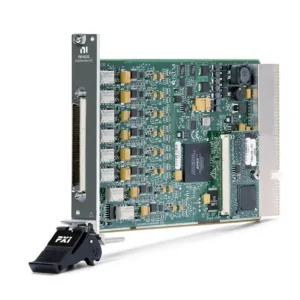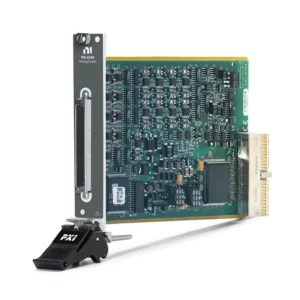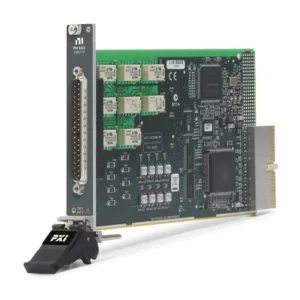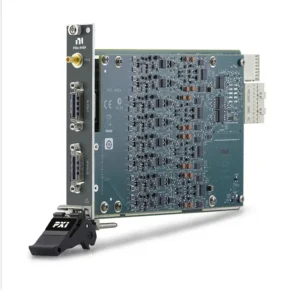




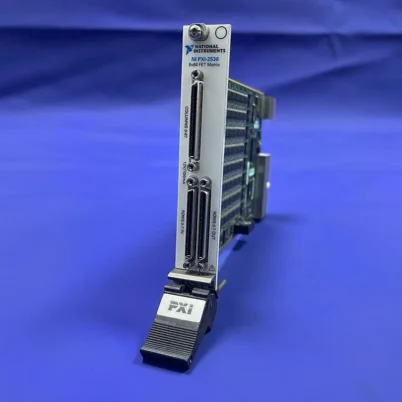
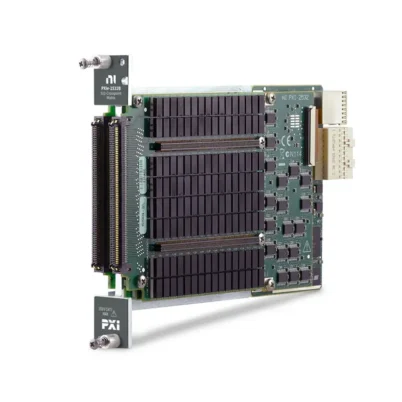
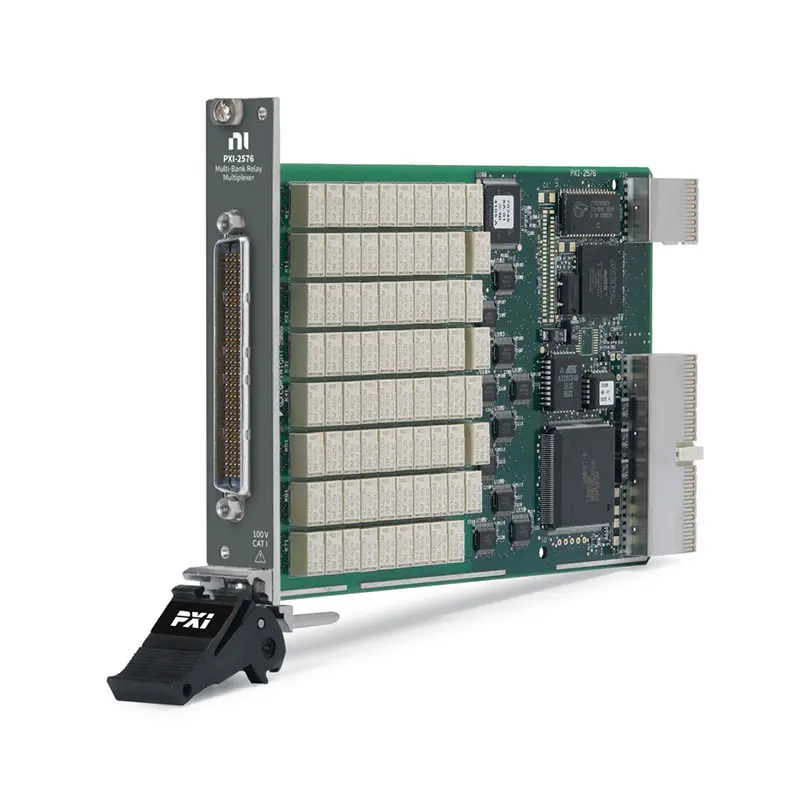
PXI-2576 64-Channel Multibank Multiplexer Module
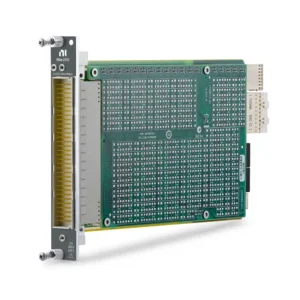
The PXI-2576 is a 64-channel, two-wire PXI multiplexer switch module with 16 independently configurable banks of 4×1 multiplexers. Its flexible architecture supports parallel measurements and high-channel-count sequential scanning.
The multiplexer banks can operate independently or be combined into larger configurations, including a single 64×1 two-wire multiplexer. The module supports switching voltages up to 100 V, currents up to 1 A and switching power up to 30 W or 37.5 VA per channel.
Key Features of the PXI-2576
- 64 two-wire input channels
- 16 independent 4×1 multiplexer banks
- Flexible multibank architecture
- Configurable 4×1, 8×1, 16×1, 32×1 and 64×1 topologies
- 100 V maximum switching voltage
- 1 A maximum switching and carrying current
- 30 W or 37.5 VA maximum switching power
- Up to 130 switching cycles per second
- Greater than 10 MHz bandwidth in the 64×1 topology
- Electromechanical latching relays
- Hardware triggering for deterministic scanning
- Onboard relay-operation counting
- PXI Hybrid bus connector
- NI-SWITCH and NI Switch Executive support
PXI-2576 Technical Specifications
| Product Model | PXI-2576 |
|---|---|
| Part Number | 778572-76 |
| Product Type | PXI Multibank Multiplexer Switch Module |
| Number of Channels | 64 two-wire channels |
| Independent Banks | 16 |
| Default Bank Topology | Sixteen 4×1, two-wire multiplexers |
| Supported Topologies | Independent, sixteen 4×1, eight 8×1, four 16×1, two 32×1 or one 64×1 |
| Relay Type | Electromechanical, latching |
| Maximum Scan Rate | 130 cycles/s |
| Typical Relay Operating Time | 2 ms |
| Maximum Switching Voltage | 100 V channel-to-channel or channel-to-ground |
| Measurement Category | CAT I |
| Maximum Switching Current | 1 A |
| Maximum Carrying Current | 1 A |
| Maximum Switching Power | 30 W or 37.5 VA per channel |
| Typical Initial Path Resistance | 0.5 Ω |
| Maximum Initial Path Resistance | Less than 1.1 Ω |
| Typical Thermal EMF | Less than 10 µV |
| Typical 4×1 and 8×1 Bandwidth | Greater than 30 MHz in a 50 Ω system |
| Typical 64×1 Bandwidth | Greater than 10 MHz |
| Front Connector | 160-pin LFH |
| Bus Connector | PXI Hybrid |
PXI-2576 Part Number and Accessories
| Item | Part Number | Description |
|---|---|---|
| PXI-2576 | 778572-76 | 64-channel, two-wire multibank PXI multiplexer |
| TB-2676 | 779535-01 | Terminal block with ribbon cable headers for PXI-2576 |
| TB-2676 Cable Kit | 779669-01 | Ribbon cable kit for accessing TB-2676 channels |
| LFH160 to 50-Pin D-SUB Cable | 780009-01 | Cable solution for connecting PXI-2576 signals to external hardware |
The TB-2676 mounts to the module and provides ribbon cable headers for accessing and configuring the switch channels. The TB-2676 Cable Kit is ordered separately when ribbon cable connections are required.
Sixteen Independent 4×1 Multiplexer Banks
The PXI-2576 contains 16 separate two-wire 4×1 multiplexer banks. Each bank routes one of four differential input channels to its corresponding common connection.
The banks can operate independently, allowing up to 16 parallel measurement paths when suitable instruments or measurement channels are available.
Flexible Multiplexer Topologies
Individual banks can be combined to create larger multiplexer configurations. Supported configurations include:
- Sixteen independent 4×1 two-wire multiplexers
- Eight independent 8×1 two-wire multiplexers
- Four independent 16×1 two-wire multiplexers
- Two independent 32×1 two-wire multiplexers
- One 64×1 two-wire multiplexer
This flexibility allows the same module to support parallel low-channel-count measurements or sequential acquisition across all 64 channels.
Two-Wire Switching
Each channel switches both the positive and negative signal conductors together. Two-wire switching is useful for differential voltage, resistance, temperature and other floating measurements.
Switching both conductors helps reduce errors caused by unwanted shared return paths and ground-potential differences.
100 V and 1 A Switching Capacity
The PXI-2576 supports channel-to-channel and channel-to-ground switching voltages up to 100 V in Measurement Category I applications.
Each channel or common connection supports switching and carrying currents up to 1 A, subject to the maximum switching power of 30 W or 37.5 VA.
Measurement Category I Operation
The module is rated for Measurement Category I and should only be used with appropriately protected signal circuits. It must not be connected directly to building mains or Measurement Category II, III or IV circuits.
When hazardous voltage is present on any channel, safety extra-low-voltage signals should not be connected to other channels on the module.
Low Path Resistance
The initial channel-to-common path resistance is typically 0.5 Ω and specified below 1.1 Ω. Low path resistance helps reduce voltage drops and resistance measurement errors.
Path resistance includes relay contact resistance, PCB traces, cables and terminal connections. The complete switching path should be considered when making precision resistance measurements.
Multiplexer Bandwidth
Bandwidth depends on the selected topology. In a 50 Ω system, the 4×1 and 8×1 configurations provide typical bandwidth greater than 30 MHz, while the 64×1 topology provides bandwidth greater than 10 MHz.
Actual system bandwidth also depends on cable length, fixture design, connected instruments and the number of linked multiplexer banks.
Electromechanical Latching Relays
The PXI-2576 uses electromechanical latching relays. Latching relays maintain their selected state without requiring continuous coil power, helping reduce module power consumption and heat generation.
Onboard relay counting allows software to monitor operation counts and plan preventive maintenance in frequently used test systems.
Hardware-Triggered Scanning
Hardware triggers allow the PXI-2576 to advance through a predefined scan list with deterministic timing. This reduces dependence on individual software commands from the host controller.
The multiplexer can be synchronized with a digital multimeter, resistance meter or other PXI instrument to automate multichannel measurements.
Typical Applications
- Multichannel voltage measurement
- Two-wire resistance measurement
- Temperature sensor scanning
- Electronic component validation
- Battery and cell monitoring
- Semiconductor device testing
- Printed circuit board testing
- Automated functional testing
- Data acquisition channel expansion
- Parallel measurement systems
Multichannel Voltage Measurements
The PXI-2576 can route as many as 64 differential voltage signals to a digital multimeter or other measurement instrument. The software-controlled scan list determines the measurement order.
For faster testing, separate multiplexer banks can be connected to multiple measurement channels and operated in parallel.
Resistance and Temperature Measurements
The two-wire architecture can route resistance sensors, thermistors and other resistive devices. Switch and cable resistance should be considered when measuring low-resistance signals.
When higher accuracy is required, use compensation techniques or select a four-wire multiplexer configuration from another compatible switch module.
NI-SWITCH Driver Support
The PXI-2576 is controlled through the NI-SWITCH driver. NI-SWITCH provides functions for selecting topologies, connecting channels, creating scan lists, processing hardware triggers and monitoring relay counts.
Applications can be developed using LabVIEW, C, C#, Python and other supported programming environments.
NI Switch Executive Integration
NI Switch Executive allows developers to define meaningful route and channel names for complex switching systems. Test software can call named routes instead of controlling individual relays directly.
This simplifies application development and helps reduce routing errors when several switch modules are used in one system.
PXI System Integration
The PXI-2576 uses a PXI Hybrid connector and requires a compatible PXI or PXI Express hybrid chassis slot. The system controller must support the required NI-SWITCH driver version.
Visit the NI PXI Modules category to explore related switch and measurement hardware.
Troubleshooting the PXI-2576
The module is not detected
Confirm that the PXI-2576 is installed in a compatible PXI Hybrid slot. Check the chassis controller, PXI Platform Services and NI-SWITCH driver installation.
A channel does not connect to the expected common
Verify the selected topology, bank number, channel name and common terminal. Channel assignments change according to the configured multiplexer topology.
Resistance measurements are higher than expected
Include relay, cable and terminal resistance in the measurement. Inspect the terminal connections and compensate for path resistance when appropriate.
The module reports a topology or route error
Confirm that the requested route is valid for the topology configured in NI-SWITCH. Disconnect conflicting routes before changing the topology.
A relay does not switch reliably
Check the load voltage and current against the minimum and maximum specifications. Review the relay count and allow sufficient settling time after switching.
Measurements contain excessive noise
Use shielded cables, maintain separation from high-power wiring and confirm that the signal source and measurement instrument have compatible grounding.
PXI-2576 Comparison
| Model | Channels | Wire Mode | Maximum Voltage | Primary Use |
|---|---|---|---|---|
| PXI-2576 | 64 | 2-wire | 100 V | Flexible multibank and parallel measurements |
| PXI-2575 | Up to 196 | 1-, 2- or 4-wire | 300 V | High-channel-count sequential measurements |
| PXIe-2575 | Up to 196 | 1-, 2- or 4-wire | 300 V | PXI Express high-channel-count multiplexing |
| PXI-2527 | 32 | 2-wire | 300 V | General-purpose high-voltage multiplexing |
Recommended Related Products
- PXI-2575 – high-density multiplexer with configurable one-, two- and four-wire operation
- PXIe-2575 – PXI Express high-channel-count multiplexer for automated measurements
- PXI-2527 – 32-channel multiplexer for higher-voltage signal routing
- PXIe-2527 – PXI Express multiplexer for general-purpose automated testing
- PXIe-4080 – digital multimeter for automated voltage, current and resistance measurements
Selecting the PXI-2576
Choose the PXI-2576 when an application requires up to 64 two-wire channels, flexible multibank configurations or several parallel measurement paths within one switch module.
If a larger number of sequential channels or four-wire measurements is required, consider the PXI-2575 or PXIe-2575. For higher-voltage 32-channel switching, the PXI-2527 may be more suitable.
PXI-2576 vs PXI-2575
The PXI-2576 provides 64 two-wire channels organized as 16 configurable 4×1 banks. It is optimized for flexible topologies and parallel measurement operations.
The PXI-2575 provides a larger channel count and supports one-, two- and four-wire operation. Select the PXI-2576 for multibank flexibility or the PXI-2575 for maximum sequential channel capacity.
Why Choose the PXI-2576?
- 64 two-wire multiplexer channels
- Sixteen independently configurable banks
- Flexible 4×1 through 64×1 topologies
- 100 V and 1 A switching capability
- Low initial path resistance
- Hardware-triggered deterministic scanning
- NI-SWITCH and Switch Executive integration
Frequently Asked Questions
What is the PXI-2576 used for?
The PXI-2576 is used to route multichannel voltage, resistance, temperature and other two-wire signals to measurement instruments in automated test systems.
How many channels does the PXI-2576 provide?
The module provides 64 two-wire channels organized as 16 banks of 4×1 multiplexers.
Which multiplexer topologies are supported?
It supports independent banks, sixteen 4×1, eight 8×1, four 16×1, two 32×1 or one 64×1 two-wire configuration.
What voltage and current can the PXI-2576 switch?
The module supports up to 100 V, 1 A and 30 W or 37.5 VA per channel in Measurement Category I applications.
Which relay type does it use?
The PXI-2576 uses electromechanical latching relays.
Can the PXI-2576 perform parallel measurements?
Yes. Its independent multiplexer banks can connect to separate measurement channels for parallel acquisition.
Which terminal block is used with the PXI-2576?
The TB-2676 terminal block, part number 779535-01, provides access to the PXI-2576 channels.
Does the module support hardware triggering?
Yes. Hardware triggering enables deterministic scan advancement and synchronization with compatible measurement instruments.
What is the PXI-2576 part number?
The standard NI part number for the PXI-2576 is 778572-76.
Request a Quote for the PXI-2576
Contact us for current availability, lead time and project pricing for the PXI-2576 Multibank Multiplexer Switch Module. We can also help confirm compatible terminal blocks, cable kits, PXI chassis and related measurement instruments.