



Product Introduction
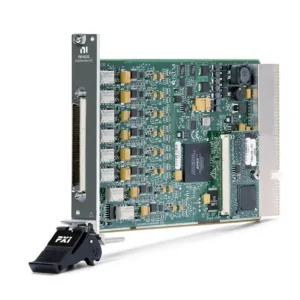
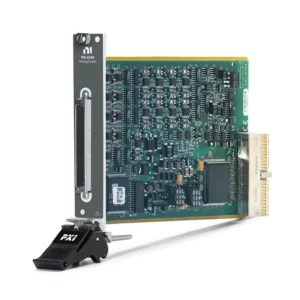
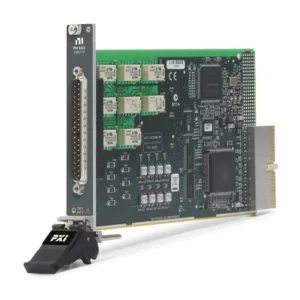
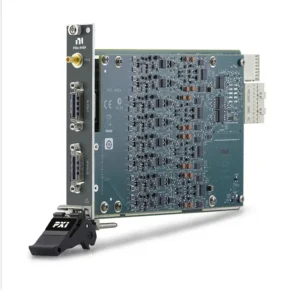
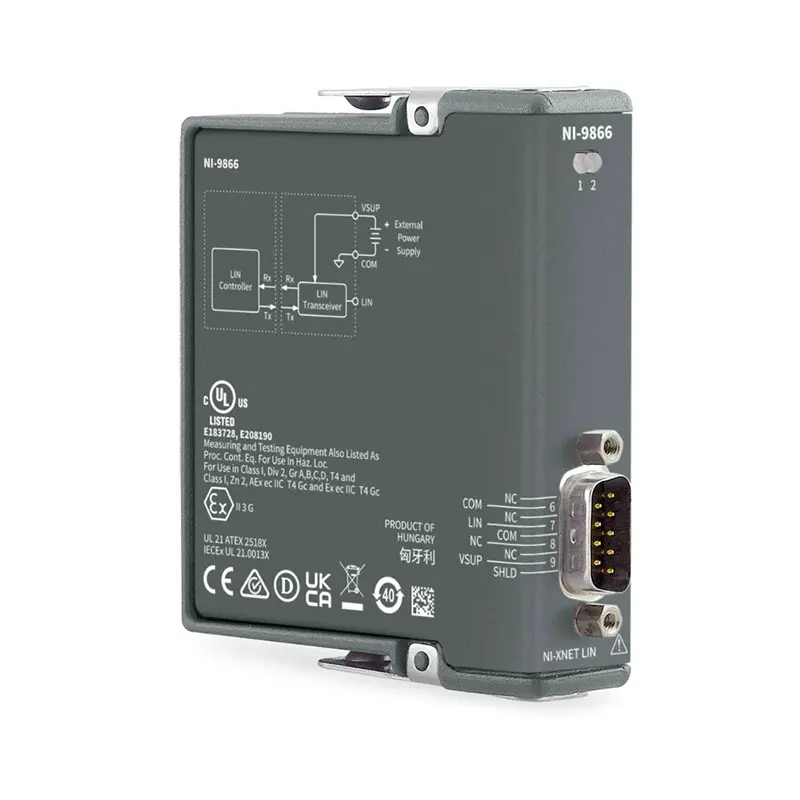
The NI-9866 is a 1-port C Series LIN interface module designed for communicating with, monitoring, and testing Local Interconnect Network (LIN) buses.
The module provides a dedicated LIN interface for compatible CompactDAQ and CompactRIO systems, making it suitable for automotive electronics development, ECU testing, hardware-in-the-loop systems, network diagnostics, automated validation, and embedded communication applications.
By integrating LIN communication with other C Series measurement and control modules, engineers can build synchronized systems that combine vehicle-network communication with analog, digital, sensor, and control measurements.
Product Overview
The National Instruments NI-9866 belongs to the NI C Series vehicle and embedded network interface family.
A typical application architecture is:
LIN Device / ECU / Sensor / Actuator → LIN Bus → NI-9866 → CompactDAQ or CompactRIO → Test and Measurement Software
This architecture allows engineers to monitor LIN frames, transmit network messages, communicate with LIN nodes, and combine network data with physical measurements during automated testing.
Key Features
1-Port LIN Interface
The NI-9866 provides one LIN network interface port.
The dedicated interface allows a compatible NI system to communicate directly with LIN devices used in automotive and embedded applications.
Local Interconnect Network Communication
The NI-9866 is specifically designed for LIN bus communication.
LIN is a low-cost serial communication network widely used for electronic devices that do not require the bandwidth and complexity of CAN.
Typical LIN-connected devices include:
- Window control modules
- Door control modules
- Seat control systems
- Mirror controllers
- Climate-control actuators
- Lighting modules
- Rain sensors
- Sunroof controllers
- Small motors and actuators
- Body electronics
LIN Master and Slave Applications
Depending on the software configuration and test architecture, the NI-9866 can be incorporated into systems that interact with LIN networks for master-side communication, node simulation, monitoring, and validation.
This makes the module useful for both network analysis and automated ECU test systems.
LIN Bus Monitoring
The NI-9866 can be used to monitor communication traffic on a LIN network.
Engineers can use captured network information to evaluate:
- LIN frame activity
- Message timing
- Signal values
- Node responses
- Communication behavior
- Network faults
Message Transmission
In addition to monitoring network traffic, the NI-9866 can participate in test systems that transmit LIN messages to connected devices.
This allows test software to generate network commands and evaluate how an ECU, sensor, actuator, or other LIN node responds.
Automotive Network Testing
LIN is widely used in automotive body electronics and distributed control systems.
The NI-9866 is therefore particularly useful for:
- ECU development
- ECU validation
- Component testing
- Vehicle network testing
- Production test
- Hardware-in-the-loop testing
- Automotive research and development
C Series Form Factor
The NI-9866 uses the compact NI C Series form factor.
This enables LIN communication to be combined with other measurement and control functionality in a single modular system.
For example:
NI-9866 → LIN Communication
Analog Input Module → Voltage Measurement
Digital I/O Module → ECU I/O Testing
Temperature Module → Thermal Measurement
Current Module → Current Monitoring
Technical Specifications
| Parameter | Specification |
|---|---|
| Product Type | C Series LIN Interface Module |
| Model | NI-9866 |
| Manufacturer | National Instruments |
| Platform | NI C Series |
| Network Type | LIN (Local Interconnect Network) |
| Number of Ports | 1 |
| Network Function | LIN Communication, Monitoring and Testing |
| Physical Interface | 9-Pin D-SUB |
| External Power | Required for LIN Transceiver Operation |
| Compatible Platforms | Compatible CompactDAQ and CompactRIO Systems |
| Primary Applications | Automotive Networking, ECU Testing, LIN Monitoring, HIL Testing and Automated Validation |
What Is LIN?
LIN stands for Local Interconnect Network.
It is a serial communication protocol designed primarily for low-cost embedded networking applications.
LIN is commonly used when the performance of CAN is not required but multiple electronic devices still need to communicate over a shared network.
A simplified LIN network can be represented as:
LIN Commander → LIN Bus → Responder Node 1 → Responder Node 2 → Responder Node 3
LIN vs CAN
LIN and CAN are both widely used in automotive electronics, but they are designed for different network requirements.
| Feature | LIN | CAN |
|---|---|---|
| Network Complexity | Lower | Higher |
| Typical Speed | Lower | Higher |
| Cost | Lower | Higher |
| Network Architecture | Commander / Responder | Multi-Master |
| Typical Application | Body Electronics and Simple Actuators | Powertrain, Chassis and Higher-Speed Networks |
LIN is commonly used as a lower-cost subnetwork connected to a higher-performance CAN-based vehicle architecture.
NI-9866 for ECU Testing
The NI-9866 can be integrated into automated ECU test systems where the device under test communicates through a LIN interface.
A typical architecture is:
Test Software → NI-9866 → LIN Bus → ECU Under Test
The test system can send LIN commands, monitor ECU responses, and compare network behavior against expected results.
Automotive Component Testing
Many automotive electronic components use LIN because they require relatively low network bandwidth.
Examples include:
- Electric window systems
- Power seats
- Door modules
- Exterior mirrors
- Interior lighting
- HVAC actuators
- Sunroof systems
- Steering-wheel controls
- Rain and light sensors
The NI-9866 can provide the LIN communication interface required to test these devices.
Hardware-in-the-Loop Testing
The NI-9866 can be incorporated into compatible hardware-in-the-loop (HIL) systems for testing LIN-connected electronic controllers.
A simplified HIL architecture is:
Real-Time Test System → NI-9866 → LIN → ECU → Simulated Sensors / Loads
The test system can reproduce network conditions and physical I/O signals while monitoring the response of the ECU under test.
Combining LIN with Physical Measurements
One major advantage of the C Series architecture is the ability to combine network communication with physical measurements.
For example, an automotive test system could simultaneously acquire:
- LIN network messages
- Supply voltage
- Current consumption
- Temperature
- Digital I/O status
- Sensor signals
This provides a more complete view of DUT behavior than network monitoring alone.
LIN Message Testing
The NI-9866 can support test architectures where software generates LIN network traffic and evaluates DUT responses.
A typical test sequence may include:
- Initialize the LIN interface.
- Load the required network configuration.
- Configure communication parameters.
- Start LIN communication.
- Transmit commands to the DUT.
- Monitor response frames.
- Measure related physical signals.
- Compare results against test limits.
- Record pass/fail results.
LIN Network Diagnostics
The NI-9866 can also be used during network troubleshooting and diagnostics.
Engineers can investigate issues such as:
- Missing LIN messages
- Incorrect signal values
- Unexpected node responses
- Timing problems
- Network configuration errors
- Intermittent communication
- DUT communication failures
External Power Requirement
The NI-9866 LIN transceiver requires an appropriate external power supply.
This external supply is used by the physical-layer transceiver to communicate with the LIN network.
When designing the test system, verify the external supply voltage, grounding, connector wiring, and LIN bus electrical requirements according to the NI-9866 hardware documentation.
9-Pin D-SUB Connection
The NI-9866 uses a 9-pin D-SUB connector for network and external power connections.
Before connecting the module, verify the pinout carefully because the connector carries LIN communication and related electrical connections.
Do not assume that the NI-9866 D-SUB pinout is identical to unrelated serial, CAN, or other D-SUB interfaces.
NI-XNET Integration
The NI-9866 is designed to work with the NI-XNET driver environment for automotive network communication.
NI-XNET provides software interfaces for configuring and communicating with supported vehicle networks.
Typical software operations can include:
- Configure LIN interfaces
- Create communication sessions
- Read network frames
- Write network frames
- Read network signals
- Write network signals
- Monitor communication
- Integrate network data into automated tests
LabVIEW Integration
The NI-9866 can be integrated with compatible LabVIEW applications through NI-XNET.
A typical application workflow is:
Configure NI-XNET → Initialize LIN Interface → Start Communication → Read / Write LIN Data → Analyze DUT Response → Log Results
This architecture is useful for automated automotive validation and network test systems.
CompactDAQ Applications
The NI-9866 can be used in supported CompactDAQ configurations for PC-based LIN communication and automated testing.
A CompactDAQ test system can combine the NI-9866 with other C Series modules to measure physical signals while communicating with the DUT.
Typical applications include:
- Automotive component validation
- Bench testing
- LIN network monitoring
- ECU development
- Production testing
CompactRIO Applications
The NI-9866 can also be used in supported CompactRIO systems for embedded and real-time test applications.
A typical architecture is:
LIN Devices → NI-9866 → CompactRIO → Real-Time Application → Test / Control System
CompactRIO integration is useful when deterministic processing, embedded operation, or integration with FPGA-based I/O is required.
NI-9866 vs NI-9862
The NI-9866 and NI-9862 are both C Series vehicle network interface modules, but they support different network protocols.
| Feature | NI-9866 | NI-9862 |
|---|---|---|
| Network Type | LIN | CAN |
| Number of Ports | 1 | 1 |
| Primary Application | LIN Communication | High-Speed CAN Communication |
| Typical Use | Body Electronics / Low-Speed Nodes | CAN-Based ECU and Vehicle Networks |
| Driver Family | NI-XNET | NI-XNET |
Choose the NI-9866 when the DUT communicates through LIN. Choose an appropriate CAN interface such as the NI-9862 when the application requires CAN communication.
NI-9866 vs NI-9861
The NI-9866 and NI-9861 should not be considered interchangeable because they are designed for different vehicle-network technologies.
| Feature | NI-9866 | NI-9861 |
|---|---|---|
| Primary Network | LIN | CAN / Vehicle Network Applications |
| Primary Purpose | LIN Communication | CAN Network Communication |
| C Series | Yes | Yes |
| Software Ecosystem | NI-XNET | NI-XNET |
The correct module should be selected according to the physical network protocol used by the DUT.
NI-9866 vs Serial Interface Modules
Although LIN is a serial communication technology, the NI-9866 should not be treated as a general-purpose RS-232 or RS-485 serial interface.
| Feature | NI-9866 | General Serial Module |
|---|---|---|
| Protocol | LIN | RS-232 / RS-422 / RS-485 |
| Automotive Network Support | Yes | Not LIN-Specific |
| LIN Physical Layer | Integrated | No |
| Primary Application | Automotive / Embedded Network Test | General Serial Communication |
ECU Development
During ECU development, the NI-9866 can provide communication between engineering software and a LIN-enabled controller.
Engineers can use this interface to evaluate:
- Command handling
- Network response
- Signal values
- Communication timing
- Fault behavior
- System integration
Production Test
The NI-9866 can also be incorporated into automated production test systems for LIN-enabled products.
A production test station may:
- Connect to the DUT.
- Power the DUT.
- Initialize LIN communication.
- Send predefined commands.
- Verify DUT responses.
- Measure related electrical signals.
- Determine pass or fail status.
- Store the test results.
System Integration Considerations
Before integrating an NI-9866 into a test system, verify:
- LIN protocol requirements
- LIN network configuration
- Required communication rate
- External power requirements
- D-SUB wiring
- Grounding
- CompactDAQ or CompactRIO chassis compatibility
- NI-XNET compatibility
- Operating system compatibility
- Application software compatibility
Troubleshooting NI-9866 Communication
If the NI-9866 cannot communicate with a LIN network, check the complete hardware and software configuration.
- Verify that the NI-9866 is detected by the host system.
- Confirm that NI-XNET is installed correctly.
- Verify the selected LIN interface.
- Check the external transceiver power supply.
- Verify the LIN bus wiring.
- Check the D-SUB connector pinout.
- Confirm the LIN communication parameters.
- Verify the network schedule and configuration.
- Check DUT power and grounding.
- Confirm that the application is using the correct LIN database or signal configuration.
How to Choose a C Series Vehicle Network Interface
Before selecting the NI-9866, determine:
- Required network protocol
- LIN, CAN, or other vehicle-network requirement
- Required number of network ports
- Required LIN communication parameters
- External power availability
- CompactDAQ or CompactRIO platform
- NI-XNET compatibility
- Real-time system requirements
- Physical measurement requirements
- Automated test architecture
Industries
- Automotive
- Transportation
- Automotive Electronics
- Embedded Systems
- Electronic Manufacturing
- Research and Development
- Automated Test
- Production Test
- Vehicle Network Development
- Industrial Electronics
Applications
LIN Network Communication
The NI-9866 provides a dedicated LIN interface for communicating with compatible embedded and automotive devices.
ECU Testing
The module can transmit and monitor LIN communication during ECU development and validation.
Automotive Component Validation
LIN-enabled actuators, sensors, body-control devices, and electronic components can be integrated into automated test systems using the NI-9866.
Hardware-in-the-Loop Testing
The NI-9866 can provide LIN communication within compatible real-time HIL test architectures.
Production Testing
Manufacturing test systems can communicate with LIN-enabled products and automatically verify their network responses.
LIN Network Diagnostics
The NI-9866 can be used to monitor network communication and investigate LIN message, timing, configuration, and DUT response problems.
Recommended Related Products
| NI-9866 | 1-port C Series interface module for LIN communication, monitoring, ECU testing, and automotive validation. |
| NI-9862 | C Series vehicle network interface for high-speed CAN communication and ECU testing. |
| NI-9861 | C Series vehicle network interface for CAN-based automotive and embedded network applications. |
| NI-9860 | C Series vehicle network interface module for supported automotive communication applications. |
Why Choose NI-9866?
- Dedicated LIN network interface
- 1 LIN communication port
- C Series form factor
- Designed for automotive and embedded networks
- Suitable for LIN monitoring
- Suitable for LIN message transmission
- Suitable for ECU testing
- Suitable for automotive component validation
- Suitable for HIL test systems
- Suitable for production testing
- NI-XNET software integration
- LabVIEW integration
- Compatible with supported CompactDAQ systems
- Compatible with supported CompactRIO systems
- Can be combined with analog and digital C Series measurement modules
Frequently Asked Questions
What is the NI-9866?
The NI-9866 is a 1-port C Series LIN interface module designed for communicating with, monitoring, and testing Local Interconnect Network buses.
What network protocol does NI-9866 support?
The NI-9866 is specifically designed for LIN (Local Interconnect Network) communication.
How many LIN ports does NI-9866 have?
The NI-9866 provides one LIN network port.
Is NI-9866 a CAN module?
No. The NI-9866 is a LIN interface module. Applications requiring CAN communication should use an appropriate NI CAN or NI-XNET CAN interface.
Can NI-9866 be used for automotive testing?
Yes. Automotive ECU development, body-electronics testing, component validation, LIN diagnostics, HIL testing, and production testing are major applications for the NI-9866.
Can NI-9866 monitor LIN traffic?
Yes. The NI-9866 can be incorporated into NI-XNET applications for monitoring and analyzing LIN network communication.
Can NI-9866 transmit LIN messages?
Yes. Compatible NI-XNET applications can use the NI-9866 to participate in LIN communication and transmit network data according to the configured application.
Does NI-9866 require external power?
Yes. The LIN physical-layer transceiver requires an appropriate external power connection. Verify the required supply and D-SUB pinout before connecting the module.
What connector does NI-9866 use?
The NI-9866 uses a 9-pin D-SUB connector for LIN network and related electrical connections.
What software is used with NI-9866?
The NI-9866 is designed for use with NI-XNET, which provides APIs and configuration capabilities for supported automotive networks.
Can NI-9866 be used with LabVIEW?
Yes. NI-XNET APIs can be incorporated into compatible LabVIEW applications for LIN communication, ECU testing, network monitoring, and automated validation.
Can NI-9866 be used with CompactDAQ?
The NI-9866 can be used with supported CompactDAQ configurations for PC-based vehicle-network testing and measurement applications. Always verify compatibility with the specific chassis before purchase.
Can NI-9866 be used with CompactRIO?
Yes. The NI-9866 can be used with supported CompactRIO configurations for embedded and real-time automotive network applications.
What is the difference between NI-9866 and NI-9862?
The primary difference is the network protocol. The NI-9866 is designed for LIN, while the NI-9862 is designed for high-speed CAN communication.
Is NI-9866 an RS-232 or RS-485 interface?
No. Although LIN is a serial communication technology, the NI-9866 is a dedicated LIN network interface and should not be treated as a general-purpose RS-232 or RS-485 serial interface.
What devices can be tested with NI-9866?
Typical devices include LIN-enabled ECUs, body-control electronics, window controllers, seat controllers, mirrors, HVAC actuators, lighting modules, sensors, motors, and other automotive or embedded LIN nodes.
Can NI-9866 be used for HIL testing?
Yes. The NI-9866 can provide LIN communication in compatible hardware-in-the-loop test systems, particularly when integrated with CompactRIO or other supported NI real-time architectures.
What should I check before purchasing NI-9866?
Verify that the DUT uses LIN communication, and check the required LIN configuration, external transceiver power, D-SUB wiring, CompactDAQ or CompactRIO chassis compatibility, NI-XNET version, operating system compatibility, real-time requirements, and application software environment.
Conclusion
The NI-9866 1-Port C Series LIN Interface Module provides a dedicated interface for communicating with and testing Local Interconnect Network devices. Its C Series architecture, NI-XNET integration, and compatibility with supported CompactDAQ and CompactRIO systems make it particularly suitable for automotive ECU testing, body-electronics validation, LIN network monitoring, HIL testing, production testing, and embedded network development.