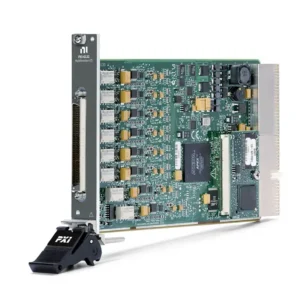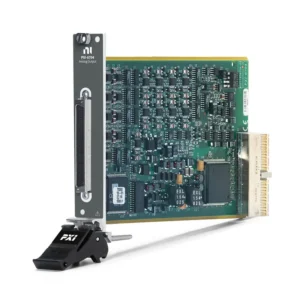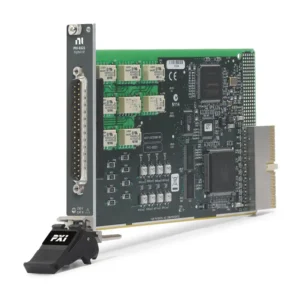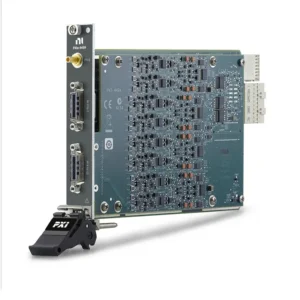


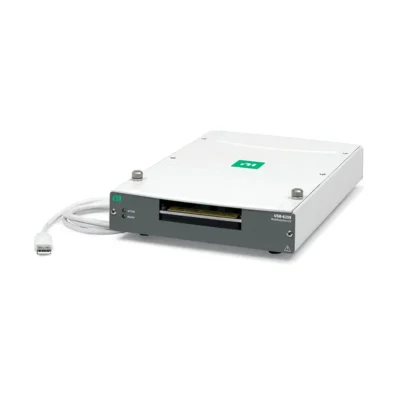
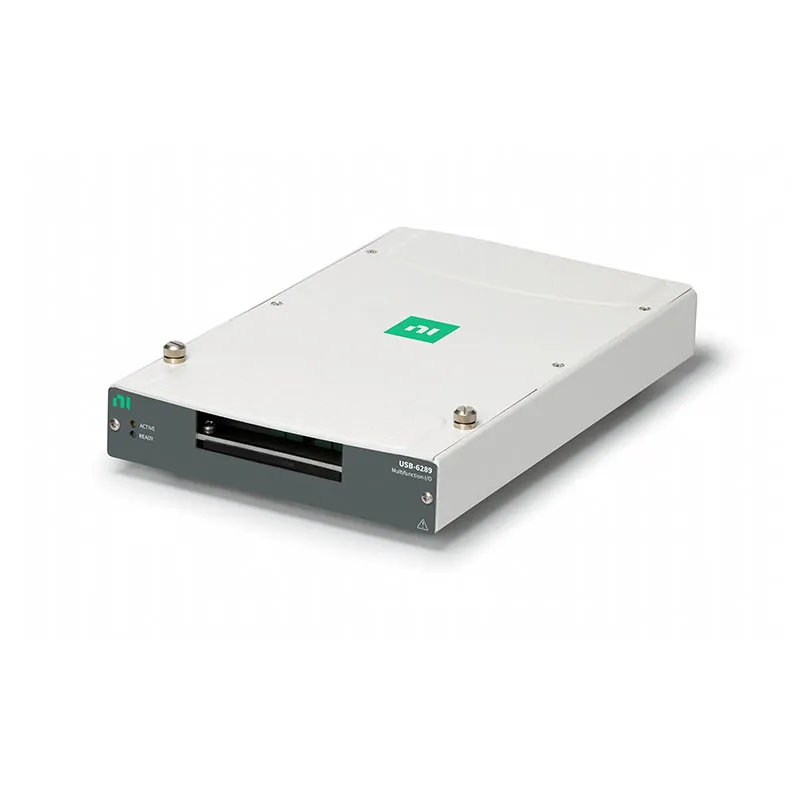
USB-6289 18-Bit Precision USB Multifunction DAQ
The NI USB-6289 is a high-accuracy M Series multifunction data acquisition device designed for precision voltage measurement, automated test and laboratory research. It combines 18-bit analog input resolution with analog output, digital I/O and counter/timer functions.
The USB-6289 provides 32 single-ended or 16 differential analog inputs. It supports a maximum single-channel rate of 625 kS/s and an aggregate multichannel rate of 500 kS/s.
Four 16-bit analog outputs, 48 programmable digital I/O lines and two 32-bit counters allow the device to perform precision acquisition and mixed-signal control from one USB interface.
Key Features of the USB-6289
- 32 single-ended or 16 differential analog inputs
- 18-bit analog input resolution
- 625 kS/s maximum single-channel sampling
- 500 kS/s aggregate multichannel sampling
- Seven programmable ranges from ±0.1 V to ±10 V
- 110 dB CMRR from DC to 60 Hz
- Selectable analog input filter
- 750 kHz bandwidth with filter disabled
- 40 kHz bandwidth with filter enabled
- Four 16-bit analog outputs
- 48 programmable digital I/O lines
- Hardware-timed correlated digital I/O
- Two 32-bit counters
- USB 2.0 Hi-Speed interface
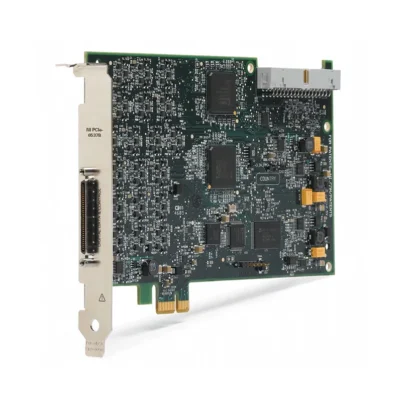
- Screw-terminal, mass-termination and OEM versions
- NI-DAQmx support
USB-6289 Technical Specifications
| Product Model | USB-6289 |
|---|---|
| Product Family | High-accuracy NI M Series multifunction DAQ |
| Analog Inputs | 32 single-ended or 16 differential |
| ADC Resolution | 18 bits |
| Single-Channel AI Rate | 625 kS/s maximum |
| Multichannel AI Rate | 500 kS/s aggregate |
| Input Ranges | ±0.1 V, ±0.2 V, ±0.5 V, ±1 V, ±2 V, ±5 V and ±10 V |
| CMRR | 110 dB from DC to 60 Hz |
| Input Bandwidth, Filter Off | 750 kHz |
| Input Bandwidth, Filter On | 40 kHz |
| Input FIFO | 2,047 samples |
| Analog Outputs | 4 |
| DAC Resolution | 16 bits |
| Analog Output Range | ±10 V |
| Maximum AO Rate | Up to approximately 2.86 MS/s, configuration dependent |
| Digital I/O | 48 individually programmable lines |
| Correlated Digital I/O | Up to 32 lines |
| Counters | 2 × 32-bit |
| USB Interface | USB 2.0 Hi-Speed |
| External Power | Required |
| Connector Options | Screw terminal, mass termination and OEM |
| Recommended Calibration Interval | 2 years |
USB-6289 Part Number and Accessories
The USB-6289 is available in several connector and integration formats. Verify the complete part number and connector type before selecting cables or terminal blocks.
| Configuration or Accessory | Description |
|---|---|
| USB-6289 Screw Terminal | Integrated wiring for precision measurement and control |
| USB-6289 Mass Termination | High-density fixture connection |
| USB-6289 OEM | Board-level integration into custom systems |
| SHC68-68-EPM Cable | Shielded 68-pin cable for compatible connections |
| SCB-68A Connector Block | Shielded screw-terminal signal access |
| External Power Supply | Required power for enclosed USB versions |
18-Bit Analog Input Resolution
The USB-6289 provides higher analog input resolution than the 16-bit USB-6259. The additional resolution helps distinguish smaller voltage changes when the complete measurement system is designed to control noise and grounding errors.
Resolution alone does not determine accuracy. Sensor quality, signal conditioning, cable shielding, calibration, input range and source impedance also affect measurement results.
Selectable Input Filter
An integrated filter can reduce broadband noise and unwanted higher-frequency signal content. With the filter enabled, the analog input bandwidth is approximately 40 kHz.
With the filter disabled, the input bandwidth increases to approximately 750 kHz. Select the filter state according to the signal bandwidth and accuracy requirements.
Precision Input Ranges
Seven input ranges extend down to ±0.1 V. Narrow ranges allow low-level signals to use more of the ADC range, improving effective sensitivity.
Always include expected sensor offset, common-mode voltage and transient amplitude when selecting a range. Overrange signals can clip even when their normal amplitude appears suitable.
Four Analog Outputs and 48 DIO
The USB-6289 retains the broad multifunction capability of the USB-6259. Four analog outputs can generate test stimulus, while 48 digital lines support fixture control and status monitoring.
Two counters add frequency, period, pulse, event and encoder measurement functions.
USB-6289 Applications
- Precision voltage measurement
- Sensor characterization
- Electronic component testing
- Research laboratory measurements
- Low-level signal acquisition
- Automated calibration systems
- High-accuracy production testing
- Analog stimulus and response testing
- Mixed-signal test fixtures
- Long-term measurement and logging
Precision Sensor Measurement
The 18-bit ADC and low-voltage ranges make the USB-6289 suitable for conditioned outputs from precision sensors. External excitation and conditioning are required for bridge, thermocouple and IEPE sensors unless they already produce compatible voltage signals.
Automated Calibration and Verification
The device can measure reference voltages, generate stimulus signals and control digital fixture functions. The complete system accuracy must include the USB-6289 specification, reference-source uncertainty, cable effects and calibration equipment.
USB-6289 Installation Workflow
Step 1: Determine Accuracy Requirements
Define the required voltage range, uncertainty, bandwidth and calibration interval before selecting the wiring configuration.
Step 2: Select the Connector Version
Choose screw terminals for direct wiring or mass termination for custom high-density fixtures.
Step 3: Install NI-DAQmx
Install a compatible driver and confirm support for the computer operating system.
Step 4: Connect External Power and USB
Apply the specified power supply and connect the device through a reliable USB 2.0 Hi-Speed port.
Step 5: Configure Input Mode and Filter
Select differential, RSE or NRSE wiring, choose the voltage range and enable or disable the filter according to signal bandwidth.
Step 6: Allow Warm-Up and Self-Calibrate
Allow the device and measurement system to reach stable temperature, then perform supported self-calibration before precision measurements.
Step 7: Validate Measurement Uncertainty
Compare representative channels with a traceable reference source and document the complete system uncertainty.
USB-6289 Troubleshooting
Measurements Are Not as Accurate as Expected
Check warm-up time, calibration status, input range, source impedance, grounding and environmental temperature.
The Signal Appears Attenuated
Check whether the 40 kHz input filter is enabled. Disable the filter if the required signal content exceeds its bandwidth.
The Measurement Is Too Noisy
Enable the input filter when appropriate, use differential wiring and shielded cables, and keep signal wiring away from switching power circuits.
The Requested Multichannel Rate Cannot Be Reached
The 625 kS/s rating applies to one channel. Multichannel acquisition is limited to 500 kS/s aggregate.
Low-Level Channels Show Settling Error
Reduce source impedance, increase conversion time or buffer the input signals.
USB-6289 Comparison
| Feature | USB-6259 | USB-6289 |
|---|---|---|
| Analog Input Resolution | 16 bits | 18 bits |
| Analog Inputs | 32 single-ended | 32 single-ended |
| Maximum Single-Channel Rate | 1.25 MS/s | 625 kS/s |
| Analog Outputs | 4 | 4 |
| Digital I/O | 48 | 48 |
| Selectable Input Filter | No equivalent precision filter | 40 kHz filter available |
| Primary Advantage | Higher acquisition speed | Higher analog input resolution and precision |
Choose the USB-6259 when sampling speed is the priority. Choose the USB-6289 for precision voltage measurement requiring 18-bit resolution, improved CMRR and selectable input filtering.
USB-6289 Frequently Asked Questions
What is the analog input resolution?
The USB-6289 provides 18-bit analog input resolution.
What is the maximum sampling rate?
It supports 625 kS/s on one channel and 500 kS/s aggregate during multichannel acquisition.
How many analog inputs are available?
The device provides 32 single-ended or 16 differential analog input channels.
Does the USB-6289 include an input filter?
Yes. The analog input path provides a selectable filter with approximately 40 kHz bandwidth.
How many analog outputs and digital lines are included?
It provides four 16-bit analog outputs and 48 programmable digital I/O lines.
Is it a simultaneous-sampling DAQ device?
No. The USB-6289 uses a multiplexed analog input architecture.
What is the recommended calibration interval?
NI specifies a recommended external calibration interval of two years.
Recommended Related Products
- USB-6251 High-Speed Multifunction DAQ
- USB-6255 High-Density Multifunction DAQ
- USB-6259 1.25 MS/s Multifunction DAQ
- PXI-6281 18-Bit Multifunction DAQ Module
Request a Quote for the USB-6289
Contact us for current availability, connector selection and project pricing for the NI USB-6289 18-bit precision multifunction DAQ device. We can also help identify compatible shielded cables, terminal blocks, power supplies and related NI data acquisition products.