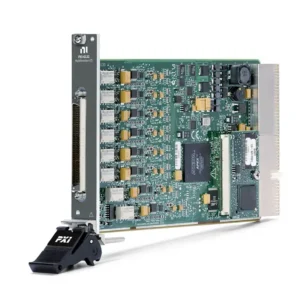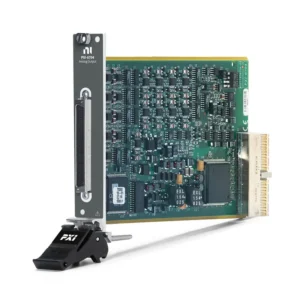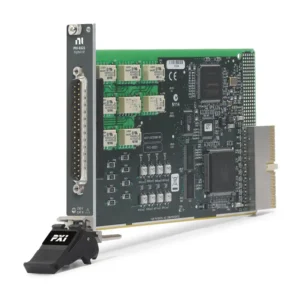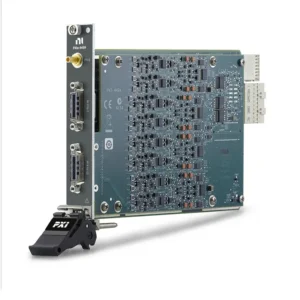


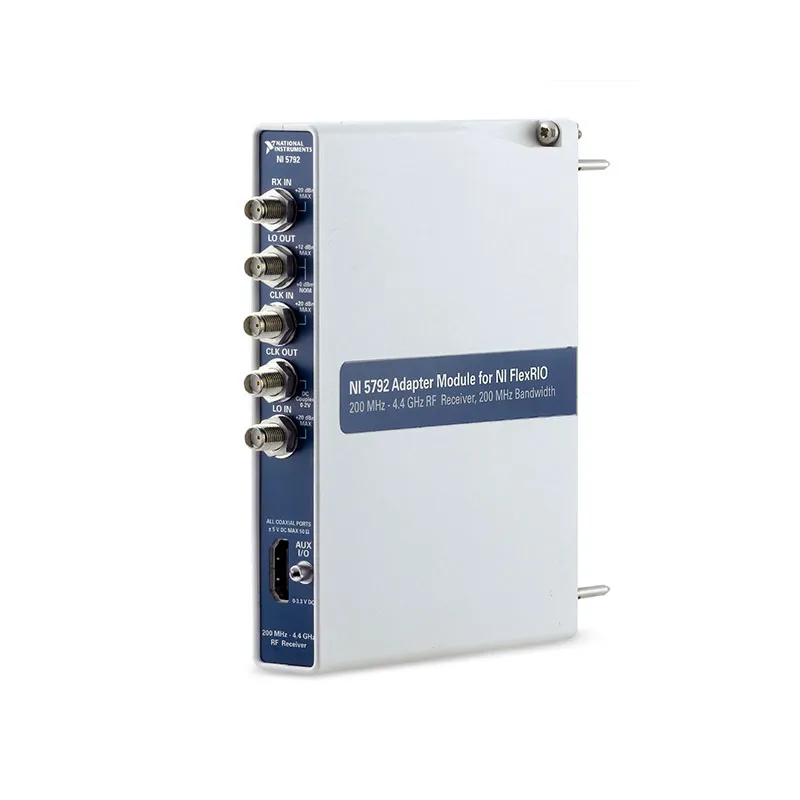
NI-5792 RF Receiver Adapter Module for FlexRIO
The NI-5792 is a wideband RF receiver adapter module designed for use with NI PXIe-796xR FlexRIO FPGA modules. It provides continuous RF-frequency coverage from 200 MHz to 4.4 GHz and instantaneous acquisition bandwidth up to 200 MHz.
The adapter uses a direct-conversion receiver architecture with dual 14-bit, 250 MS/s analog-to-digital conversion for the I and Q baseband paths. Its onboard synthesizer, programmable attenuation, selectable filters and local-oscillator connections support custom RF analysis and synchronized multichannel receiver systems.
Key Features of the NI-5792
- RF receiver adapter module for FlexRIO
- 200 MHz to 4.4 GHz continuous frequency coverage
- 200 MHz instantaneous bandwidth
- Direct-conversion receiver architecture
- Dual-channel 14-bit ADC
- 250 MS/s ADC sample rate
- Programmable RF attenuation
- Selectable receive filters
- Integrated local-oscillator synthesizer
- External LO input and LO output
- Front-panel clock input and output
- Auxiliary digital I/O connector
- FPGA-based real-time signal processing
- Compatible with NI PXIe-796xR FlexRIO modules
NI-5792 Technical Specifications
| Product Model | NI-5792 |
|---|---|
| Product Type | RF receiver adapter module for FlexRIO |
| RF Frequency Range | 200 MHz to 4.4 GHz |
| Instantaneous Bandwidth | 200 MHz |
| Receiver Architecture | Single-stage direct conversion |
| ADC Configuration | Dual-channel I/Q ADC |
| ADC Resolution | 14 bits |
| ADC Sample Rate | 250 MS/s |
| RF Input Connector | RX IN coaxial connector |
| Maximum RX Input Power | +20 dBm |
| Local Oscillator Connections | LO IN and LO OUT |
| Clock Connections | CLK IN and CLK OUT |
| Input Impedance | 50 Ω nominal |
| RF Control | Programmable attenuation and selectable filter bank |
| Compatible FPGA Modules | NI PXIe-796xR FlexRIO FPGA modules |
| Programming Environment | LabVIEW FPGA, NI-RIO and FlexRIO adapter support |
The NI-5792 is the receiver adapter only. The designation NI-5792R can refer to a complete system composed of an NI-5792 adapter and a compatible FlexRIO FPGA module.
NI-5792 Part Number and Accessories
| Item | Part Number | Description |
|---|---|---|
| NI-5792 | 782511-01 | 200 MHz to 4.4 GHz FlexRIO RF receiver adapter |
| PXIe-796xR FPGA Module | Model dependent | Required FPGA carrier for the NI-5792 |
| 50 Ω RF Cable | Frequency dependent | Connects the RX input to an antenna, fixture or DUT |
| LO Synchronization Cable | Configuration dependent | Connects the local oscillator between compatible RF adapters |
| Clock Cable | Configuration dependent | Provides external reference-clock or exported-clock connectivity |
| AUX I/O Cable | Configuration dependent | Provides access to auxiliary digital signals |
The AUX I/O connector may mechanically accept a standard HDMI-style cable, but it is not an HDMI multimedia interface. It must never be connected to a display, computer HDMI port or other conventional HDMI device.
Wideband Direct-Conversion Receiver
The direct-conversion architecture translates the selected RF channel directly into I and Q baseband data. This reduces the number of intermediate-frequency stages and provides wide instantaneous bandwidth in a compact FlexRIO adapter.
FPGA algorithms can combine the digitized I and Q data for spectrum analysis, channelization, demodulation, detection and custom signal classification.
200 MHz Instantaneous Bandwidth
The 200 MHz instantaneous bandwidth allows the receiver to capture wide communication channels, multiple narrowband signals or broadband transient activity without sweeping through the entire occupied spectrum.
Sustained host streaming of the full raw bandwidth may require careful FPGA decimation, DMA configuration and high-performance host storage.
Local-Oscillator Sharing
The LO IN and LO OUT connections allow compatible receiver and transmitter adapters to use a shared local oscillator. This is important when building phase-related or synchronized multichannel RF systems.
LO sharing alone does not automatically guarantee complete phase coherence. Clock distribution, calibration, cable delay and FPGA timing must also be addressed.
Programmable Attenuation and Filters
Programmable attenuation helps adapt the receiver to different input levels and protects measurement quality when stronger signals are present. Selectable filters help limit unwanted spectrum entering the direct-conversion signal chain.
NI-5792 Applications
- Software-defined radio receivers
- Wideband spectrum monitoring
- Wireless communication research
- Radar signal acquisition
- RF protocol development
- Custom modulation analysis
- Electronic warfare research
- RFID receiver development
- Multichannel and MIMO receiver systems
- Real-time RF signal classification
- Channelization and digital downconversion
- Closed-loop RF test systems
Wideband Spectrum Monitoring
The NI-5792 can acquire a broad section of spectrum for FPGA-based channel detection, triggering and real-time analysis. Selected signal information can then be transferred to the host for visualization or storage.
Software-Defined Radio
Custom demodulators, decoders and signal-processing algorithms can be implemented in LabVIEW FPGA. This makes the platform suitable for experimental protocols and research that cannot be addressed efficiently with a fixed-function receiver.
MIMO and Multichannel Reception
Multiple adapters can share local oscillator and timing resources to create expanded receiver systems. Channel-to-channel delay and phase should be measured and calibrated for coherent applications.
NI-5792 Installation Workflow
Step 1: Verify the FPGA Carrier
Confirm that the selected carrier belongs to the supported NI PXIe-796xR FlexRIO family.
Step 2: Install the Software
Install a mutually compatible version of LabVIEW, LabVIEW FPGA, NI-RIO and FlexRIO Adapter Module Support.
Step 3: Attach the Receiver Adapter
Power down the chassis and attach the NI-5792 to the FPGA carrier according to the FlexRIO installation procedure.
Step 4: Connect the RF Input
Use a suitable 50 Ω coaxial cable and confirm that the RF input does not exceed the +20 dBm absolute maximum rating.
Step 5: Configure Clocking and LO Operation
Select the internal or external clock and local-oscillator configuration required by the system.
Step 6: Configure the NI-5792 CLIP
Add the adapter to the FPGA project, select the correct CLIP and configure the required clock resources.
Step 7: Run a Known RF Test Signal
Apply a low-level signal at a known frequency and verify center frequency, amplitude and I/Q acquisition before testing the final DUT.
NI-5792 Troubleshooting
No RF signal is acquired
Check the center frequency, attenuation, filter selection and RX cable. Verify that the FPGA bitfile and NI-5792 configuration code have initialized the receiver.
The measured level is lower than expected
Review programmed attenuation and cable loss. Confirm that the selected filter covers the desired signal and that the source and receiver use 50 Ω impedance.
The spectrum contains an unexpected image or DC component
Perform the applicable I/Q correction and review direct-conversion receiver behavior. Check for LO leakage, DC offset and imbalance in the signal path.
Samples are lost during streaming
Reduce the transferred bandwidth with FPGA filtering or decimation. Increase DMA buffering and verify host PCI Express, processor and storage performance.
Multiple receivers are not phase aligned
Confirm shared LO and clock connections, equalize cable lengths and perform system-level phase calibration after initialization.
NI-5792 Comparison
| Model | RF Function | Best Suited For |
|---|---|---|
| NI-5792 | One RF receiver, 200 MHz to 4.4 GHz, 200 MHz bandwidth | Wideband RF acquisition and analysis |
| NI-5793 | One RF transmitter, 200 MHz to 4.4 GHz, 200 MHz bandwidth | Wideband RF signal generation |
| NI-5791 | One RF receiver and one transmitter | Integrated RF transceiver applications |
| NI-5781 | Dual-input and dual-output baseband adapter | Baseband processing with external RF conversion |
Recommended Related Products
- NI-5793 RF Transmitter Adapter
- NI-5791 RF Transceiver Adapter
- NI-5781 Baseband Transceiver Adapter
- PXIe-7966R FlexRIO FPGA Module
- View More NI FlexRIO and PXI Modules
Frequently Asked Questions
What is the NI-5792?
The NI-5792 is a wideband RF receiver adapter for supported PXIe-796xR FlexRIO FPGA modules.
What frequency range does it cover?
It provides continuous RF-frequency coverage from 200 MHz to 4.4 GHz.
What is its instantaneous bandwidth?
The NI-5792 supports instantaneous bandwidth up to 200 MHz.
Can it generate RF signals?
No. The NI-5792 is a receiver. The complementary NI-5793 provides RF transmission, while the NI-5791 combines receive and transmit functions.
Can several NI-5792 modules share an LO?
Yes. LO input and output connectors support local-oscillator sharing for synchronized multichannel applications.
Which FPGA modules are compatible?
The documented NI-5792 adapter is compatible with the NI PXIe-796xR FlexRIO FPGA family.
What is the NI-5792 part number?
The standard ordering part number is 782511-01.
Request a Quote for the NI-5792
Contact us for pricing and availability for the NI-5792 200 MHz to 4.4 GHz RF Receiver Adapter. We can also help identify the required FlexRIO FPGA module, RF cables and synchronization accessories.