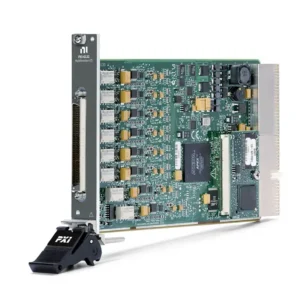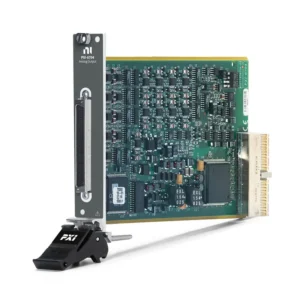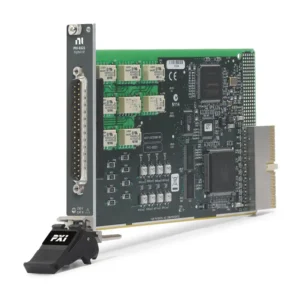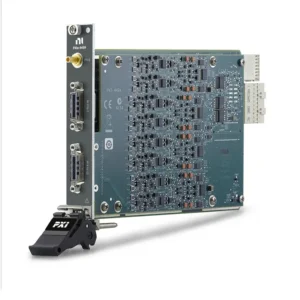


PXIe-5832 44 GHz mmWave Vector Signal Transceiver
The NI PXIe-5832 is a modular millimeter-wave vector signal transceiver system providing continuous RF generation and analysis from 22.5 GHz to 44 GHz with 1 GHz instantaneous bandwidth. It also supports intermediate-frequency operation from 5 GHz to 21 GHz.
The PXIe-5832 is designed for 5G NR FR2, mmWave semiconductor, phased-array, radar and front-end-module testing. It combines a vector signal analyzer, vector signal generator and FPGA-based real-time processing in a scalable PXI Express platform.
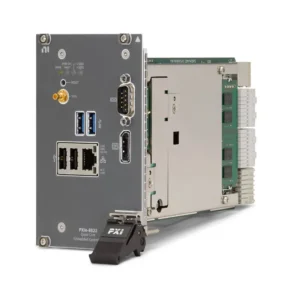
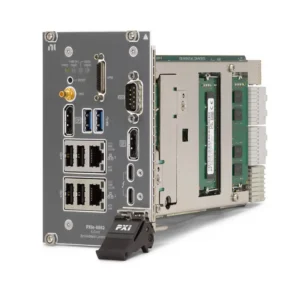
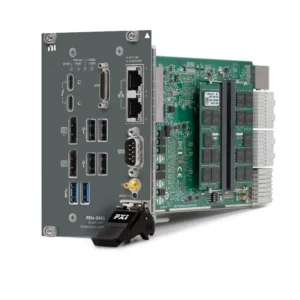
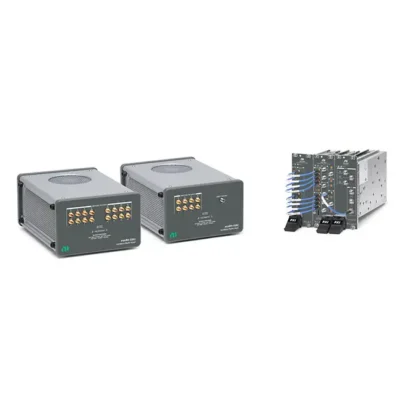
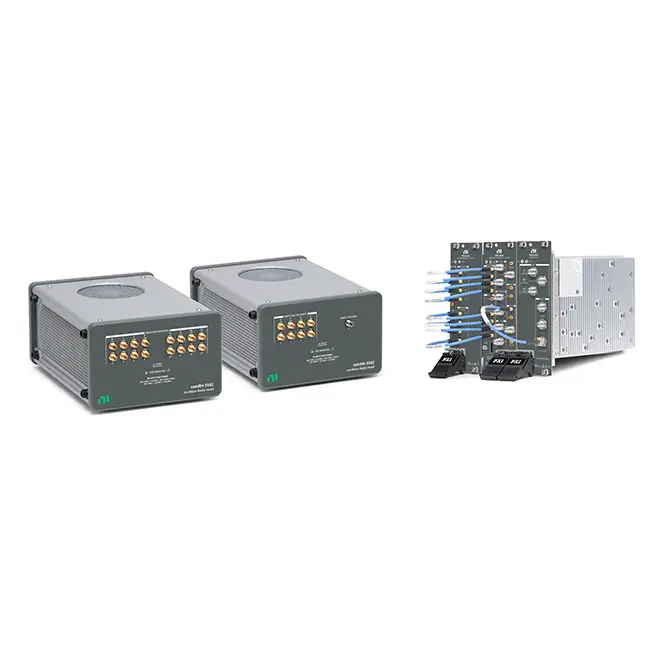
PXIe-5832 is a configured instrument name rather than the label of one individual module. A complete system contains multiple PXI Express modules, one or more mmRH-5582 radio heads and matched interconnect cables.
Key Features of the PXIe-5832
- Continuous 22.5 GHz to 44 GHz mmWave transmit coverage
- Continuous 22.5 GHz to 44 GHz mmWave receive coverage
- 5 GHz to 21 GHz intermediate-frequency operation
- 1 GHz instantaneous generation and acquisition bandwidth
- Integrated vector signal generation and analysis
- FPGA-based real-time signal processing
- Direct and switched TRX port configurations
- One-head and two-head architectures
- Peer-to-peer data streaming
- NI-RFSA, NI-RFSG and RFmx support
PXIe-5832 Technical Specifications
| Product Model | PXIe-5832 configured instrument system |
|---|---|
| Part Number | 787728-01 for the listed two-head configuration |
| Product Type | 44 GHz mmWave Vector Signal Transceiver |
| IF Frequency Range | 5 GHz to 21 GHz |
| mmWave Generator Range | 22.5 GHz to 44 GHz |
| mmWave Analyzer Range | 22.5 GHz to 44 GHz |
| Maximum Instantaneous Bandwidth | 1 GHz |
| Tuning Resolution | 4.45 µHz |
| Typical Generator Tuning Time | 40 µs, listed configuration |
| Typical Analyzer Tuning Time | 34 ms, listed configuration |
| Maximum Output Power | 11 dBm, listed configuration |
| Average Noise Level | -131 dBm/Hz |
| Core Baseband Module | PXIe-5820 |
| Upconverter and Downconverter | PXIe-3623 |
| Onboard mmWave LO Source | PXIe-5653 in applicable configurations |
| Radio Head | mmRH-5582 |
| Peer-to-Peer Streaming | Supported |
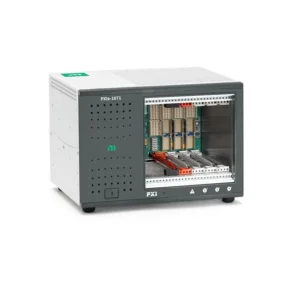
| System Width | Approximately six PXI Express slots for the listed configuration |
PXIe-5832 System Components
PXIe-5820 Vector Signal Transceiver
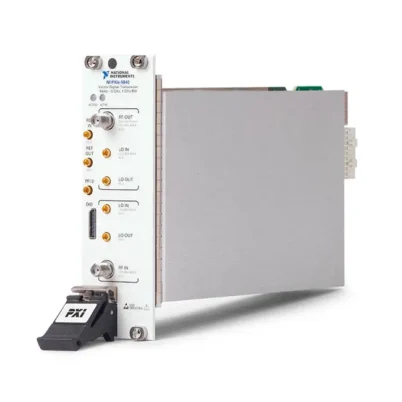
The PXIe-5820 provides high-speed I/Q generation and acquisition together with FPGA processing. It manages baseband waveforms and real-time data movement.
PXIe-3623 Upconverter and Downconverter
The PXIe-3623 provides two IF input and output ports covering 5 GHz to 21 GHz. It replaces the PXIe-3622 architecture used in the preceding PXIe-5831 generation and supports continuous mmWave conversion across the target bands.
PXIe-5653 Local-Oscillator Source
The PXIe-5653 supplies the high-quality local-oscillator signal for applicable mmWave configurations. LO sharing can be used to improve phase relationships between generation and analysis sessions.
mmRH-5582 Radio Head
The radio head converts between IF and 22.5 GHz to 44 GHz mmWave signals close to the DUT. Direct and switched port variants support different signal-integrity and test-density requirements.
Continuous 22.5 GHz to 44 GHz Coverage
A major advantage of the PXIe-5832 is continuous transmit and receive coverage from 22.5 GHz to 44 GHz. This removes the transmit gap associated with original PXIe-5831 specifications.
Continuous coverage simplifies test systems that must support several 5G FR2 bands or scan a wide mmWave frequency range without changing instruments.
1 GHz Instantaneous Bandwidth
The 1 GHz bandwidth supports wide 5G NR waveforms, broadband radar chirps, multi-carrier generation, spectrum measurements and high-speed RFIC characterization.
Offset mode can be configured to balance maximum bandwidth against residual image and LO-leakage performance. The default automatic mode selects an appropriate operating method according to the requested signal bandwidth.
Multiport mmWave Testing
Configured radio heads can provide multiple switched TRX ports, allowing a single PXIe-5832 to connect to multiple DUT paths. This can reduce external switching equipment and improve production-test density.
Direct ports should be considered when minimum insertion loss and the cleanest available RF path are the primary requirements.
5G NR FR2 Applications
The PXIe-5832 can generate and analyze FR2 waveforms across its continuous mmWave range. RFmx NR supports automated measurements including channel power, occupied bandwidth, ACLR, EVM and spectral emissions.
For over-the-air systems, the radio heads can be positioned close to antennas, probes or chamber feedthroughs to reduce high-frequency cable loss.
RFIC and Semiconductor Production Test
The PXI Express form factor combines fast software control, modular switching and high-throughput measurement. The system can be integrated with handlers, probers and automated test executives for wafer-level or packaged-device testing.
Multiport radio heads allow several DUT connections to share one VST while maintaining software-controlled routing.
Typical PXIe-5832 Applications
- 5G NR FR2 transmitter and receiver testing
- mmWave RFIC validation
- Front-end-module production testing
- Phased-array and beamformer characterization
- Over-the-air antenna testing
- Radar waveform generation and analysis
- Multi-site semiconductor testing
- Wideband spectrum analysis
- mmWave research and prototyping
Software Integration
NI-RFSA controls RF acquisition, while NI-RFSG controls waveform generation. RFmx provides general-purpose spectrum and standards-based analysis. InstrumentStudio can be used to verify system operation interactively.
Custom FPGA processing can implement low-latency triggering, inline measurements, digital control and reduced-data streaming.
Cooling and Calibration Requirements
The PXIe-5832 system requires compatible chassis cooling. NI specifies 82 W slot cooling for the component modules under published performance conditions.
Allow the system to warm up and perform self-calibration after thermal stabilization. Keep unused chassis slots fitted with appropriate slot blockers and EMC panels.
PXIe-5832 Troubleshooting
The configured PXIe-5832 is not recognized
Confirm that the PXIe-5820, PXIe-3623, PXIe-5653 and radio heads are detected. Inspect every I/Q, IF, LO and control cable.
The system fails self-test
Restart the chassis, confirm module detection, perform self-calibration and then repeat the self-test. Review the reported module or cable associated with the failure.
One radio-head port has no output
Verify the selected resource name and port number. Check whether the requested port is direct, switched or unavailable in the installed radio-head configuration.
Output power is lower than expected
Inspect high-frequency connectors, clean or replace damaged cables and verify the selected path. Repeat self-calibration after the required warm-up period.
Measurements are not repeatable
Check thermal stability, chassis cooling, external reference configuration, cable movement and calibration-plane placement.
PXIe-5832 vs PXIe-5831
| Feature | PXIe-5832 | PXIe-5831 |
|---|---|---|
| Maximum Frequency | 44 GHz | 44 GHz |
| Instantaneous Bandwidth | 1 GHz | 1 GHz |
| mmWave Transmit Range | Continuous 22.5 GHz to 44 GHz | Original specifications include a gap above 31.3 GHz to below 37 GHz |
| Conversion Module | PXIe-3623 | PXIe-3622 |
| Best Suited For | Continuous multi-band mmWave test | Existing PXIe-5831 systems |
Recommended Related Products
- PXIe-5831 mmWave Vector Signal Transceiver
- PXIe-5840 Wideband Vector Signal Transceiver
- PXIe-5841 Vector Signal Transceiver
- PXIe-5653 RF Analog Signal Generator
- View More NI PXI Express Modules
Frequently Asked Questions
What is the PXIe-5832?
The PXIe-5832 is a configured mmWave vector signal transceiver system providing generation and analysis to 44 GHz with 1 GHz bandwidth.
Is the PXIe-5832 one physical module?
No. It is assembled from several PXI Express modules, compatible radio heads and interconnect cables.
What is the standard listed part number?
NI lists 787728-01 for its documented two-head PXIe-5832 configuration.
What is the mmWave frequency range?
It provides continuous 22.5 GHz to 44 GHz transmit and receive coverage.
What is the IF frequency range?
The two IF input and output ports cover 5 GHz to 21 GHz.
Can it test 5G NR FR2 signals?
Yes. The 44 GHz range and 1 GHz bandwidth support wideband FR2 generation and analysis.
Does it require special cooling?
Yes. The system should be installed in a chassis satisfying NI’s 82 W slot-cooling requirement for applicable modules.
Request a Quote for the PXIe-5832
Contact us with the required radio-head quantity, direct or switched port topology and test frequency range for a complete PXIe-5832 mmWave VST quotation.