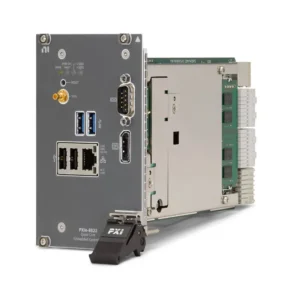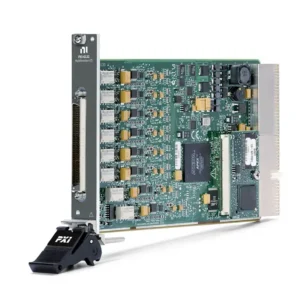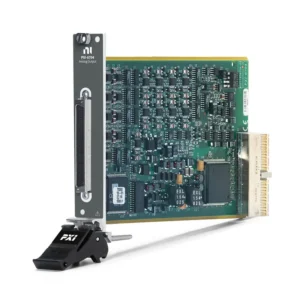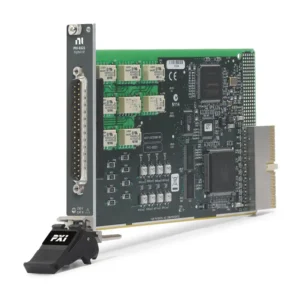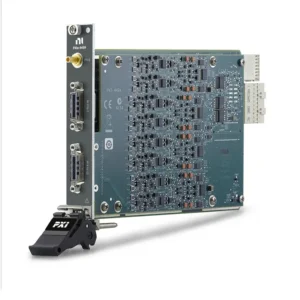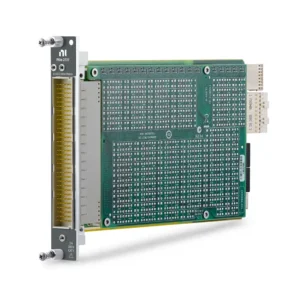


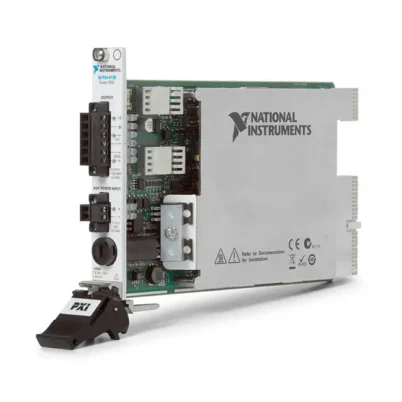
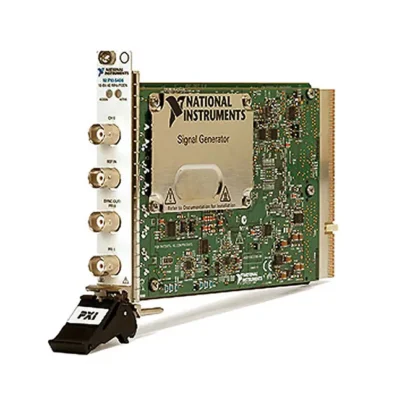
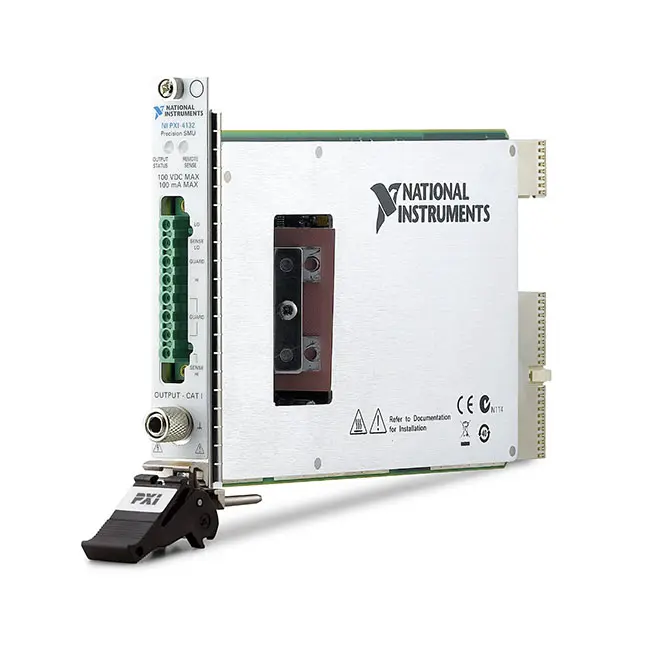
PXI-4132 ±100 V 10 pA Precision PXI Source Measure Unit
The PXI-4132 is a programmable, high-precision PXI source measure unit designed for semiconductor characterization, leakage-current measurement and automated current-voltage testing. It combines precision voltage and current sourcing with simultaneous voltage and current measurement in one isolated SMU channel.
The module provides four-quadrant operation with voltage capability up to ±100 V, current capability up to ±100 mA and continuous output power up to 2 W. Its lowest current measurement range provides 10 pA resolution for detecting small leakage currents in integrated circuits, discrete components, printed circuit boards and cables.
Remote four-wire sensing compensates for voltage drop in fixture wiring, while integrated guarding helps reduce leakage and settling errors during low-current measurements. An onboard sequencing engine and PXI hardware triggers support fast, repeatable I-V sweeps without software controlling every individual source step.
Key Features of the PXI-4132
- Single isolated precision SMU channel
- Four-quadrant voltage and current operation
- Maximum voltage capability of ±100 V
- Maximum current capability of ±100 mA
- 2 W continuous source or sink power
- 10 pA minimum current measurement resolution
- Voltage source and current source modes
- Simultaneous voltage and current measurement
- Five programmable current ranges
- ±10 V and ±100 V voltage ranges
- Remote four-wire sense connections
- Integrated external guard terminals
- Onboard hardware sequencing engine
- Up to 4,200 source updates per second
- Up to 3,490 measurements per second
- 500 ns nominal trigger-to-source delay
- PXI trigger-line synchronization
- NI-DCPower and InstrumentStudio support
PXI-4132 Technical Specifications
| Product Model | PXI-4132 |
|---|---|
| Part Number | 780558-01 |
| Product Type | Precision PXI source measure unit |
| Number of SMU Channels | 1 isolated channel |
| Operating Quadrants | Four-quadrant source and sink operation |
| Maximum Voltage | ±100 V |
| Voltage Ranges | ±10 V and ±100 V |
| Maximum Current | ±100 mA |
| Current Ranges | 10 µA, 100 µA, 1 mA, 10 mA and 100 mA |
| Maximum Continuous Power | 2 W in all four quadrants |
| Minimum Current Measurement Resolution | 10 pA on the 10 µA range |
| Current Measurement Resolutions | 10 pA, 100 pA, 1 nA, 10 nA and 100 nA |
| Current Programming Resolutions | 500 pA, 5 nA, 50 nA, 500 nA and 5 µA |
| Voltage Measurement Resolution | 10 µV on ±10 V range and 100 µV on ±100 V range |
| Voltage Programming Resolution | 50 µV on ±10 V range and 500 µV on ±100 V range |
| Remote Sense | Four-wire sensing supported |
| Guarding | Integrated external guard connection |
| Maximum Source Update Rate | 4,200 updates/s |
| Maximum Measure-to-Host Rate | 3,490 readings/s at 1/64 PLC and 60 Hz |
| Maximum Source-Measure-to-Host Rate | 1,900 operations/s at 1/64 PLC and 60 Hz |
| Trigger-to-Source Delay | 500 ns nominal |
| PXI Trigger Sources | PXI trigger lines 0 through 7 |
| Front-Panel Connector | 8-position, 5.08 mm COMBICON-style connector |
| Front-Panel Terminals | Output HI, Output LO, Sense HI, Sense LO and Guard |
| Module Format | 3U, single-slot PXI module |
| Weight | Approximately 295 g |
| Software Driver | NI-DCPower |
| Recommended Replacement | PXIe-4136 |
| Availability Status | Discontinued by NI |
PXI-4132 Part Number and Accessories
| Item | Part Number | Description |
|---|---|---|
| PXI-4132 | 780558-01 | Single-channel, ±100 V, 10 pA precision PXI source measure unit |
| PXI-4132 Connector and Backshell Kit | 781175-01 | 8-position screw-terminal connector and backshell for SMU output wiring |
| Low-Leakage Guarded Cable | Application dependent | Custom guarded cable for precision low-current measurements |
| Kelvin Test Leads | Application dependent | Four-wire force and sense connections for accurate DUT voltage regulation |
| Triaxial Fixture Adapter | Application dependent | Custom interface for guarded semiconductor and leakage-current fixtures |
| PXIe-4136 | Verify current configuration | NI-recommended ±200 V, ±1 A, 20 W PXI Express replacement |
The original PXI-4132 connector kit is discontinued. When purchasing a used module, verify that the 8-position terminal connector and backshell are included or available separately.
Low-current accuracy depends heavily on cables, connectors, insulation cleanliness and fixture design. Use suitable low-leakage materials and guarded wiring when measuring nanoampere or picoampere signals.
Source Measure Unit Architecture
A source measure unit combines a programmable voltage source, current source, voltmeter and ammeter in one tightly integrated instrument. It sources either voltage or current while simultaneously measuring both electrical quantities.
When operating as a voltage source, the PXI-4132 regulates the programmed voltage and limits current to protect the device under test. In current-source mode, it regulates current while enforcing a voltage limit.
This architecture supports direct I-V characterization without requiring separate power supplies, digital multimeters and switching arrangements for every measurement point.
Four-Quadrant Operation
The PXI-4132 operates in all four quadrants of the current-voltage plane. It can source or sink current at either positive or negative voltage.
Four-quadrant capability enables testing of devices that both consume and return energy, including batteries, capacitive devices, photovoltaic cells and active semiconductor circuits.
The maximum voltage and current ratings cannot be used simultaneously. Output combinations must remain within the module’s 2 W four-quadrant operating boundary.
Understanding the 2 W I-V Boundary
The PXI-4132 can reach ±100 V under lower-current conditions and ±100 mA at lower voltage. It cannot produce 100 V and 100 mA simultaneously because that would require 10 W.
At 100 V, the 2 W limit corresponds to approximately 20 mA. At 100 mA, the voltage must remain within the applicable low-voltage portion of the official I-V boundary.
Always compare the complete DUT voltage-current requirement with the quadrant diagram rather than evaluating the maximum voltage and current specifications independently.
±100 V Voltage Capability
The module provides ±10 V and ±100 V source and measurement ranges. The higher range supports devices requiring elevated bias voltage, while the lower range provides finer programming and measurement resolution.
High-voltage applications require suitable insulation, test fixtures and operating procedures. The output should be disabled and discharged before changing DUT connections.
Five Current Ranges
The PXI-4132 provides 10 µA, 100 µA, 1 mA, 10 mA and 100 mA current ranges. Selecting the smallest range that accommodates the expected DUT current improves measurement resolution.
The autorange function can simplify measurements spanning several current decades, but range changes may add time or create transient effects. Fixed ranges can provide more consistent timing during high-speed sweeps.
10 pA Current Measurement Resolution
On its 10 µA current range, the PXI-4132 provides measurement resolution down to 10 pA. This is useful for leakage testing, insulation evaluation and low-current semiconductor measurements.
Measurement resolution does not mean every 10 pA change can be resolved under all conditions. Noise, aperture time, fixture leakage, humidity and electromagnetic interference affect the usable sensitivity.
Increasing the measurement aperture and using averaging can reduce noise, although it also increases the time required for each reading.
Remote Four-Wire Sensing
Remote sensing uses separate force and sense conductors. Output HI and LO carry the DUT current, while Sense HI and Sense LO measure voltage directly at the DUT terminals.
The SMU adjusts its output to compensate for voltage drop in the force leads. This improves voltage accuracy when testing low-resistance devices, using long cables or sourcing higher current.
The sense leads carry very little current and should be connected as close as possible to the DUT. Incorrect remote-sense wiring can cause unstable regulation or an output-voltage error.
Two-Wire Connections
For applications where lead resistance is insignificant, the sense terminals can be connected locally to their corresponding output terminals. This creates a conventional two-wire connection.
Two-wire operation simplifies fixtures but includes cable and contact voltage drops in the DUT voltage. Four-wire operation is preferable when those drops are significant relative to the required accuracy.
External Guarding
The guard terminal is driven to approximately the same electrical potential as the sensitive measurement node. This reduces voltage across cable insulation and fixture surfaces, thereby reducing leakage current into the measurement path.
Guarding is important when measuring nanoampere or picoampere currents. A conventional cable or contaminated connector can leak more current than the DUT being measured.
The guard is not a protective earth connection and should not be treated as a normal output terminal. Follow the official wiring diagram when constructing a guarded cable or test fixture.
Low-Leakage Fixture Design
Use clean, dry, high-resistance insulation materials such as PTFE where practical. Avoid touching sensitive insulators because skin oils and moisture can create leakage paths.
Keep sensitive nodes short and shielded. Route them away from digital signals, mains wiring, fans and high-voltage switching circuits.
Allow the system to settle after changing voltage, current range or fixture connections. Cable capacitance and dielectric absorption can create long transient currents.
Onboard Hardware Sequencing
The PXI-4132 includes an onboard sequencing engine that can execute a list of source levels without requiring a host-software command for every step.
Each sequence step can configure a voltage or current level, apply a delay, perform a measurement and generate an event. A sequence can repeat for a selected number of iterations.
Hardware sequencing reduces communication overhead and improves the timing repeatability of I-V sweeps.
4,200 Source Updates per Second
The module supports a maximum source update rate of 4,200 updates per second under the specified test conditions. The actual DUT voltage or current may require additional time to settle.
Capacitive loads, long cables, large level changes and low-current ranges can increase settling time. A shorter programmed source delay does not guarantee that the output has reached its final value.
High-Speed Measurement Rates
With an aperture of 1/64 power-line cycle and auto zero disabled, the PXI-4132 can transfer up to approximately 3,490 measurements per second to the host in a 60 Hz system.
A combined source-measure sequence can achieve up to approximately 1,900 operations per second under the specified conditions. Slower aperture settings improve noise rejection but reduce throughput.
Power-Line-Cycle Aperture
Measurement aperture can be expressed in power-line cycles. An aperture of one power-line cycle integrates over one complete 50 Hz or 60 Hz period and improves rejection of line-frequency interference.
Short apertures provide faster measurements but higher noise. The appropriate setting depends on whether throughput or low-current precision is the primary requirement.
PXI Hardware Triggering
The PXI-4132 can receive Start, Source, Sequence Advance and Measure triggers through PXI trigger lines 0 through 7.
It can generate Source Complete, Sequence Iteration Complete, Sequence Engine Done and Measure Complete events. These events can coordinate the SMU with switches, digital multimeters and other modular instruments.
The nominal delay from an input trigger to a source operation is 500 ns, excluding output settling time.
Multiple-SMU Synchronization
Several PXI-4132 modules can be synchronized through the PXI backplane for testing multi-terminal devices such as transistors and integrated circuits.
One module can advance a sequence or generate an event that triggers measurements on other SMUs. This reduces external wiring and improves channel-to-channel coordination.
Diode I-V Characterization
The PXI-4132 can sweep voltage across a diode while measuring current at every point. Current limiting protects the device if the forward current rises more quickly than expected.
Reverse-bias leakage can be measured using the low-current ranges, while the ±100 V capability supports higher reverse-voltage testing within the module’s power boundary.
LED and OLED Testing
The module can source current to an LED or OLED and measure the corresponding forward voltage. A current sweep can characterize turn-on behavior and series resistance.
Optical instruments can be synchronized with the SMU to measure brightness, color or spectral response at each electrical operating point.
Semiconductor Leakage Testing
The 10 pA measurement resolution and guard connection make the PXI-4132 suitable for leakage-current testing of semiconductor devices, connectors, cables and printed circuit boards.
For accurate results, the test fixture must have lower leakage than the measurement requirement. Stabilize temperature and humidity when environmental changes significantly affect DUT current.
NI-DCPower Software Support
The PXI-4132 is controlled through the NI-DCPower instrument driver. NI-DCPower provides functions for source configuration, measurement, limits, sequencing, triggering and status monitoring.
The driver supports LabVIEW, LabWindows/CVI and compatible text-based programming environments. IVI-compliant interfaces help integrate the SMU into automated test software.
InstrumentStudio Integration
InstrumentStudio can be used for interactive voltage and current sourcing and measurement. It helps engineers verify wiring, configure ranges and observe DUT behavior before developing automated code.
InstrumentStudio is also useful for troubleshooting compliance conditions, unexpected current flow and fixture connection errors.
Typical PXI-4132 Applications
- Semiconductor I-V characterization
- Diode forward and reverse testing
- LED and OLED electrical testing
- Integrated-circuit leakage measurement
- PCB insulation and leakage testing
- Cable and connector leakage measurement
- Transistor characterization with multiple SMUs
- Photovoltaic cell testing
- Sensor excitation and measurement
- Automated production parametric testing
- Research and device characterization
- High-resistance component testing
PXI-4132 Troubleshooting
The module is not detected in NI MAX
Confirm that the PXI-4132 is fully installed in a compatible PXI slot. Check chassis power, controller communication and NI-DCPower installation, then restart the system.
The output immediately enters current limit
Check the DUT resistance, output polarity and current-limit setting. Inspect the fixture for a short circuit and verify that the programmed voltage-current combination lies within the SMU’s 2 W boundary.
The module cannot output 100 V at 100 mA
The maximum voltage and maximum current cannot be used simultaneously. The PXI-4132 is limited to 2 W, so the permitted current at 100 V is substantially lower than 100 mA.
The measured voltage is lower than expected
Check whether force-lead resistance is creating a voltage drop. Use four-wire remote sensing and connect the sense terminals directly at the DUT.
The output becomes unstable with remote sense
Verify Sense HI and Sense LO polarity and continuity. Keep sense wiring close to the corresponding force conductors and confirm that no sense lead is open.
Leakage-current readings are too high
Clean and dry the fixture, cables and connectors. Use guarded low-leakage wiring, increase settling time and check whether humidity or cable insulation is contributing current.
Readings are noisy on the 10 µA range
Increase the aperture time, enable auto zero where suitable and apply averaging. Reduce vibration and electrical interference and allow the fixture capacitance to settle.
The current does not fall to zero when output is disabled
When disabled normally, the module regulates near 0 V with an applicable current limit. Set the output-connected property to false when a complete relay disconnection from the DUT is required.
A sequence runs more slowly than expected
Review the source delay, measurement aperture, auto-zero setting and load-dependent settling time. The specified update rate does not include every DUT and fixture settling requirement.
PXI-4132 Comparison with Similar SMUs
| Model | Primary Configuration | Best Suited For |
|---|---|---|
| PXI-4130 | Higher-power dual-channel PXI SMU and power supply | Applications prioritizing DC power |
| PXI-4132 | ±100 V, ±100 mA, 2 W, 10 pA resolution | Precision leakage and low-current I-V testing |
| PXIe-4136 | ±200 V, ±1 A DC, 20 W, 1 pA sensitivity | Modern high-voltage and higher-power precision testing |
| PXIe-4137 | ±200 V, ±1 A DC, 20 W precision SMU | High-accuracy system SMU applications |
| PXIe-4141 | Four channels, ±10 V, ±100 mA | High-density low-power semiconductor testing |
PXI-4132 vs PXI-4130
The PXI-4132 emphasizes high voltage and low-current precision, providing ±100 V and measurement resolution down to 10 pA. The PXI-4130 provides greater power for applications requiring substantially higher current.
Choose the PXI-4132 for leakage testing and precision I-V characterization. Select the PXI-4130 when powering the DUT is more important than picoampere-level resolution.
PXI-4132 vs PXIe-4136
NI recommends the PXIe-4136 as the modern replacement for the PXI-4132. The PXIe-4136 provides up to ±200 V, ±1 A continuous current, 20 W DC power and 1 pA current sensitivity.
The PXIe-4136 also provides much higher sampling and update performance. It is preferable for new systems, while the PXI-4132 remains useful for maintaining validated legacy PXI test platforms.
PXI-4132 vs PXIe-4141
The PXI-4132 provides one precision channel with ±100 V capability. The PXIe-4141 provides four lower-voltage SMU channels in one PXI Express module.
Choose the PXI-4132 for higher-voltage or guarded low-current measurements. Select the PXIe-4141 when channel density is more important and the DUT operates within its lower voltage and power limits.
Recommended Related Products
- PXI-4130 Power Source Measure Unit
- PXIe-4136 Precision System Source Measure Unit
- PXIe-4137 Precision System Source Measure Unit
- PXIe-4139 High-Current Precision SMU
- PXIe-4141 4-Channel Source Measure Unit
- View More NI PXI and PXI Express Modules
Selecting the Right PXI Source Measure Unit
Choose the PXI-4132 when an existing system requires ±100 V operation, current measurement down to 10 pA, remote four-wire sense and external guarding.
Select the PXIe-4136 or PXIe-4137 for modern high-voltage systems requiring more power and speed. Consider a PXIe-414x module when several lower-power SMU channels are needed in a compact PXI system.
Why Choose the PXI-4132?
- Provides four-quadrant source and sink operation
- Supports voltages up to ±100 V
- Supports currents up to ±100 mA
- Measures current with resolution down to 10 pA
- Includes remote four-wire sensing
- Provides integrated guarding for low-current fixtures
- Supports hardware-timed source-measure sequences
- Synchronizes through the PXI trigger bus
- Integrates with NI-DCPower and InstrumentStudio
- Supports precision semiconductor and leakage testing
Frequently Asked Questions
What is the PXI-4132?
The PXI-4132 is a single-channel, four-quadrant precision PXI source measure unit that can source and measure both voltage and current.
What is the PXI-4132 part number?
The standard NI part number for the PXI-4132 is 780558-01.
What is the maximum output voltage?
The maximum voltage capability is ±100 V. The voltage-current combination must remain within the module’s 2 W operating boundary.
What is the maximum current?
The maximum current capability is ±100 mA at lower output voltages. The module cannot provide 100 mA while simultaneously sourcing 100 V.
What is the lowest current measurement resolution?
The lowest specified current measurement resolution is 10 pA on the 10 µA range.
Does the PXI-4132 support four-wire measurements?
Yes. Separate Output HI/LO and Sense HI/LO terminals provide remote Kelvin sensing at the DUT.
What is the guard terminal used for?
The guard reduces leakage through cable insulation and fixture surfaces by surrounding the sensitive measurement node with a conductor at a similar potential.
Does the PXI-4132 support hardware sequencing?
Yes. Its onboard sequencing engine can execute source and measurement steps and exchange events with other PXI instruments.
Which connector accessory is compatible?
The PXI-4132 connector and backshell kit is part number 781175-01. This accessory is discontinued, so availability should be confirmed when purchasing the module.
Which software controls the PXI-4132?
The module is controlled through NI-DCPower and can be operated interactively with InstrumentStudio or programmed from LabVIEW and compatible environments.
What is the recommended replacement?
NI recommends the PXIe-4136 for new systems requiring greater voltage, current, power, speed and low-current sensitivity.
Request a Quote for the PXI-4132
Contact us for current availability, condition, lead time and project pricing for the PXI-4132 ±100 V 10 pA Precision PXI Source Measure Unit. We can also help identify compatible connector kits, guarded fixtures, PXI chassis and modern replacement SMUs.