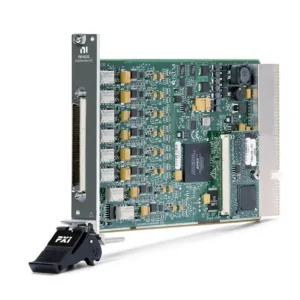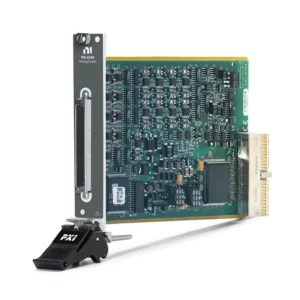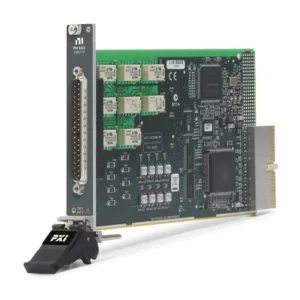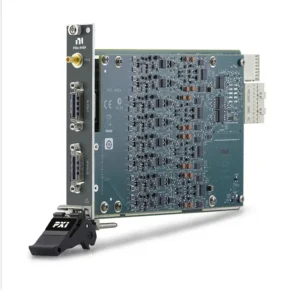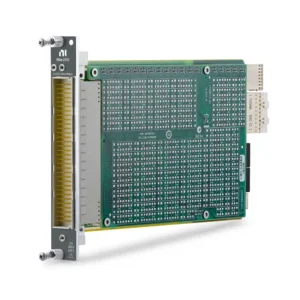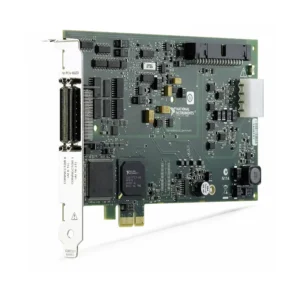





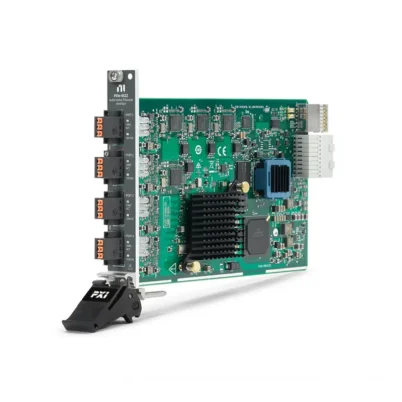
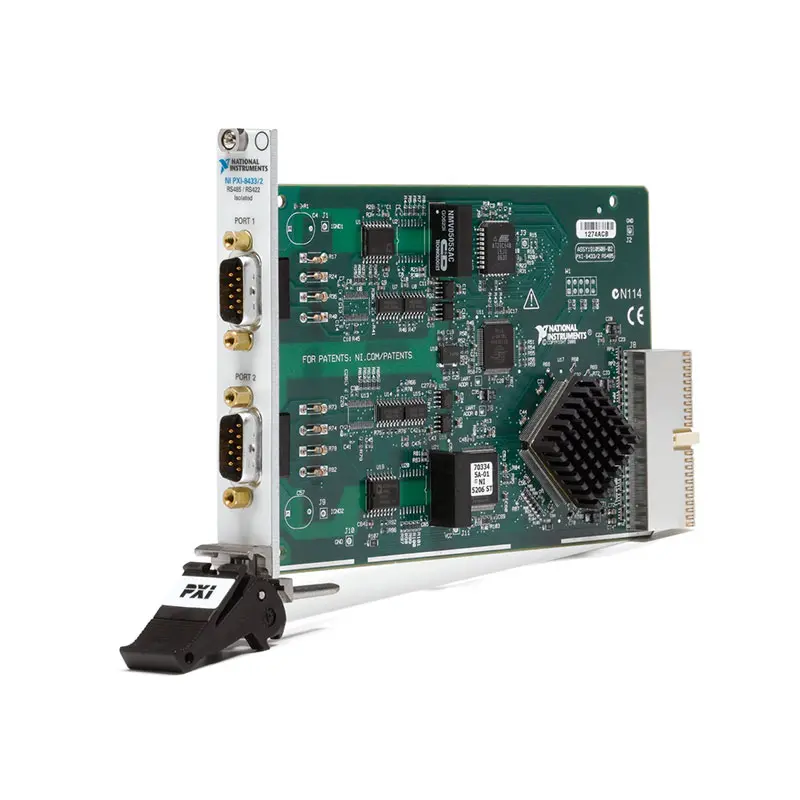
PXI-8433/2 2-Port Isolated RS-485/RS-422 PXI Serial Module
The PXI-8433/2 is a two-port isolated PXI serial interface module designed for high-speed communication with industrial instruments, controllers and embedded systems using RS-485 or RS-422 connections.
Each port supports data rates up to 3 Mbps, selectable two-wire or four-wire transceiver operation and independent port isolation. High-performance DMA transfers, 128-byte hardware FIFOs and standard COM-port compatibility help the module provide reliable communication in automated test, industrial control and hardware-in-the-loop systems.
The PXI-8433/2 is especially useful when connected devices operate from different ground references or are installed in electrically noisy environments. Its isolated architecture helps reduce ground-loop problems and limits unwanted electrical interaction between the PXI controller and external equipment.
Key Features of the PXI-8433/2
- Two independent RS-485/RS-422 serial ports
- Port-to-port and port-to-system isolation
- Maximum data rate of 3 Mbps per port
- Custom baud rates from 2 baud to 3 Mbps
- Selectable two-wire and four-wire operation
- Half-duplex and full-duplex communication
- Automatic transceiver control for two-wire RS-485
- 128-byte hardware FIFO per serial interface
- High-performance DMA data transfers
- Two male DB-9 front-panel connectors
- Multithreaded and multiprocessor support
- Standard operating-system COM-port compatibility
- NI-Serial and NI-VISA software support
- LabVIEW and LabVIEW Real-Time integration
- Single-slot 3U PXI module
PXI-8433/2 Technical Specifications
| Product Model | PXI-8433/2 |
|---|---|
| Part Number | 779744-01 |
| Product Type | Isolated PXI serial interface module |
| Supported Serial Standards | RS-485 and RS-422 |
| Number of Serial Ports | 2 |
| Isolation Type | Port-to-port and port-to-system isolation |
| Maximum Baud Rate | 3 Mbps |
| Programmable Baud-Rate Range | 2 baud to 3 Mbps |
| Two-Wire Automatic Control Limit | Up to 2 Mbps |
| Transceiver Modes | Two-wire and four-wire |
| Communication Modes | Half duplex and full duplex |
| FIFO Size | 128 bytes |
| Data Transfer Architecture | DMA |
| Front-Panel Connectors | 2 × DB-9 male |
| Software Interface | Standard COM ports, NI-Serial and NI-VISA |
| Module Format | 3U, single-slot PXI module |
| Bus Interface | PXI hybrid compatible |
| Availability Status | Discontinued by NI |
PXI-8433/2 Part Number and Accessories
| Item | Part Number | Description |
|---|---|---|
| PXI-8433/2 | 779744-01 | Two-port isolated RS-485/RS-422 PXI serial interface module |
| RS-485/RS-422 DB-9 Cable | Application dependent | Shielded twisted-pair cable wired for the required two-wire or four-wire interface |
| DB-9 Terminal Adapter | Application dependent | Provides accessible screw terminals for custom RS-485 or RS-422 wiring |
| RS-485 Termination Network | Application dependent | External termination and bias components selected for the network design |
| PCIe-8433/2 | 781745-01 | Active PCI Express alternative for two-port isolated RS-485/RS-422 communication |
The PXI-8433/2 uses two male DB-9 connectors directly on its front panel. Before connecting a cable or terminal adapter, verify the NI pin assignment and the wiring required by the external device.
RS-485 and RS-422 equipment does not always use a standardized DB-9 pinout. Matching connector types do not guarantee electrical or wiring compatibility.
Two Independent Isolated Serial Ports
The PXI-8433/2 provides two independently configurable serial ports. Each port can communicate with a separate device or RS-485 network using its own baud rate, framing and transceiver configuration.
Port isolation allows the interfaces to operate with different external ground references. This is valuable when two connected instruments receive power from separate electrical systems or are installed at different locations within an industrial facility.
Because the ports are independently isolated, a ground-related disturbance on one external connection is less likely to affect the other serial interface or the PXI system.
RS-485 and RS-422 Communication
RS-485 and RS-422 use differential signaling to improve noise immunity and support longer communication distances than conventional single-ended serial standards. They are commonly found in industrial automation, process control, motion systems and environmental test equipment.
RS-422 is typically used for full-duplex point-to-point or multidrop communication. RS-485 supports bidirectional multidrop networks in which several addressed devices share a common differential bus.
The PXI-8433/2 provides the physical serial interface but does not define the application-level protocol. It can be used with Modbus RTU and other compatible standard or proprietary protocols implemented in software.
Port-to-Port Isolation
Port-to-port isolation electrically separates the two external serial interfaces. Each port can therefore communicate with equipment using a different local ground reference without directly joining the ground systems through the PXI module.
This isolation is beneficial in factory automation, power-system testing and distributed equipment installations where ground loops can introduce communication errors, unwanted current or electrical noise.
Isolation does not remove the need for proper cable shielding, grounding, surge protection and safe fixture construction. Always operate the ports within the isolation and common-mode ratings defined by the official hardware specifications.
Port-to-System Isolation
The serial ports are also isolated from the PXI system. This provides an electrical barrier between external RS-485/RS-422 wiring and the chassis controller.
Port-to-system isolation helps protect the host system from ground differences and common-mode disturbances encountered on industrial communication lines. It is particularly valuable when test fixtures frequently connect to different devices under test.
Two-Wire Half-Duplex Operation
In two-wire RS-485 mode, transmitted and received data share one differential pair. Every device must release the bus after transmitting so another node can respond.
The PXI-8433/2 supports automatic transceiver control, allowing the hardware and driver to control the transmit-enable state. This reduces the need for application software to manually switch between transmission and reception.
The specified maximum baud rate for the automatic two-wire control mode is 2 Mbps. For applications operating at higher speeds, verify the required direction-control method and timing with the official NI documentation.
Four-Wire Full-Duplex Operation
Four-wire mode uses separate differential pairs for transmitting and receiving. This permits simultaneous bidirectional communication and is suitable for RS-422 links and four-wire RS-485 systems.
When wiring a full-duplex connection, connect the transmitting pair of one device to the receiving pair of the other. Confirm positive and negative signal polarity for both differential pairs.
3 Mbps Maximum Baud Rate
Each PXI-8433/2 port supports communication speeds up to 3 Mbps. The interface can also generate custom data rates between 2 baud and its maximum supported rate.
This flexible baud-rate generation allows the module to communicate with standard industrial devices and equipment using uncommon or application-specific serial speeds.
Maximum practical cable distance depends on baud rate, cable impedance, conductor capacitance, termination, stub length and electrical noise. Higher speeds generally require shorter cables and more carefully controlled network topology.
128-Byte Hardware FIFOs
Each serial interface provides 128-byte hardware buffering. The FIFOs temporarily store transmitted and received characters, reducing how frequently the host processor must service the serial hardware.
Hardware buffering helps maintain reliable communication when both ports operate simultaneously or when the operating system experiences short scheduling delays. Software should still read received data frequently and allocate buffers appropriate for the expected traffic rate.
High-Performance DMA Transfers
The PXI-8433/2 uses direct memory access to transfer data efficiently between the serial interface and host memory. DMA reduces processor involvement compared with handling every transmitted or received byte individually.
This architecture is useful in automated systems that combine continuous serial communication with measurement, control and data-processing tasks. Actual throughput also depends on message size, driver configuration, application structure and remote-device response time.
Standard COM-Port Compatibility
With a compatible NI-Serial driver installed, the two interfaces appear as standard operating-system COM ports. Existing applications can access them using conventional serial communication functions.
Software must configure the correct COM port, baud rate, data bits, stop bits, parity and RS-485 transceiver mode. Communication errors commonly occur when only one of these parameters differs from the remote-device configuration.
NI-Serial and NI-VISA Support
NI-Serial provides the required device driver and configuration support for the PXI-8433/2. NI-VISA offers a common programming API for opening serial resources, setting communication parameters and transferring messages.
The module can be integrated with LabVIEW, LabWindows/CVI and compatible text-based programming environments. Existing applications written for standard COM ports can also use the interface when supported by the operating system and driver.
Because the PXI-8433/2 is discontinued, confirm compatibility between the module, PXI controller, operating system and NI-Serial version before deploying it in a new system.
LabVIEW Real-Time Integration
Applicable versions of NI-Serial for LabVIEW Real-Time support the PXI-8433/2. A compatible PXI real-time controller can use the isolated serial ports while executing automated test or control applications.
Real-time execution can improve the consistency of host-side processing, but the response timing of an asynchronous serial network still depends on the protocol, connected devices and bus access method.
RS-485 Network Termination
A properly designed RS-485 network normally uses termination at the two physical ends of the main cable. The termination resistance should match the characteristic impedance of the twisted-pair cable.
Avoid installing termination at every device because excessive parallel loading can reduce the differential signal amplitude. Branch stubs should also be kept short, especially when operating at high baud rates.
Bias resistors may be required to establish a defined idle state when no transceiver is enabled. Their values must be selected together with the termination resistance and loading of the connected devices.
Typical PXI-8433/2 Applications
- Isolated industrial RS-485 communication
- RS-422 instrument control
- Modbus RTU networks
- Factory automation systems
- Environmental chamber control
- Motor-drive and motion-controller testing
- Programmable power-supply communication
- Embedded controller validation
- Hardware-in-the-loop testing
- Production functional testing
- Distributed monitoring systems
- Communication across different ground domains
Industrial Automation
The PXI-8433/2 can communicate with programmable controllers, variable-frequency drives, motion controllers, remote I/O and process-control equipment using isolated RS-485 or RS-422 connections.
Isolation is particularly useful when industrial equipment is located near motors, contactors and power converters that produce electrical noise and ground disturbances.
Automated Test Equipment
In automated test systems, one port can control a device under test while the second communicates with an environmental chamber, power supply or other supporting instrument.
The serial module can operate alongside PXI digitizers, digital multimeters, data acquisition modules and programmable power instruments to create a unified test platform.
Modbus RTU Communication
The PXI-8433/2 can provide the RS-485 physical interface for Modbus RTU communication. Application software must implement the Modbus master or slave protocol and configure the correct node address, baud rate, parity and timing.
For two-wire multidrop systems, connect devices in a linear bus arrangement and install termination only at the physical ends. Every node must use a unique address where required by the protocol.
PXI-8433/2 Troubleshooting
The module is not detected in NI MAX
Confirm that the PXI-8433/2 is fully installed in a compatible PXI or hybrid slot. Check chassis power, controller communication and installation of a compatible NI-Serial driver, then restart the system.
The COM ports do not appear
Check the module status in NI Measurement & Automation Explorer and the operating-system device manager. Reinstall or repair NI-Serial if the hardware appears without the correct driver.
No data is received
Verify the baud rate, parity, data bits and stop bits. Confirm that the selected interface uses the correct two-wire or four-wire mode and inspect the cable pinout and differential-pair polarity.
The port can receive but cannot transmit
For two-wire RS-485, confirm that automatic transceiver control is enabled and supported at the configured baud rate. Check whether another device is holding the shared bus in its transmit state.
Communication fails at higher baud rates
Reduce cable length, keep branch stubs short and verify that the cable and termination match the network impedance. Inspect the installation for star connections, excessive capacitive loading and incorrect termination.
Received characters are corrupted
Check the positive and negative conductors of each differential pair, communication framing and signal grounding. Reversed polarity or mismatched parity can produce framing errors and unreadable characters.
Communication works on one port but not the other
Test each port with the same known-good cable and device. Compare the software configuration and verify that the application is opening the correct COM-port resource.
The application loses data during heavy traffic
Increase the software receive buffer, process incoming data more frequently and confirm that the application handles partial messages correctly. Use termination characters or protocol framing to identify complete messages.
PXI-8433/2 Comparison with Similar Serial Modules
| Model | Configuration | Best Suited For |
|---|---|---|
| PXI-8431/2 | 2-port, nonisolated RS-485/RS-422 | Common-ground differential serial systems |
| PXI-8433/2 | 2-port, isolated RS-485/RS-422 | Two isolated industrial serial connections |
| PXI-8433/4 | 4-port, isolated RS-485/RS-422 | Higher isolated serial-port density |
| PXI-8432/2 | 2-port isolated RS-232 | Isolated single-ended RS-232 equipment |
| PCIe-8433/2 | 2-port isolated RS-485/RS-422 PCI Express interface | Desktop computers without a PXI chassis |
PXI-8433/2 vs PXI-8431/2
Both modules provide two RS-485/RS-422 ports and maximum data rates up to 3 Mbps. The main difference is that the PXI-8433/2 provides isolated ports, while the PXI-8431/2 is nonisolated.
Choose the PXI-8431/2 for devices operating within a controlled common-ground system. Select the PXI-8433/2 when ground-potential differences, electrical noise or equipment protection make isolation important.
PXI-8433/2 vs PXI-8433/4
The PXI-8433/2 provides two isolated serial interfaces, while the PXI-8433/4 provides four. The two-port model is appropriate when only a small number of connections is required and direct DB-9 access is preferred.
Select the four-port version when port density is more important and the system must connect additional isolated RS-485 or RS-422 devices.
PXI-8433/2 vs PXI-8432/2
The PXI-8433/2 supports differential RS-485 and RS-422 communication. The PXI-8432/2 supports isolated RS-232 communication. These standards use different signaling methods and are not directly interchangeable.
Select the module that matches the electrical interface specified by the external device. A passive cable adapter cannot convert RS-232 signaling to RS-485 or RS-422.
PXI-8433/2 vs PCIe-8433/2
The PXI-8433/2 installs in a PXI chassis, whereas the PCIe-8433/2 installs in a desktop computer with an available PCI Express slot. Both provide two isolated RS-485/RS-422 interfaces.
The PCIe-8433/2 is the practical choice for PC-based systems that do not use a PXI chassis. The PXI-8433/2 is suitable for maintaining existing modular PXI test platforms.
Recommended Related Products
- PXI-8431/2 2-Port RS-485/RS-422 Serial Module
- PXI-8433/4 4-Port Isolated RS-485/RS-422 Serial Module
- PXI-8432/2 2-Port Isolated RS-232 Serial Module
- PXI-8431/4 4-Port RS-485/RS-422 Serial Module
- PCIe-8433/2 2-Port Isolated RS-485/RS-422 Interface
- View More NI PXI and PXI Express Modules
Selecting the Right Isolated Serial Module
Choose the PXI-8433/2 when the application requires two isolated RS-485 or RS-422 interfaces, speeds up to 3 Mbps and selectable half-duplex or full-duplex communication.
Choose the PXI-8433/4 when more isolated ports are required. Select the PXI-8431 series when isolation is unnecessary, or the PXI-8432 series when the connected equipment uses RS-232.
Why Choose the PXI-8433/2?
- Provides two independently isolated serial ports
- Supports both RS-485 and RS-422 devices
- Handles data rates up to 3 Mbps
- Supports two-wire and four-wire communication
- Reduces ground-loop and common-mode problems
- Uses DMA and 128-byte FIFOs for efficient transfers
- Offers direct DB-9 front-panel connections
- Appears as standard COM ports in supported systems
- Integrates with NI-VISA, LabVIEW and LabVIEW Real-Time
Frequently Asked Questions
What is the PXI-8433/2?
The PXI-8433/2 is a two-port isolated PXI serial interface module used to communicate with RS-485 and RS-422 devices.
What is the PXI-8433/2 part number?
The standard NI orderable part number for the PXI-8433/2 is 779744-01.
What is its maximum baud rate?
Each port supports data rates up to 3 Mbps. The automatic two-wire RS-485 transceiver-control mode is limited to 2 Mbps.
Are the two ports isolated?
Yes. The module provides port-to-port isolation and isolation between the external serial ports and the PXI system.
Does it support two-wire RS-485?
Yes. The module supports two-wire half-duplex RS-485 with automatic transceiver control.
Can it operate in four-wire mode?
Yes. Four-wire operation uses separate transmit and receive differential pairs for full-duplex RS-485 or RS-422 communication.
Which connectors does the module use?
The PXI-8433/2 provides two male DB-9 connectors on its front panel.
Can it communicate with Modbus RTU equipment?
Yes. It can provide the isolated RS-485 physical interface for Modbus RTU when compatible protocol software and the correct communication settings are used.
Which software controls the PXI-8433/2?
The module uses NI-Serial and can be accessed through standard COM-port functions or NI-VISA in LabVIEW and compatible programming environments.
Is the PXI-8433/2 still available from NI?
NI lists the PXI-8433/2 as no longer available. Used and surplus modules may still be sourced for maintaining existing PXI systems.
Request a Quote for the PXI-8433/2
Contact us for current availability, condition, lead time and project pricing for the PXI-8433/2 2-Port Isolated RS-485/RS-422 PXI Serial Module. We can also help identify compatible DB-9 cables, PXI chassis and alternative isolated serial interfaces.