



Product Introduction
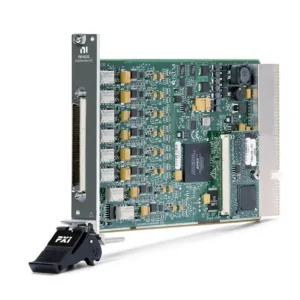
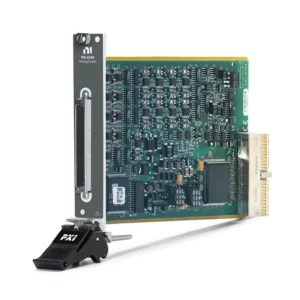
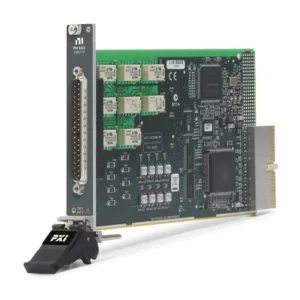
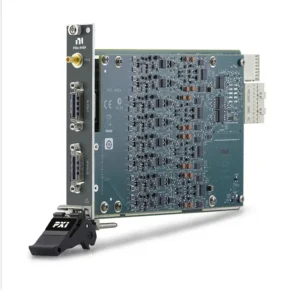
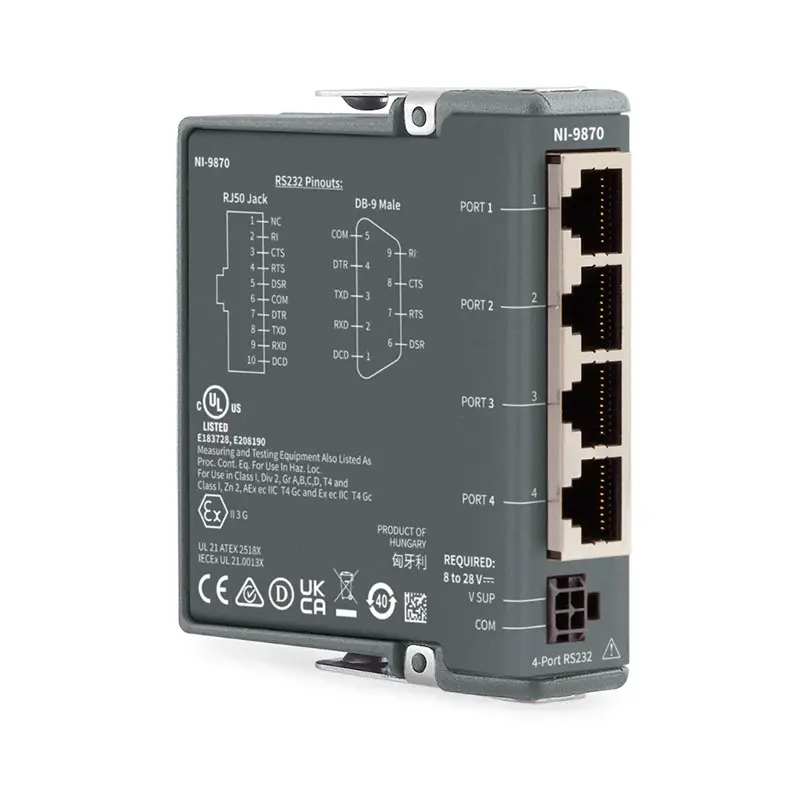
The NI-9870 is a 4-port C Series RS-232 serial interface module designed for connecting RS-232 serial devices to compatible NI CompactDAQ and CompactRIO systems.
With four independent RS-232 ports in a single C Series module, the NI-9870 is suitable for industrial communication, automated test, embedded control, laboratory automation, machine integration, instrument communication, and serial device monitoring applications.
The module enables engineers to integrate serial communication with analog input, analog output, digital I/O, sensor measurement, and other C Series functions within a modular test or control system.
Product Overview
The National Instruments NI-9870 belongs to the NI C Series serial interface family and provides four RS-232 serial communication ports.
A typical system architecture is:
RS-232 Devices → NI-9870 → CompactDAQ / CompactRIO → Application Software
The module is useful when multiple serial devices must be connected to the same measurement, automation, or embedded control platform.
Key Features
4 RS-232 Serial Ports
The NI-9870 provides four independent RS-232 serial communication ports.
Multiple ports allow several serial devices to communicate with the host system through a single C Series module.
Typical connected equipment can include:
- Industrial instruments
- Barcode scanners
- Serial sensors
- GPS receivers
- Measurement instruments
- Motor controllers
- Embedded controllers
- Laboratory equipment
- Legacy RS-232 devices
RS-232 Communication
The NI-9870 is specifically designed for RS-232 serial communication.
RS-232 remains widely used in industrial equipment, laboratory instruments, embedded systems, and legacy devices because of its simple point-to-point communication architecture.
A typical connection is:
RS-232 Device ↔ NI-9870 ↔ NI Chassis ↔ Application Software
Independent Serial Interfaces
Each NI-9870 port can communicate with an individual RS-232 device.
This allows one module to interface with multiple devices in a test or automation system without requiring several separate USB-to-serial adapters.
For example:
Port 1 → Measurement Instrument
Port 2 → Barcode Scanner
Port 3 → Motor Controller
Port 4 → Serial Sensor
Standard Serial Communication Parameters
The NI-9870 supports configurable serial communication parameters required for communication with different RS-232 devices.
Typical configuration parameters include:
- Baud rate
- Data bits
- Stop bits
- Parity
- Flow control
These parameters should be configured to match the communication settings of the connected serial device.
Hardware Handshaking Support
The NI-9870 supports standard RS-232 modem and handshaking signals, allowing it to communicate with devices that require more than basic transmit and receive lines.
Depending on the application, supported serial signals can be used for hardware flow control and device-status communication.
C Series Form Factor
The NI-9870 uses the compact C Series module format.
This allows serial communication to be integrated with other C Series measurement and control functions in the same system.
A system could combine:
- RS-232 communication
- Analog voltage measurement
- Temperature measurement
- Digital I/O
- Relay control
- Current measurement
- Industrial communication
Technical Specifications
| Parameter | Specification |
|---|---|
| Product Type | C Series Serial Interface Module |
| Model | NI-9870 |
| Manufacturer | National Instruments |
| Platform | NI C Series |
| Serial Interface | RS-232 |
| Number of Ports | 4 |
| Communication Type | Asynchronous Serial |
| Maximum Baud Rate | 921.6 kbit/s |
| Data Bits | 5, 6, 7, 8 |
| Stop Bits | 1, 1.5, 2 |
| Parity | Odd, Even, Mark, Space, None |
| Flow Control | RTS/CTS, XON/XOFF and Other Supported Serial Configurations |
| Connector Type | RJ50 |
| Connectors | 4 |
| External Power | Required |
| Operating Temperature | -40 °C to 70 °C |
| Compatible Platforms | Supported CompactDAQ and CompactRIO Systems |
| Primary Applications | Serial Communication, Industrial Automation, Instrument Control and Embedded Systems |
NI-9870 Part Number
When purchasing or replacing an NI-9870, use the complete National Instruments model and part number to verify the exact hardware configuration.
Different production revisions or environmental configurations may exist, so the complete part number printed on the module should be confirmed before ordering.
How Does the NI-9870 Work?
The NI-9870 provides the physical and communication interface between RS-232 devices and a compatible NI C Series system.
A simplified communication path is:
Serial Device → RS-232 → NI-9870 → C Series Chassis → Host / Real-Time Application
Application software can transmit commands to the connected device and receive serial responses for processing, monitoring, logging, or control.
What Is RS-232?
RS-232 is a serial communication standard commonly used for point-to-point communication between electronic devices.
RS-232 communication typically uses separate transmit and receive signals and can also include hardware handshaking lines.
Typical applications include:
- Instrument control
- Industrial equipment communication
- Embedded device configuration
- Barcode scanning
- Laboratory automation
- Machine control
- Legacy equipment integration
RS-232 Point-to-Point Communication
RS-232 is primarily designed for point-to-point communication.
Each NI-9870 port normally communicates directly with one RS-232 device.
A four-device architecture can therefore be:
Device A ↔ Port 1
Device B ↔ Port 2
Device C ↔ Port 3
Device D ↔ Port 4
If the application requires multidrop communication between multiple devices on a shared bus, an RS-485 interface may be more appropriate.
Maximum Baud Rate
The NI-9870 supports serial communication rates up to 921.6 kbit/s.
The actual baud rate used in an application must match the communication capabilities and configuration of the connected RS-232 device.
Common serial rates include:
- 9,600 bit/s
- 19,200 bit/s
- 38,400 bit/s
- 57,600 bit/s
- 115,200 bit/s
- Higher supported rates up to 921.6 kbit/s
RJ50 Connectivity
The NI-9870 uses RJ50 connectors for its four RS-232 ports.
This is important when replacing conventional PC serial interfaces because many traditional RS-232 devices use DB9 connectors.
An appropriate NI serial cable or correctly wired adapter may therefore be required between the NI-9870 and a DB9-equipped serial device.
Always verify the NI-9870 pinout and the connected device pinout before wiring the system.
External Power Requirement
The NI-9870 requires an appropriate external power supply for operation of its serial transceivers.
When integrating the module, verify:
- External supply voltage
- Power wiring
- Ground connection
- Module pinout
- Chassis compatibility
Failure to provide the required external power can prevent the serial ports from communicating correctly.
NI-9870 for Instrument Control
Many laboratory and industrial instruments continue to provide RS-232 communication ports.
The NI-9870 can be used to send commands to these instruments and receive measurement or status information.
A typical architecture is:
Test Application → NI-9870 → RS-232 → Instrument
This allows serial instrument control to be incorporated into a larger automated measurement system.
Industrial Automation Applications
The NI-9870 is useful for industrial systems containing equipment that communicates through RS-232.
Examples include:
- Machine controllers
- Serial sensors
- Barcode readers
- Weighing systems
- Motor drives
- Industrial displays
- Legacy PLC interfaces
- Measurement equipment
Automated Test Applications
The NI-9870 can be incorporated into automated test systems where one or more DUTs or instruments require serial communication.
A typical automated sequence may:
- Initialize the NI-9870 serial port.
- Configure baud rate and communication parameters.
- Open communication with the DUT.
- Transmit a test command.
- Receive the DUT response.
- Acquire related physical measurements.
- Compare results with test limits.
- Record the result.
Embedded Control Applications
When used with a compatible CompactRIO system, the NI-9870 can provide serial communication for embedded control applications.
The CompactRIO controller can exchange commands and data with external RS-232 equipment while simultaneously performing real-time measurement and control.
A typical architecture is:
RS-232 Devices → NI-9870 → CompactRIO → Real-Time Application → Control / Logging
CompactDAQ Applications
The NI-9870 can be used with supported CompactDAQ configurations for PC-based serial communication and measurement applications.
A CompactDAQ system can combine serial communication with other C Series modules for:
- Voltage measurement
- Current measurement
- Temperature acquisition
- Digital monitoring
- Relay control
- Sensor measurement
Always verify compatibility with the exact CompactDAQ chassis and software environment before purchasing.
CompactRIO Applications
The NI-9870 is commonly integrated into CompactRIO systems requiring serial communication with industrial or embedded equipment.
CompactRIO provides a modular architecture that can combine:
- Real-time processing
- FPGA-based I/O
- RS-232 communication
- Analog measurement
- Digital control
- Industrial communication
LabVIEW Integration
The NI-9870 can be integrated into compatible LabVIEW applications for serial device communication.
A typical software workflow is:
Configure Serial Port → Open Communication → Write Command → Read Response → Parse Data → Display / Log / Control
This makes the module suitable for automated test, laboratory automation, industrial control, and embedded applications.
Serial Device Command and Response
Many RS-232 devices operate using a command-and-response protocol.
For example:
Host → Measurement Request → Serial Device
Serial Device → Measurement Result → Host
The NI-9870 provides the communication interface while the application software handles the device-specific protocol.
NI-9870 vs NI-9871
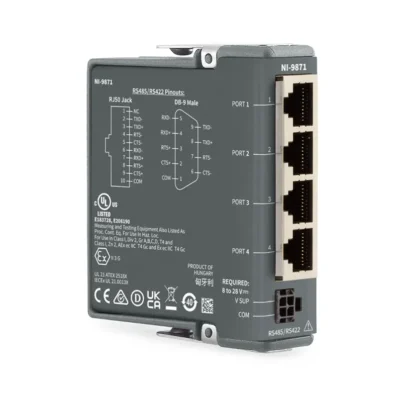
The NI-9870 and NI-9871 are closely related C Series serial interface modules, but they support different physical-layer standards.
| Feature | NI-9870 | NI-9871 |
|---|---|---|
| Serial Standard | RS-232 | RS-422 / RS-485 |
| Number of Ports | 4 | 4 |
| Primary Network Type | Point-to-Point | Point-to-Point / Multidrop |
| Typical Cable Distance | Shorter | Longer |
| Noise Immunity | Standard | Higher |
| Typical Application | RS-232 Instruments and Devices | Industrial RS-485 / RS-422 Networks |
Choose the NI-9870 for RS-232 devices. Choose the NI-9871 when the equipment requires RS-422 or RS-485 communication.
RS-232 vs RS-485
RS-232 and RS-485 are both serial communication standards, but their electrical architectures differ significantly.
| Feature | RS-232 | RS-485 |
|---|---|---|
| Typical Topology | Point-to-Point | Multidrop |
| Signaling | Single-Ended | Differential |
| Noise Immunity | Lower | Higher |
| Typical Cable Distance | Shorter | Longer |
| Multiple Devices on Bus | No | Yes |
| Recommended NI Module | NI-9870 | NI-9871 |
NI-9870 vs USB-to-Serial Adapters
A conventional USB-to-RS-232 adapter may be sufficient for simple desktop communication, while the NI-9870 is designed for integration into modular NI measurement and control systems.
| Feature | NI-9870 | Typical USB Serial Adapter |
|---|---|---|
| Ports | 4 | Typically 1 |
| C Series Integration | Yes | No |
| CompactRIO Integration | Yes | Limited / Application Dependent |
| Industrial System Integration | Designed for Modular Systems | Primarily Desktop Use |
| Other C Series I/O Integration | Yes | No |
Legacy Equipment Integration
One important application for the NI-9870 is integrating older RS-232 equipment into modern measurement and automation systems.
Many instruments and industrial devices remain operational for years and may provide only an RS-232 communication interface.
The NI-9870 allows these devices to be incorporated into a modern CompactDAQ or CompactRIO architecture without replacing the original equipment solely because of its communication interface.
Multi-Device Serial Communication
Because the NI-9870 provides four ports, one C Series slot can support multiple RS-232 devices.
| NI-9870 Port | Example Device |
|---|---|
| Port 1 | Power Supply |
| Port 2 | Barcode Scanner |
| Port 3 | Motor Controller |
| Port 4 | Environmental Sensor |
Each port can be configured according to the communication parameters required by its connected device.
Serial Communication Configuration
Before communicating with an RS-232 device, configure the NI-9870 port to match the device settings.
Important parameters include:
- Baud rate
- Number of data bits
- Parity mode
- Number of stop bits
- Flow-control method
- Message termination character
- Communication timeout
A mismatch in any of these parameters can cause communication errors or unreadable data.
RS-232 Wiring Considerations
Correct wiring is essential when connecting equipment to the NI-9870.
Before connecting a serial device, verify:
- NI-9870 RJ50 pinout
- DUT connector pinout
- Transmit and receive connections
- Signal ground
- Required handshaking signals
- DTE or DCE configuration
- Cable type
- External power
DTE and DCE Considerations
Traditional RS-232 systems distinguish between DTE and DCE equipment.
Depending on the connected device, a straight-through or crossover/null-modem wiring arrangement may be required.
Always compare the NI-9870 pinout with the target device documentation rather than assuming that two serial connectors can be connected directly.
Troubleshooting NI-9870 Communication
If the NI-9870 cannot communicate with an RS-232 device, check the complete hardware and software configuration.
- Verify that the NI-9870 is recognized by the system.
- Confirm that the module is installed in a supported chassis.
- Verify external power.
- Check the RJ50 cable and adapter.
- Confirm TX, RX, and ground wiring.
- Verify baud rate.
- Verify data bits.
- Check parity and stop bits.
- Verify hardware or software flow control.
- Check DTE/DCE requirements.
- Verify message termination characters.
- Confirm the connected device is powered and operating correctly.
How to Choose a C Series Serial Interface
Before selecting the NI-9870, determine:
- Required serial standard
- RS-232 or RS-422/RS-485
- Required number of serial ports
- Required baud rate
- Flow-control requirements
- Connector and cable requirements
- External power requirements
- CompactDAQ or CompactRIO compatibility
- Real-time requirements
- Software and driver compatibility
Industries
- Industrial Automation
- Automated Test
- Manufacturing
- Laboratory Automation
- Research and Development
- Machine Control
- Transportation
- Energy
- Embedded Systems
- Electronic Validation
Applications
RS-232 Device Communication
The NI-9870 provides four RS-232 interfaces for communicating with serial instruments, sensors, controllers, and other compatible devices.
Instrument Control
Laboratory and industrial instruments equipped with RS-232 interfaces can be controlled from compatible NI systems using the NI-9870.
Industrial Automation
The module can integrate legacy and modern serial devices into modular industrial measurement and automation systems.
Automated Test
Test systems can use the NI-9870 to send commands to DUTs and instruments and collect serial responses during automated test sequences.
Embedded Control
CompactRIO systems can use the NI-9870 to communicate with external RS-232 equipment while performing real-time measurement and control.
Legacy Device Integration
Existing RS-232 equipment can be integrated into newer CompactDAQ and CompactRIO systems without replacing functional legacy hardware.
Recommended Related Products
| NI-9870 | 4-port C Series RS-232 serial interface module for instrument control, automation, and embedded communication. |
| NI-9871 | 4-port C Series RS-422/RS-485 serial interface module for longer-distance and multidrop industrial communication. |
| NI-9866 | C Series LIN interface module for automotive and embedded Local Interconnect Network communication. |
| NI-9862 | C Series CAN interface module for automotive, embedded, and ECU network testing. |
Why Choose NI-9870?
- 4 independent RS-232 ports
- Up to 921.6 kbit/s serial communication
- C Series modular form factor
- Suitable for instrument control
- Suitable for industrial automation
- Suitable for automated test
- Suitable for embedded control
- Supports standard RS-232 communication parameters
- Supports serial handshaking
- RJ50 connectivity
- Wide industrial operating temperature range
- CompactRIO integration
- Supported CompactDAQ integration
- Can be combined with other C Series I/O modules
- Useful for legacy serial equipment integration
Frequently Asked Questions
What is the NI-9870?
The NI-9870 is a 4-port C Series RS-232 serial interface module for communicating with RS-232 instruments, sensors, controllers, and other serial devices.
How many serial ports does NI-9870 have?
The NI-9870 provides four independent RS-232 ports.
What serial standard does NI-9870 support?
The NI-9870 is designed for RS-232 serial communication.
What is the maximum baud rate of NI-9870?
The NI-9870 supports baud rates up to 921.6 kbit/s.
What connector does NI-9870 use?
The NI-9870 provides four RJ50 connectors, one for each RS-232 interface.
Can NI-9870 connect directly to a DB9 serial device?
The NI-9870 uses RJ50 connectors, while many conventional RS-232 devices use DB9 connectors. An appropriate serial cable or adapter may therefore be required. Always verify the pinout of both devices before connection.
Does NI-9870 require external power?
Yes. The NI-9870 requires an appropriate external power source for operation of its serial interfaces.
Does NI-9870 support RS-485?
No. The NI-9870 is an RS-232 interface module. For RS-422 or RS-485 communication, consider the NI-9871.
What is the difference between NI-9870 and NI-9871?
The NI-9870 provides four RS-232 ports, while the NI-9871 provides four RS-422/RS-485 serial interfaces. The correct model depends on the electrical serial standard used by the connected device.
Can NI-9870 communicate with four devices simultaneously?
The NI-9870 provides four independent serial ports, allowing multiple RS-232 devices to be integrated into the same system. Actual communication behavior depends on the software and system architecture.
Can NI-9870 be used for instrument control?
Yes. Instrument control is a common application, particularly for laboratory and industrial equipment that provides an RS-232 communication interface.
Can NI-9870 be used with CompactRIO?
Yes. The NI-9870 can be used with compatible CompactRIO systems for embedded and real-time serial communication applications.
Can NI-9870 be used with CompactDAQ?
The NI-9870 can be used in supported CompactDAQ configurations. Compatibility should be checked against the exact CompactDAQ chassis and software environment before purchase.
Can NI-9870 be used with LabVIEW?
Yes. The NI-9870 can be integrated into compatible LabVIEW applications for serial communication, instrument control, automated test, and embedded system development.
Is NI-9870 suitable for Modbus RTU?
The NI-9870 provides the RS-232 physical communication interface. If a Modbus RTU device operates over RS-232, the appropriate software implementation can communicate with the device through the NI-9870. Protocol compatibility and software support should be verified for the specific application.
Can NI-9870 replace a USB-to-RS-232 adapter?
In a compatible NI C Series system, the NI-9870 can provide RS-232 connectivity without separate USB serial adapters. It is particularly useful when multiple serial ports need to be integrated with measurement and control I/O.
Why is my NI-9870 not communicating?
Common causes include missing external power, incorrect RJ50-to-device wiring, reversed TX/RX connections, incorrect baud rate, parity or stop-bit settings, incorrect flow control, DTE/DCE wiring issues, incompatible chassis configuration, or incorrect software settings.
What should I check before purchasing NI-9870?
Verify that the connected equipment uses RS-232, then check the number of required ports, baud rate, flow-control requirements, RJ50 cable or adapter requirements, external power requirements, CompactDAQ or CompactRIO chassis compatibility, software compatibility, and the exact NI part number.
Conclusion
The NI-9870 4-Port C Series RS-232 Serial Interface Module provides four independent RS-232 interfaces for integrating serial instruments, sensors, controllers, and legacy equipment into compatible NI measurement and control systems. With serial communication rates up to 921.6 kbit/s, C Series integration, and support for CompactRIO and compatible CompactDAQ applications, the NI-9870 is well suited for industrial automation, instrument control, automated test, laboratory systems, embedded control, and legacy RS-232 device integration.