




Product Introduction
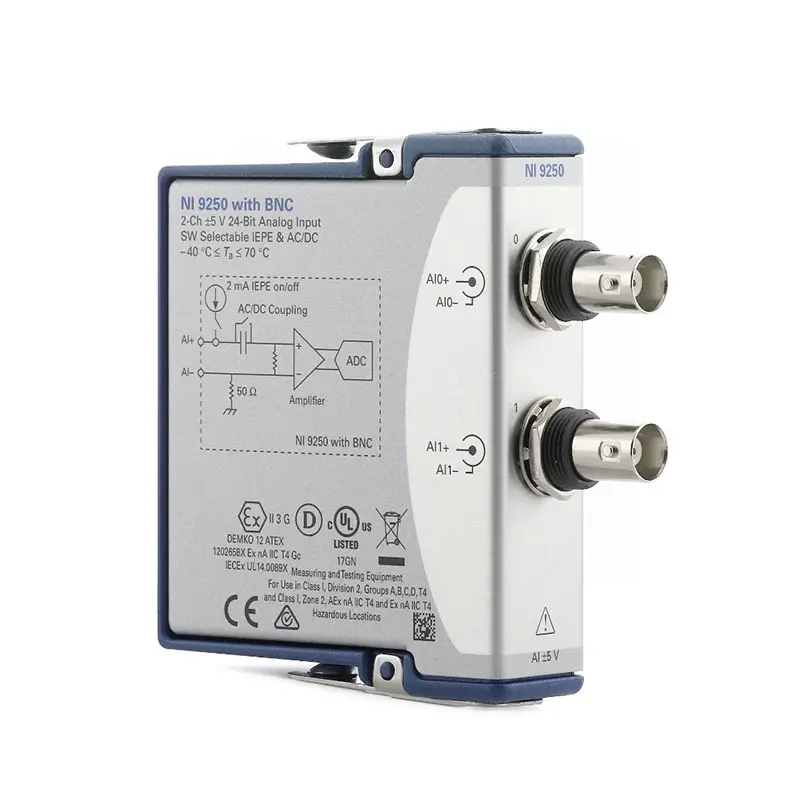
The NI-9250 is a 2-channel C Series sound and vibration input module designed for high-accuracy dynamic signal acquisition. It provides 24-bit resolution, a ±5 V input range, and simultaneous sampling rates up to 102.4 kS/s per channel.
Designed for measurements from IEPE and non-IEPE sensors, the NI-9250 is particularly suitable for accelerometers, measurement microphones, vibration sensors, and other dynamic signal transducers. Integrated IEPE signal conditioning eliminates the need for an external excitation source in many sensor configurations.
With a wide dynamic range, low noise, software-selectable AC/DC coupling, TEDS sensor compatibility, and built-in anti-aliasing filters, the NI-9250 is well suited for sound and vibration measurement, NVH testing, condition monitoring, acoustic analysis, modal testing, and structural dynamics applications.
Product Overview
The National Instruments NI-9250 is part of the C Series dynamic signal acquisition platform and is optimized for precision sound and vibration measurements.
A typical measurement architecture is:
Accelerometer / Microphone → NI-9250 → CompactDAQ / CompactRIO → Measurement and Analysis Software
The module simultaneously digitizes both input channels, preserving the timing and phase relationships required for frequency-domain, vibration, acoustic, and modal analysis.
Key Features
2 Simultaneously Sampled Input Channels
The NI-9250 provides two analog input channels with simultaneous sampling.
Simultaneous acquisition is important for dynamic measurements where phase relationships between multiple signals must be maintained.
Typical applications include:
- Dual-axis vibration measurement
- Acoustic measurements
- Transfer-function analysis
- Modal analysis
- Frequency-response testing
- Machine condition monitoring
102.4 kS/s/ch Sampling Rate
The NI-9250 supports simultaneous sampling rates up to 102.4 kS/s per channel.
This sampling capability enables acquisition of dynamic waveforms for vibration, acoustic, and frequency-domain analysis.
24-Bit Resolution
The NI-9250 uses 24-bit analog-to-digital conversion to provide high-resolution dynamic signal measurements.
High-resolution conversion is particularly valuable when measuring signals with a large dynamic range or when small signal components must be detected alongside larger vibration or acoustic signals.
±5 V Input Range
Each NI-9250 input channel supports an input range of approximately ±5 V.
This input range is well suited to many conditioned vibration, acoustic, and IEPE sensor outputs.
IEPE Signal Conditioning
The NI-9250 provides software-selectable IEPE signal conditioning.
IEPE excitation allows compatible accelerometers and microphones to receive the constant-current excitation required for operation directly from the measurement module.
This reduces the need for external sensor power supplies and simplifies the measurement system.
IEPE and Non-IEPE Sensor Support
The NI-9250 can measure signals from both IEPE and non-IEPE sensors.
Typical compatible sensor applications include:
- IEPE accelerometers
- IEPE measurement microphones
- Conditioned vibration sensors
- Voltage-output sensors
- Dynamic measurement transducers
Software-Selectable AC/DC Coupling
The NI-9250 provides software-selectable AC and DC coupling.
AC coupling can be useful when engineers want to remove the DC component of a signal and focus on dynamic content, while DC coupling allows the complete signal waveform to be acquired.
Built-In Anti-Aliasing Filters
Each NI-9250 input channel incorporates an anti-aliasing filter that automatically adjusts according to the configured sampling rate.
Anti-aliasing filtering is important in dynamic signal acquisition because frequencies above the usable measurement bandwidth can otherwise appear incorrectly within the measured frequency spectrum.
TEDS Sensor Compatibility
The NI-9250 supports compatible TEDS smart sensors.
TEDS technology allows compatible sensors to store identification and calibration information that can simplify sensor configuration and reduce manual setup requirements.
BNC Connectivity
The NI-9250 uses BNC connectors for its analog input channels.
BNC connectivity is widely used in vibration and acoustic measurement systems and provides convenient connection to accelerometers, microphones, signal conditioners, and laboratory instrumentation.
High Dynamic Range
The NI-9250 is designed for high-dynamic-range measurements. This makes it particularly useful when both relatively strong and weak signal components must be captured accurately within the same measurement.
Technical Specifications
| Parameter | Specification |
|---|---|
| Product Type | C Series Sound and Vibration Input Module |
| Model | NI-9250 |
| Part Number | 783827-01 |
| Manufacturer | National Instruments |
| Number of Analog Input Channels | 2 |
| Input Configuration | Single-Ended |
| ADC Resolution | 24-Bit |
| Maximum Sample Rate | 102.4 kS/s/ch |
| Sampling Architecture | Simultaneous Sampling |
| Input Range | ±5 V |
| Connector Type | BNC |
| IEPE Signal Conditioning | Software Selectable |
| Input Coupling | Software-Selectable AC/DC |
| TEDS Support | Yes |
| Anti-Aliasing Filters | Built-In, Automatically Adjusted to Sample Rate |
| Dynamic Range | Up to 114 dB at 51.2 kS/s |
| Noise | <10 µVrms |
| Operating Temperature | -40 °C to 70 °C |
| Primary Applications | Sound, Vibration, Acoustic and Dynamic Signal Measurement |
How Does the NI-9250 Work?
The NI-9250 receives analog signals from accelerometers, microphones, and other compatible dynamic sensors and converts them into high-resolution digital measurement data.
A simplified signal path is:
Physical Vibration / Sound → Sensor → NI-9250 Signal Conditioning → 24-Bit ADC → CompactDAQ / CompactRIO → Analysis Software
When an IEPE sensor is used, the module can provide the required sensor excitation while simultaneously acquiring the resulting measurement signal.
Sound and Vibration Measurement
The NI-9250 is specifically designed for applications where dynamic waveform quality, noise performance, synchronization, and frequency-domain accuracy are important.
Typical measurements include:
- Acceleration
- Vibration
- Sound pressure
- Frequency response
- Structural vibration
- Machine vibration
- Acoustic noise
Vibration Measurement with NI-9250
The NI-9250 can be connected directly to compatible IEPE accelerometers for vibration measurement.
A typical configuration is:
IEPE Accelerometer → BNC Cable → NI-9250 → CompactDAQ / CompactRIO → Vibration Analysis Software
The acquired acceleration waveform can then be analyzed in the time or frequency domain.
Acoustic Measurement
The module can also acquire signals from compatible measurement microphones and microphone preamplifiers.
Applications can include:
- Sound pressure level measurement
- Product noise testing
- Environmental noise measurement
- Acoustic characterization
- Frequency analysis
- Audio testing
NVH Testing
The NI-9250 is well suited for Noise, Vibration and Harshness (NVH) applications.
NVH testing is widely used in automotive, transportation, aerospace, machinery, and product-development applications to characterize unwanted sound and vibration.
Typical measurements can include:
- Vehicle vibration
- Motor noise
- Gearbox vibration
- Powertrain noise
- Electric motor vibration
- Structural resonance
- Cabin noise
Machine Condition Monitoring
The NI-9250 can be used in machine condition monitoring systems to acquire vibration signals from rotating equipment.
Typical equipment includes:
- Motors
- Pumps
- Fans
- Compressors
- Gearboxes
- Bearings
- Turbines
The acquired vibration data can be processed using techniques such as frequency analysis and order tracking to identify changes in machine behavior.
Frequency Analysis
Dynamic vibration and acoustic measurements are frequently analyzed in the frequency domain using FFT and related signal-processing techniques.
The NI-9250 provides high-resolution, simultaneous waveform acquisition suitable for analyzing:
- Fundamental frequencies
- Harmonics
- Resonances
- Bearing frequencies
- Gear mesh frequencies
- Structural modes
- Acoustic tones
Order Tracking
Order analysis is commonly used for rotating machinery and automotive measurements where vibration or sound is related to rotational speed.
When used with appropriate speed or tachometer information and analysis software, NI-9250 measurement data can support order tracking applications for motors, engines, turbines, gearboxes, and other rotating systems.
Modal Analysis
The simultaneous sampling architecture of the NI-9250 makes it suitable for modal and structural dynamics measurements where phase relationships between channels are important.
Typical applications include:
- Structural resonance testing
- Frequency-response measurements
- Modal parameter estimation
- Mechanical structure validation
- Component vibration testing
Frequency Response Measurement
The NI-9250 can be paired with an appropriate analog output module to build excitation-response measurement systems.
For example:
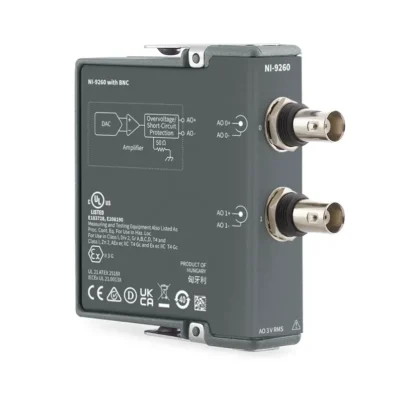
NI-9260 → Excitation Signal → Device Under Test → Sensor → NI-9250
This type of configuration can be used for frequency-response, modal, and acoustic analysis.
Why 24-Bit Resolution Matters
Dynamic signals often contain components with significantly different amplitudes.
A 24-bit measurement architecture provides a wide measurement range that is useful when capturing small vibration or acoustic components together with larger signals.
This is especially important for:
- Acoustic testing
- Low-level vibration measurement
- Machine diagnostics
- Structural analysis
- High-dynamic-range measurements
Why Simultaneous Sampling Matters
In vibration and acoustic analysis, the phase relationship between channels can be as important as signal amplitude.
Because the NI-9250 samples both channels simultaneously, engineers can perform measurements that depend on accurate interchannel timing.
Examples include:
- Transfer functions
- Cross-spectrum analysis
- Phase measurements
- Modal analysis
- Frequency-response testing
What Is IEPE?
IEPE refers to a widely used interface for piezoelectric sensors with integrated electronics. IEPE accelerometers and microphones typically require constant-current excitation while transmitting the measurement signal over the same connection.
Because the NI-9250 includes software-selectable IEPE excitation, compatible sensors can often be connected directly without an external IEPE signal conditioner.
What Is TEDS?
TEDS technology allows compatible smart sensors to store information such as sensor identification and calibration parameters.
TEDS support can simplify large measurement systems by reducing manual sensor configuration and helping maintain correct sensor scaling.
AC Coupling vs DC Coupling
| Feature | AC Coupling | DC Coupling |
|---|---|---|
| DC Component | Removed | Preserved |
| Dynamic Signal Measurement | Well Suited | Supported |
| Vibration Measurement | Commonly Used | Application Dependent |
| Complete Waveform | Dynamic Component | DC + Dynamic Components |
NI-9250 vs NI-9234
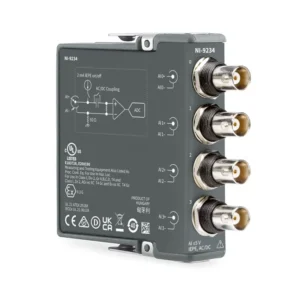
The NI-9250 and NI-9234 are both C Series modules designed for sound and vibration measurements, but they target different channel-count and performance requirements.
| Feature | NI-9250 | NI-9234 |
|---|---|---|
| Channels | 2 | 4 |
| Resolution | 24-Bit | 24-Bit |
| Maximum Sample Rate | 102.4 kS/s/ch | 51.2 kS/s/ch |
| IEPE Support | Yes | Yes |
| AC/DC Coupling | Yes | Yes |
| Primary Advantage | Higher Sample Rate and Low-Noise Measurement | Higher Channel Count |
NI-9250 vs NI-9232
Both modules provide 24-bit simultaneous dynamic signal acquisition at up to 102.4 kS/s/ch, but their input ranges and channel configurations differ.
| Feature | NI-9250 | NI-9232 |
|---|---|---|
| Channels | 2 | 3 |
| Resolution | 24-Bit | 24-Bit |
| Maximum Sample Rate | 102.4 kS/s/ch | 102.4 kS/s/ch |
| Input Range | ±5 V | ±30 V |
| IEPE Support | Yes | Yes |
| Best Fit | Low-Noise, High-Dynamic-Range Sound and Vibration | Higher-Voltage Dynamic Signals |
NI-9250 for CompactDAQ
When installed in compatible CompactDAQ hardware, the NI-9250 can be used to create PC-based sound and vibration measurement systems.
CompactDAQ configurations are suitable for:
- Laboratory testing
- Portable vibration measurement
- NVH testing
- Product validation
- Acoustic testing
- Machine diagnostics
NI-9250 for CompactRIO
The NI-9250 can also be used with compatible CompactRIO systems for embedded sound, vibration, and condition-monitoring applications.
CompactRIO can add capabilities such as:
- Real-time processing
- Standalone operation
- FPGA functionality
- Industrial deployment
- Continuous data logging
- Automated monitoring
Sound and Vibration Test System Architecture
A complete dynamic measurement system can include:
Accelerometers / Microphones
↓
NI-9250
↓
CompactDAQ / CompactRIO
↓
Data Acquisition Software
↓
FFT / Order / NVH / Frequency Analysis
How to Choose a Sound and Vibration Input Module
Before selecting the NI-9250, evaluate:
- Number of measurement channels
- Sensor type
- IEPE excitation requirements
- Maximum sensor output voltage
- Required sample rate
- Measurement bandwidth
- Dynamic range requirements
- Noise requirements
- AC or DC coupling requirements
- TEDS requirements
- Connector type
- CompactDAQ or CompactRIO compatibility
- Software compatibility
Software and Analysis
The NI-9250 can be integrated with compatible NI data acquisition and analysis software.
Depending on the system architecture, applications can perform:
- Waveform acquisition
- FFT analysis
- Frequency analysis
- Order tracking
- Sound level analysis
- Vibration analysis
- Condition monitoring
- Data logging
Industries
- Automotive Testing
- Aerospace
- Industrial Machinery
- Transportation
- Consumer Product Testing
- Structural Testing
- Acoustic Engineering
- Condition Monitoring
- Research and Development
- Automated Test
Applications
Vibration Measurement
The NI-9250 can acquire high-resolution signals from compatible accelerometers for machine, structural, and product vibration measurements.
Acoustic Testing
Measurement microphones can be used with the NI-9250 for sound pressure, product noise, and acoustic characterization.
NVH Testing
The module is suitable for noise, vibration, and harshness testing in automotive and transportation applications.
Condition Monitoring
Vibration signals from motors, bearings, pumps, fans, and gearboxes can be acquired for machine-health analysis.
Modal Analysis
Simultaneous sampling supports phase-sensitive measurements required for structural dynamics and modal testing.
Frequency Analysis
High-resolution waveform acquisition supports FFT, spectral analysis, order tracking, and related dynamic signal-processing applications.
Recommended Related Products
| NI-9250 | 2-channel, ±5 V, 24-bit, 102.4 kS/s/ch C Series sound and vibration input module with IEPE support. |
| NI-9234 | 4-channel, 24-bit C Series sound and vibration input module for applications requiring additional IEPE measurement channels. |
| NI-9232 | 3-channel, ±30 V, 24-bit, 102.4 kS/s/ch C Series dynamic signal input module with IEPE support. |
| NI-9230 | 3-channel dynamic signal input module for lower-rate sound and vibration measurement applications. |
| NI-9260 | 2-channel C Series analog output module that can be paired with the NI-9250 for excitation-response and frequency-response measurements. |
| CompactDAQ Chassis | Modular data acquisition chassis for laboratory, portable, acoustic, vibration, and NVH measurement systems. |
| CompactRIO Controllers | Embedded real-time platforms for condition monitoring, vibration measurement, and industrial data acquisition. |
Why Choose NI-9250?
- 2 simultaneously sampled analog input channels
- 24-bit resolution
- 102.4 kS/s/ch maximum sample rate
- ±5 V input range
- High dynamic range
- Low-noise dynamic measurements
- Software-selectable IEPE excitation
- IEPE and non-IEPE sensor support
- Software-selectable AC/DC coupling
- Built-in anti-aliasing filters
- TEDS sensor compatibility
- BNC connectivity
- Suitable for vibration measurement
- Suitable for acoustic testing
- Suitable for NVH analysis
- Suitable for condition monitoring
Frequently Asked Questions
What is the NI-9250?
The NI-9250 is a two-channel C Series sound and vibration input module designed for high-resolution dynamic signal acquisition from accelerometers, microphones, and other compatible sensors.
What is the part number of the NI-9250?
The NI-9250 BNC version has the ordering part number 783827-01.
How many channels does the NI-9250 have?
The NI-9250 provides two simultaneously sampled analog input channels.
What is the maximum sample rate of the NI-9250?
The NI-9250 supports sampling rates up to 102.4 kS/s per channel.
What is the resolution of the NI-9250?
The module provides 24-bit analog-to-digital conversion.
What is the input range of the NI-9250?
The NI-9250 provides an input range of approximately ±5 V.
Does the NI-9250 support IEPE sensors?
Yes. The NI-9250 provides software-selectable IEPE signal conditioning for compatible accelerometers, microphones, and other IEPE sensors.
Does the NI-9250 require an external IEPE power supply?
Normally, compatible IEPE sensors can use the module’s integrated IEPE excitation, reducing the need for a separate external sensor excitation source.
Does the NI-9250 support TEDS sensors?
Yes. The NI-9250 is compatible with supported TEDS smart sensors.
Does the NI-9250 support AC and DC coupling?
Yes. Input coupling is software selectable between AC and DC modes.
Does the NI-9250 have anti-aliasing filters?
Yes. Each channel includes built-in anti-aliasing filtering that automatically adjusts according to the configured sample rate.
Can the NI-9250 measure vibration?
Yes. Vibration measurement using accelerometers is one of the primary applications of the NI-9250.
Can the NI-9250 measure sound?
Yes. Compatible measurement microphones can be used for acoustic, noise, and sound measurement applications.
Can the NI-9250 be used for NVH testing?
Yes. The NI-9250 is well suited for automotive and mechanical noise, vibration, and harshness measurements.
What is the difference between NI-9250 and NI-9234?
The NI-9250 provides two channels with sampling rates up to 102.4 kS/s/ch, while the NI-9234 provides four channels with a lower maximum sampling rate. The NI-9250 is particularly attractive when higher sample rate and low-noise performance are priorities, while the NI-9234 provides higher channel density.
What is the difference between NI-9250 and NI-9232?
Both provide 24-bit simultaneous acquisition at up to 102.4 kS/s/ch. The NI-9250 provides two ±5 V channels and is optimized for high-dynamic-range sound and vibration measurements, while the NI-9232 provides three channels with a wider ±30 V input range.
Can the NI-9250 be used with CompactDAQ?
Yes. The NI-9250 is designed for compatible CompactDAQ systems and can be used to create PC-based sound, vibration, NVH, and acoustic measurement systems.
Can the NI-9250 be used with CompactRIO?
Yes. It can also be used with compatible CompactRIO hardware for embedded vibration measurement and condition-monitoring applications.
What should I check before purchasing an NI-9250?
Verify the required channel count, ±5 V input range, sensor type, IEPE excitation requirements, sample rate, measurement bandwidth, noise and dynamic range requirements, AC/DC coupling, TEDS requirements, BNC connectivity, host compatibility, and software environment.
Conclusion
The NI-9250 C Series Sound and Vibration Input Module combines two simultaneously sampled channels, 24-bit resolution, 102.4 kS/s/ch sampling, a ±5 V input range, integrated IEPE conditioning, AC/DC coupling, TEDS support, and automatic anti-aliasing filtering. These capabilities make the NI-9250 particularly well suited for precision vibration measurement, acoustic testing, NVH analysis, machine condition monitoring, modal testing, frequency analysis, and other high-dynamic-range sound and vibration applications.