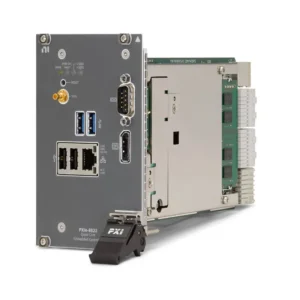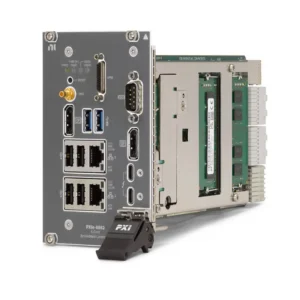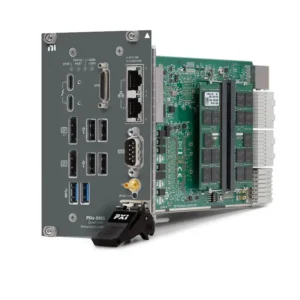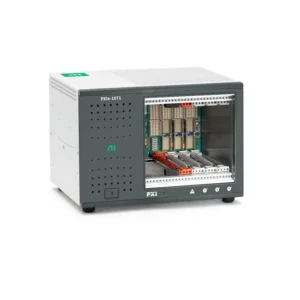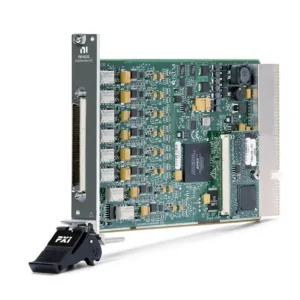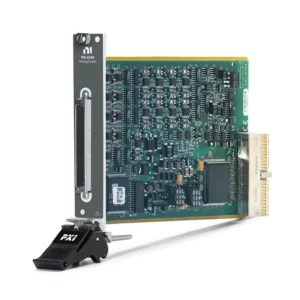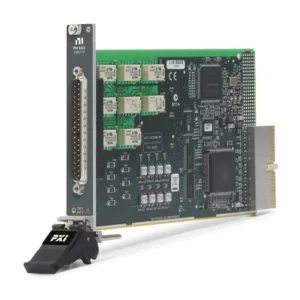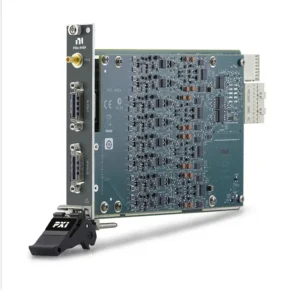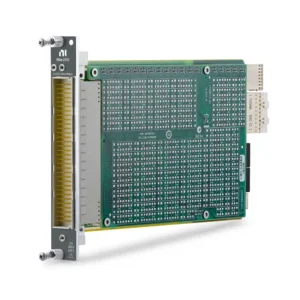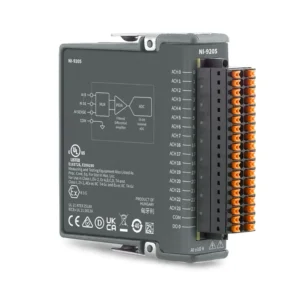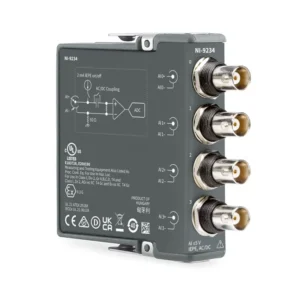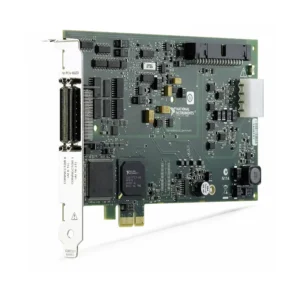




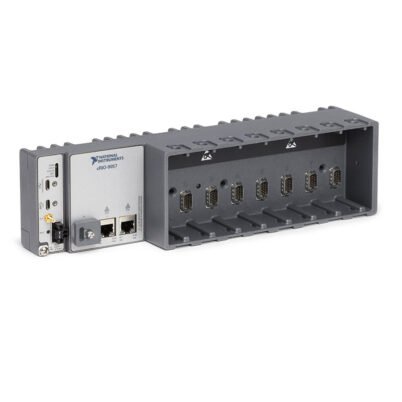

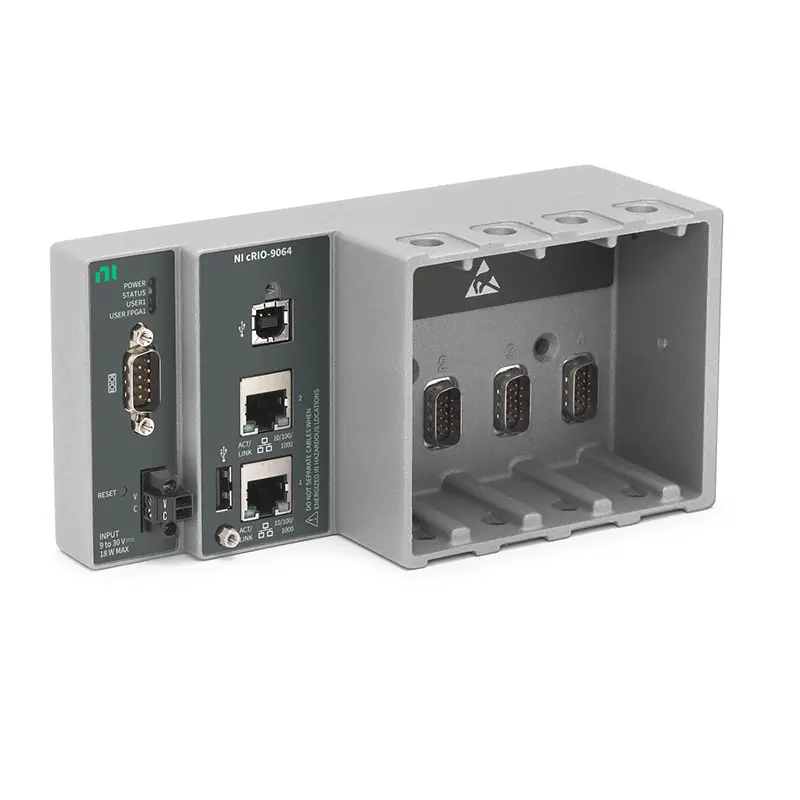
The NI cRIO-9064 is a rugged 4-slot CompactRIO embedded controller designed for industrial automation, embedded control, distributed measurement, and machine monitoring applications. It combines a dual-core ARM Cortex-A9 processor, a Xilinx Zynq-7020 FPGA, modular C Series I/O, and NI Linux Real-Time into a compact industrial platform optimized for deterministic real-time operation.
Compared with traditional PLC architectures, the cRIO-9064 integrates the processor and FPGA into a single SoC platform, reducing latency between real-time software and hardware-level FPGA processing. This makes it suitable for synchronized acquisition, industrial communication, embedded analytics, and deterministic control applications.
Typical applications include:
- Industrial automation
- Distributed data acquisition
- Embedded machine control
- Machine condition monitoring
- Industrial IoT edge systems
- Remote measurement platforms
- Embedded test systems
- Energy monitoring
Processor and FPGA Architecture
The cRIO-9064 is built around:
- 667 MHz dual-core ARM Cortex-A9 processor
- Xilinx Zynq-7000 XC7Z020 FPGA
- 512 MB DRAM
- 1 GB nonvolatile storage
- 4-slot CompactRIO architecture
- NI Linux Real-Time operating system
The onboard Zynq FPGA provides:
- Deterministic hardware timing
- FPGA-based trigger logic
- High-speed digital processing
- Encoder synchronization
- Real-time coprocessing
- Embedded signal processing
- Hardware-level industrial control
- Custom FPGA application development
NI lists FPGA resources including:
- 85,000 logic cells
- 106,400 flip-flops
- 53,200 LUTs
- 220 DSP slices
- 4,480 kbits block RAM
- 16 DMA channels
Compared with older CompactRIO controllers using separate processor and FPGA devices, the Zynq architecture improves embedded integration efficiency and reduces communication overhead.
NI Linux Real-Time and Embedded Development
One of the major advantages of the cRIO-9064 is support for NI Linux Real-Time, allowing engineers to combine deterministic control with Linux-based embedded software development.
Supported development approaches include:
- LabVIEW Real-Time
- LabVIEW FPGA
- C/C++ programming
- Python integration
- SSH remote access
- Linux networking tools
- Third-party Linux libraries
Compared with closed PLC environments, the cRIO-9064 provides greater software flexibility for embedded industrial applications and custom edge systems.
Modular C Series Expansion
The cRIO-9064 supports up to 4 NI C Series modules, allowing flexible configuration for:
- Analog input/output
- Digital I/O
- Temperature measurement
- Strain and bridge measurement
- Vibration acquisition
- CAN communication
- Serial communication
- Industrial communication interfaces
The controller can simultaneously function as:
- A deterministic industrial controller
- A distributed acquisition node
- An FPGA edge processing platform
Its compact 4-slot architecture is suitable for embedded systems where installation space and power consumption are important.
Connectivity and Industrial Design
The cRIO-9064 provides:
- 2× Gigabit Ethernet ports
- USB 2.0 host port
- USB 2.0 device port
- RS-232 serial interface
- SD storage support
Industrial features include:
- -20 °C to 55 °C operating range
- Fanless rugged construction
- DIN-rail and panel mounting support
- IP40 protection rating
- 9 VDC to 30 VDC input range
These features make the cRIO-9064 suitable for industrial cabinets, remote monitoring systems, embedded machinery, and distributed industrial deployments.
Data Acquisition and Real-Time Performance
The cRIO-9064 supports deterministic hardware-timed acquisition and FPGA-based processing. NI specifies:
- 5 ppm real-time clock accuracy
- Hardware-timed digital and analog tasks
- FPGA-based deterministic timing
- Ethernet communication up to 1 Gbps
- USB communication up to 480 Mbps
This makes the platform suitable for:
- Synchronized acquisition
- Embedded control systems
- Real-time triggering
- Machine monitoring
- Industrial communication gateways
Application-Oriented Use Cases
Machine Condition Monitoring
With vibration and analog modules, the cRIO-9064 can be used for predictive maintenance, rotating machinery diagnostics, and industrial health monitoring systems.
Embedded Industrial Automation
The combination of NI Linux RT and FPGA timing enables deterministic control, synchronized triggering, and custom industrial logic execution.
Distributed Measurement Systems
Gigabit Ethernet and modular I/O make the cRIO-9064 suitable for distributed acquisition nodes in industrial plants, laboratories, and energy systems.
Embedded Test Platforms
Its compact architecture is useful for embedded test systems requiring mixed-signal acquisition, serial communication, and deterministic execution.
Comparison with Similar Models
| Model | Main Difference | Typical Use |
|---|---|---|
| cRIO-9063 | Lower memory and storage | Entry-level embedded systems |
| cRIO-9065 | Extended temperature version | Harsh industrial environments |
| cRIO-9055 | Artix-7 FPGA platform | Newer distributed systems |
| cRIO-9041 | Kintex-7 FPGA platform | Higher FPGA performance |
| cRIO-9053 | UltraScale FPGA platform | Advanced FPGA applications |
Compared with the cRIO-9063, the cRIO-9064 provides larger memory and storage resources for more complex embedded applications.
Compared with the newer cRIO-905x series, the cRIO-9064 uses an earlier Zynq platform but remains highly practical for compact embedded control and distributed acquisition systems.
Compared with cRIO-9041 or cRIO-9053, the cRIO-9064 focuses more on embedded Linux flexibility and cost-effective deployment rather than FPGA-intensive processing.
Conclusion
The NI cRIO-9064 is a rugged 4-slot CompactRIO controller designed for industrial automation, distributed measurement, embedded monitoring, and deterministic real-time control applications.
Its combination of:
- ARM Cortex-A9 dual-core processing
- Xilinx Zynq-7020 FPGA
- NI Linux Real-Time
- Modular C Series I/O
- Compact embedded architecture
- Rugged industrial design
makes it a practical solution for machine monitoring, distributed acquisition, embedded automation, and industrial edge control systems.