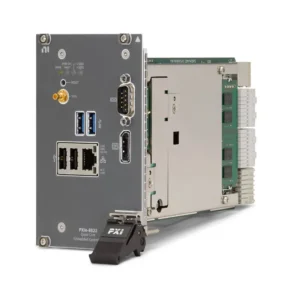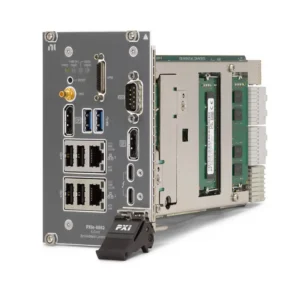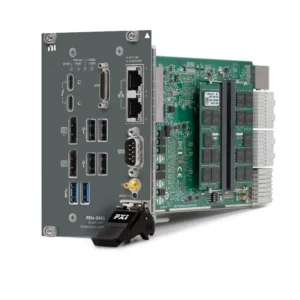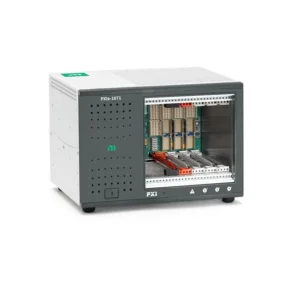


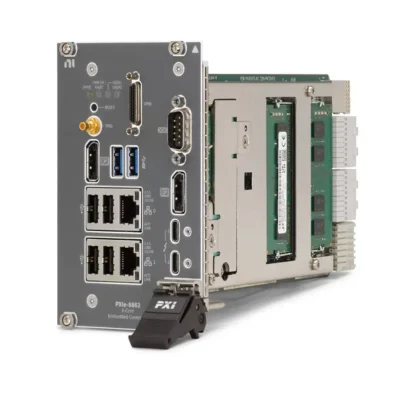


PXIe-8881 High-Performance Intel Xeon PXI Express Controller
Земля NI PXIe-8881 is a high-performance embedded controller designed for processor-intensive PXI Express test, measurement and automation systems. Depending on the selected configuration, it is available with a 4.1 GHz four-core, 3.9 GHz eight-core or 3.0 GHz eighteen-core Intel Xeon processor.
Every PXIe-8881 configuration provides up to 24 GB/s maximum controller-to-backplane bandwidth. The controller is suitable for high-throughput RF testing, modular instrumentation, semiconductor validation, high-speed data acquisition and other applications that combine several PXI Express instruments with intensive data processing.
The controller integrates M.2 NVMe solid-state storage, dual Gigabit Ethernet, two Thunderbolt 3 ports, DisplayPort, USB 3.2 Gen 1, USB 2.0, RS-232 serial, Mini-GPIB and an SMB trigger interface. Windows 10, Windows 11, NI Linux Real-Time and no-operating-system versions are available under configuration-specific part numbers.
Key Features of the PXIe-8881
- Four-core Intel Xeon W-2225 processor option
- Eight-core Intel Xeon W-2245 processor option
- Eighteen-core Intel Xeon W-2295 processor option
- Up to 4.6 GHz maximum Turbo frequency
- 16 GB, 32 GB or 64 GB standard memory, processor dependent
- 64 GB maximum supported DDR4 memory
- Quad-channel DDR4-2666 memory architecture
- 500 GB or greater M.2 NVMe solid-state drive
- 512 GB storage listed for current ordering configurations
- 24 GB/s maximum PXI Express controller bandwidth
- Four-link x4, x4, x4 and x4 backplane configuration
- Two-link x16 and x8 backplane configuration
- Two 10/100/1000BASE-T Ethernet ports
- IEEE 1588-capable Intel I210 Ethernet port
- Two Thunderbolt 3 USB Type-C ports
- One DisplayPort 1.2 video output
- Two USB 3.2 Gen 1 Type-A ports
- Four USB 2.0 Type-A ports
- One DB-9 RS-232 serial interface
- One Mini-GPIB IEEE 488 controller interface
- One SMB PXI trigger-bus input/output
- Windows 10 and Windows 11 IoT Enterprise options
- NI Linux Real-Time and no-OS options
- TPM 2.0 and no-TPM configurations
- 0°C to 55°C operating-temperature range
Three Intel Xeon Processor Options
The PXIe-8881 family offers three Intel Xeon processor configurations. This allows system designers to select between higher per-core frequency and a larger number of processor cores.
Intel Xeon W-2225 Four-Core Version
The four-core version uses the Intel Xeon W-2225 processor. It provides a 4.1 GHz base frequency, up to 4.6 GHz Turbo frequency and 8.25 MB of cache.
This configuration is suitable for applications that depend heavily on high single-thread performance. Examples include instrument drivers, legacy test programs and analysis routines that cannot effectively distribute their workload across many processor cores.
Intel Xeon W-2245 Eight-Core Version
The eight-core version uses the Intel Xeon W-2245 processor. It provides a 3.9 GHz base frequency, up to 4.5 GHz Turbo frequency and 16.5 MB of cache.
This version provides a balance between high clock frequency and multicore processing. It is appropriate for test systems that must control several instruments, process acquired data and execute test sequences simultaneously.
Intel Xeon W-2295 Eighteen-Core Version
The highest-core-count PXIe-8881 uses the Intel Xeon W-2295 processor. It provides 18 processor cores, a 3.0 GHz base frequency, up to 4.6 GHz Turbo frequency and 24.75 MB of cache.
The eighteen-core version is designed for heavily parallel processing. It can support multiple simultaneous measurements, parallel DUT testing, RF waveform analysis and computationally intensive validation applications.
Selecting Processor Frequency or Core Count
A larger number of cores does not automatically make every test application faster. Software that uses only one or two execution threads may perform better on the higher-frequency four-core or eight-core version.
The eighteen-core model provides the greatest benefit when the application can divide work across many independent threads. Examples include parallel test sockets, multiple simultaneous RF measurements, waveform-processing pipelines and concurrent analysis tasks.
Before selecting a processor, measure or estimate single-thread usage, parallel execution, memory consumption and expected background activity. The operating system and instrument drivers also consume processor resources.
Up to 64 GB DDR4 Memory
The PXIe-8881 uses quad-channel DDR4-2666 memory. Standard memory depends on the selected processor configuration.
- The four-core Xeon W-2225 version includes 16 GB and supports up to 64 GB.
- The eight-core Xeon W-2245 version includes 32 GB and supports up to 64 GB.
- The eighteen-core Xeon W-2295 version includes 64 GB.
Higher memory capacity supports large waveform buffers, multi-instrument applications, parallel test processes and data-analysis software. It can also reduce dependence on slower storage-based virtual memory.
Use compatible DDR4 modules and preserve the supported memory-channel arrangement. Incorrectly matched memory can reduce bandwidth or prevent the controller from starting.
M.2 NVMe Solid-State Storage
The PXIe-8881 uses a 500 GB or greater M.2 NVMe solid-state drive. Current NI ordering configurations list 512 GB of nonvolatile storage.
NVMe storage provides faster startup, application loading and test-data access than older SATA-based controller storage. The absence of mechanical components also improves resistance to vibration and shock.
The SSD stores the operating system, NI drivers, test software, configuration files and locally recorded results. Large RF captures and continuous acquisition data should be archived to an appropriately designed external or network storage system.
24 GB/s PXI Express Bandwidth
All processor configurations provide up to 24 GB/s maximum controller-to-backplane bandwidth. This high-throughput architecture is designed for data-intensive PXI Express instruments and multi-module systems.
The controller supports a four-link configuration of x4, x4, x4 and x4. It also supports a two-link configuration of x16 and x8. The actual connection to individual chassis slots depends on the PXI Express backplane topology.
Actual application throughput depends on the chassis, installed instruments, DMA implementation, record size, memory transfers, storage system and test software. The 24 GB/s rating is not a guaranteed sustained recording rate for the internal NVMe drive.
Два гигабитных Ethernet
Two RJ45 Ethernet interfaces support 10 Mbps, 100 Mbps and 1 Gbps operation. The first interface uses an Intel I219 controller and supports Wake-on-LAN. The second uses an Intel I210 controller and supports IEEE 1588.
Dual network ports can separate instrument or DUT communication from enterprise and production traffic. One port can connect to a private test network while the other communicates with databases, file servers or remote operators.
IEEE 1588 Network Timing
The Intel I210 Ethernet interface supports IEEE 1588 functionality for compatible network-timing applications. It can assist in coordinating timestamped data between networked devices and distributed measurement systems.
Final synchronization performance depends on the network switches, connected hardware, operating system and software configuration. IEEE 1588 capability on the controller does not by itself guarantee a specific system-level timing accuracy.
Two Thunderbolt 3 Ports
The PXIe-8881 provides two Thunderbolt 3 ports through USB Type-C connectors. The interfaces can support compatible Thunderbolt, USB, PCI Express and DisplayPort devices.
Thunderbolt connectivity can be used with supported external storage, displays and expansion peripherals. The specific peripheral, cable, operating system and driver combination must be verified before permanent installation.
Power supplied to Thunderbolt devices must be included in the complete chassis power budget. A USB Type-C connector or cable does not necessarily support Thunderbolt data rates or functionality.
DisplayPort 1.2 Video Output
One DisplayPort 1.2 connector supports a local monitor for operating-system setup, BIOS configuration, software development, diagnostics and test-station operation.
NI includes a 7-inch DisplayPort-to-VGA adapter cable with the controller. A direct DisplayPort connection is preferable when a compatible digital display is available.
USB Peripheral Connections
The controller includes two USB 3.2 Gen 1 Type-A ports and four USB 2.0 Type-A ports. The USB 3.2 Gen 1 interfaces are suitable for higher-throughput peripherals, while the USB 2.0 ports can support keyboards, mice and software-license devices.
USB 3.2 Gen 1 ports are backward compatible with USB 2.0 equipment. Bus-powered devices must remain within the electrical limits of the controller and PXI Express chassis.
RS-232 Serial Interface
A DB-9 RS-232 port provides communication with serial instruments, environmental chambers, programmable devices and legacy test fixtures.
Reliable serial communication requires compatible baud rate, parity, data bits, stop bits and flow-control settings. The cable must also have the correct straight-through or null-modem pinout for the connected device.
Mini-GPIB Instrument Control
A Mini-GPIB connector allows the PXIe-8881 to communicate with IEEE 488 instruments. This enables existing oscilloscopes, power supplies, signal generators and other laboratory equipment to be included in a modern PXI Express test system.
A compatible Mini-GPIB cable or adapter is required for conventional full-size GPIB connections. NI-488.2 software must be installed, and each instrument must use a unique GPIB address.
PXI Trigger Bus Connection
The front-panel SMB connector can route PXI trigger signals between external equipment and the chassis backplane. It can be used to initiate measurements from an external event or export a PXI trigger to another instrument.
Trigger direction, backplane line and signal compatibility must be configured correctly. The SMB connection is intended for timing and control signals rather than general analog measurements.
82 W Per-Slot Cooling Requirement
The PXIe-8881 requires a PXI Express chassis capable of providing 82 W of cooling per slot. This is a critical compatibility requirement and must be checked before installation.
A chassis may be mechanically compatible while lacking sufficient cooling for the controller. Inadequate airflow can cause processor throttling, reduced performance or unreliable operation.
NI notes that the processor may throttle under maximum workloads when ambient temperature exceeds 40°C. Use the appropriate chassis fan setting and maintain clear intake and exhaust paths.
Windows and Real-Time Options
The PXIe-8881 is available with Windows 10 IoT Enterprise, Windows 11 IoT Enterprise, NI Linux Real-Time or no preinstalled operating system.
Windows 10 IoT Enterprise
Windows 10 configurations support compatible desktop applications, LabVIEW, TestStand, InstrumentStudio and third-party software. Several Windows 10 part numbers are available for different processor and TPM combinations.
Windows 11 IoT Enterprise
Windows 11 configurations are available for selected eight-core and eighteen-core controllers. These versions are appropriate when current Windows support and organizational security requirements are important.
NI Linux Real-Time
The eight-core configuration is available with NI Linux Real-Time for supported deterministic test and control applications. Verify driver compatibility for every installed PXI module before ordering.
No Operating System
A no-OS eight-core configuration allows qualified system integrators to install and manage their own supported software image. Operating-system licensing, drivers, recovery and technical compatibility become the system owner’s responsibility.
PXIe-8881 Technical Specifications
| Product Model | PXIe-8881 |
|---|---|
| Product Type | High-performance PXI Express embedded controller |
| Processor Options | Intel Xeon W-2225, W-2245 or W-2295 |
| Processor Core Options | 4, 8 or 18 cores |
| Four-Core Base Frequency | 4.1 GHz |
| Four-Core Maximum Turbo | 4.6 GHz |
| Four-Core Cache | 8.25 MB |
| Eight-Core Base Frequency | 3.9 GHz |
| Eight-Core Maximum Turbo | 4.5 GHz |
| Eight-Core Cache | 16.5 MB |
| Eighteen-Core Base Frequency | 3.0 GHz |
| Eighteen-Core Maximum Turbo | 4.6 GHz |
| Eighteen-Core Cache | 24.75 MB |
| Memory Type | Quad-channel DDR4-2666 |
| Four-Core Standard Memory | 16 GB |
| Eight-Core Standard Memory | 32 GB |
| Eighteen-Core Standard Memory | 64 GB |
| Maximum Memory | 64 GB |
| Хранение | 500 GB or greater M.2 NVMe SSD; 512 GB on current ordering configurations |
| Removable Storage | No |
| Maximum Controller Bandwidth | 24 ГБ/с |
| Four-Link Configuration | x4, x4, x4, x4 |
| Two-Link Configuration | x16 and x8 |
| Ethernet | 2 × 10/100/1000BASE-T RJ45 ports |
| Ethernet Controllers | Intel I219 with Wake-on-LAN and Intel I210 with IEEE 1588 |
| Thunderbolt | 2 × Thunderbolt 3 USB Type-C ports |
| USB 3.2 Gen 1 | 2 × Type-A ports |
| USB 2.0 | 4 × Type-A ports |
| Video Output | 1 × DisplayPort 1.2 |
| Serial Interface | 1 × DB-9 RS-232 port |
| GPIB | 1 × Mini-GPIB IEEE 488 controller |
| Trigger Interface | 1 × SMB PXI trigger-bus input/output |
| Operating System Options | Windows 10 IoT, Windows 11 IoT, NI Linux Real-Time or no OS |
| Module Format | Four-wide 3U PXI Express module |
| Slot Requirement | One system slot plus three controller expansion slots |
| Cooling Requirement | PXI Express chassis with 82 W per-slot cooling capacity |
| Совместимость с PXI | PXI Express Specification 1.0 |
| Typical Weight | 1.6 kg |
| Operating Temperature | 0°C to 55°C |
| Operating Humidity | 10% to 90%, noncondensing |
| Storage Temperature | -40°C to 71°C |
| Storage Humidity | 5% to 95%, noncondensing |
| Maximum Altitude | 2,000 m at 25°C with chassis fans set to high |
| Operational Shock | 30 g peak, half-sine, 11 ms pulse |
| Operating Random Vibration | 5 Hz to 500 Hz, 0.3 grms |
| Nonoperating Random Vibration | 5 Hz to 500 Hz, 2.4 grms |
| Operating Environment | Indoor use, Pollution Degree 2 |
Processor-Specific Electrical Requirements
| Процессор | Power Rail | Typical Current | Максимальный ток |
|---|---|---|---|
| Xeon W-2225, 4-Core | +3.3 V | 2.3 A | 2.5 A |
| Xeon W-2225, 4-Core | +5 V | 4.0 A | 4.1 A |
| Xeon W-2225, 4-Core | +12 V | 11.5 A | 20 A |
| Xeon W-2245, 8-Core | +12 V | 14.6 A | 20 A |
| Xeon W-2295, 18-Core | +12 V | 15.5 A | 22 A |
| All Versions | +5 V auxiliary | 0.5 A | 0.7 A |
The electrical specifications do not include external USB or Thunderbolt loads. Include the controller, all PXI modules and all bus-powered peripherals when calculating chassis power and cooling requirements.
PXIe-8881 Part Number and Accessories
| Part Number | Процессор | Операционная система | TPM | Хранение |
|---|---|---|---|---|
| 787807-01 | Xeon W-2225, 4 cores | Windows 10 IoT LTSC 21H2, 64-bit | TPM 2.0 | 512 GB NVMe SSD |
| 786636-01 | Xeon W-2245, 8 cores | Windows 10 IoT LTSC 21H2, 64-bit | TPM 2.0 | 512 GB NVMe SSD |
| 787805-01 | Xeon W-2245, 8 cores | Windows 10 IoT LTSC 21H2, 64-bit | No TPM | 512 GB NVMe SSD |
| 787806-01 | Xeon W-2295, 18 cores | Windows 10 IoT LTSC 21H2, 64-bit | TPM 2.0 | 512 GB NVMe SSD |
| 789431-01 | Xeon W-2245, 8 cores | Windows 11 IoT LTSC 24H2, 64-bit | TPM 2.0 | 512 GB NVMe SSD |
| 790697-01 | Xeon W-2295, 18 cores | Windows 11 IoT LTSC 24H2, 64-bit | TPM 2.0 | 512 GB NVMe SSD |
| 787805-33 | Xeon W-2245, 8 cores | NI Linux Real-Time | No TPM | 512 GB NVMe SSD |
| 786636-00 | Xeon W-2245, 8 cores | No operating system | TPM 2.0 | 512 GB NVMe SSD |
The PXIe-8881 model name does not identify the processor, memory, operating system or TPM configuration. Always use the full NI part number when requesting a quotation or replacement controller.
Included Items
- PXIe-8881 controller in the selected configuration
- 7-inch DisplayPort-to-VGA adapter cable
- Recovery media for the installed operating system
- Safety, environmental and regulatory documentation
Recommended Supporting Hardware
- Compatible PXI Express chassis providing at least 82 W per-slot cooling
- DisplayPort monitor, USB keyboard and mouse
- Mini-GPIB cable for IEEE 488 instruments
- Cat 5e or better Ethernet cables
- Certified Thunderbolt 3 cables
- Compatible external or network storage
- Supported DDR4 memory modules for qualified upgrades
- PXI Express instruments and cables required by the test application
Recommended Software
- LabVIEW for test and measurement development
- TestStand for automated sequencing and result management
- InstrumentStudio for supported instrument configuration
- NI Linux Real-Time for deterministic applications
- NI-DAQmx for compatible DAQ hardware
- NI-RFSA and NI-RFSG for compatible RF instruments
- NI-488.2 for GPIB communication
- NI-VISA for compatible instrument-control interfaces
Selecting the Correct PXIe-8881 Configuration
Select the four-core model when high single-thread performance is more important than extensive parallelism. Choose the eight-core model for a balanced combination of clock speed, core count and 32 GB standard memory.
Select the eighteen-core model for heavily parallel analysis or multi-DUT applications that can use many processing threads. Then choose Windows 10, Windows 11, NI Linux Real-Time or no OS according to software requirements.
Confirm TPM requirements and verify that the selected chassis provides 82 W per-slot cooling before placing the order.
PXIe-8881 Applications
Processor-Intensive RF Testing
The PXIe-8881 can coordinate compatible vector signal transceivers, signal analyzers, signal generators and RF switching modules. Its processor options allow the system to balance single-thread measurement speed against highly parallel waveform processing.
The 24 GB/s backplane bandwidth supports large RF data transfers between compatible instruments and controller memory. High-core-count versions can process several measurement records or DUT channels simultaneously.
Анализ широкополосных сигналов
Wideband RF and digitizer systems can generate large waveform records that require substantial memory and processing. The PXIe-8881 supports up to 64 GB of RAM for buffering and analysis.
Final throughput depends on instrument bandwidth, acquisition length, analysis software and data-storage requirements. The complete system should be benchmarked using representative waveforms.
Parallel Multi-DUT Testing
The eighteen-core controller can support applications that divide testing across multiple devices. Separate execution threads can control instruments, process measurements and evaluate limits for different test sockets.
Effective parallel testing also requires sufficient instrument channels, switching capacity, memory bandwidth and test-software architecture. Processor core count alone does not guarantee linear throughput improvement.
High-Speed Data Acquisition
The PXIe-8881 can control high-speed digitizers, multifunction DAQ modules and FPGA-based acquisition hardware. Its NVMe storage and high backplane bandwidth provide a strong platform for burst acquisition and data processing.
Continuous streaming systems must calculate aggregate channel data rate, memory buffering, storage throughput and analysis load. External high-performance storage may be required for sustained recording.
Валидация полупроводников
Semiconductor test systems can combine the controller with SMUs, digital pattern instruments, digitizers, waveform generators and switch matrices. High-frequency and high-core-count versions support different characterization and production workloads.
Automated software can coordinate stimulus, measurements, limit evaluation, binning and result storage from one PXI Express platform.
Automated Production Testing
The controller can operate a complete production station, communicate with factory databases and execute test sequences. Dual Ethernet ports can separate DUT communication from manufacturing-network traffic.
TestStand can manage test sequences and results, while LabVIEW or supported text-based applications control instruments and perform custom analysis.
Hardware-in-the-Loop Testing
The NI Linux Real-Time configuration can support compatible deterministic control and hardware-in-the-loop applications. The controller may be combined with FPGA, DAQ, vehicle-bus and fault-insertion modules.
Confirm driver support, loop-rate requirements, processor affinity, interrupt behavior and system jitter before using the controller in a critical real-time application.
Research and Scientific Computing
Research systems can use the eighteen-core controller for parallel mathematical processing and the four-core version for high-frequency single-thread operations. PXI Express instrumentation provides synchronized data acquisition and stimulus within the same platform.
Aerospace and Defense Test
The PXIe-8881 can coordinate RF, avionics communication, data-acquisition and switching modules used for electronic subsystem validation. Integrated GPIB and serial interfaces also support external equipment.
The complete system must be evaluated for application-specific safety, environmental, cybersecurity and export-control requirements.
PXIe-8881 Installation Workflow
Step 1: Verify the Part Number
Confirm the processor, memory, operating system, TPM and storage configuration associated with the complete NI part number.
Step 2: Confirm the Cooling Requirement
Verify that the chassis provides at least 82 W per-slot cooling capacity. Do not install the controller based only on mechanical compatibility.
Step 3: Confirm Available Chassis Space
The four-wide controller requires the system-controller slot and three adjacent controller expansion slots. Remove any filler panels or modules occupying these positions.
Step 4: Calculate the Power Budget
Use the electrical table for the selected processor. The eighteen-core version can require as much as 22 A from the +12 V rail. Include all PXI modules and USB or Thunderbolt loads.
Step 5: Apply ESD Protection
Keep the controller in its antistatic package until installation. Ground yourself before handling it and avoid touching exposed backplane connectors or circuit components.
Step 6: Power Off the Chassis
Connect the chassis to protective ground according to its manual but leave power off while installing the controller.
Step 7: Install the PXIe-8881
Lower the injector/ejector handle, align the controller with the upper and lower guides and slide it into the system-controller slot. Use the handle to seat the backplane connectors and secure the front-panel screws.
Step 8: Connect Peripherals
Connect the DisplayPort monitor, keyboard and mouse when local setup is required. Attach Ethernet, Thunderbolt, serial, GPIB and trigger cables according to the system design.
Step 9: Start the Controller
Power on the chassis and monitor the LEDs and display output. Enter the BIOS only when boot, power, processor, security or real-time configuration requires adjustment.
Step 10: Configure the Operating System
Complete Windows or NI Linux Real-Time setup. Configure network addresses, accounts, time settings, security policy and remote access.
Step 11: Install Drivers and Software
Install the required NI platform software and drivers for every PXI module. Verify compatibility with the controller’s exact Windows or Linux Real-Time version.
Step 12: Verify System Recognition
Confirm that the chassis and installed modules appear correctly in NI Measurement & Automation Explorer or the applicable real-time configuration tool.
Step 13: Perform a Full-Load Thermal Test
Run representative instrument and analysis workloads while monitoring processor temperature, CPU frequency and chassis airflow. The processor may throttle above 40°C ambient under maximum load.
Step 14: Create a Recovery Plan
Preserve recovery media and create a validated system backup. Document the BIOS, operating system, drivers, network configuration, application versions and software licenses.
PXIe-8881 Troubleshooting
The Controller Does Not Power On
Recommended Checks
Verify chassis power and confirm that the chassis supports the controller’s electrical load. Reseat the controller in the system slot and temporarily disconnect unnecessary USB and Thunderbolt peripherals.
The Chassis Is Mechanically Compatible but the Controller Overheats
Recommended Checks
Confirm that the chassis provides 82 W per-slot cooling. Check fan mode, air filters, inlet temperature and airflow around adjacent modules. Mechanical fit does not guarantee sufficient thermal performance.
The Processor Frequency Drops Under Load
Recommended Checks
Check ambient temperature and chassis airflow. NI notes that throttling can occur above 40°C when the processor operates at maximum workload. Set the chassis fans appropriately and reduce airflow restrictions.
The PXIe-8881 Does Not Boot
Recommended Checks
Disconnect unnecessary bootable USB devices and review the BIOS boot order. Confirm that the NVMe SSD is detected. Restore BIOS defaults only after recording required custom settings.
PXI Express Modules Are Missing
Recommended Checks
Power down and reseat the affected modules. Verify chassis slot compatibility, backplane topology and installed drivers. Check whether the issue affects one module, one chassis segment or the complete system.
Application Throughput Is Below 24 GB/s
Recommended Checks
Review the chassis link topology, peripheral-module bandwidth and DMA configuration. Monitor CPU, memory and storage activity. The 24 GB/s value is the controller’s maximum backplane capability rather than guaranteed application throughput.
The NVMe Drive Cannot Sustain Acquisition
Recommended Checks
Measure the actual storage write rate and compare it with the acquisition data rate. Use larger buffers, segmented acquisition, data reduction or qualified external storage when continuous streaming exceeds SSD capability.
An Ethernet Port Operates Slowly
Recommended Checks
Confirm Gigabit link negotiation, cable quality and network-switch configuration. Test the two ports separately and verify that the application uses the intended interface.
A Thunderbolt Device Is Not Recognized
Recommended Checks
Use a certified Thunderbolt 3 cable and confirm peripheral, operating-system and driver compatibility. Test without intermediate docks or adapters and verify the device’s power requirements.
A GPIB Instrument Does Not Respond
Recommended Checks
Install NI-488.2, inspect the Mini-GPIB cable and confirm the instrument address. Test one instrument before reconnecting the complete bus.
RS-232 Communication Fails
Recommended Checks
Verify baud rate, parity, data bits, stop bits and flow control. Check whether the device requires straight-through or null-modem wiring.
NI Linux Real-Time Deployment Fails
Recommended Checks
Confirm that the controller is the NI Linux Real-Time part number and that host tools, runtime software and PXI drivers use compatible versions.
Windows Security Features Are Unavailable
Recommended Checks
Verify whether the exact controller part number includes TPM 2.0. The 787805-01 and 787805-33 configurations are specified without TPM.
Memory Usage Is Excessive
Recommended Checks
Monitor application buffers, waveform copies and parallel test processes. Reduce unnecessary data duplication or select a configuration with additional memory.
PXIe-8881 Comparison
| Модель | Процессор | Maximum Bandwidth | Best Suited For |
|---|---|---|---|
| PXIe-8842 | Six-core Intel Core i5 | 8 GB/s | Multifunction DAQ and moderate streaming |
| PXIe-8861 | Quad-core Intel Xeon | 16 GB/s | Processor-intensive RF and DAQ applications |
| PXIe-8880 | Eight-core Intel Xeon E5 | 24 ГБ/с | Established high-bandwidth PXI systems |
| PXIe-8881 | Four-, eight- or eighteen-core Intel Xeon W | 24 ГБ/с | High-frequency or highly parallel test workloads |
| PXIe-8862 | Eight-core Intel Core i7 | Configuration dependent | Modern high-performance automated testing |
PXIe-8881 vs PXIe-8880
Both controllers provide up to 24 GB/s of PXI Express bandwidth. The PXIe-8880 uses an older eight-core Intel Xeon E5 processor, while the PXIe-8881 offers newer four-, eight- and eighteen-core Xeon W configurations.
The PXIe-8881 also provides NVMe storage, up to 64 GB of DDR4 memory, Thunderbolt 3 and newer operating-system options. The PXIe-8880 may remain appropriate for maintaining validated legacy systems.
PXIe-8881 vs PXIe-8861
The PXIe-8861 provides a 2.8 GHz quad-core Xeon processor and 16 GB/s controller bandwidth. The PXIe-8881 provides faster processor options, up to 18 cores, up to 64 GB memory and 24 GB/s bandwidth.
Select the PXIe-8861 when its performance and established configuration meet the application. Choose the PXIe-8881 for heavier processing, higher aggregate data transfer or larger memory requirements.
PXIe-8881 vs PXIe-8842
The PXIe-8842 is a balanced six-core controller with 8 GB/s bandwidth, dual 2.5GbE and Thunderbolt 4. The PXIe-8881 provides substantially more processor and memory options with up to 24 GB/s backplane bandwidth.
The PXIe-8842 is appropriate for moderate-streaming and general automated test systems. The PXIe-8881 is intended for demanding RF, digitizer and parallel-processing applications.
PXIe-8881 vs PXIe-8862
The PXIe-8862 provides a newer eight-core Intel Core i7 platform with modern connectivity. The PXIe-8881 provides Xeon W processor choices and supports as many as 18 cores.
Choose according to actual processor benchmarks, memory requirements, backplane throughput, chassis cooling, operating-system compatibility and peripheral interfaces.
Four-Core vs Eight-Core vs Eighteen-Core PXIe-8881
| Конфигурация | Primary Advantage | Recommended Workload |
|---|---|---|
| Four-Core | Highest base frequency | Single-thread-sensitive instrument control and legacy applications |
| Eight-Core | Balanced frequency and parallelism | RF test, DAQ and multi-instrument automation |
| Eighteen-Core | Maximum parallel-processing capacity | Parallel DUT testing and computationally intensive analysis |
Recommended Related Products
- PXIe-8880 Eight-Core Xeon PXI Controller
- PXIe-8861 Quad-Core Xeon PXI Controller
- PXIe-8862 Eight-Core PXI Express Controller
- PXIe-8842 Six-Core PXI Express Controller
- PXIe-1095 High-Bandwidth PXI Express Chassis
- PXIe-1092 PXI Express Chassis
- PXIe-1085 PXI Express Chassis
- View More NI PXI Controllers
Why Choose the PXIe-8881?
- Offers four-, eight- and eighteen-core Intel Xeon processors
- Provides up to 4.6 GHz Turbo frequency
- Supports up to 64 GB DDR4 memory
- Delivers up to 24 GB/s controller bandwidth
- Uses high-speed M.2 NVMe storage
- Provides dual Gigabit Ethernet interfaces
- Includes two Thunderbolt 3 ports
- Supports DisplayPort and six USB ports
- Integrates RS-232 and GPIB instrument control
- Supports Windows 10, Windows 11 and NI Linux Real-Time
- Suitable for RF, semiconductor, DAQ and parallel testing
Frequently Asked Questions
What is the PXIe-8881?
The PXIe-8881 is a high-performance four-wide embedded controller for PXI Express systems. It provides the processor, memory, storage and peripheral interfaces required to operate a compatible chassis.
Which processors are available?
Options include the four-core Intel Xeon W-2225, eight-core Xeon W-2245 and eighteen-core Xeon W-2295.
Which version has the highest base frequency?
The four-core Xeon W-2225 version has the highest base frequency at 4.1 GHz.
Which version provides the most processor cores?
The Xeon W-2295 configuration provides 18 processor cores.
What is the maximum Turbo frequency?
The four-core and eighteen-core versions support up to 4.6 GHz Turbo frequency. The eight-core version supports up to 4.5 GHz.
What is the maximum PXI Express bandwidth?
All configurations provide up to 24 GB/s between the controller and a compatible PXI Express backplane.
How much memory is installed?
The four-core version includes 16 GB, the eight-core version includes 32 GB and the eighteen-core version includes 64 GB.
What is the maximum supported memory?
The PXIe-8881 supports up to 64 GB of quad-channel DDR4-2666 memory.
What storage does the PXIe-8881 use?
It uses a 500 GB or greater M.2 NVMe SSD. Current ordering configurations list 512 GB.
Does it support Windows 11?
Yes. Windows 11 IoT Enterprise LTSC 24H2 configurations are available for selected eight-core and eighteen-core versions.
Can it run NI Linux Real-Time?
Yes. Part number 787805-33 is an eight-core NI Linux Real-Time configuration without TPM.
Is a no-OS configuration available?
Yes. Part number 786636-00 is an eight-core configuration without a preinstalled operating system.
Does every version include TPM 2.0?
No. Both TPM and no-TPM versions are available. The full part number must be checked when TPM is required.
How many Ethernet ports are provided?
Two Gigabit Ethernet ports are included. One supports Wake-on-LAN and the other supports IEEE 1588.
How many Thunderbolt ports are included?
The PXIe-8881 provides two Thunderbolt 3 ports using USB Type-C connectors.
Does the controller include GPIB?
Yes. One Mini-GPIB IEEE 488 controller interface is included.
Does it include an RS-232 port?
Yes. The front panel provides one DB-9 RS-232 serial port.
How many USB ports are available?
The controller provides two USB 3.2 Gen 1 ports and four USB 2.0 ports.
How many chassis slots does it occupy?
It occupies the system-controller slot and three adjacent controller expansion slots.
Can it be installed in any PXI Express chassis?
No. The chassis must be mechanically and electrically compatible and must provide at least 82 W per-slot cooling capacity.
What is the operating-temperature range?
The specified range is 0°C to 55°C. Processor throttling may occur above 40°C ambient when operating at maximum workload.
Is the PXIe-8881 suitable for RF testing?
Yes. Its high processor performance, large memory and 24 GB/s backplane bandwidth make it suitable for processor-intensive RF and wireless testing.
Which version is best for parallel DUT testing?
The eighteen-core version is generally the strongest choice for software that can distribute testing and analysis across many processor cores.
Which version is best for single-thread performance?
The four-core Xeon W-2225 version provides the highest base frequency and may be preferable for workloads that cannot use many cores.
Does the controller require an external computer?
No. The PXIe-8881 functions as the embedded computer for the PXI Express chassis.
What should be verified before purchasing a PXIe-8881?
Confirm the processor, memory, operating system, TPM, SSD, chassis cooling capacity and required instrument-driver versions.
Request a Quote for the PXIe-8881
Contact us for current availability, lead time and project pricing for the NI PXIe-8881 High-Performance Intel Xeon PXI Express Embedded Controller. Please specify the required processor core count, operating system and TPM configuration.
We can also help identify compatible PXI Express chassis, memory, NVMe storage, GPIB cables and related controllers for RF, semiconductor, data-acquisition and automated production test systems.