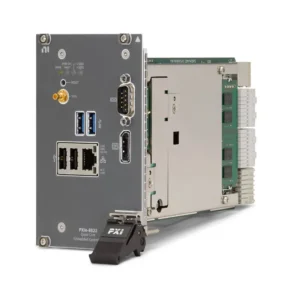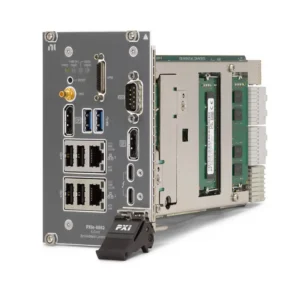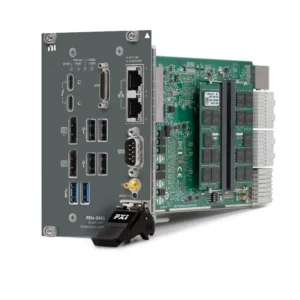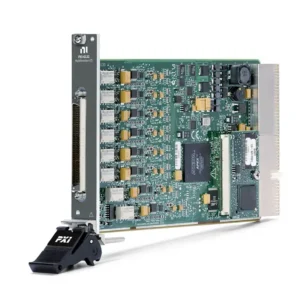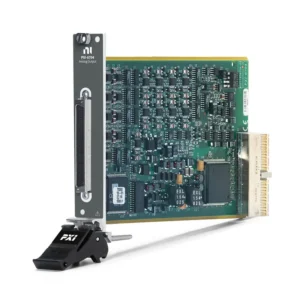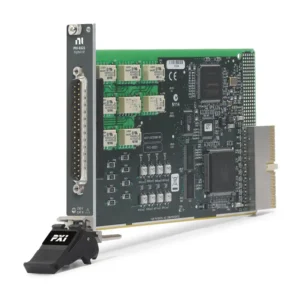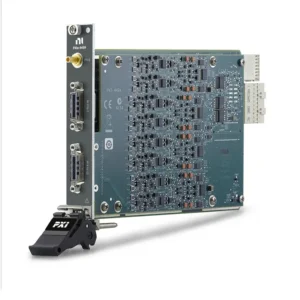


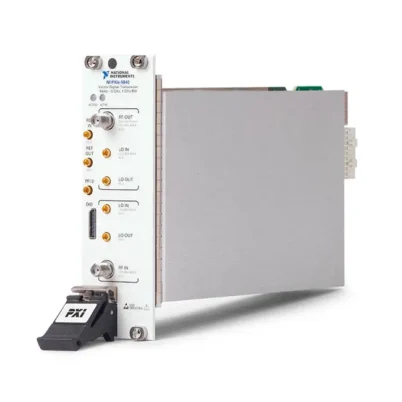
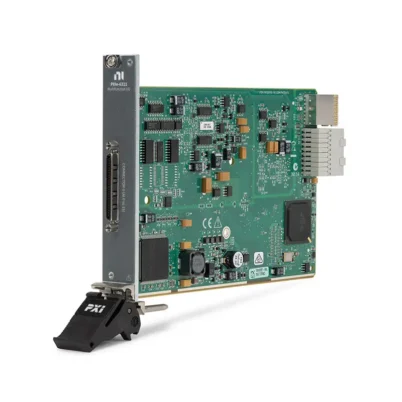
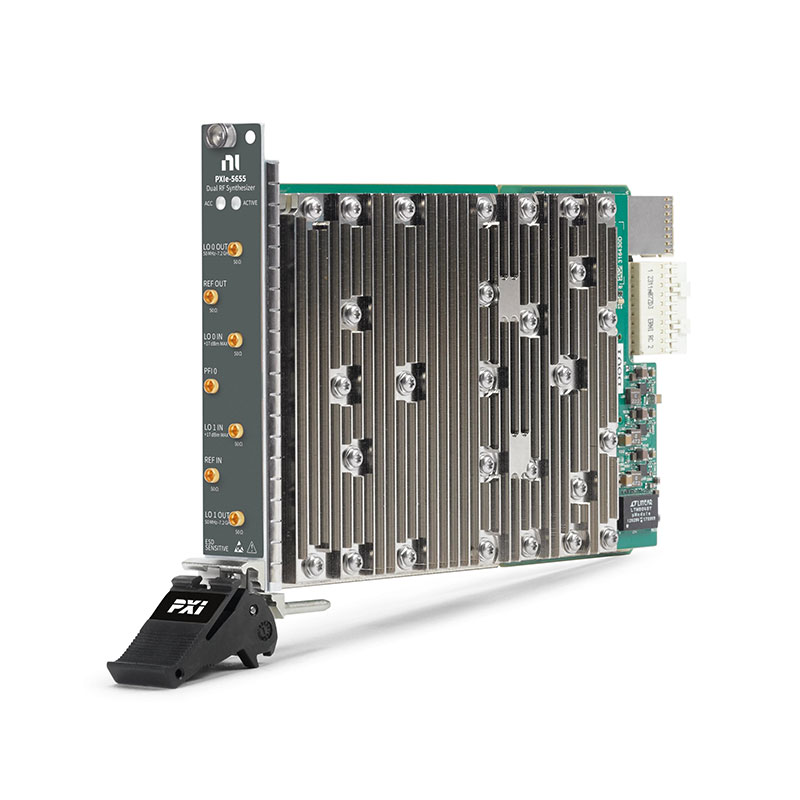
PXIe-5655 7.2 GHz Dual Local Oscillator Signal Generator
Земля PXIe-5655 is a dual-channel PXI Express local oscillator module covering frequencies from 50 MHz to 7.2 GHz. It is designed primarily to operate with compatible NI vector signal transceivers such as the PXIe-5841 and supported PXIe-5842 configurations.
The module provides two independently routable local-oscillator paths, low phase noise, fast frequency tuning, programmable output power and an internal 10 MHz oven-controlled reference oscillator. Depending on the hardware version, RF connections use MMPX or SMA connectors.
Key Features of the PXIe-5655
- Dual local-oscillator architecture
- 50 MHz to 7.2 GHz frequency range
- 1 Hz frequency-tuning resolution
- -2 dBm to +10 dBm programmable output power
- Fast frequency settling below 250 µs
- Low phase-noise performance
- Internal 10 MHz OCXO reference
- External reference input support
- 10 MHz reference output
- External LO input and loopback routing
- MMPX or SMA connector versions
- 50 Ω AC-coupled RF paths
- Designed for PXIe-5841 and PXIe-5842 integration
- One-slot PXI Express module
PXIe-5655 Technical Specifications
| Product Model | PXIe-5655 |
|---|---|
| Commonly Listed Part Number | 786586-02 |
| Product Type | Dual local oscillator and PXI RF analog signal generator |
| LO Frequency Range | 50 MHz to 7.2 GHz |
| Frequency Resolution | 1 Hz |
| LO Output Power Range | -2 dBm to +10 dBm |
| LO Input Range | -6 dBm to +6 dBm |
| LO Output Absolute Maximum | +18 dBm |
| LO Input Absolute Maximum | +17 dBm |
| LO Path Impedance | 50 Ω nominal |
| LO Coupling | AC coupled |
| Frequency Settling Without Band Transition | Less than 100 µs to 1 ppm; less than 130 µs to 0.1 ppm |
| Frequency Settling with Band Transition | Less than 230 µs to 1 ppm; less than 250 µs to 0.1 ppm |
| Typical Amplitude Settling | 40 µs to 0.5 dB; 70 µs to 0.1 dB |
| Internal Reference | 10 MHz OCXO |
| Initial Reference Accuracy | ±60 ppb under specified calibration conditions |
| Reference Output | 10 MHz, approximately 1.65 Vpk-pk into 50 Ω |
| RF Connector Versions | MMPX female or SMA female |
| Nominal Power Consumption | 33 W |
| Dimensions | 20.5 mm × 129 mm × 211 mm |
| Weight | Approximately 570 g |
| Calibration Interval | 1 year |
PXIe-5655 Versions and Connectivity
| Item | Part Number | Описание |
|---|---|---|
| PXIe-5655 | 786586-02 | Commonly listed PXIe-5655 dual local-oscillator configuration |
| MMPX Version | Confirm complete part number | MMPX female LO, reference and synchronization connections |
| SMA Version | Confirm complete part number | SMA female version used in supported instrument configurations |
| 47 mm MMPX Cable | System dependent | Connects the PXIe-5655 to an adjacent compatible vector signal transceiver |
Connector style must be confirmed before ordering. An MMPX cable cannot be connected directly to an SMA-only version without suitable RF adaptation, and incorrect cable length may prevent proper adjacent-module installation.
Dual Local-Oscillator Architecture
The PXIe-5655 provides LO 0 and LO 1 signal paths. Each path includes input and output connectivity that supports generated LO signals or external-LO loopback operation.
Dual-channel operation can support compatible multi-band or multi-port vector signal-transceiver architectures where two synchronized local oscillators are required.
50 MHz to 7.2 GHz Frequency Range
The module tunes from 50 MHz to 7.2 GHz with 1 Hz programming resolution. This range covers many sub-6 GHz wireless, aerospace, defense and RF test applications while extending above 6 GHz for supported VST configurations.
The PXIe-5655 is primarily a local-oscillator subsystem. It should not automatically be treated as a general-purpose calibrated RF stimulus generator for direct DUT testing.
Programmable LO Output Power
LO output power can be programmed from -2 dBm to +10 dBm. The correct level depends on the requirements of the connected mixer, transceiver or signal path.
Exceeding the maximum LO input or output ratings can damage the module. Check external source power, DC content and connector routing before enabling an RF path.
Fast Frequency and Amplitude Settling
Frequency steps that remain within one internal band can settle to within 1 ppm in less than 100 µs. Steps crossing the internal transition near 6.3 GHz require additional settling time.
Fast tuning supports frequency-list execution and multi-band RF test sequences. Complete system settling also depends on the associated VST and test application.
Low Phase Noise
Low local-oscillator phase noise helps preserve modulation quality and receiver measurement performance. NI specifies phase-noise performance at representative frequencies such as 2.4, 5.8 and 7.2 GHz.
Actual system phase noise includes the frequency reference, PXIe-5655, connected transceiver and any external distribution components.
Internal and External Frequency References
The internal 10 MHz OCXO provides a stable frequency reference for both oscillator channels. A reference output allows the internal reference to be shared with compatible equipment.
The reference input supports several specified clock frequencies, including 10 MHz, 100 MHz and 270 MHz, plus selected multiples of 3.84 MHz. Confirm the required amplitude and frequency before connection.
PXIe-5841 and PXIe-5842 Integration
The PXIe-5655 is commonly installed directly beside a compatible PXIe-5841 vector signal transceiver. Short matched RF cables connect the LO paths between modules.
Supported versions of the PXIe-5842 vector signal transceiver can also use the PXIe-5655 as part of their local-oscillator architecture. Follow the model-specific interconnection diagram rather than selecting ports by connector appearance alone.
Chassis Cooling Requirements
The PXIe-5655 consumes approximately 33 W and requires a chassis with at least 38 W of slot cooling. Full 0°C to 55°C operation requires a suitable high-power cooling configuration.
Install slot blockers and EMC filler panels in empty chassis positions and use the fan mode specified for the instrument configuration.
Typical PXIe-5655 Applications
- PXIe-5841 vector signal-transceiver expansion
- Supported PXIe-5842 RF test systems
- Dual local-oscillator generation
- Wireless device characterization
- RF semiconductor testing
- Phase-noise-sensitive measurements
- Frequency-agile RF test sequences
- Aerospace and defense RF validation
- Multi-band transceiver testing
- Automated production RF test
Software and System Control
The PXIe-5655 is normally configured as part of the associated vector signal-transceiver instrument rather than operated as an unrelated standalone module.
Use the driver and soft front panel specified for the complete VST configuration. The installed software must support the PXIe-5655 hardware revision and connected VST.
PXIe-5655 Troubleshooting
The associated VST does not recognize the PXIe-5655
Confirm that the two modules occupy the required adjacent slots and that every LO and reference cable follows the NI interconnection diagram.
No LO output is detected
Check the enabled LO path, requested frequency, programmed power and connector assignment. Verify whether the configuration expects internally generated or external loopback operation.
Frequency lock fails
Inspect the external reference frequency, power and lock range. If using the internal reference, allow the specified warm-up period and check calibration status.
Phase-noise performance is worse than expected
Confirm the reference source, cable integrity, chassis cooling and connected VST configuration. Remove unnecessary adapters and inspect RF connectors for damage.
The module becomes unusually hot
Verify that the chassis provides sufficient per-slot cooling and that empty positions contain the recommended slot blockers and filler panels.
An RF cable does not fit
Check whether the module is the MMPX or SMA version. Do not force an incompatible connector or substitute a cable with an incorrect mechanical length.
PXIe-5655 vs PXIe-5652
| Функция | PXIe-5655 | PXIe-5652 |
|---|---|---|
| Primary Function | Dual local oscillator for compatible VSTs | General RF analog signal generation |
| Максимальная частота | 7.2 GHz | Model configuration dependent |
| Direct DUT Stimulus | Not its primary role | Designed for RF stimulus generation |
| Best Suited For | PXIe-5841 and PXIe-5842 LO systems | Standalone automated RF generation |
Recommended Related Products
- PXIe-5841 Vector Signal Transceiver
- PXIe-5842 Vector Signal Transceiver
- PXIe-5652 RF Signal Generator
- PXIe-5840 Vector Signal Transceiver
- PXIe-5672 Vector Signal Generator
- PXIe-1095 High-Power PXI Express Chassis
- View More NI PXI Modules
Frequently Asked Questions
What is the PXIe-5655?
The PXIe-5655 is a dual-output local-oscillator module covering 50 MHz to 7.2 GHz for compatible NI vector signal-transceiver systems.
Is it a conventional standalone RF signal generator?
Not primarily. It is designed mainly as a local-oscillator companion for supported PXIe-5841 and PXIe-5842 configurations.
How many LO paths does it provide?
It provides two local-oscillator paths, identified as LO 0 and LO 1.
What is the output-power range?
The programmable LO output range is -2 dBm to +10 dBm.
Does it contain an internal frequency reference?
Yes. It contains a 10 MHz oven-controlled crystal oscillator.
Are all PXIe-5655 modules equipped with the same connectors?
No. MMPX and SMA versions exist, so the complete part number and front-panel connector type must be verified.
What is the commonly listed part number?
A commonly listed PXIe-5655 ordering part number is 786586-02. Confirm the connector version when requesting a quotation.
Request a Quote for the PXIe-5655
Contact us for availability, lead time and project pricing for the PXIe-5655 7.2 GHz Dual Local Oscillator. Please provide the connected VST model and required MMPX or SMA connector configuration so that the correct module and interconnection cables can be identified.