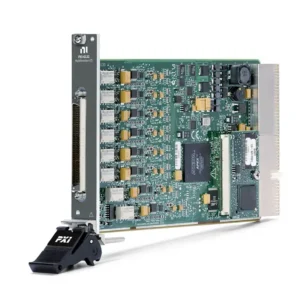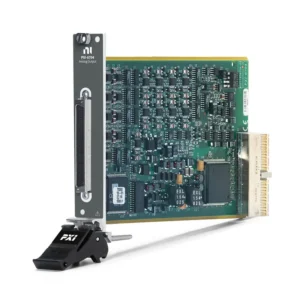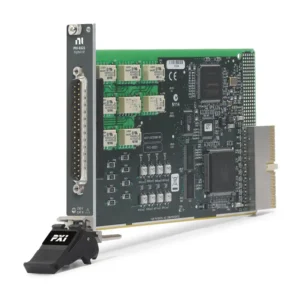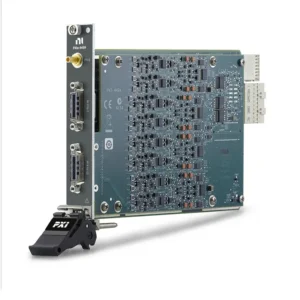


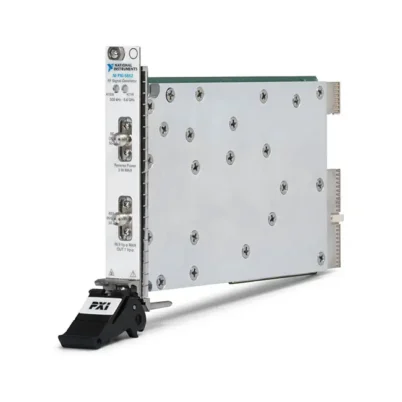
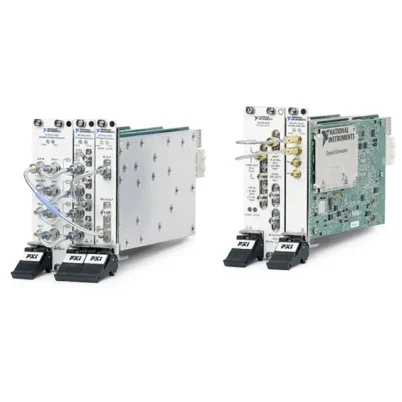
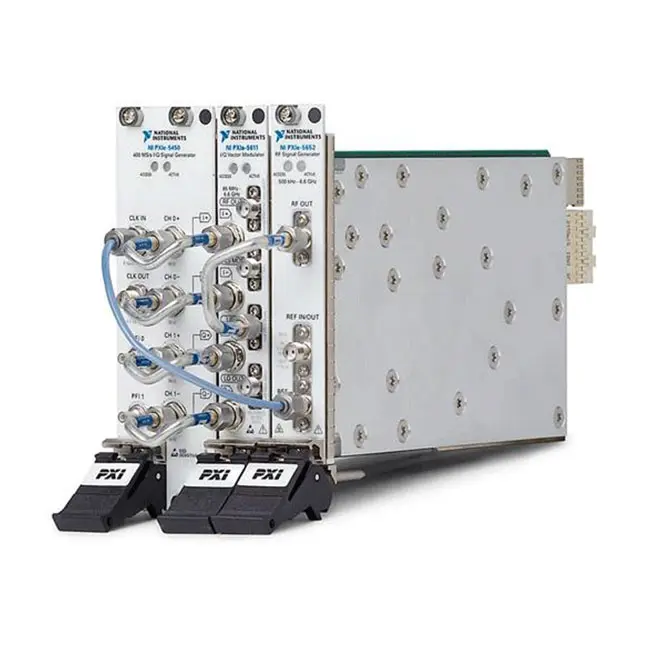
PXIe-5672 2.7 GHz PXI Vector Signal Generator
Земля NI PXIe-5672 is a modular PXI vector signal generator designed for generating continuous-wave and digitally modulated RF signals. It covers frequencies from 250 kHz to 2.7 GHz, provides 20 MHz instantaneous bandwidth and supports output levels from −145 dBm to +10 dBm.
The PXIe-5672 combines a PXIe-5442 arbitrary waveform generator с PXI-5610 RF upconverter. The PXIe-5442 creates baseband waveforms using 16-bit digital-to-analog conversion and quadrature digital upconversion, while the PXI-5610 translates those signals to the selected RF carrier frequency.
This architecture supports AM, FM, PM, ASK, FSK, MSK, GMSK, PSK, QPSK, PAM and QAM signal generation. The PXIe-5672 is suitable for RF receiver testing, wireless-device validation, aerospace and defense testing, semiconductor characterization, RFID development and automated production systems.
Key Features of the PXIe-5672
- 250 kHz to 2.7 GHz RF frequency range
- 20 MHz instantaneous modulation bandwidth
- −145 dBm to +10 dBm output-power range
- Single RF output channel
- 16-bit arbitrary waveform generation
- 100 MS/s AWG sample rate
- 400 MS/s interpolated waveform rate
- Quadrature digital upconversion
- 256 MB onboard waveform-memory configuration
- 355 nHz CW frequency resolution
- Maximum tuning time of 18 ms
- 132 dB compression-to-noise dynamic range
- Internal 10 MHz OCXO frequency reference
- ±20 ppb maximum reference temperature stability
- Supports CW and arbitrary waveform generation
- Supports AM, FM and PM modulation
- Supports ASK, FSK, MSK, GMSK, PSK, QPSK, PAM and QAM
- RF output reverse-power and DC protection
- NI-RFSG driver software support
- Three-slot modular PXI/PXI Express architecture
PXIe-5672 Technical Specifications
| Product Model | PXIe-5672 |
|---|---|
| Part Number | 779900-02 |
| Product Type | PXI vector signal generator |
| Диапазон частот | 250 kHz to 2.7 GHz |
| Мгновенная пропускная способность | 20 MHz |
| Number of RF Output Channels | 1 |
| RF Output-Power Range | −145 dBm to +10 dBm |
| CW Frequency Resolution | 355 nHz |
| Maximum Tuning Time | 18 ms |
| Amplitude Settling Time | Within 0.1 dB in 5 ms typical |
| AWG Resolution | 16 bits |
| AWG Sample Rate | 100 MS/s |
| Interpolated Rate | 400 MS/s |
| Onboard Waveform Memory | 256 MB for part number 779900-02 |
| Compression-to-Noise Dynamic Range | 132 dB |
| Typical Noise Density | −120 dBm/Hz at 2 GHz and 0 dBm output |
| Vector Modulation Flatness | ±0.5 dB typical with equalization enabled |
| Group-Delay Deviation | ±20 ns typical within the vector modulation bandwidth |
| Internal Reference | 10 MHz OCXO |
| Reference Temperature Stability | ±20 ppb maximum |
| Initial Achievable Accuracy | ±50 ppb maximum |
| Maximum Reverse RF Power | 4 W |
| Maximum Reverse DC Input | ±50 VDC |
| System Components | PXI-5610 RF upconverter and PXIe-5442 AWG |
| Required Chassis Space | Three slots |
| Combined Weight | 1.51 kg |
| Operating Temperature | 0°C to 55°C |
| Storage Temperature | −41°C to 71°C |
| Warm-Up Time | 30 minutes |
| Software Driver | NI-RFSG |
PXIe-5672 Part Number and Product Status
| Item | Part Number | Описание |
|---|---|---|
| PXIe-5672 | 779900-02 | 2.7 GHz, 20 MHz bandwidth PXI vector signal generator with 256 MB memory |
| Recommended NI Replacement | 781263-03 | Newer NI vector signal generator configuration recommended by NI |
NI currently identifies the PXIe-5672 as a legacy product available for support, repair and calibration but no longer available for standard new-product purchase. New-old-stock, refurbished and tested used units may still be available from independent suppliers.
When sourcing a replacement system, verify that both the PXI-5610 and PXIe-5442 are included with the required intermodule cables. Purchasing only one of these modules does not provide a complete PXIe-5672 vector signal generator.
PXIe-5672 Modular Architecture
There is no individual physical module labeled PXIe-5672. The product name refers to a coordinated two-module RF generation system.
| Module | Function | Chassis Space |
|---|---|---|
| PXIe-5442 | Generates 16-bit baseband and digitally upconverted arbitrary waveforms | One PXI Express slot |
| PXI-5610 | Upconverts the waveform to an RF carrier between 250 kHz and 2.7 GHz | Two PXI slots |
The two modules are interconnected using the specified SMA-to-SMB coaxial cables. NI-RFSG associates and controls them as one RF vector signal generator.
PXIe-5442 Arbitrary Waveform Generator
Земля PXIe-5442 is a 16-bit arbitrary waveform generator with a 100 MS/s sample rate and 400 MS/s interpolated generation rate. It produces the baseband waveform supplied to the PXI-5610 upconverter.
Its quadrature digital upconverter can shift complex baseband signals digitally before analog generation. This reduces waveform download requirements and allows the same waveform data to be reused with different digital frequency offsets.
PXI-5610 RF Upconverter
Земля PXI-5610 is a 2.7 GHz superheterodyne RF upconverter. It accepts the waveform generated by the PXIe-5442 and translates it to the requested RF carrier frequency.
The upconverter also provides programmable RF attenuation, filtering, frequency conversion, local-oscillator generation and the final RF output connector.
250 kHz to 2.7 GHz Frequency Range
The PXIe-5672 generates signals from 250 kHz to 2.7 GHz. This coverage supports low-frequency RF systems, broadcast receivers, RFID, wireless sensor networks, mobile communication equipment, navigation systems and many aerospace and defense applications.
Its 2.7 GHz upper limit supports common cellular, ISM and 2.4 GHz wireless bands. Applications above 2.7 GHz require a higher-frequency vector signal generator.
20 MHz Instantaneous Bandwidth
The generator provides 20 MHz of instantaneous modulation bandwidth. This is the maximum continuous RF bandwidth that can be generated around the selected carrier frequency.
The available bandwidth is suitable for many legacy and narrowband wireless standards, including various PSK, QAM, FSK and spread-spectrum signals. Confirm that the complete occupied bandwidth of the waveform remains within the generator’s usable modulation bandwidth.
−145 dBm to +10 dBm Output Range
The PXIe-5672 provides a broad programmable RF output range from −145 dBm to +10 dBm. This allows one instrument to generate both low-level receiver sensitivity signals and higher-level stimulus for component testing.
The PXI-5610 supplies coarse 1 dB output adjustments, while the PXIe-5442 provides fine amplitude control with resolution as small as 0.02 dB. The combination enables accurate level changes across the available range.
Power-Level Accuracy
| Диапазон частот | Output Range | Typical Accuracy |
|---|---|---|
| 10 MHz to 2.7 GHz | +7 dBm to −30 dBm | ±0.7 dB |
| 10 MHz to 2.7 GHz | −30 dBm to −80 dBm | ±0.8 dB |
| 10 MHz to 2.7 GHz | −80 dBm to −127 dBm | ±1.0 dB |
| 10 MHz to 2.7 GHz | Below −127 dBm | ±1.5 dB typical |
| 250 kHz to below 10 MHz | +7 dBm to −30 dBm | ±1.2 dB |
| 250 kHz to below 10 MHz | Below −127 dBm | ±2.0 dB typical |
Power delivered to the DUT also depends on cable, connector, attenuator and switching losses. Temperature changes can affect output accuracy during long generation periods, so thermal correction should be performed when required.
Quadrature Digital Upconversion
Quadrature digital upconversion shifts a complex I/Q waveform within the available generation bandwidth using digital processing. Engineers can modify the signal’s frequency placement without creating and downloading an entirely new waveform.
This capability improves test throughput when the same modulated waveform must be generated at multiple frequency offsets or channel positions.
Arbitrary I/Q Waveform Generation
The PXIe-5672 can generate user-defined complex I/Q waveforms. Waveform data can represent standard modulation formats, customized communication signals, captured field signals or specialized research waveforms.
The waveform must be created with an appropriate sample rate, bandwidth, scaling and crest factor. Excessive digital waveform amplitude can cause clipping and degrade modulation quality.
Supported Modulation Formats
- Amplitude modulation
- Frequency modulation
- Phase modulation
- Amplitude-shift keying
- Frequency-shift keying
- Minimum-shift keying
- Gaussian minimum-shift keying
- Phase-shift keying
- Quadrature phase-shift keying
- Pulse-amplitude modulation
- Quadrature amplitude modulation
- User-defined arbitrary I/Q waveforms
Support for a particular communications standard can require compatible waveform-generation software or a custom waveform created by the user.
QPSK and QAM Generation
The PXIe-5672 can generate QPSK, 16-QAM and 64-QAM signals for receiver and component testing. NI’s documented typical performance includes modulation error measurements at symbol rates from 200 kS/s to 2.56 MS/s.
| Symbol Rate | Typical EVM | Typical MER |
|---|---|---|
| 200 kS/s | 0.5% | 45 dB |
| 1 MS/s | 1.0% | 38 dB |
| 2.56 MS/s | 1.2% | 36 dB |
Actual modulation performance depends on waveform scaling, symbol rate, filtering, carrier frequency, output level and equalization settings.
Frequency Tuning and Settling
The PXIe-5442 AWG provides a typical tuning time of approximately 3 ms. The PXI-5610 upconverter’s settling time depends on the required frequency accuracy.
| Step Accuracy | Typical PXI-5610 Settling Time |
|---|---|
| 0.1% | 2 ms |
| 0.01% | 6 ms |
| 0.001% | 13 ms |
| 0.0001% | 18 ms |
For production testing, the required settling delay should be selected according to frequency accuracy, amplitude accuracy and DUT stabilization requirements.
10 MHz OCXO Reference
The PXIe-5672 includes a 10 MHz oven-controlled crystal oscillator that provides a stable frequency reference for RF generation.
| Reference Characteristic | Спецификация |
|---|---|
| Reference Frequency | 10 MHz |
| Temperature Stability | ±20 ppb maximum |
| Initial Achievable Accuracy | ±50 ppb maximum |
| Annual Aging | ±100 ppb maximum |
| Daily Aging After 72 Hours | ±1 ppb |
| External Reference Locking Range | ±0.5 ppm minimum |
| External Reference Lock Time | 5 seconds maximum |
| 10 MHz Reference Output | 1 ±0.1 Vpk-pk into 50 Ω |
A shared external reference can synchronize the generator with analyzers, digitizers and other PXI instruments in frequency-coherent test systems.
Spectral Purity
RF signal quality depends on phase noise, harmonic distortion, nonharmonic spurs, noise density and LO leakage. The PXIe-5672 provides characterized spectral performance for CW and wideband arbitrary-waveform operation.
At 0 dBm RF output, the second harmonic above 10 MHz is specified below −35 dBc. Typical output third-order intermodulation is approximately −68 dBc at or below 500 MHz and −71 dBc above 500 MHz under the documented two-tone conditions.
RF Output Protection
The RF output includes protection against reverse signals from the connected DUT. The specified maximum reverse RF power is 4 W, and the maximum reverse DC input is ±50 VDC.
These are protection limits rather than recommended normal operating levels. Use external attenuators, isolators, DC blocks and limiters when testing transmitters, powered amplifiers or other devices capable of returning energy to the generator.
Typical PXIe-5672 Applications
- Wireless receiver testing
- RF component characterization
- QPSK and QAM signal generation
- RFID device testing
- Wireless sensor-network development
- Cellular receiver validation
- Software-defined radio research
- Испытания в аэрокосмической и оборонной промышленности
- Тестирование полупроводниковых ВЧ-устройств
- Automated production testing
- Custom I/Q waveform generation
- Record-and-playback systems
Wireless Receiver Testing
The PXIe-5672 can generate repeatable modulated RF signals for evaluating receiver sensitivity, selectivity and functional response. Test software can adjust signal power, frequency, modulation and waveform content automatically.
The broad output range allows receiver performance to be tested from strong input conditions down to very low signal levels without manually changing external attenuators for every test point.
RFID and Wireless Sensor Testing
The frequency range and arbitrary-waveform architecture support the generation of signals for RFID readers, tags and wireless sensor devices. Custom waveforms can reproduce protocol timing, modulation patterns and interference conditions.
Verify that the signal bandwidth, carrier frequency and required modulation accuracy fall within the PXIe-5672 capabilities.
Aerospace and Defense Testing
The generator can create customized RF stimulus for navigation receivers, communications equipment and other aerospace or defense subsystems operating below 2.7 GHz.
Its PXI architecture enables synchronization with digitizers, switches and analyzers for automated stimulus-and-response testing.
Automated Production Testing
NI-RFSG allows test software to download waveforms, select carrier frequency, set output power and initiate generation automatically. Stored waveform data can be reused during repetitive production sequences.
Quadrature digital upconversion helps reduce waveform-download requirements when the same modulation must be moved between several channel frequencies.
PXIe-5672 with a Vector Signal Analyzer
The PXIe-5672 can be paired with a vector signal analyzer such as the PXIe-5663 for automated stimulus-and-response measurements.
The generator applies a known modulated RF signal to the DUT, while the analyzer captures and evaluates the DUT output. A shared 10 MHz reference and hardware trigger can improve synchronization between the instruments.
NI-RFSG Software Support
The PXIe-5672 is controlled through the NI-RFSG instrument driver. NI-RFSG transparently coordinates the PXIe-5442 and PXI-5610 as one vector signal generator.
The driver provides functions for configuring RF frequency, output power, waveform data, generation modes, triggers, reference clocks and waveform sequencing. It supports interactive operation through a soft front panel and programmatic control through LabVIEW and compatible text-based environments.
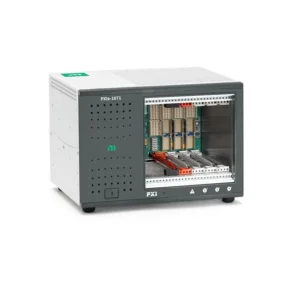
PXI Express Chassis Requirements
The complete PXIe-5672 occupies three chassis slots. The PXIe-5442 requires a PXI Express slot, while the two-slot PXI-5610 requires compatible PXI or PXI hybrid slots.
Before installation, verify that three suitable adjacent slots are available. Also confirm chassis cooling, controller compatibility, NI-RFSG support and sufficient front-panel space for the intermodule cables.
PXIe-5672 Troubleshooting
The PXIe-5672 does not appear as one instrument
Confirm that both the PXIe-5442 and PXI-5610 are detected in NI Measurement & Automation Explorer. Check the intermodule cables and associate the modules correctly using the applicable NI-RFSG configuration procedure.
No RF output is detected
Verify that generation is initiated and RF output is enabled. Check the carrier frequency, power level, waveform configuration, RF cable and spectrum-analyzer settings.
The output waveform is distorted
Check digital waveform scaling, crest factor, interpolation and filtering. Reduce waveform amplitude if clipping occurs and confirm that the signal fits within the 20 MHz modulation bandwidth.
The measured output power is incorrect
Allow the system to warm up for at least 30 minutes. Check external cable and switch losses, waveform crest factor, power-level settings and thermal-correction requirements.
The requested waveform does not fit in memory
Reduce the waveform length or sample rate, use waveform looping or divide the sequence into smaller segments. Confirm the installed PXIe-5442 memory configuration.
The upconverter does not lock
Check the 10 MHz reference connections and the intermodule clock cables. Verify that the external reference is within the specified frequency and amplitude range.
Modulation performance is inconsistent
Verify the I/Q waveform, sample rate, digital upconversion frequency, interpolation, filter settings and RF output power. Confirm that equalization is enabled when required.
The system is not recognized after replacing one module
Reconfigure the module association in NI MAX and confirm hardware revision and NI-RFSG compatibility. A replacement PXIe-5442 or PXI-5610 may require driver or firmware updates.
PXIe-5672 Comparison with Similar Vector Signal Generators
| Модель | General Configuration | Best Suited For |
|---|---|---|
| PXI-5670 | Legacy 2.7 GHz PXI vector signal generator | Maintaining established PXI RF systems |
| PXI-5671 | Legacy 2.7 GHz vector signal generator with improved waveform generation | Earlier modular wireless-test systems |
| PXIe-5672 | 2.7 GHz, 20 MHz bandwidth, PXIe-5442-based VSG | Legacy wideband RF and wireless receiver testing |
| PXIe-5673E | Higher-frequency modular vector signal generator | Applications requiring coverage beyond 2.7 GHz |
| PXIe-5840 | Vector signal transceiver with RF generation and analysis | Integrated wideband RF stimulus-and-response testing |
PXIe-5672 vs PXIe-5673E
The PXIe-5672 provides frequency coverage to 2.7 GHz with 20 MHz instantaneous bandwidth. The PXIe-5673E extends frequency coverage to 6.6 GHz and supports wider-bandwidth applications depending on its configuration.
Select the PXIe-5672 when maintaining an existing 2.7 GHz system or when its frequency and bandwidth meet the application. Select the PXIe-5673E or a newer VST when higher-frequency coverage or wider modulation bandwidth is required.
Recommended Related Products
- PXIe-5442 Arbitrary Waveform Generator
- PXI-5610 RF Signal Upconverter
- PXIe-5673E Vector Signal Generator
- PXIe-5663 Vector Signal Analyzer
- PXIe-5840 Vector Signal Transceiver
- PXIe-1095 PXI Express Chassis
- View More NI PXI and PXI Express Modules
Selecting a PXIe-5672 System
Choose the PXIe-5672 when the application requires arbitrary RF waveform generation from 250 kHz to 2.7 GHz, bandwidth up to 20 MHz and output levels extending to −145 dBm.
Before purchasing, verify that the system includes both hardware modules, the correct intermodule cables and a compatible PXI Express chassis. Also confirm the PXIe-5442 memory capacity, calibration status, hardware revisions and supported NI-RFSG version.
Why Choose the PXIe-5672?
- Generates RF signals from 250 kHz to 2.7 GHz
- Provides 20 MHz instantaneous bandwidth
- Offers output levels from −145 dBm to +10 dBm
- Uses 16-bit arbitrary waveform generation
- Supports quadrature digital upconversion
- Generates common analog and digital modulation formats
- Provides a high-stability 10 MHz OCXO reference
- Supports waveform sequencing and automated generation
- Integrates with NI-RFSG and LabVIEW
- Fits established PXI and PXI Express RF test systems
Frequently Asked Questions
What is the PXIe-5672?
The PXIe-5672 is a modular 2.7 GHz PXI vector signal generator used to create CW and digitally modulated RF signals for automated testing.
Is the PXIe-5672 one physical module?
No. It is a system consisting of a one-slot PXIe-5442 arbitrary waveform generator and a two-slot PXI-5610 RF upconverter.
What is the PXIe-5672 part number?
The 256 MB PXIe-5672 configuration is part number 779900-02.
What is its frequency range?
The generator covers RF frequencies from 250 kHz to 2.7 GHz.
What is the instantaneous bandwidth?
The PXIe-5672 provides 20 MHz of instantaneous RF generation bandwidth.
What is the output-power range?
The programmable RF output range is −145 dBm to +10 dBm.
Which modulation formats are supported?
The generator supports AM, FM, PM, ASK, FSK, MSK, GMSK, PSK, QPSK, PAM, QAM and user-defined arbitrary I/Q waveforms.
What is quadrature digital upconversion?
Quadrature digital upconversion digitally shifts a complex I/Q waveform within the available bandwidth, reducing the need to create and download a new waveform for each frequency offset.
Which software controls the PXIe-5672?
The PXIe-5672 is controlled with the NI-RFSG instrument driver, which operates the PXIe-5442 and PXI-5610 as one instrument.
How many PXI slots are required?
The complete PXIe-5672 system occupies three adjacent chassis slots.
Does it require a PXI hybrid slot?
Yes. The PXI-5610 is a PXI module, while the PXIe-5442 is a PXI Express module. The chassis must provide compatible slots for both modules.
Can the PXIe-5672 generate 5 GHz WLAN signals?
No. Its maximum RF frequency is 2.7 GHz. A higher-frequency vector signal generator is required for 5 GHz WLAN testing.
Is the PXIe-5672 still manufactured?
NI lists the PXIe-5672 for standard support, repair and calibration but no longer offers it as a standard new-product purchase. Availability is generally limited to existing inventory and secondary-market units.
Request a Quote for the PXIe-5672
Contact us for current availability, condition, calibration options and project pricing for the NI PXIe-5672 2.7 GHz Vector Signal Generator. Please confirm whether you require a complete PXIe-5672 system or an individual PXIe-5442 or PXI-5610 replacement module.
We can also help identify compatible intermodule cables, PXI Express chassis, vector signal analyzers and newer NI RF signal-generation alternatives for your test application.