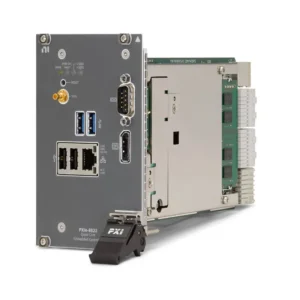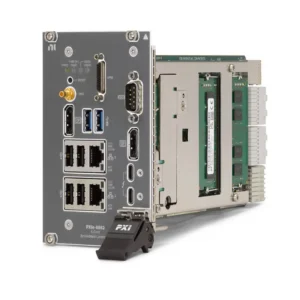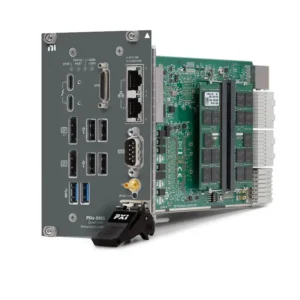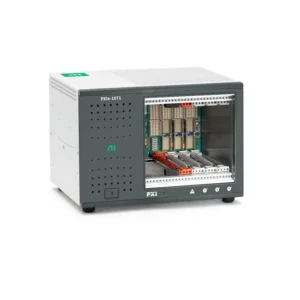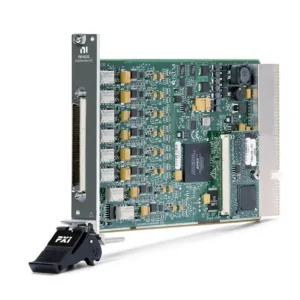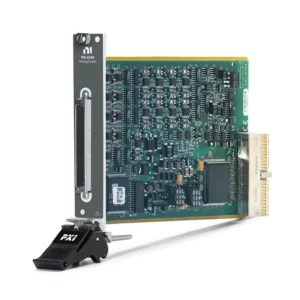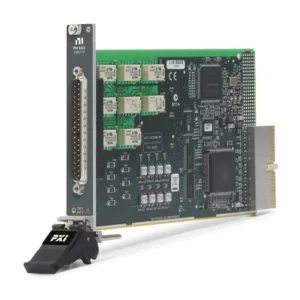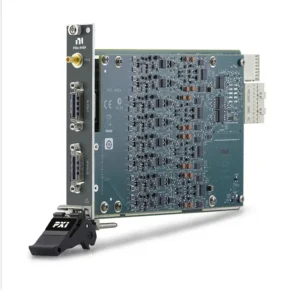




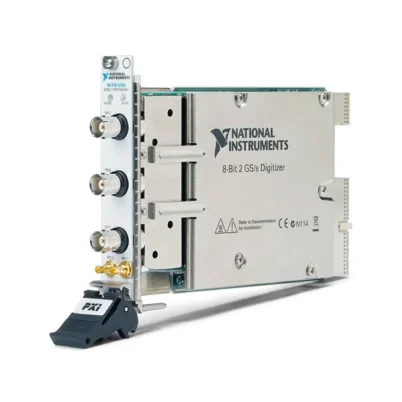
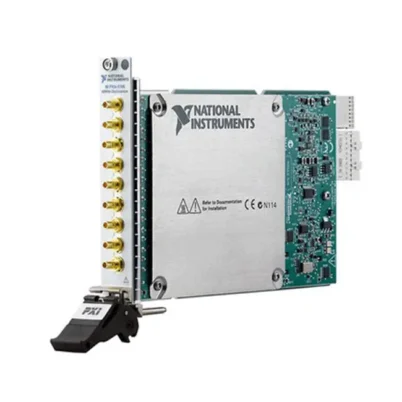
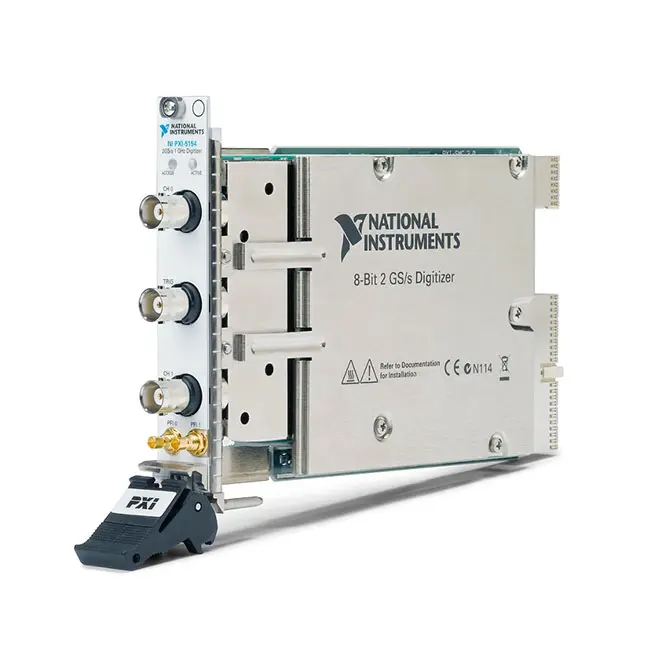
PXI-5154 1 GHz 2 GS/s 8-Bit PXI Oscilloscope
Земля PXI-5154 is a high-speed, dual-channel PXI oscilloscope designed for automated test, component characterization, communications testing and high-bandwidth waveform analysis. It combines 1 GHz analog bandwidth, 8-bit vertical resolution and sampling rates up to 2 GS/s in single-channel operation.
When both channels are enabled, the PXI-5154 can simultaneously digitize two signals at up to 1 GS/s per channel. Its 50 Ω signal inputs, multiple voltage ranges, advanced triggering and deep onboard memory make it suitable for capturing fast pulses, transients, clock signals and broadband electronic waveforms.
Key Features of the PXI-5154
- Two simultaneously accessible analog input channels
- 1 GHz analog input bandwidth
- 2 GS/s maximum real-time sample rate in single-channel mode
- 1 GS/s real-time sample rate per channel with both channels enabled
- Up to 20 GS/s random-interleaved sampling for repetitive signals
- 8-bit vertical resolution
- 50 Ω input impedance
- 100 mVpk-pk to 5 Vpk-pk input ranges
- AC, DC and ground input coupling
- 8 MB, 64 MB or 256 MB onboard memory per channel
- Multirecord acquisition support
- Analog edge, digital and software triggering
- PXI trigger and reference-clock synchronization
- NI-TClk synchronization with compatible instruments
- Programmable with the NI-SCOPE instrument driver
PXI-5154 Technical Specifications
| Product Model | PXI-5154 |
|---|---|
| Product Type | High-speed PXI oscilloscope and digitizer |
| Number of Analog Channels | 2 |
| Analog Bandwidth | 1 GHz |
| Maximum Real-Time Sample Rate | 2 GS/s in single-channel mode |
| Dual-Channel Sample Rate | 1 GS/s per channel |
| Maximum Random-Interleaved Sample Rate | Up to 20 GS/s for repetitive signals |
| Vertical Resolution | 8 bits |
| Input Impedance | 50 Ω ±2 Ω |
| Input Coupling | AC, DC or GND |
| Input Voltage Ranges | 0.1, 0.2, 0.5, 1, 2 and 5 Vpk-pk |
| Maximum Input Overload | 7 Vrms, with peaks not exceeding 10 V |
| VSWR | 1.27 typical from DC to 1 GHz |
| Input Connectors | Two front-panel BNC connectors |
| Onboard Memory | 8 MB, 64 MB or 256 MB per channel |
| Maximum Number of Records | Up to 100,000, depending on memory option |
| Trigger Types | Analog edge, digital, software and PXI trigger |
| Синхронизация | PXI clocks, PXI trigger lines and NI-TClk |
| Calibration Interval | Two years |
| Recommended Warm-Up Time | 15 minutes |
| Software Driver | NI-SCOPE |
| Шинный интерфейс | PXI |
| Module Format | 3U, one-slot PXI module |
PXI-5154 Part Numbers and Memory Options
| Part Number | Onboard Memory | Описание |
|---|---|---|
| 780319-01 | 8 MB per channel | PXI-5154 with standard acquisition memory |
| 780319-02 | 64 MB per channel | PXI-5154 with extended acquisition memory |
| 780319-03 | 256 MB per channel | PXI-5154 with maximum acquisition memory |
Memory configuration affects the maximum record length and the number of waveforms that can be retained onboard. Confirm the installed memory option from the module label, NI Measurement & Automation Explorer or the original ordering information.
1 GHz Analog Bandwidth
The PXI-5154 provides 1 GHz analog bandwidth on both input channels. This makes it suitable for measuring fast digital edges, high-frequency clock signals, pulse waveforms, communication signals and broadband electronic events.
Available measurement bandwidth depends on the complete signal path, including probes, coaxial cables, adapters, fixtures and source termination. Use high-quality 50 Ω cabling and impedance-controlled connections to preserve the module’s frequency response.
2 GS/s Single-Channel Sampling
The PXI-5154 provides a maximum real-time sampling rate of 2 GS/s when operating with one analog input channel. This mode supports detailed acquisition of high-speed transient and single-shot signals without relying on repetitive waveform reconstruction.
A 2 GS/s sample rate corresponds to a sampling interval of 500 ps. The actual temporal detail available in a measurement also depends on analog bandwidth, trigger stability, signal-to-noise ratio and waveform interpolation.
Simultaneous Dual-Channel Acquisition
When both analog channels are enabled, the PXI-5154 supports simultaneous sampling at up to 1 GS/s per channel. This allows engineers to compare two related signals, such as input and output waveforms, clock and data signals or stimulus and response.
Because both channels share a common acquisition timing system, waveform timing can be compared without the uncertainty associated with separate standalone oscilloscopes.
Random-Interleaved Sampling
For repetitive signals, the PXI-5154 supports random-interleaved sampling at effective rates up to 20 GS/s. This mode combines samples from multiple repeated acquisitions to create a waveform with finer time spacing.
Random-interleaved sampling is not appropriate for nonrepetitive or single-shot events because it requires a stable waveform that repeats relative to the trigger. Real-time sampling should be used when every acquisition may contain unique information.
8-Bit Vertical Resolution
The PXI-5154 uses an 8-bit analog-to-digital converter. This resolution is optimized for high-speed waveform capture where sample rate and bandwidth are more important than precision DC measurement.
Selecting the smallest suitable input range improves utilization of the converter’s available codes. Excessively large ranges reduce voltage resolution, while ranges that are too small can clip or overload the acquired waveform.
Programmable Input Ranges
The oscilloscope provides full-scale input ranges of 100 mVpk-pk, 200 mVpk-pk, 500 mVpk-pk, 1 Vpk-pk, 2 Vpk-pk and 5 Vpk-pk. These ranges allow the acquisition system to be adapted to signals with different amplitudes.
Always account for the signal’s DC offset and transient peaks when selecting a range. The complete waveform must remain inside the configured acquisition window to avoid clipping.
50 Ω Input Termination
The PXI-5154 analog inputs use fixed 50 Ω termination. This impedance is appropriate for RF, communications and high-speed digital systems constructed with 50 Ω sources, cables and fixtures.
The module does not provide the 1 MΩ input commonly found on general-purpose benchtop oscilloscopes. A suitable high-impedance probe, active probe interface or external adapter is required when the circuit cannot safely drive a 50 Ω load.
AC, DC and Ground Coupling
DC coupling passes both the DC component and time-varying content of the input signal. AC coupling removes much of the DC component, helping users examine a smaller varying waveform superimposed on a larger offset.
Ground coupling disconnects the external signal from the acquisition path and connects the internal path to ground. It can be used to evaluate the oscilloscope baseline and offset condition.
Deep Onboard Acquisition Memory
Depending on the ordered configuration, the PXI-5154 includes 8 MB, 64 MB or 256 MB of onboard memory per channel. Deep memory allows longer time windows to be recorded while maintaining a high sampling rate.
Additional memory is particularly useful for protocol analysis, radar pulse capture, transient monitoring and applications where an event occurs long after acquisition begins.
Multirecord Acquisition
Multirecord acquisition divides onboard memory into separate waveform records. The PXI-5154 can capture many triggered events without transferring every waveform to the host controller immediately after acquisition.
The 8 MB configuration supports as many as 32,768 records, while the 64 MB and 256 MB configurations support as many as 100,000 records. The practical record count depends on record length, reference position and acquisition settings.
Advanced Triggering
The PXI-5154 supports analog edge triggering from its input channels as well as digital and software trigger sources. Trigger configuration can include source, level, slope, coupling, delay and reference position.
PXI trigger lines allow an acquisition to be initiated by another instrument, a PXI controller or a test-system event. The module can also participate in synchronized measurement sequences involving signal generators and additional digitizers.
PXI and NI-TClk Synchronization
PXI timing resources and NI-TClk technology allow the PXI-5154 to be synchronized with compatible modular instruments. Multiple digitizers can acquire additional channels, or a waveform generator can produce a stimulus aligned with the oscilloscope acquisition.
Synchronization accuracy depends on chassis timing architecture, cabling, reference-clock configuration and the capabilities of every participating module. NI-TClk synchronization should be configured through supported NI instrument drivers.
Self-Calibration and External Calibration
Self-calibration adjusts internal gain, offset, timing and trigger parameters to compensate for changes in operating temperature. Perform self-calibration after the module has warmed up and whenever the chassis temperature changes significantly.
The recommended warm-up period is 15 minutes, and the specified external calibration interval is two years. Measurement programs that require traceable results should follow the applicable calibration schedule.
NI-SCOPE Software Support
The PXI-5154 is controlled with the NI-SCOPE instrument driver. NI-SCOPE provides functions for configuring channels, sample rates, record lengths, triggers, multirecord acquisition and waveform transfer.
The driver can be used with LabVIEW, LabWindows/CVI, C, C++, .NET and other supported development environments. Soft Front Panel software can also be used for interactive configuration and initial signal inspection.
Typical PXI-5154 Applications
- High-speed automated test equipment
- Fast digital waveform analysis
- Clock and data signal characterization
- Pulse and transient measurement
- Communication-system testing
- Валидация полупроводников
- Radar and pulsed RF testing
- Time-domain component characterization
- Production functional testing
- Электронное проектирование верификация
- Multichannel synchronized acquisition
- Research and laboratory automation
High-Speed Digital Signal Testing
The 1 GHz bandwidth and 2 GS/s single-channel rate allow the PXI-5154 to capture clock signals, pulse trains and other fast digital waveforms. Measurements can be used to evaluate amplitude, frequency, overshoot, undershoot and timing behavior.
For reliable results, use controlled-impedance fixtures and minimize cable length, connector transitions and unterminated branches. Signal-integrity problems in the fixture can otherwise appear as device-under-test behavior.
Communication and Modulated-Signal Analysis
The PXI-5154 can acquire intermediate-frequency and other broadband communication signals for time-domain or software-based spectral analysis. Captured data can be processed using custom algorithms or compatible NI analysis software.
Its 8-bit resolution should be considered when the application requires a large dynamic range or the detection of very small signals near larger spectral components.
Pulse and Transient Capture
Deep memory and multirecord acquisition make the PXI-5154 useful for observing short-duration pulses and intermittent transient events. A series of triggered pulses can be stored onboard and transferred as a group for analysis.
This approach can improve test throughput by reducing communication overhead between individual acquisitions.
Semiconductor and Component Validation
The PXI-5154 can measure high-speed responses from amplifiers, converters, clock devices, interfaces and other electronic components. When combined with PXI waveform generators, digital instruments and source-measure units, it can form part of an automated characterization system.
Fixture loss and frequency-dependent response should be characterized when testing devices near the upper end of the module’s analog bandwidth.
Production Test Integration
The PXI form factor allows the oscilloscope to operate in a compact automated test platform alongside switches, digital instruments, waveform generators and programmable power supplies.
Programmatic control enables consistent configuration, acquisition and analysis across repeated production tests. Stored calibration information and self-calibration support measurement stability during extended operation.
PXI-5154 Troubleshooting
The PXI-5154 Is Not Detected in NI MAX
Confirm that the module is fully installed in a compatible PXI or PXI hybrid slot. Check chassis power, controller communication and the installed NI-SCOPE version, then rescan the system in NI Measurement & Automation Explorer.
The Input Signal Amplitude Is Too Low
Verify that the source is designed to drive a 50 Ω load. A source specified for a high-impedance load may produce approximately half its open-circuit voltage when connected to the PXI-5154 input.
The Waveform Is Clipped
Select a larger voltage range or adjust the vertical offset. Confirm that both the signal amplitude and DC offset remain within the configured input range and the module’s absolute overload limits.
The Signal Shows Excessive Ringing
Check for impedance mismatches, unterminated cables, adapters, long fixture traces and connector discontinuities. Use 50 Ω cables and terminate every high-speed signal path correctly.
The Selected Sample Rate Is Unavailable
The 2 GS/s real-time rate is available in single-channel operation. When both analog channels are enabled, the maximum real-time sampling rate is 1 GS/s per channel.
Random-Interleaved Sampling Produces Poor Results
Confirm that the waveform is repetitive and stable relative to the trigger. Use real-time sampling for single-shot, changing or asynchronously timed signals.
Triggered Events Are Being Missed
Review the trigger source, level, slope, coupling and holdoff. For events that occur in rapid bursts, use multirecord acquisition to reduce the time required for waveform transfer between triggers.
The Baseline or Gain Changes with Temperature
Allow the module to warm up for at least 15 minutes and perform self-calibration. Verify chassis airflow and repeat self-calibration if the operating temperature changes significantly.
Two Instruments Are Not Properly Synchronized
Verify that the modules share the intended reference clock and trigger resources. Configure compatible devices through NI-TClk and confirm that every instrument supports the selected synchronization arrangement.
PXI-5154 Comparison with Similar Oscilloscopes
| Модель | Key Configuration | Best Suited For |
|---|---|---|
| PXI-5124 | 200 MHz, 12-bit, 200 MS/s, 2 channels | Higher-resolution measurements at moderate bandwidth |
| PXI-5152 | 300 MHz, 8-bit, up to 2 GS/s | General-purpose high-speed acquisition with lower bandwidth |
| PXI-5153 | 500 MHz, 8-bit, up to 2 GS/s | Mid-bandwidth clock, pulse and communications testing |
| PXI-5154 | 1 GHz, 8-bit, up to 2 GS/s | Highest-bandwidth acquisition in the PXI-515x family |
| PXIe-5160 | 500 MHz, 10-bit, 2.5 GS/s | Higher resolution and simultaneous high-speed sampling |
| PXIe-5162 | Up to 1.5 GHz, 10-bit, 5 GS/s | Newer PXI Express systems requiring more bandwidth and resolution |
PXI-5154 vs PXI-5153
The PXI-5154 provides 1 GHz analog bandwidth, while the PXI-5153 provides 500 MHz bandwidth. Both models offer two 8-bit channels, up to 2 GS/s single-channel real-time sampling and 50 Ω inputs.
Choose the PXI-5154 when the signal contains frequency content above 500 MHz or when faster edge response is required. Select the PXI-5153 when 500 MHz bandwidth is sufficient and system cost is a greater consideration.
PXI-5154 vs PXI-5152
The PXI-5154 increases analog bandwidth to 1 GHz compared with 300 MHz for the PXI-5152. The PXI-5152 also offers more flexible input-impedance options for applications that require a high-impedance input.
The PXI-5154 is the better choice for high-frequency 50 Ω signal paths. The PXI-5152 may be preferable for lower-bandwidth signals that cannot directly drive a 50 Ω termination.
PXI-5154 vs PXIe-5162
The PXI-5154 is intended for legacy PXI systems and provides 1 GHz bandwidth with 8-bit resolution. The PXIe-5162 uses the PXI Express interface and offers higher sampling speed, greater analog bandwidth and 10-bit resolution.
Choose the PXI-5154 when maintaining a compatible PXI test platform or replacing an existing module. Consider the PXIe-5162 when building a new system that requires higher performance and has compatible PXI Express slots.
Recommended Related Products
- PXI-5152 300 MHz High-Speed Oscilloscope
- PXI-5153 500 MHz High-Speed Oscilloscope
- PXI-5124 12-Bit PXI Oscilloscope
- PXIe-5160 10-Bit PXI Express Oscilloscope
- PXIe-5162 High-Bandwidth PXI Express Oscilloscope
- View More NI PXI and PXI Express Modules
Selecting the Right PXI Oscilloscope
Choose the PXI-5154 when the application requires 1 GHz analog bandwidth, two 50 Ω inputs and real-time sampling up to 2 GS/s. It is especially appropriate for maintaining established PXI test systems that need high-bandwidth waveform acquisition.
Consider the PXI-5124 when vertical resolution is more important than bandwidth. Choose the PXI-5152 or PXI-5153 for lower-bandwidth testing, or select a PXI Express oscilloscope when higher sampling speed, resolution and data-transfer performance are required.
Why Choose the PXI-5154?
- Provides 1 GHz bandwidth in a compact PXI module
- Captures single-channel waveforms at up to 2 GS/s
- Acquires two channels simultaneously at up to 1 GS/s each
- Supports repetitive-waveform sampling up to 20 GS/s
- Offers up to 256 MB onboard memory per channel
- Supports multirecord acquisition for rapid triggered events
- Includes PXI triggering and NI-TClk synchronization
- Integrates with automated systems through NI-SCOPE
Frequently Asked Questions
What Is the PXI-5154?
The PXI-5154 is a dual-channel, 1 GHz, 8-bit PXI oscilloscope for high-speed waveform acquisition and automated test applications.
What Is the Maximum Real-Time Sample Rate?
The maximum real-time sample rate is 2 GS/s with one analog input channel enabled. With both channels enabled, the maximum rate is 1 GS/s per channel.
What Is the Analog Bandwidth?
The PXI-5154 provides 1 GHz analog bandwidth on its two 50 Ω input channels.
Does the PXI-5154 Have a 1 MΩ Input?
No. The PXI-5154 uses fixed 50 Ω input termination. An appropriate probe or external interface is required for high-impedance circuits.
What Voltage Ranges Are Available?
The available full-scale ranges are 100 mVpk-pk, 200 mVpk-pk, 500 mVpk-pk, 1 Vpk-pk, 2 Vpk-pk and 5 Vpk-pk.
How Much Memory Does the PXI-5154 Provide?
The module was offered with 8 MB, 64 MB or 256 MB of onboard memory per channel, depending on the ordered version.
Can the PXI-5154 Capture Single-Shot Signals?
Yes. Its real-time sampling modes can capture nonrepetitive and single-shot signals. Random-interleaved sampling should only be used for stable repetitive waveforms.
Can Multiple PXI-5154 Modules Be Synchronized?
Yes. Compatible modules can be synchronized using PXI timing resources and NI-TClk technology, subject to chassis and system configuration.
Which Driver Controls the PXI-5154?
The PXI-5154 is controlled with the NI-SCOPE instrument driver, which supports LabVIEW and compatible text-based programming environments.
What Are the PXI-5154 Part Numbers?
Common PXI-5154 part numbers include 780319-01, 780319-02 и 780319-03, corresponding to different onboard-memory configurations.
Request a Quote for the PXI-5154
Contact us for current availability, lead time and project pricing for the PXI-5154 1 GHz 2 GS/s PXI Oscilloscope. We can also help identify the installed memory option, compatible PXI chassis and alternative NI oscilloscopes for your automated test system.