






Quick Answer: PXI and PXIe are modular test and measurement platforms that share similar chassis mechanics, timing resources, triggering, and software concepts. Their main difference is the communication bus: traditional PXI uses parallel PCI, while PXIe—also called PXI Express—uses serial PCI Express. PXIe therefore provides substantially higher data bandwidth and is usually preferred for high-speed digitizers, RF instruments, vision, and multi-channel streaming. Traditional PXI remains practical for many switching, digital I/O, DMM, relay, and moderate-speed automated test applications.
PXI vs PXIe at a Glance
| Функция | PXI | PXIe |
|---|---|---|
| Full name | PCI eXtensions for Instrumentation | PCI eXtensions for Instrumentation Express |
| Primary data bus | Parallel PCI | Serial PCI Express |
| Backplane communication | Shared PCI bus segments | Point-to-point PCIe links through switches |
| Data bandwidth | Suitable for low- to moderate-rate measurements | Suitable for high-rate streaming and data-intensive instruments |
| Timing and triggering | Reference clock, trigger bus, and star trigger support | Retains PXI resources and adds enhanced differential timing options |
| Module installation | Accepts compatible PXI modules | Accepts PXIe modules; hybrid slots may also accept compatible PXI modules |
| Typical cost | Often lower for legacy or moderate-performance systems | Often higher, depending on bandwidth, controller, and module performance |
| Best use | Switching, DMM, digital I/O, industrial control, and legacy test | RF, wideband digitizing, vision, semiconductor, and synchronized high-speed test |
Key point: PXIe is not simply a newer connector. It changes the backplane data architecture while preserving the modular instrumentation and synchronization principles of PXI.
What Is PXI?
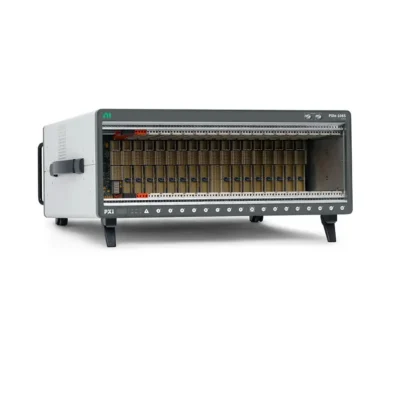
PXI is an open modular instrumentation standard based on CompactPCI. A typical PXI system combines a chassis, a controller, and measurement or control modules. The chassis supplies power, cooling, a PCI communication bus, reference clocks, and hardware triggers so that several instruments can operate as one coordinated platform.
Traditional PXI is well suited to applications whose data-transfer requirements fit within the available PCI bus bandwidth. These include relay switching, multiplexing, digital I/O, serial communication, resistance and voltage measurements, and many production functional tests.
For a complete introduction to the platform, read What Is PXI?
What Is PXIe?
PXIe is the PCI Express-based generation of the PXI standard. It uses PCIe links between the system controller, backplane switches, and peripheral slots. These point-to-point serial connections provide much greater bandwidth than the shared parallel PCI bus used by conventional PXI.
PXIe is designed for applications that generate or consume large volumes of data, including wideband RF analysis, high-speed waveform acquisition, image processing, semiconductor test, and multi-channel data streaming. It also extends the timing architecture with resources such as differential star triggers and a 100 MHz reference clock.
See What Is PXIe? for a detailed explanation of the complete platform.
The Main Difference: PCI vs PCI Express
The core technical difference between PXI and PXIe is how data travels across the backplane.
PXI Uses Parallel PCI
Multiple devices may share a PCI bus segment. Available bandwidth is divided among devices using that segment, and performance is limited by the bus implementation.
PXIe Uses Serial PCI Express
Each peripheral connection uses one or more PCIe lanes routed through backplane switches. More lanes and newer PCIe generations can provide higher link bandwidth.
PCIe also supports full-duplex communication, meaning data can move in both directions simultaneously. This is particularly valuable when several instruments stream data to the controller while receiving configuration or generation data.
What Bandwidth Specifications Really Mean
Do not compare systems using only a chassis headline bandwidth figure. Check the link assigned to each slot, the PCIe generation, lane width, switch topology, shared upstream links, controller connection, module throughput, memory, and storage performance.
Земля PXI Backplane Explained guide provides more detail about buses, switches, and shared system resources.
How Much Faster Is PXIe?
There is no single fixed multiplier because PXI and PXIe systems exist in many configurations. Traditional PXI bandwidth depends on PCI frequency, bus width, bridge topology, and the number of devices sharing a segment. PXIe performance depends on PCIe generation, lane count, slot allocation, switching topology, and the controller connection.
A high-bandwidth PXIe chassis can provide several gigabytes per second of aggregate system throughput, while an individual slot may receive only a portion of that capacity. Real sustained performance is also lower than theoretical link bandwidth because of encoding, protocol overhead, driver behavior, processing, and storage limitations.
Basic Data-Rate Calculation
For uncompressed digitizer data, estimate the raw rate using:
Data rate = channel count × sample rate × bytes per sample
For example, eight channels sampled at 50 MS/s with two bytes per sample generate approximately 800 MB/s before overhead. If multiple instruments stream simultaneously, calculate their combined sustained rate and identify every point where their data paths share a switch or controller link.
PXI and PXIe Slot Types Explained
PXI and PXIe modules may have a similar 3U form factor, but physical size alone does not guarantee compatibility. The backplane connector and supported electrical bus determine whether a module can operate in a particular slot.
| Slot Type | Supported Function | Important Note |
|---|---|---|
| PXI peripheral slot | Traditional PXI peripheral modules | Does not provide a PCIe connection for PXIe modules |
| PXIe peripheral slot | PXIe peripheral modules | Generally cannot accept a conventional PXI module |
| PXIe hybrid peripheral slot | PXIe modules and many compatible PXI modules | Connector style, voltage, driver, and vendor support must still be checked |
| PXIe system timing slot | Specialized timing modules and supported peripheral modules | Offers dedicated timing resources not available in a standard peripheral slot |
| System controller slot | Embedded controller or remote-control interface | Not counted as a normal instrument slot |
Can PXI Modules Work in a PXIe Chassis?
Many PXI modules can operate in PXIe hybrid peripheral slots, but this must be verified for the exact chassis and module. A hybrid slot includes support for PCI Express and the connector arrangement needed by compatible conventional PXI modules.
Before installing a PXI module in a PXIe chassis, confirm:
- The target slot is explicitly identified as a hybrid peripheral slot.
- The module connector and keying match the chassis.
- The module uses a signaling voltage supported by the chassis.
- The operating system and controller support the required driver.
- The chassis provides sufficient power and cooling.
- The required clocks and triggers are routed to that slot.
Compatibility warning: A conventional PXI chassis cannot operate a PXIe peripheral module because it does not provide the required PCI Express backplane connection.
Timing and Synchronization Differences
Both platforms are designed for coordinated instrumentation. Traditional PXI commonly provides a 10 MHz reference clock, PXI trigger bus lines, local bus connections, and a star trigger architecture. PXIe retains core PXI synchronization concepts and adds higher-performance resources for modern instruments.
| Timing Resource | PXI | PXIe |
|---|---|---|
| 10 MHz reference clock | Commonly supported | Retained for compatibility |
| 100 MHz differential clock | Not part of conventional PXI | Available as PXIe_CLK100 |
| Trigger bus | Eight PXI trigger lines | Retains compatible trigger resources |
| Star trigger | PXI star trigger support | Enhanced differential star trigger options |
| System timing slot | Available in selected chassis designs | Defined for high-performance timing modules |
PXIe can support lower-skew and higher-frequency timing distribution, but it does not automatically make every installed instrument phase-aligned. Module architecture, trigger latency, clock configuration, cables, and calibration still affect synchronization accuracy. See PXI Trigger Bus Explained and the PXI Timing and Synchronization Guide.
Controller Differences
PXI and PXIe systems can use either an embedded controller or a remote controller connected to an external computer. The controller interface must match the chassis system slot and backplane architecture.
PXIe controllers are generally selected for higher processor performance and faster PCIe communication. However, the best controller depends on the complete workload, including real-time analysis, number of modules, sustained data streaming, storage volume, software environment, and network traffic.
Embedded Controller
Creates a compact, self-contained system and is convenient for rack integration, production deployment, and controlled software configurations.
Remote Controller
Connects the chassis to a desktop, workstation, or server and can provide flexible CPU, GPU, storage, and maintenance options.
Compare controller options in How to Choose a PXI Controller, or browse available PXI controllers.
When Should You Choose PXI?
Traditional PXI can still be the right technical and economic choice when:
- Your required modules are available only in PXI format.
- The application uses switching, relay, digital I/O, DMM, or communication modules with moderate data rates.
- You need to maintain or expand a validated legacy system.
- Software, fixtures, and test procedures already depend on specific PXI hardware.
- A lower acquisition cost is more important than future high-bandwidth expansion.
- The existing system already meets timing, throughput, and lifecycle requirements.
Replacing a stable PXI system with PXIe may require new controllers, chassis, drivers, operating-system validation, calibration, and regression testing. Upgrade value should be based on measurable application benefits rather than platform age alone.
When Should You Choose PXIe?
PXIe is generally the stronger choice when:
- High-speed digitizers must stream large amounts of data continuously.
- RF instruments require wide instantaneous bandwidth.
- Multiple instruments must acquire or generate data simultaneously.
- Image acquisition, FPGA processing, or semiconductor test creates high bus traffic.
- The project requires enhanced clock and trigger distribution.
- The system must support future high-bandwidth modules.
- You are building a new platform with a long expected service life.
Application Comparison
| Приложение | Typical Choice | Reason |
|---|---|---|
| Relay switching and multiplexing | PXI or PXIe hybrid system | Usually requires low data bandwidth; module availability is more important |
| Digital multimeter measurements | PXI or PXIe | Accuracy and channel routing often matter more than bus bandwidth |
| High-speed oscilloscope streaming | PXIe | Large waveform data benefits from PCI Express throughput |
| Wideband RF test | PXIe | High sample rates and real-time processing require fast data movement |
| Semiconductor test | Usually PXIe | Parallel test, precise synchronization, and high channel density |
| Legacy production test maintenance | PXI or hybrid PXIe | Preserves validated modules, software, fixtures, and test sequences |
| Vision and image acquisition | PXIe | High-resolution images can produce sustained data traffic |
| Industrial digital I/O and communication | PXI or PXIe | Selection depends on module availability and system lifecycle |
Cost and Lifecycle Considerations
A PXIe system is not always more expensive, but high-bandwidth chassis, advanced controllers, and high-performance modules can increase the initial investment. Traditional PXI equipment may offer lower acquisition costs, especially in refurbished or legacy markets.
Purchase price should not be evaluated alone. Consider:
- Expected service life and manufacturer support
- Availability of replacement modules and controllers
- Calibration and repair costs
- Software migration and validation effort
- Future channel, bandwidth, and timing requirements
- Downtime risk and spare-parts strategy
- Whether existing modules can be reused in hybrid slots
For a new long-term system, PXIe may provide better expansion potential. For an existing validated station with modest bandwidth needs, preserving PXI can be less risky and more economical.
How to Choose Between PXI and PXIe
- Define the measurements. Document signal type, frequency, voltage, channel count, accuracy, sample rate, isolation, and connector requirements.
- Select the modules first. Confirm that suitable instruments exist and identify whether they use PXI, PXIe, or both.
- Calculate sustained data rates. Include all modules that may stream simultaneously.
- Define timing requirements. Determine whether modules need a common reference clock, hardware triggers, low skew, timestamps, or phase alignment.
- Map slot compatibility. Verify peripheral, hybrid, timing, and controller slot requirements.
- Inspect the backplane topology. Check per-slot links and shared bandwidth rather than relying on aggregate specifications.
- Size the controller. Match CPU, RAM, storage, ports, operating system, and connection bandwidth to the workload.
- Verify software support. Confirm drivers, development tools, firmware, licenses, and operating-system compatibility.
- Plan the lifecycle. Consider expansion, spares, calibration, migration, and vendor support.
- Test the proposed configuration. Validate the most demanding timing and data-rate scenario before full deployment.
Use How to Choose a PXI System, How to Choose a PXI Chassis, и How to Choose PXI Modules for more detailed selection guidance.
Common PXI vs PXIe Selection Mistakes
Choosing by Slot Count Alone
Empty slots do not guarantee the correct connectors, bandwidth, cooling, power, or timing resources.
Assuming Every PXI Module Fits
Traditional PXI modules normally require hybrid slots in a PXIe chassis, and individual compatibility must be verified.
Using Aggregate Bandwidth Only
A chassis may advertise high total bandwidth while a particular slot or shared switch path provides much less.
Ignoring Driver Support
Compatible mechanics and buses do not help if the module driver does not support the controller operating system.
Overlooking Cooling
High-performance PXIe modules may require more airflow and careful slot placement.
Upgrading Without a Test Plan
Moving a validated PXI station to PXIe may change drivers, timing behavior, enumeration, and application performance.
Frequently Asked Questions
Is PXIe backward compatible with PXI?
PXIe hybrid slots can support many compatible PXI modules, but compatibility is not universal. Check the exact chassis, slot, module connector, voltage, driver, power, and cooling requirements.
Can a PXIe module be installed in a PXI chassis?
No. A conventional PXI chassis does not provide the PCI Express connector and backplane link required by a PXIe peripheral module.
Is PXIe always faster than PXI?
PXIe offers a much higher potential data bandwidth, but actual performance depends on the module, slot link, switches, controller, software, processing, and storage.
Does PXIe provide better measurement accuracy?
Not automatically. Measurement accuracy is primarily determined by the instrument design, calibration, range, noise, signal connections, and environment—not the data bus alone.
Do PXI and PXIe use the same software?
They can often be controlled through similar APIs and test software, but the exact driver, operating-system, and application compatibility must be verified for each device.
Can PXI and PXIe modules run in one chassis?
Yes, when a PXIe chassis provides suitable hybrid slots and all modules meet its electrical, mechanical, cooling, timing, and software requirements.
Which platform is better for a new system?
PXIe is usually the better long-term choice for a new high-performance system. PXI may still be appropriate when required modules are PXI-only or the application has modest bandwidth needs.
Can a PXI controller be used in a PXIe chassis?
Only if the controller and chassis system slot are specifically compatible. Do not assume compatibility based on the physical form factor.
Final Recommendation
Choose PXI when it already satisfies the application's bandwidth and timing needs, when essential modules are available only in PXI format, or when maintaining a validated legacy platform offers the lowest lifecycle risk. Choose PXIe when the system requires high-speed streaming, RF bandwidth, image acquisition, FPGA processing, enhanced synchronization, or stronger future expansion capability.
For mixed systems, a PXIe chassis with the correct number of hybrid slots can provide a practical migration path. The final decision should be based on the complete system—not just the bus name—including modules, slot types, backplane topology, controller, software, cooling, power, and lifecycle support.
Categories
Latest Articles
Products on Sale


Need Help Choosing a Product?
Contact our sales team for product selection, pricing, availability and lead-time information.
sales@pxisource.com