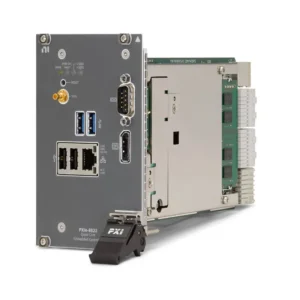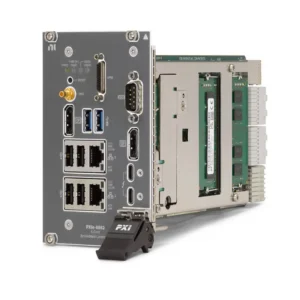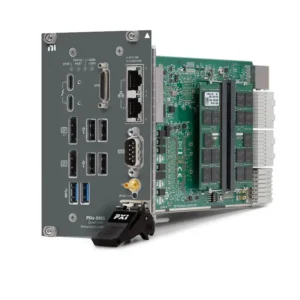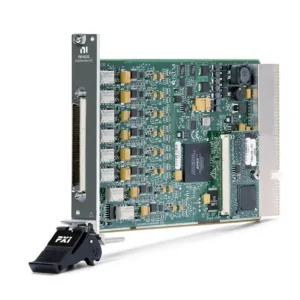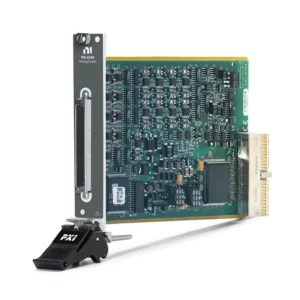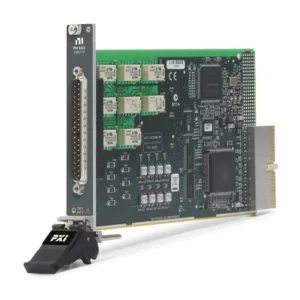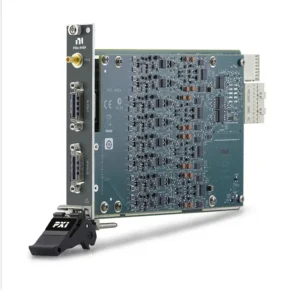




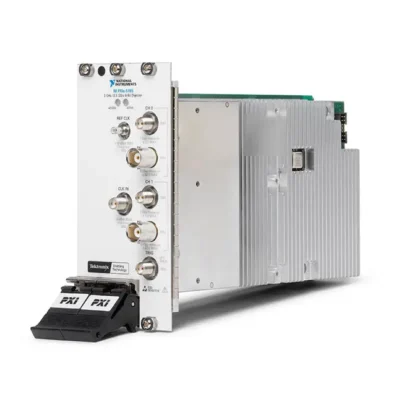

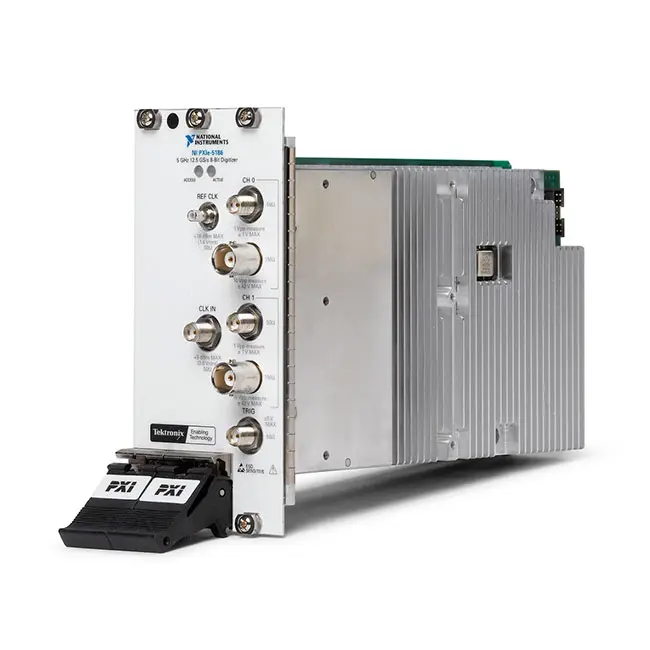
PXIe-5186 5 GHz 12.5 GS/s 8-Bit PXI Oscilloscope
The PXIe-5186 is a two-channel, high-speed PXI Express oscilloscope designed for broadband waveform acquisition, semiconductor validation, high-speed digital testing and automated measurement systems. It combines 5 GHz analog bandwidth, 8-bit vertical resolution and a maximum real-time sampling rate of 12.5 GS/s.
The module samples one channel at up to 12.5 GS/s or two channels simultaneously at up to 6.25 GS/s per channel. Flexible input impedance, AC and DC coupling, advanced triggering, deep onboard memory and PXI synchronization make it suitable for acquiring fast pulses, high-frequency clocks, broadband transients and serial communication signals.
Key Features of the PXIe-5186
- Two analog input channels
- 5 GHz maximum analog bandwidth
- 12.5 GS/s maximum real-time sample rate with one channel enabled
- 6.25 GS/s simultaneous sample rate per channel with both channels enabled
- Up to 250 GS/s random-interleaved sampling for repetitive signals
- 8-bit vertical resolution
- 50 Ω and 1 MΩ input impedance on applicable hardware versions
- AC and DC input coupling
- Programmable voltage range and vertical offset
- 32 MB or 1 GB onboard acquisition memory
- Multirecord acquisition support
- Analog, digital, immediate and software triggering
- PXI Express high-throughput data transfer
- NI-TClk synchronization between compatible modules
- NI-SCOPE instrument driver support
PXIe-5186 Technical Specifications
| Product Model | PXIe-5186 |
|---|---|
| Product Type | High-speed PXI Express oscilloscope and digitizer |
| Number of Analog Channels | 2 |
| Maximum Analog Bandwidth | 5 GHz |
| Maximum Single-Channel Sample Rate | 12.5 GS/s |
| Maximum Dual-Channel Sample Rate | 6.25 GS/s per channel |
| Maximum Random-Interleaved Sample Rate | Up to 250 GS/s for repetitive signals |
| Vertical Resolution | 8 bits |
| Input Impedance | 50 Ω and 1 MΩ on applicable versions |
| Input Coupling | AC or DC |
| Input Voltage Range | Approximately 110 mVpk-pk to 10 Vpk-pk, depending on input path |
| Published Input Span | Up to -1 V to +1 V for supported configurations |
| 1 MΩ Input Bandwidth | Up to 500 MHz on applicable versions |
| Onboard Memory | 32 MB or 1 GB, shared between enabled channels |
| Trigger Types | Edge, digital, software and immediate |
| Trigger Sources | Analog channels, external trigger, software and PXI trigger lines |
| Synchronization | PXI timing resources and NI-TClk |
| Data Transfer Interface | PXI Express |
| User-Programmable FPGA | No |
| Software Driver | NI-SCOPE |
| Module Format | 3U PXI Express module |
| Product Status | Discontinued |
PXIe-5186 Part Numbers and Memory Options
| Item | Part Number | Memory Configuration |
|---|---|---|
| PXIe-5186 | 782058-01 | 32 MB onboard acquisition memory shared between enabled channels |
| PXIe-5186 | 782058-02 | 1 GB onboard acquisition memory shared between enabled channels |
The PXIe-5186 was manufactured in different hardware generations. Assembly numbers may include 152961-01L or 152961-02L, while some non-RoHS versions use 159095-series assembly numbers. Confirm the orderable part number, assembly revision, input configuration and memory capacity before purchasing a replacement.
5 GHz Analog Bandwidth
The PXIe-5186 provides up to 5 GHz of analog bandwidth on its high-speed signal path. This bandwidth supports measurement of fast digital edges, broadband pulses, high-frequency clocks and communication waveforms that exceed the capabilities of lower-bandwidth PXI oscilloscopes.
Achieving the expected bandwidth requires an appropriate measurement path. Use high-quality coaxial cables, microwave-rated connectors, controlled-impedance fixtures and correctly terminated signal sources. Cable loss and connector discontinuities become increasingly important at multi-gigahertz frequencies.
12.5 GS/s Single-Channel Sampling
When one channel is enabled, the PXIe-5186 samples at up to 12.5 GS/s in real time. This corresponds to an 80 ps sampling interval and enables detailed acquisition of single-shot and nonrepetitive high-speed events.
The available time resolution is also affected by analog bandwidth, trigger jitter, signal-to-noise ratio and waveform interpolation. Sample rate alone does not compensate for bandwidth limitations in probes, cables or test fixtures.
6.25 GS/s Dual-Channel Acquisition
With both analog channels enabled, the PXIe-5186 samples simultaneously at up to 6.25 GS/s per channel. This configuration allows two related signals to be captured within the same timing system.
Dual-channel operation can be used to compare clock and data, input and output, stimulus and response or two nodes within a high-speed electronic circuit. The effective memory available to each channel depends on how the shared onboard memory is allocated.
Random-Interleaved Sampling
For stable repetitive signals, the PXIe-5186 supports random-interleaved sampling at effective rates up to 250 GS/s. This mode combines samples collected over multiple triggered acquisitions to reconstruct a waveform with finer time spacing.
Random-interleaved sampling requires a repetitive waveform with a stable timing relationship to the trigger. Use real-time sampling for single-shot pulses, changing waveforms and asynchronous transient events.
8-Bit Vertical Resolution
The PXIe-5186 uses an 8-bit analog-to-digital converter optimized for high bandwidth and fast sampling. It is intended for applications where waveform timing and broadband content are more important than high-resolution DC measurement.
Select the smallest input range that safely contains the complete waveform. Proper range selection uses more of the converter’s available codes and improves voltage resolution.
50 Ω High-Bandwidth Input
The 50 Ω input path is intended for impedance-controlled RF, microwave and high-speed digital systems. It provides access to the module’s highest bandwidth when used with appropriate cables and fixtures.
Verify that the signal source can safely drive a 50 Ω load. A source specified for a high-impedance load may produce a lower measured amplitude after connection to the oscilloscope’s 50 Ω input.
1 MΩ Input Path
Applicable PXIe-5186 hardware versions also provide a 1 MΩ input path for circuits that should not be terminated with 50 Ω. The 1 MΩ path offers up to approximately 500 MHz bandwidth, depending on the configured range and measurement conditions.
The 1 MΩ input supports greater voltage-range flexibility but does not provide the full 5 GHz bandwidth of the 50 Ω path. Confirm the required impedance, bandwidth and voltage range before configuring the measurement.
Early and Later Hardware Versions
Some early PXIe-5186 modules were produced with only a 50 Ω input configuration. Later versions support both 50 Ω and 1 MΩ operation. The available modes can be identified from the front panel, assembly number and device information reported by NI software.
This hardware difference is important when purchasing a used replacement. Do not assume that every PXIe-5186 supports identical input-impedance settings.
Programmable Voltage Ranges
The PXIe-5186 provides programmable input ranges beginning at approximately 110 mVpk-pk. Higher ranges are available depending on the selected impedance path, with the 1 MΩ configuration supporting ranges up to 10 Vpk-pk.
Account for the waveform’s amplitude, DC offset, noise and transient peaks when selecting a range. Exceeding the applicable input limit can clip the acquisition or damage the module.
AC and DC Coupling
DC coupling passes the signal’s DC component and time-varying content. It should be used when absolute voltage level and low-frequency behavior are part of the measurement.
AC coupling removes much of the DC component and can help examine a smaller changing waveform riding on a larger DC offset. The coupling mode must be suitable for the frequency content being measured.
32 MB and 1 GB Memory Options
The PXIe-5186 was offered with either 32 MB or 1 GB of onboard acquisition memory. This memory is shared between the enabled analog channels rather than provided as a separate full allocation for each channel.
The 1 GB version supports substantially longer acquisition windows at high sample rates. It is useful for capturing serial-data sequences, radar pulses, transient events and waveforms that require significant pretrigger or posttrigger history.
Multirecord Acquisition
Multirecord acquisition divides onboard memory into multiple triggered waveform records. This allows a series of events to be captured without transferring each record to the host controller immediately after every trigger.
Reducing transfer overhead between acquisitions can improve test throughput. This is useful for repetitive pulse analysis, production testing and intermittent fault detection.
Advanced Triggering
The PXIe-5186 supports edge, digital, immediate and software triggering. Trigger sources can include the analog input channels, an external trigger connection, PXI trigger lines and software commands.
Trigger configuration can include source, level, slope, delay and reference position. A stable trigger configuration is essential for repeatable waveform alignment and random-interleaved acquisition.
PXI Express Data Transfer
The PXI Express interface transfers acquired waveform data to the system controller for display, storage and analysis. It also enables the oscilloscope to operate alongside waveform generators, RF modules, digital instruments and switches within a modular test system.
Sustained transfer performance depends on the chassis, controller, slot bandwidth, record size and software architecture. Long records should be processed and transferred efficiently to avoid unnecessary test delays.
PXI Synchronization and NI-TClk
PXI timing resources and NI-TClk technology can synchronize multiple PXIe-5185 or PXIe-5186 oscilloscopes. This allows a system to acquire more than two channels with a coordinated reference trigger.
NI specifies typical intermodule skew of approximately 500 ps without manual adjustment and approximately 160 ps after manual adjustment for supported identical-module configurations. The sample-clock delay adjustment resolution is 80 ps.
NI-TClk support for this instrument family is intended for compatible PXIe-5185 and PXIe-5186 configurations. Confirm support before attempting to synchronize the module with other oscilloscope families.
Self-Calibration
Self-calibration corrects internal gain and offset changes caused by temperature variation. Allow the chassis and oscilloscope to reach a stable operating temperature before performing critical measurements.
Calibration status is particularly important when purchasing discontinued or previously installed equipment. Request calibration information and verify channel operation before placing the module into a production system.
NI-SCOPE Software Support
The PXIe-5186 is controlled with the NI-SCOPE instrument driver. NI-SCOPE provides functions for configuring impedance, coupling, voltage range, sample rate, record length, trigger settings and waveform transfer.
The driver supports integration with LabVIEW, LabWindows/CVI and compatible C, C++ and .NET applications. Automated programs can configure the module, acquire records and perform waveform analysis without manual front-panel operation.
InstrumentStudio Integration
Compatible NI software provides an interactive environment for configuring the PXIe-5186 and inspecting acquired waveforms. This can help verify cables, signal amplitude, impedance settings and trigger conditions before creating an automated test sequence.
Once a working configuration has been established, the measurement can be reproduced through NI-SCOPE or integrated into a larger LabVIEW or TestStand application.
Typical PXIe-5186 Applications
- High-speed automated test equipment
- Broadband waveform acquisition
- High-speed serial signal characterization
- Fast clock and data analysis
- Microwave pulse measurement
- Radar and pulsed RF testing
- Semiconductor validation
- Communications-system testing
- Time-domain component characterization
- Single-shot transient capture
- Multichannel synchronized acquisition
- Research and laboratory automation
High-Speed Digital Testing
The 5 GHz bandwidth and 12.5 GS/s sample rate make the PXIe-5186 suitable for measuring fast clock and serial-data waveforms. Engineers can evaluate amplitude, pulse width, rise behavior, overshoot, undershoot, ringing and relative timing.
The supported data rate depends on the signal standard, required harmonic content and measurement method. Fixture bandwidth and signal integrity must be considered when interpreting results.
Radar and Pulsed RF Measurement
The PXIe-5186 can acquire short-duration broadband pulses and intermediate-frequency signals. Deep memory and multirecord acquisition allow repeated pulse events to be stored for timing, amplitude and waveform analysis.
When the source frequency approaches the module’s bandwidth limit, characterize the response of all cables, connectors, attenuators and fixtures in the measurement path.
Semiconductor Validation
The module can be integrated with PXI waveform generators, digital instruments, source measure units and switches to create an automated semiconductor validation system. It can capture the output behavior of high-speed amplifiers, clock devices, converters and communication interfaces.
Automated synchronization allows stimulus generation and response acquisition to occur within a coordinated test sequence.
Fast Transient Capture
Real-time sampling supports acquisition of nonrepetitive and single-shot transient events. The 1 GB memory version can preserve longer pretrigger and posttrigger time windows while maintaining a high sampling rate.
Applications include switching-event analysis, fault capture, detector signals, fast physical experiments and component reliability testing.
Production Test Integration
The PXIe-5186 can operate as part of a compact automated production platform. Software-defined configuration and waveform analysis support consistent testing across multiple devices without manual oscilloscope adjustment.
Because the model is discontinued, maintaining a compatible tested spare can help reduce downtime in production systems built specifically around the PXIe-5186.
PXIe-5186 Troubleshooting
The PXIe-5186 Is Not Detected in NI MAX
Confirm that the module is fully installed in a compatible PXI Express or hybrid-compatible slot. Check chassis power, controller communication and the installed NI-SCOPE version, then rescan the system in NI Measurement & Automation Explorer.
The 5 GHz Bandwidth Is Not Achieved
Verify that the 50 Ω high-bandwidth input path is selected. Check the source, cables, connectors and fixture for insufficient bandwidth or excessive insertion loss.
The Module Does Not Offer a 1 MΩ Setting
Some early PXIe-5186 modules support only 50 Ω input operation. Verify the front-panel markings, assembly number and device information reported by NI software.
The Measured Amplitude Is Too Low
Check the selected input impedance and source specification. A source designed for a high-impedance load may produce a lower voltage when connected to a 50 Ω input.
The Waveform Is Clipped
Select a larger input range or adjust the vertical offset. Confirm that the entire waveform, including transient peaks, remains within the selected range and applicable overload limits.
The Signal Shows Ringing or Reflections
Inspect the signal path for impedance discontinuities, unterminated branches and unsuitable adapters. Use microwave-rated 50 Ω cables, connectors and fixtures for multi-gigahertz measurements.
The 12.5 GS/s Rate Is Unavailable
The maximum 12.5 GS/s rate applies when one channel is enabled. With both channels enabled, the maximum simultaneous sampling rate is 6.25 GS/s per channel.
Random-Interleaved Sampling Produces an Unstable Waveform
Confirm that the source waveform is repetitive and stable relative to the trigger. Use real-time sampling for single-shot, asynchronous or changing signals.
Long Acquisitions Fill the Memory Too Quickly
Reduce the sample rate or record length if the measurement allows it. Confirm whether the module contains 32 MB or 1 GB of shared onboard memory.
Multiple Modules Are Not Properly Synchronized
Verify the shared reference clock, PXI trigger routing and NI-TClk configuration. Confirm that the modules and software version support the selected synchronization arrangement.
PXIe-5186 Comparison with Similar PXI Oscilloscopes
| Model | Key Configuration | Best Suited For |
|---|---|---|
| PXI-5154 | 1 GHz, 8-bit, up to 2 GS/s | Legacy PXI systems with lower bandwidth requirements |
| PXIe-5160 | 500 MHz, 10-bit, 2.5 GS/s | Higher vertical resolution at moderate bandwidth |
| PXIe-5162 | Up to 1.5 GHz, 10-bit, 5 GS/s | Balanced resolution, bandwidth and sample rate |
| PXIe-5185 | 3 GHz, 8-bit, 12.5 GS/s | High-speed testing that does not require 5 GHz bandwidth |
| PXIe-5186 | 5 GHz, 8-bit, 12.5 GS/s | Highest-bandwidth measurements in the PXIe-5185/5186 family |
PXIe-5186 vs PXIe-5185
The PXIe-5186 provides 5 GHz analog bandwidth, while the PXIe-5185 provides 3 GHz. Both models offer two 8-bit channels, 12.5 GS/s single-channel sampling and 6.25 GS/s per channel in dual-channel operation.
Choose the PXIe-5186 when the signal contains important frequency content above 3 GHz or requires the fastest available edge response in this product family. Select the PXIe-5185 when 3 GHz bandwidth is sufficient.
PXIe-5186 vs PXIe-5162
The PXIe-5186 offers greater bandwidth and a higher maximum sampling rate than the PXIe-5162. The PXIe-5162 provides 10-bit resolution and is better suited to measurements requiring greater vertical fidelity.
Select the PXIe-5186 for very fast broadband waveforms. Choose the PXIe-5162 when its bandwidth is sufficient and higher vertical resolution is more important.
PXIe-5186 vs PXI-5154
The PXIe-5186 provides 5 GHz bandwidth and 12.5 GS/s maximum sampling, compared with 1 GHz and 2 GS/s for the PXI-5154.
The PXI-5154 uses the legacy PXI interface and is appropriate for maintaining older systems. The PXIe-5186 requires a compatible PXI Express chassis and supports substantially faster signals.
Recommended Related Products
- PXIe-5185 3 GHz 12.5 GS/s PXI Oscilloscope
- PXIe-5162 10-Bit PXI Express Oscilloscope
- PXIe-5160 500 MHz PXI Express Oscilloscope
- PXI-5154 1 GHz PXI Oscilloscope
- PXIe-5442 Arbitrary Waveform Generator
- View More NI PXI and PXI Express Modules
Selecting the Right PXI Oscilloscope
Choose the PXIe-5186 when the application requires 5 GHz analog bandwidth, two input channels and real-time sampling up to 12.5 GS/s. It is suitable for high-speed digital signals, broadband pulses and automated systems designed around this instrument family.
Choose the PXIe-5185 when 3 GHz bandwidth is sufficient. Consider the PXIe-5160 or PXIe-5162 when greater vertical resolution is more important than the highest bandwidth and sample rate.
Purchasing a Discontinued PXIe-5186
The PXIe-5186 is no longer manufactured. Available inventory may consist of unused surplus, previously installed or refurbished modules.
Before ordering, verify the complete part number, onboard memory, input-impedance version, assembly revision, serial number and calibration condition. A used unit should be tested for both analog channels, impedance selection, triggering, memory, synchronization and NI-SCOPE communication.
Why Choose the PXIe-5186?
- Provides up to 5 GHz analog bandwidth
- Samples one channel at up to 12.5 GS/s
- Samples two channels at up to 6.25 GS/s each
- Supports single-shot and repetitive waveform acquisition
- Offers up to 1 GB of onboard acquisition memory
- Provides 50 Ω and 1 MΩ input flexibility on applicable versions
- Supports advanced triggering and multirecord acquisition
- Integrates with PXI timing and NI-TClk synchronization
- Supports automated operation through NI-SCOPE
Frequently Asked Questions
What Is the PXIe-5186?
The PXIe-5186 is a two-channel, 5 GHz, 8-bit PXI Express oscilloscope for high-speed waveform acquisition and automated test applications.
What Is the Maximum Sample Rate?
The maximum real-time sample rate is 12.5 GS/s with one channel enabled. With both channels enabled, the maximum rate is 6.25 GS/s per channel.
What Is the Analog Bandwidth?
The high-bandwidth 50 Ω signal path provides up to 5 GHz analog bandwidth.
How Many Input Channels Does It Provide?
The PXIe-5186 provides two analog input channels.
What Is the Vertical Resolution?
The module uses an 8-bit analog-to-digital converter.
Does Every PXIe-5186 Support 1 MΩ Inputs?
No. Later applicable versions support both 50 Ω and 1 MΩ inputs, while some early hardware versions support only 50 Ω.
How Much Onboard Memory Does It Provide?
The PXIe-5186 was offered with either 32 MB or 1 GB of memory shared between the enabled channels.
What Is the Difference Between 782058-01 and 782058-02?
Part number 782058-01 provides 32 MB of onboard memory, while 782058-02 provides 1 GB.
Can the PXIe-5186 Capture Single-Shot Signals?
Yes. Real-time sampling supports nonrepetitive and single-shot acquisition. Random-interleaved sampling should only be used for stable repetitive signals.
Can Multiple PXIe-5186 Modules Be Synchronized?
Yes. Compatible PXIe-5185 and PXIe-5186 modules can be synchronized using PXI timing resources and NI-TClk, subject to supported system configurations.
Which Software Controls the PXIe-5186?
The PXIe-5186 is controlled through the NI-SCOPE instrument driver and can be integrated with LabVIEW and supported text-based development environments.
Is the PXIe-5186 Still Manufactured?
No. NI lists the PXIe-5186 as no longer available, and third-party component listings classify its orderable part numbers as obsolete.
Request a Quote for the PXIe-5186
Contact us for current availability, condition, calibration information and project pricing for the PXIe-5186 5 GHz 12.5 GS/s PXI Oscilloscope. We can also help verify the memory configuration, input-impedance version, compatible PXI Express chassis and suitable replacement models for your test system.