



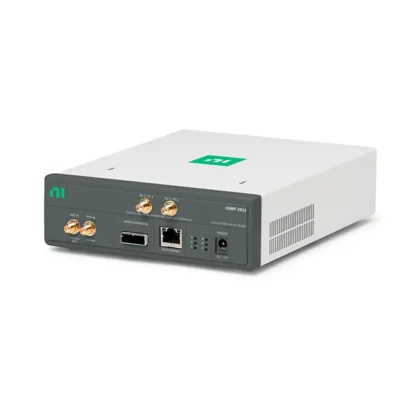
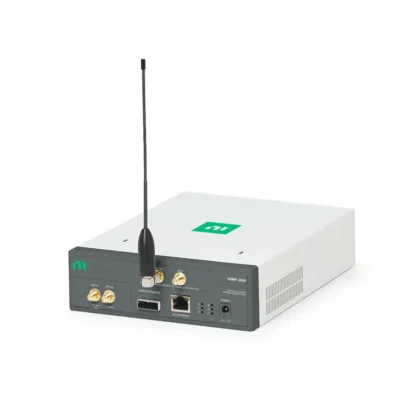
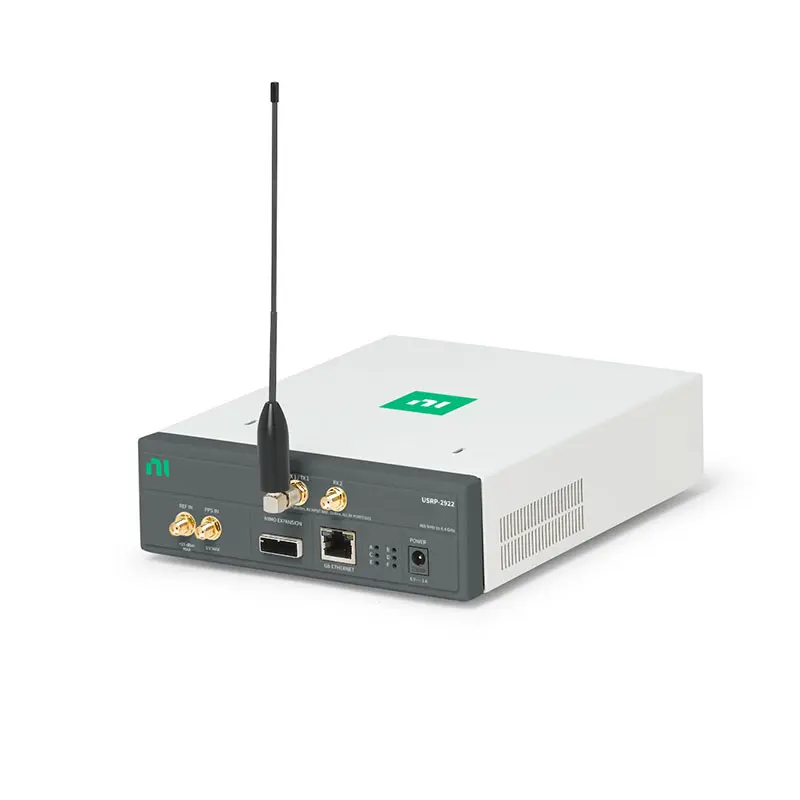
Product Introduction
Земля NI USRP-2922 is a software defined radio (SDR) transceiver designed for wireless communications research, RF prototyping, spectrum monitoring, radar experimentation, signal intelligence research, and university communication laboratories.
Featuring continuous RF coverage from 400 MHz to 4.4 GHz, up to 20 MHz of real-time instantaneous bandwidth with 16-bit samples, up to 40 MHz with 8-bit samples, programmable transmit and receive gain, and host-based I/Q processing, the USRP-2922 provides a flexible platform for developing and evaluating wireless communication systems.
Product Overview
Земля NI USRP-2922 belongs to the NI Universal Software Radio Peripheral family and provides a programmable RF architecture in which many traditional radio functions can be implemented in software.
Its broad 400 MHz to 4.4 GHz tuning range covers numerous wireless and RF research bands, making the USRP-2922 suitable for cellular communication research, GNSS-related experiments, 2.4 GHz wireless systems, radar research, custom modulation development, and spectrum analysis applications.
The device combines RF transmit and receive hardware with high-speed ADC and DAC resources and FPGA-based digital processing. Baseband I/Q data can be streamed to and from a host computer for modulation, demodulation, filtering, decoding, spectrum processing, and other software-defined radio algorithms.
Key Features
400 MHz to 4.4 GHz RF Frequency Range
The USRP-2922 provides continuous RF tuning across a wide frequency range for both transmission and reception.
- 400 MHz to 4.4 GHz transmit frequency range
- 400 MHz to 4.4 GHz receive frequency range
- Frequency step below 1 kHz
- Software-programmable center frequency
- Multi-band RF research
Advantage: A single SDR platform can be used across multiple wireless, radar, navigation, and experimental RF frequency bands.
20 MHz Real-Time Bandwidth with 16-Bit Samples
The USRP-2922 supports up to 20 MHz of instantaneous real-time bandwidth when operating with 16-bit I/Q samples.
- Up to 20 MHz instantaneous bandwidth
- 16-bit host sample format
- Wideband waveform acquisition
- Wideband RF generation
- Communication signal analysis
Advantage: Provides sufficient real-time bandwidth for many communications, radar, and spectrum research applications while maintaining 16-bit host sample representation.
Up to 40 MHz Bandwidth with 8-Bit Samples
When configured for 8-bit sample width, the USRP-2922 supports instantaneous real-time bandwidth up to 40 MHz under suitable host and network conditions.
- Up to 40 MHz instantaneous bandwidth
- 8-bit sample operation
- Higher streaming throughput
- Wideband RF experiments
- Broadband signal capture
Advantage: Allows engineers to trade sample width for increased real-time streaming bandwidth when required by the application.
High-Speed I/Q Sampling
The USRP-2922 supports high-rate I/Q data transfer for software-defined signal processing.
- Up to 25 MS/s with 16-bit samples
- Up to 50 MS/s with 8-bit samples
- Complex I/Q acquisition
- Complex I/Q generation
- Host-based DSP applications
Advantage: High I/Q sample rates support wideband digital modulation, spectrum processing, radar experiments, and custom RF waveform development.
RF Transmit Capability
The USRP-2922 provides a programmable RF transmitter for generating communication and experimental waveforms.
- 400 MHz to 4.4 GHz transmit operation
- 0 dB to 31 dB transmit gain range
- 0.5 dB gain steps
- Maximum output power approximately 17 dBm to 20 dBm
- Software-controlled waveform generation
Advantage: Engineers can generate real RF signals from custom digital waveforms developed in software.
RF Receive Capability
The USRP-2922 provides a programmable RF receiver for capturing wireless signals within its tuning range.
- 400 MHz to 4.4 GHz receive operation
- 0 dB to 31.5 dB receive gain range
- 0.5 dB gain steps
- 0 dBm maximum RF input power
- 5 dB to 7 dB specified noise figure
Advantage: Adjustable receive gain allows the SDR to be configured for different signal strengths and RF environments.
14-Bit ADC Architecture
The receiver section incorporates high-speed analog-to-digital conversion for RF signal acquisition.
- 2-channel ADC architecture
- 100 MS/s converter rate
- 14-bit ADC resolution
- 88 dB ADC spurious-free dynamic range
- High-speed digital signal acquisition
Advantage: Provides a high-performance conversion stage for software-defined receiver applications.
16-Bit DAC Architecture
The transmitter section uses high-speed digital-to-analog conversion for RF waveform generation.
- 2-channel DAC architecture
- 400 MS/s converter rate
- 16-битное разрешение ЦАП
- 80 dB DAC spurious-free dynamic range
- Programmable RF waveform generation
Advantage: Supports flexible generation of complex digital modulation and custom RF waveforms.
Software Defined Radio Architecture
The USRP-2922 allows communication functionality to be implemented and modified through software.
- Software-controlled center frequency
- Software-controlled RF gain
- Custom modulation and demodulation
- Digital filtering
- Protocol experimentation
- Signal processing research
Advantage: The same RF hardware can support many different radio experiments without redesigning the analog RF front end.
Simultaneous Transmit and Receive Applications
The transceiver architecture enables transmit and receive functions to operate as part of complete SDR communication experiments.
- Wireless link development
- Transmitter and receiver prototyping
- Duplex communication experiments
- Radar transmit/receive research
- Closed RF test configurations
Advantage: Researchers can develop complete over-the-air communication systems using a programmable SDR platform.
Frequency Accuracy
The USRP-2922 provides a specified frequency accuracy of 2.5 ppm.
- 2.5 ppm frequency accuracy
- Stable RF carrier generation
- Repeatable receiver tuning
- Wireless communication experiments
- Frequency-sensitive RF research
Advantage: Provides a stable reference for many laboratory communication and RF prototyping applications.
External Power Architecture
The USRP-2922 uses an external DC supply for operation.
- 6 VDC input
- 3 A power requirement
- 12 W to 15 W typical operating power
- 18 W maximum power
- Standalone external SDR hardware
Advantage: The external hardware architecture allows the radio to be positioned independently from the host computer.
NI-USRP Software Integration
The USRP-2922 can be controlled through compatible NI-USRP software environments for RF configuration and signal processing.
- NI-USRP driver support
- Интеграция LabVIEW
- Software-defined RF configuration
- I/Q waveform streaming
- Custom communications development
Advantage: Provides an integrated hardware and software environment for rapid wireless communication prototyping.
Technical Specifications
| Параметр | Описание |
|---|---|
| Product Type | Software Defined Radio Transceiver |
| Модель | NI USRP-2922 |
| Transmit Frequency Range | 400 MHz to 4.4 GHz |
| Receive Frequency Range | 400 MHz to 4.4 GHz |
| Frequency Step | <1 kHz |
| Frequency Accuracy | 2.5 ppm |
| Maximum Real-Time Bandwidth | 20 MHz with 16-bit Samples / 40 MHz with 8-bit Samples |
| Maximum I/Q Sample Rate | 25 MS/s with 16-bit Samples / 50 MS/s with 8-bit Samples |
| Transmit Gain Range | 0 dB to 31 dB |
| Transmit Gain Step | 0.5 dB |
| Maximum RF Output Power | 50 mW to 100 mW / Approximately 17 dBm to 20 dBm |
| Receive Gain Range | 0 dB to 31.5 dB |
| Receive Gain Step | 0.5 dB |
| Maximum RF Input Power | 0 dBm |
| Receiver Noise Figure | 5 dB to 7 dB |
| ADC | 2 Channels, 100 MS/s, 14-bit |
| ADC SFDR | 88 dB |
| DAC | 2 Channels, 400 MS/s, 16-bit |
| DAC SFDR | 80 dB |
| Power Requirement | 6 VDC, 3 A |
| Typical Power Consumption | 12 W to 15 W |
| Maximum Power Consumption | 18 W |
| Weight | 1.193 kg |
| Primary Applications | Wireless Research, SDR Development, RF Prototyping, Radar Experiments and Spectrum Monitoring |
Software Ecosystem
The NI USRP-2922 can be integrated into software-defined radio development environments for RF configuration, signal generation, acquisition, analysis, and communications research.
- NI-USRP: Provides the primary NI software interface for controlling compatible USRP hardware and streaming I/Q data.
- LabVIEW: Enables development of RF transmit, receive, modulation, demodulation, spectrum analysis, and communications applications.
- Digital Signal Processing: Host-based applications can implement filters, FFT processing, channel coding, synchronization, and modulation algorithms.
- Custom SDR Applications: The programmable radio architecture can be used for application-specific wireless communication and RF research systems.
Industries
- Wireless Communications
- Telecommunications Research
- Aerospace and Defense Research
- Radar Development
- RF Engineering
- Universities and Education
- Scientific Research
- Electronic System Development
Applications
Wireless Communications Research
The USRP-2922 provides a flexible RF platform for developing and testing custom wireless communications technologies.
- Modulation development
- Receiver algorithm research
- Wireless channel experiments
- Communication protocol development
- Over-the-air testing
Cellular Communications Research
The broad tuning range covers many frequency bands used for cellular and related wireless communication research.
- Cellular waveform experiments
- Baseband algorithm research
- Receiver development
- Wireless link characterization
GNSS and Navigation Research
The 400 MHz to 4.4 GHz operating range allows the USRP-2922 to be used in compatible navigation and GNSS-related research applications.
- GNSS signal experiments
- Navigation receiver research
- Signal acquisition studies
- Digital processing development
2.4 GHz Wireless Research
The USRP-2922 covers the 2.4 GHz ISM band used by many wireless communication technologies.
- 2.4 GHz communication research
- WLAN experiments
- ISM-band signal analysis
- Interference research
- Custom wireless protocols
Radar Research
The wide tuning range and programmable waveform architecture make the USRP-2922 useful for experimental radar systems.
- L-band radar research
- S-band radar research
- Pulse waveform experiments
- Radar signal processing
- Prototype radar development
Spectrum Monitoring
The receiver can acquire wideband I/Q data for software-based spectrum analysis within its operating range.
- RF spectrum monitoring
- Signal detection
- Interference analysis
- Wideband signal acquisition
- RF environment research
Modulation and Demodulation Research
The software-defined architecture allows researchers to implement a broad range of digital communication algorithms.
- PSK
- QAM
- FSK
- OFDM
- Custom digital modulation
University Communication Laboratories
The USRP-2922 provides a practical platform for teaching communication theory using real RF hardware.
- Software-defined radio courses
- Digital communication laboratories
- RF engineering education
- Signal processing experiments
- Graduate research
Comparison with Similar USRP Devices
| Модель | Основное различие | Best Application |
|---|---|---|
| NI USRP-2922 | 400 MHz to 4.4 GHz SDR transceiver with up to 20 MHz real-time bandwidth using 16-bit samples and up to 40 MHz with 8-bit samples. | Wide-frequency wireless and RF research |
| NI USRP-2921 | SDR platform focused primarily on the 2.4 GHz and 5 GHz wireless frequency bands. | 2.4 GHz and 5 GHz wireless research |
| NI USRP-2932 | Related 400 MHz to 4.4 GHz USRP platform with integrated GPS-disciplined timing capabilities. | Timing-sensitive and synchronized SDR research |
| NI USRP-2952 | Higher-performance USRP platform for advanced wireless communications and RF prototyping applications. | Advanced SDR and MIMO research |
Recommended Related Products
| NI USRP-2921 | Software-defined radio optimized for research primarily in the 2.4 GHz and 5 GHz wireless bands. |
| NI USRP-2932 | 400 MHz to 4.4 GHz SDR with integrated GPS-disciplined timing for synchronized RF experiments. |
| NI USRP-2952 | Higher-performance software-defined radio platform for advanced wireless communications and RF research. |
| NI USRP-2950 | Higher-performance SDR platform for wireless prototyping, MIMO research, and advanced communication applications. |
Why Choose USRP-2922?
- 400 MHz to 4.4 GHz continuous RF coverage
- RF transmit and receive capability
- Up to 20 MHz real-time bandwidth with 16-bit samples
- Up to 40 MHz real-time bandwidth with 8-bit samples
- Up to 25 MS/s 16-bit I/Q sampling
- Up to 50 MS/s 8-bit I/Q sampling
- 14-bit, 100 MS/s receive ADC architecture
- 16-bit, 400 MS/s transmit DAC architecture
- Programmable transmit and receive gain
- 2.5 ppm frequency accuracy
- Software-defined RF architecture
- Suitable for communications, radar, and spectrum research
Frequently Asked Questions
What is the NI USRP-2922?
The NI USRP-2922 is a software-defined radio transceiver designed for wireless communication research, RF prototyping, radar experimentation, spectrum monitoring, and communication engineering education.
What frequency range does the USRP-2922 support?
The USRP-2922 supports both RF transmission and reception from 400 MHz to 4.4 GHz.
What is the bandwidth of the USRP-2922?
The USRP-2922 supports maximum instantaneous real-time bandwidth of 20 MHz when using 16-bit samples and up to 40 MHz when using 8-bit samples. Actual achievable throughput depends on network configuration and host computer performance.
What is the maximum I/Q sample rate of the USRP-2922?
The maximum I/Q sampling rate is 25 MS/s with 16-bit samples and 50 MS/s with 8-bit samples, subject to host and network performance.
Can the USRP-2922 transmit RF signals?
Yes. The USRP-2922 includes a programmable RF transmitter covering 400 MHz to 4.4 GHz with a gain range from 0 dB to 31 dB.
What is the maximum transmit power of the USRP-2922?
The maximum specified RF output power varies with operating frequency and hardware characteristics and is approximately 50 mW to 100 mW, equivalent to about 17 dBm to 20 dBm.
What is the maximum RF input power of the USRP-2922?
The specified maximum receiver input power is 0 dBm. Signals exceeding the specified input level should not be applied directly to the receiver.
What ADC does the USRP-2922 use?
The receiver architecture includes two 14-bit ADC channels operating at 100 MS/s, with a specified ADC spurious-free dynamic range of 88 dB.
What DAC does the USRP-2922 use?
The transmitter includes two 16-bit DAC channels operating at 400 MS/s, with a specified DAC spurious-free dynamic range of 80 dB.
What is the difference between USRP-2921 and USRP-2922?
The primary difference is RF frequency coverage. The USRP-2921 focuses on the 2.4 GHz and 5 GHz wireless bands, while the USRP-2922 provides continuous tuning from 400 MHz to 4.4 GHz. The USRP-2922 is therefore more flexible for applications spanning cellular, navigation, radar, ISM, and other RF bands.
What is the difference between USRP-2922 and USRP-2932?
Both platforms provide similar broad RF frequency coverage, but the USRP-2932 adds integrated GPS-disciplined timing capability. The USRP-2932 is therefore preferable when accurate frequency reference, absolute timing, or synchronization between geographically separated radios is required.
Can the USRP-2922 be used for radar research?
Yes. Its 400 MHz to 4.4 GHz tuning range, programmable waveform generation, wideband I/Q acquisition, and software-defined architecture make it suitable for experimental L-band and S-band radar research within the device’s performance limits.
Can the USRP-2922 be used as a spectrum analyzer?
The USRP-2922 can capture wideband I/Q data for software-based spectrum analysis and monitoring. However, it should not automatically be treated as a replacement for a calibrated spectrum analyzer when traceable amplitude accuracy, regulatory measurements, or instrument-grade dynamic range are required.
What software supports the USRP-2922?
The USRP-2922 can be used with compatible NI-USRP software and LabVIEW environments for RF configuration, I/Q streaming, waveform generation, signal acquisition, and communications algorithm development.
Заключение
Земля NI USRP-2922 software defined radio transceiver provides a flexible platform for wireless communications research, RF prototyping, radar experimentation, spectrum monitoring, and education. With continuous 400 MHz to 4.4 GHz RF coverage, up to 20 MHz real-time bandwidth using 16-bit samples or 40 MHz using 8-bit samples, high-speed ADC and DAC resources, programmable gain, and software-defined I/Q processing, the USRP-2922 is well suited for researchers and engineers developing custom RF and wireless systems.