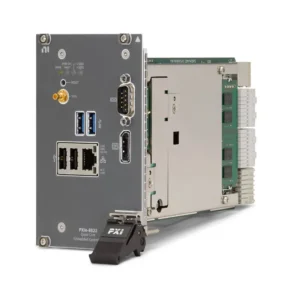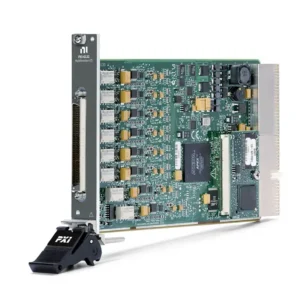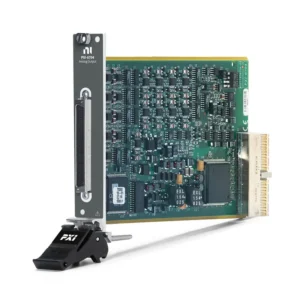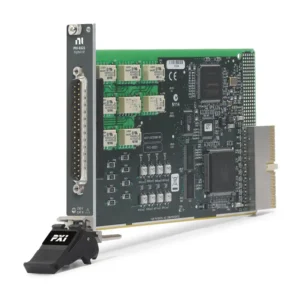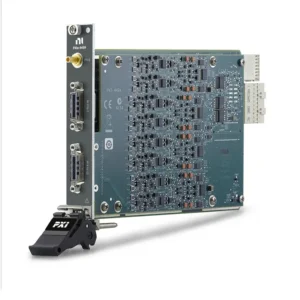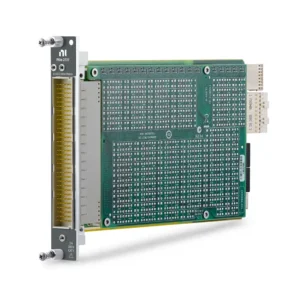


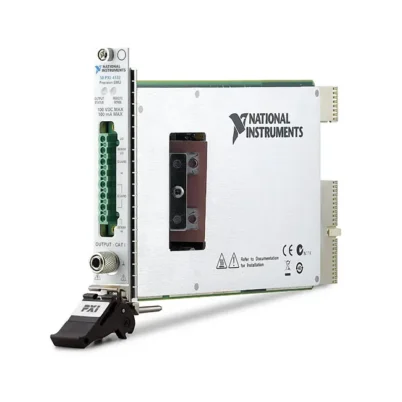
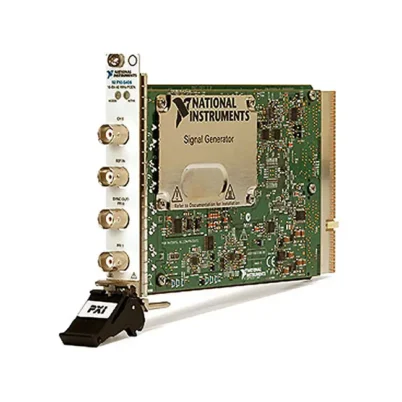
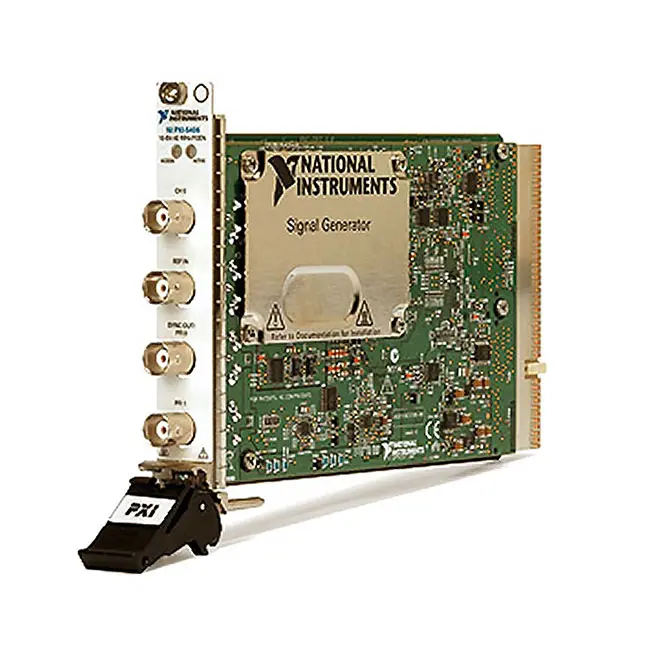
PXI-5406 40 MHz 16-Bit PXI Function Generator
Земля PXI-5406 is a single-channel, 16-bit PXI function generator designed for automated test, electronic validation, research and stimulus-response measurement systems. It uses direct digital synthesis to generate stable, accurately controlled periodic waveforms from a compact 3U PXI module.
The PXI-5406 can generate sine waves and square waves at frequencies up to 40 MHz, while triangle and ramp waveforms can be generated at frequencies up to 5 MHz. It also supports pseudorandom noise, DC output and user-defined periodic function waveforms.
The analog output supports a maximum instantaneous voltage from -5 V to +5 V. Programmable amplitude, offset, phase, frequency sweeps and frequency lists allow the module to reproduce a wide range of test stimuli without manual reconfiguration.
Key Features of the PXI-5406
- Single analog waveform output channel
- 40 MHz maximum sine-wave bandwidth
- 40 MHz maximum square-wave frequency
- 5 MHz maximum triangle and ramp frequency
- 16-bit digital-to-analog resolution
- Direct digital synthesis waveform generation
- 400 MS/s DDS update rate
- Approximately 0.355 µHz frequency resolution
- -5 V to +5 V maximum instantaneous output
- Up to 10 V peak-to-peak into a 50 Ω load
- Up to 20 V peak-to-peak into a high-impedance load
- Selectable 50 Ω or 75 Ω output impedance
- Sine, square, triangle and ramp waveforms
- Pseudorandom noise and DC signal generation
- Frequency sweep and frequency-list operation
- 32 kB of onboard waveform memory
- Front-panel waveform and synchronization connectors
- PXI triggering and PXI_CLK10 synchronization
- NI-FGEN software support
PXI-5406 Technical Specifications
| Product Model | PXI-5406 |
|---|---|
| Part Number | 779657-01 |
| Product Type | PXI function generator |
| Number of Output Channels | 1 |
| DAC Resolution | 16 bits |
| Generation Architecture | Direct digital synthesis |
| DDS Update Rate | 400 MS/s |
| Maximum Bandwidth | 40 MHz |
| Sine-Wave Frequency Range | 0 Hz to 40 MHz |
| Square-Wave Frequency Range | 0 Hz to 40 MHz |
| Triangle and Ramp Frequency Range | 0 Hz to 5 MHz |
| Frequency Resolution | Approximately 0.355 µHz |
| Standard Waveforms | Sine, square, triangle, ramp up, ramp down, noise and DC |
| User-Defined Function Size | Up to 16,384 samples |
| Arbitrary Waveform Generation Mode | Not supported as a conventional streaming arbitrary waveform generator |
| Maximum Instantaneous Output | -5 V to +5 V |
| Amplitude Range into 50 Ω | 5.64 mV peak-to-peak to 10 V peak-to-peak |
| Amplitude Range into High Impedance | 11.28 mV peak-to-peak to 20 V peak-to-peak |
| Maximum Combined AC and DC Output | ±5 V peak |
| Output Impedance | Selectable 50 Ω or 75 Ω nominal |
| Analog Output Connector | BNC |
| Onboard Memory | 32 kB |
| Square-Wave Duty Cycle | Programmable from 20% to 80% |
| Frequency-List Capacity | Up to 9,999 lists |
| Minimum Frequency-List Step Duration | 1.28 µs |
| Maximum Frequency-List Step Duration | 21 s |
| Synchronization Resources | PXI trigger bus, PXI star trigger and PXI_CLK10 reference |
| Шинный интерфейс | PXI |
| Module Format | 3U, single-slot PXI module |
| Поддержка программного обеспечения | NI-FGEN, LabVIEW and compatible text-based programming environments |
| Lifecycle Status | Limited support and no longer available for purchase from NI |
| Recommended Replacement | PXIe-5413, part number 785114-01 |
PXI-5406 Part Number
| Item | Part Number | Описание |
|---|---|---|
| PXI-5406 | 779657-01 | Single-channel, 40 MHz, 16-bit PXI function generator |
| PXIe-5413 Replacement | 785114-01 | Single-channel, 20 MHz, 16-bit PXI Express arbitrary waveform generator |
The PXI-5406 uses a front-panel BNC connector for its primary analog output. Verify the required cable impedance, connector condition, chassis slot compatibility and software version before ordering a replacement module.
40 MHz Function Generation
The PXI-5406 generates sine and square waveforms at frequencies up to 40 MHz. This range supports stimulus generation for audio, electronic, communications and general-purpose automated test applications.
Triangle, ramp-up and ramp-down functions are supported at frequencies up to 5 MHz. The maximum usable frequency also depends on amplitude, connected load, cable quality and the bandwidth of the complete test fixture.
For measurements near the upper frequency limit, use short, impedance-controlled coaxial cables and terminate the signal correctly. Improper termination can produce reflections, ringing and inaccurate amplitude at the DUT.
16-Bit Output Resolution
The PXI-5406 uses a 16-bit digital-to-analog architecture. The higher resolution provides finer waveform-level control than lower-resolution function generators when generating supported amplitudes and offsets.
Output resolution should not be interpreted as absolute accuracy. Final signal performance also depends on amplitude accuracy, offset accuracy, noise, distortion, load impedance and calibration condition.
Direct Digital Synthesis
Direct digital synthesis generates periodic waveforms by reading waveform values according to a precisely controlled digital phase accumulator. This architecture provides fine frequency resolution and phase-continuous frequency changes.
The PXI-5406 offers frequency resolution of approximately 0.355 µHz. Engineers can program closely spaced frequency steps for resonance searches, transfer-function measurements and frequency-response characterization.
DDS also allows the generator to change frequency without the long settling behavior associated with some conventional analog oscillators.
Sine-Wave Generation
Sine-wave output is available from very low frequencies through 40 MHz. Programmable amplitude, offset, phase and frequency make the module suitable for gain measurements, filter testing, resonant-device excitation and general analog stimulus generation.
At higher frequencies, the measured amplitude can be affected by the cable, termination and input impedance of the connected instrument. Configure the expected load impedance in the software so the displayed amplitude corresponds to the intended DUT voltage.
Square-Wave Generation
The PXI-5406 can generate square waves at frequencies up to 40 MHz. Square-wave duty cycle is programmable from 20% to 80%, allowing the output to simulate clocks, pulse trains and digital timing signals.
The analog output is not a substitute for a protected digital I/O interface. Verify voltage thresholds, output impedance, overshoot and current requirements before connecting the waveform generator to a digital device.
Triangle and Ramp Generation
Triangle, ramp-up and ramp-down waveforms can be generated at frequencies up to 5 MHz. These functions are useful for linearity tests, comparator evaluation, threshold characterization and repetitive voltage-sweep applications.
The practical edge shape and linearity depend on the programmed frequency, amplitude and load. Use an oscilloscope to verify the waveform at the DUT when precise ramp behavior is required.
Pseudorandom Noise Generation
The module can produce pseudorandom noise for stimulus-response testing. Noise signals can help characterize filters, amplifiers, sensors and other systems across a range of frequencies.
Generated pseudorandom noise is deterministic according to the instrument configuration and should not be treated as a certified physical random source for cryptographic or security applications.
DC Signal Generation
The PXI-5406 can provide a programmable DC signal within its supported output range. DC output can establish a bias voltage, reference level or operating point for a DUT.
The combined waveform amplitude and DC offset must remain within the maximum -5 V to +5 V instantaneous output range. The software may limit configurations that would exceed the available output range.
User-Defined Periodic Functions
The PXI-5406 supports user-defined periodic function shapes containing up to 16,384 samples. This allows generation of customized repeating waveforms that cannot be represented by the standard sine, square, triangle or ramp functions.
However, NI classifies the PXI-5406 as a function generator rather than a conventional arbitrary waveform generator. It does not provide the flexible arbitrary-waveform sequencing and host streaming capabilities offered by later PXI arbitrary waveform generators.
Programmable Amplitude and Offset
Into a 50 Ω load, the PXI-5406 supports amplitudes from approximately 5.64 mV peak-to-peak to 10 V peak-to-peak. With a high-impedance load, the available amplitude is approximately 11.28 mV peak-to-peak to 20 V peak-to-peak.
The maximum instantaneous output remains limited to ±5 V. The programmed waveform amplitude and DC offset must therefore fit within this limit at every point in the waveform.
When the generator is configured for a 50 Ω load but connected to a high-impedance input, the measured voltage can be approximately twice the programmed load voltage. Correct load configuration is essential for obtaining the intended signal level.
Selectable 50 Ω or 75 Ω Output Impedance
The analog output impedance can be configured as 50 Ω or 75 Ω nominal. The 50 Ω setting is commonly used with laboratory oscilloscopes, RF instruments and general electronic test fixtures.
The 75 Ω setting supports video and other systems based on 75 Ω signal paths. Use cables, feedthrough terminations and DUT inputs that match the selected impedance to minimize reflections.
Frequency Sweeps
Automated frequency sweeps allow the PXI-5406 to step or continuously change the output frequency across a defined test range. This capability is useful for measuring filter response, amplifier gain, sensor resonance and mechanical or acoustic behavior.
The generator can be combined with a PXI digitizer or digital multimeter to create an automated stimulus-response measurement system.
Frequency-List Operation
Frequency-list mode allows a test sequence to define a series of frequencies and corresponding step durations. The PXI-5406 supports up to 9,999 lists, with individual step durations ranging from 1.28 µs to 21 seconds.
Frequency lists are useful for repeated production tests in which the same set of stimulus frequencies must be generated with deterministic timing.
Phase-Continuous Frequency Changes
The DDS architecture supports phase-continuous frequency hopping. The output phase can remain continuous when the frequency changes, avoiding unwanted discontinuities caused by restarting the waveform at an arbitrary phase.
This capability is useful for frequency-agile stimulus generation, communications experiments and tests that are sensitive to abrupt waveform transitions.
PXI Synchronization
The PXI-5406 can use PXI backplane resources for timing and synchronization. PXI trigger lines, the PXI star trigger and the PXI_CLK10 reference allow waveform generation to be coordinated with digitizers, switches and other instruments.
Backplane synchronization reduces the need for external timing cables and supports repeatable timing relationships in multi-instrument test systems.
Triggering and Burst Generation
Triggering allows the waveform output to begin at a defined point in an automated test. Trigger sources can include software commands, front-panel signals and PXI backplane trigger resources, depending on the selected configuration.
Triggered and burst-style generation can stimulate a DUT only during a required measurement interval. Coordinate trigger polarity, routing and delay with the receiving instrument before running the complete test sequence.
Module-to-Module Synchronization
Multiple PXI instruments can share reference clocks and trigger signals through the chassis backplane. This allows the PXI-5406 to operate as the stimulus source while a digitizer or measurement module captures the DUT response.
Synchronization performance depends on the reference-clock configuration, trigger route, receiving instrument and application software. Verify timing with the completed system when sub-microsecond relationships are important.
Automated Frequency-Response Testing
The PXI-5406 can generate stepped sine waves while another PXI instrument measures the resulting amplitude and phase. This creates an automated system for evaluating filters, amplifiers, transducers and resonant structures.
Test software can control the frequency list, measurement timing, averaging and data storage without requiring manual adjustment of a benchtop generator.
Electronic Component Validation
The module can provide repeatable signals for testing amplifiers, filters, comparators, analog-to-digital converters and other electronic circuits. Programmable amplitude and offset allow different operating conditions to be applied automatically.
External attenuation, amplification or protection may be required when the DUT operates outside the PXI-5406 output range or requires more current than the waveform output can provide.
Sensor and Transducer Excitation
Sine sweeps and stepped-frequency signals can excite sensors, piezoelectric elements, acoustic devices and mechanical test specimens. The resulting response can be captured with a compatible digitizer or dynamic signal acquisition module.
When driving capacitive or specialized transducers, verify the required voltage, current and load impedance. An external amplifier may be needed for high-voltage or high-power excitation.
Production Functional Testing
In production systems, the PXI-5406 can generate standardized stimulus signals for each DUT according to a software-controlled test sequence. PXI switching modules can route its output to different test points or fixtures.
Frequency-list operation and hardware triggering help improve repeatability and reduce the time required to change signal conditions.
NI-FGEN Software Support
The PXI-5406 is controlled through the NI-FGEN instrument driver. NI-FGEN provides functions for configuring waveform type, frequency, amplitude, offset, duty cycle, triggering and frequency lists.
The driver supports LabVIEW, LabWindows/CVI and compatible text-based development environments. Before installing a PXI-5406 in a current system, confirm that the selected NI-FGEN version supports the operating system, PXI controller and development software.
Typical PXI-5406 Applications
- Automated electronic functional testing
- Filter frequency-response measurements
- Amplifier gain and bandwidth testing
- Sensor and transducer excitation
- Resonance and vibration research
- Audio and ultrasonic testing
- Clock and pulse stimulus generation
- Comparator and threshold testing
- Production end-of-line testing
- Frequency sweep generation
- Mixed-signal validation
- Laboratory automation
PXI-5406 Troubleshooting
The PXI-5406 Is Not Detected
Confirm that the module is fully inserted into a compatible PXI or PXI hybrid slot. Check chassis power, controller communication and NI-FGEN installation, then inspect the module in NI Measurement & Automation Explorer.
There Is No Analog Output
Verify that the output channel is enabled and that the BNC cable is connected to the correct front-panel connector. Check the trigger configuration because the module may be waiting for a trigger before generation begins.
The Output Amplitude Is Twice the Programmed Value
This commonly occurs when the generator is configured for a 50 Ω load but connected to a high-impedance oscilloscope input. Set the receiving instrument to 50 Ω or configure the expected load correctly in NI-FGEN.
The Waveform Is Distorted at High Frequency
Use a short coaxial cable with the correct characteristic impedance. Check the DUT input, termination and output amplitude. Cable reflections and capacitive loading can distort the waveform near the maximum operating frequency.
The Square Wave Has Excessive Ringing
Confirm that the cable and termination match the selected 50 Ω or 75 Ω output impedance. Avoid unterminated branches and long fixture traces, and inspect the signal directly at the DUT connection.
The Programmed Offset Cannot Be Applied
The requested waveform amplitude and offset may exceed the ±5 V instantaneous output limit. Reduce the amplitude or offset so that the complete waveform remains within the supported range.
The Frequency Sweep Is Not Repeatable
Use hardware triggers and frequency-list operation instead of relying only on software-timed frequency changes. Verify the list step duration, trigger routing and measurement settling time.
A User-Defined Waveform Does Not Load
Confirm that the waveform contains no more than 16,384 samples and is configured as a supported user-defined periodic function. The PXI-5406 does not provide the same arbitrary-waveform mode as later AWG modules.
The Module Cannot Be Installed in a PXI Express Slot
The PXI-5406 is a conventional PXI module. It can be installed in PXI-1 peripheral slots or compatible PXI hybrid slots, but not in PXI Express-only peripheral slots.
The Module Is Not Supported by Current Software
The PXI-5406 is a legacy product. Verify compatibility among NI-FGEN, the operating system and the development environment. Maintaining a validated legacy software image may be necessary for existing test systems.
PXI-5406 Comparison with Similar PXI Waveform Generators
| Модель | Primary Configuration | Best Suited For |
|---|---|---|
| PXI-5402 | 20 MHz, 14-bit function generator | Lower-frequency standard function generation |
| PXI-5406 | 40 MHz, 16-bit DDS function generator | High-resolution standard functions and frequency sweeps |
| PXI-5412 | 20 MHz, 14-bit arbitrary waveform generator | Custom arbitrary waveform generation |
| PXI-5421 | 43 MHz, 16-bit arbitrary waveform generator | Flexible arbitrary waveforms and modulation |
| PXI-5422 | 80 MHz, 16-bit arbitrary waveform generator | Higher-bandwidth arbitrary signal generation |
| PXIe-5413 | 20 MHz, 16-bit, one- or two-channel PXI Express AWG | Modern arbitrary waveform generation and system migration |
PXI-5406 vs PXI-5402
Земля PXI-5402 provides 20 MHz bandwidth and 14-bit resolution, while the PXI-5406 provides 40 MHz bandwidth and 16-bit resolution.
Choose the PXI-5406 when higher output frequency and finer DAC resolution are required. The PXI-5402 may be sufficient for lower-frequency standard function generation.
PXI-5406 vs PXI-5412
Земля PXI-5412 is a 14-bit arbitrary waveform generator that supports flexible stored waveform generation. The PXI-5406 provides higher standard-function bandwidth and 16-bit resolution but is not classified as a conventional arbitrary waveform generator.
Select the PXI-5406 for sine, square, ramp and frequency-sweep applications. Select the PXI-5412 when custom arbitrary waveform records are the primary requirement.
PXI-5406 vs PXI-5421
Земля PXI-5421 is a 16-bit arbitrary waveform generator with approximately 43 MHz sine-wave bandwidth and more flexible custom-waveform functionality.
The PXI-5406 is suitable for DDS-based standard functions and phase-continuous frequency changes. The PXI-5421 is preferred for complex arbitrary waveforms and modulation applications.
PXI-5406 vs PXI-5422
Земля PXI-5422 offers greater bandwidth and arbitrary waveform capability. It is better suited to higher-frequency mixed-signal and communications testing.
Choose the PXI-5406 when 40 MHz standard-function generation meets the application requirements. Choose the PXI-5422 when higher bandwidth and custom waveform generation are necessary.
PXI-5406 vs PXIe-5413
Земля PXIe-5413, part number 785114-01, is NI’s recommended replacement for the PXI-5406. It provides 16-bit resolution, arbitrary waveform generation, a wider ±12 V output range and advanced synchronization.
The PXI-5406 offers a higher 40 MHz standard-function bandwidth, while the PXIe-5413 has a 20 MHz maximum bandwidth. Verify frequency, waveform, voltage, channel-count and PXI Express chassis requirements before migrating.
Recommended Related Products
- PXI-5402 20 MHz Function Generator
- PXI-5412 20 MHz Arbitrary Waveform Generator
- PXI-5421 43 MHz Arbitrary Waveform Generator
- PXI-5422 80 MHz Arbitrary Waveform Generator
- PXIe-5413 20 MHz PXI Express Arbitrary Waveform Generator
- PXI-5122 High-Speed Digitizer
- View More NI PXI and PXI Express Modules
Selecting the Right PXI Waveform Generator
Choose the PXI-5406 when the test system requires a single-channel, 16-bit DDS function generator with sine and square-wave frequencies up to 40 MHz. It is particularly suitable for frequency sweeps, periodic stimulus and maintaining validated legacy PXI systems.
Choose an arbitrary waveform generator such as the PXI-5412, PXI-5421 or PXI-5422 when the application requires complex stored waveform records. For new PXI Express systems, consider the PXIe-5413 while confirming that its 20 MHz bandwidth satisfies the test requirement.
Why Choose the PXI-5406?
- Generates sine and square waves up to 40 MHz
- Provides 16-bit output resolution
- Uses precise direct digital synthesis
- Offers extremely fine frequency resolution
- Supports triangle, ramp, noise and DC outputs
- Provides frequency sweeps and frequency lists
- Offers programmable amplitude, offset and duty cycle
- Supports 50 Ω and 75 Ω signal systems
- Synchronizes with other PXI instruments
- Integrates with NI-FGEN and LabVIEW
Frequently Asked Questions
What Is the PXI-5406?
The PXI-5406 is a single-channel, 40 MHz, 16-bit PXI function generator that uses direct digital synthesis to produce standard periodic waveforms.
What Is the PXI-5406 Part Number?
The standard NI part number for the PXI-5406 is 779657-01.
What Is the Maximum Output Frequency?
The maximum sine and square-wave frequency is 40 MHz. Triangle and ramp waveforms support frequencies up to 5 MHz.
What Waveforms Can the PXI-5406 Generate?
It can generate sine, square, triangle, ramp-up, ramp-down, pseudorandom noise, DC and supported user-defined periodic function waveforms.
Does the PXI-5406 Support Arbitrary Waveforms?
NI classifies the PXI-5406 as a function generator and lists conventional arbitrary waveform support as unavailable. It can generate limited user-defined periodic functions but does not provide the full arbitrary-waveform functionality of an AWG such as the PXI-5421.
What Is the Output Voltage Range?
The maximum instantaneous output range is -5 V to +5 V. It can provide up to 10 V peak-to-peak into 50 Ω or 20 V peak-to-peak into a high-impedance load.
What Output Impedances Are Available?
The analog output impedance can be configured as either 50 Ω or 75 Ω nominal.
How Much Onboard Memory Does It Have?
The PXI-5406 provides 32 kB of onboard analog output memory.
Which Software Controls the PXI-5406?
The module is controlled with the NI-FGEN instrument driver and can be integrated with LabVIEW, LabWindows/CVI and compatible text-based programming environments.
Can the PXI-5406 Be Installed in Any PXI Express Slot?
No. It is a conventional PXI module and requires a PXI-1 peripheral slot or a compatible PXI hybrid slot. It cannot be installed in an Express-only peripheral slot.
Is the PXI-5406 Still Manufactured?
No. The PXI-5406 is no longer available for purchase from NI and is maintained under limited support. Surplus and refurbished units may still be available.
What Is the Recommended Replacement?
NI identifies the single-channel PXIe-5413, part number 785114-01, as the recommended replacement. Confirm its lower 20 MHz bandwidth and PXI Express requirements before migration.
Request a Quote for the PXI-5406
Contact us for current availability, condition, lead time and project pricing for the PXI-5406 40 MHz 16-Bit PXI Function Generator. We can also help identify compatible PXI chassis, coaxial cables, digitizers and replacement waveform generators for your automated test system.