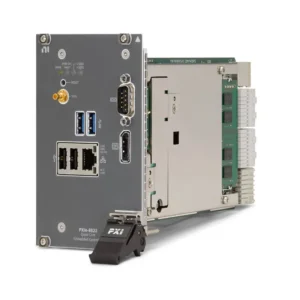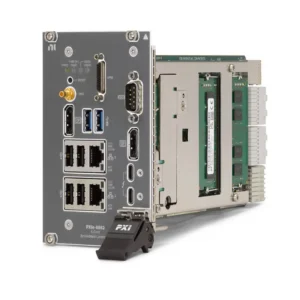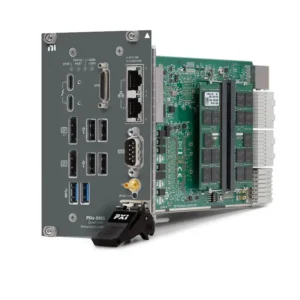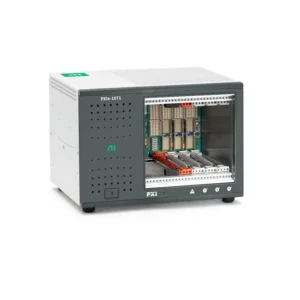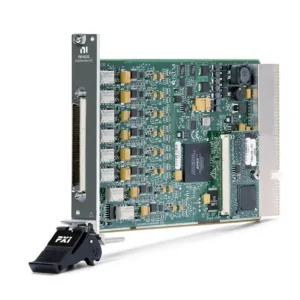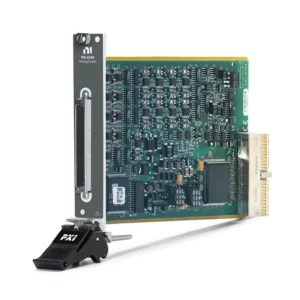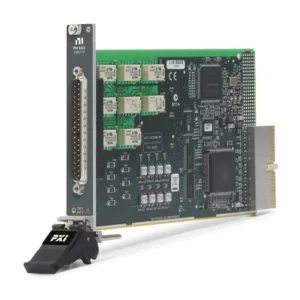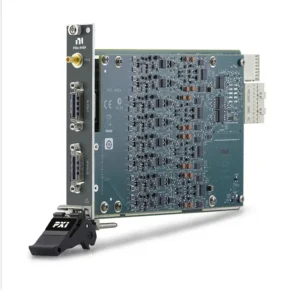




PXIe-5606 26.5 GHz Wideband PXI RF Signal Downconverter
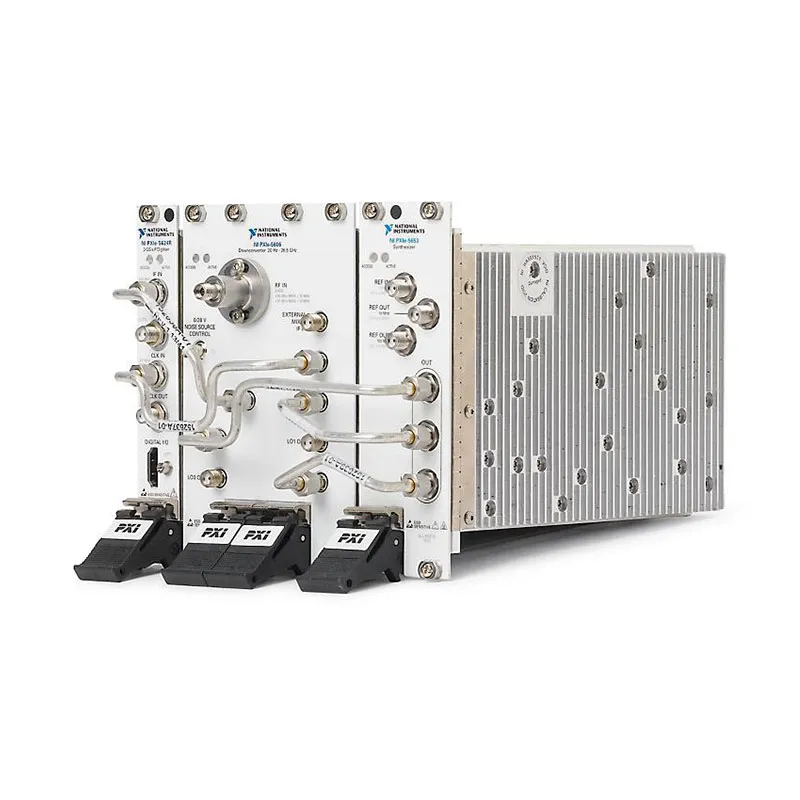
Земля PXIe-5606 is a wideband PXI Express RF signal downconverter designed to translate microwave and radio-frequency signals to a lower intermediate frequency for digitization and analysis. It is a primary RF component of the NI PXIe-5668 vector signal analyzer system.
PXIe-5606 configurations are available with maximum RF frequencies of 14 GHz or 26.5 GHz. Hardware versions support 80 MHz, 200 MHz or 320 MHz configured analysis bandwidth, while specific wideband PXIe-5668 system arrangements can achieve as much as 765 MHz instantaneous bandwidth in the high-frequency signal path.
The module includes a female RF input connector and supports AC- and DC-coupled operation. It works with the PXIe-5653 synthesizer and local-oscillator source and the PXIe-5624 intermediate-frequency digitizer to create a complete modular vector signal analyzer.
The PXIe-5606 is discontinued as a separately identified legacy component. Before ordering a replacement, verify the frequency range, bandwidth version, assembly number, associated PXIe-5668 configuration and required intermodule cables.
Key Features of the PXIe-5606
- Wideband PXI Express RF signal downconverter
- Available with frequency coverage up to 14 GHz
- Available with frequency coverage up to 26.5 GHz
- 80 MHz configured bandwidth version
- 200 MHz configured bandwidth version
- 320 MHz configured bandwidth version
- Supports wider high-band operation in eligible PXIe-5668 systems
- AC- and DC-coupled signal paths
- Female RF input connector
- Integrated RF attenuation and signal conditioning
- Internal high-pass filtering options
- Multiple local-oscillator stages
- External local-oscillator connectivity
- Designed for the PXIe-5668 vector signal analyzer
- Compatible with the PXIe-5624 IF digitizer
- Compatible with the PXIe-5653 synthesizer and LO source
- Controlled through the NI-RFSA instrument driver
- Supported by compatible NI RFmx measurement software
PXIe-5606 Technical Specifications
| Product Model | PXIe-5606 |
|---|---|
| Product Type | PXI Express wideband RF signal downconverter |
| Primary Function | Converts RF and microwave input signals to an intermediate frequency for digitization |
| Maximum Frequency Options | 14 GHz or 26.5 GHz |
| Configured Bandwidth Options | 80 MHz, 200 MHz or 320 MHz |
| Extended System Bandwidth | Up to 765 MHz in eligible high-band PXIe-5668 configurations |
| Standard Wideband Operation | Up to 320 MHz below a 3.6 GHz center frequency in compatible systems |
| High-Band Operation | 3.6 GHz to the selected 14 GHz or 26.5 GHz maximum |
| Input Impedance | 50 Ω nominal |
| Input Coupling | AC and DC coupling supported |
| RF Input Connector | Female coaxial RF connector |
| RF Attenuation Resolution | 1 dB steps in supported low-band configurations and 5 dB steps in high-band configurations |
| Low-Band RF Attenuation Range | 1 dB to 106 dB, configuration dependent |
| High-Band RF Attenuation Range | 5 dB to 75 dB in 5 dB steps |
| High-Pass Filter Options | 1.35 GHz and 2.2 GHz internal high-pass filters |
| Primary System Digitizer | PXIe-5624 intermediate-frequency digitizer |
| Primary LO Source | PXIe-5653 RF synthesizer and local-oscillator source |
| Optional Preamplifier | PXIe-5698 in compatible PXIe-5668 systems |
| Driver | NI-RFSA |
| Measurement Software | Compatible NI RFmx personalities |
| Hardware Platform | PXI Express |
| Typical System Applications | Spectrum analysis, vector signal analysis and wideband RF measurements |
| Lifecycle Status | Discontinued or supplied as a component of supported analyzer configurations |
PXIe-5606 Assembly and System Configurations
| PXIe-5606 Assembly | Максимальная частота | Configured Bandwidth | Related PXIe-5668 System |
|---|---|---|---|
| 198265-01L | 26.5 GHz | 80 MHz | 783124-01 |
| 198265-02L | 26.5 GHz | 200 МГц | 783124-02 |
| 198265-03L | 26.5 GHz | 320 MHz base configuration | 783124-03 |
| 198265-04L | 14 GHz | 80 MHz | 783156-01 |
| 198265-05L | 14 GHz | 200 МГц | 783156-02 |
| 198265-06L | 14 GHz | 320 MHz or 765 MHz system configuration | 783156-03 or compatible upgraded system |
The 198265 numbers identify module assembly variations. The 783124 and 783156 numbers identify complete PXIe-5668 vector signal analyzer configurations that include the PXIe-5606, PXIe-5624, PXIe-5653 and required interconnect cables.
Do not select a replacement using only the PXIe-5606 model name. Match the maximum frequency, bandwidth license or hardware configuration, assembly revision and complete analyzer system.
PXIe-5668 System Components
| Component | System Function |
|---|---|
| PXIe-5606 | RF and microwave signal downconversion, attenuation and filtering |
| PXIe-5653 | Synthesized local-oscillator signals for the downconversion stages |
| PXIe-5624 | Digitizes the intermediate-frequency signal and provides FPGA-based processing |
| PXIe-5698 | Optional RF preamplifier for improved sensitivity in compatible configurations |
| NI-RFSA | Configures and controls the complete RF signal analyzer |
| NI RFmx | Provides spectrum, modulation and wireless measurement personalities |
Wideband RF Downconversion
High-frequency RF signals cannot always be digitized directly with the required resolution and dynamic range. The PXIe-5606 uses multiple frequency-conversion stages to translate the selected RF spectrum to an intermediate frequency suitable for the PXIe-5624 digitizer.
The NI-RFSA driver coordinates tuning, attenuation, filtering, local-oscillator configuration and digitizer settings. The user normally controls the complete PXIe-5668 analyzer rather than configuring each internal module independently.
14 GHz and 26.5 GHz Versions
The PXIe-5606 is available in versions supporting maximum frequencies of 14 GHz or 26.5 GHz. The required model depends on the highest carrier, harmonic or spurious signal that must be measured.
The 14 GHz version supports many wireless, aerospace, radar and semiconductor applications below the Ku-band range. The 26.5 GHz version extends measurement coverage through additional microwave bands.
Selecting a frequency range higher than the immediate requirement can provide flexibility for future projects, but the complete analyzer configuration and calibration coverage must match that range.
80 MHz Bandwidth Configuration
The 80 MHz version is suitable for traditional spectrum analysis, narrowband modulation analysis and signals that do not require very wide instantaneous capture.
A narrower bandwidth configuration may reduce data-transfer and processing requirements. It remains capable of tuning across the module’s full specified RF frequency range.
200 MHz Bandwidth Configuration
The 200 MHz configuration supports wider wireless channels, radar pulses, frequency-agile signals and broadband modulation measurements.
It provides a balance between acquisition bandwidth, system cost and processing requirements. The associated PXIe-5624 digitizer and analyzer configuration must support the selected bandwidth.
320 MHz Bandwidth Configuration
The 320 MHz configuration supports wideband vector signal analysis and transient RF capture. It is useful for RFIC characterization, wide-channel wireless measurements and radar testing.
At center frequencies below approximately 3.6 GHz, compatible PXIe-5668 configurations provide as much as 320 MHz of instantaneous analysis bandwidth.
765 MHz High-Band Operation
Eligible wideband PXIe-5668 configurations can provide up to 765 MHz instantaneous bandwidth at center frequencies from approximately 3.6 GHz to the analyzer’s maximum RF frequency.
This capability depends on the complete analyzer configuration, including the PXIe-5606 assembly, PXIe-5624 digitizer, PXIe-5653 local oscillator, cabling, software and calibration. It should not be assumed for every PXIe-5606 version.
AC and DC Coupling
The PXIe-5606 supports AC- and DC-coupled operation. The correct coupling mode depends on signal frequency, DC content and the connected source.
AC coupling blocks the DC component and is commonly used for RF signals. DC coupling allows compatible low-frequency content to pass through the analyzer signal path.
Before applying a signal containing DC voltage, verify the complete analyzer’s input limits and selected coupling mode.
RF Attenuation
Programmable RF attenuation helps protect the signal path and sets the appropriate mixer level for the applied signal. The available range and resolution depend on the selected frequency band.
Supported low-band configurations provide attenuation adjustment from approximately 1 dB to 106 dB in 1 dB steps. High-band paths provide approximately 5 dB to 75 dB attenuation in 5 dB steps.
Automatic reference-level control normally selects an appropriate attenuation setting. Manual control can be useful when optimizing dynamic range for distortion, noise or transient measurements.
Integrated High-Pass Filters
The PXIe-5606 includes selectable high-pass filters with nominal corner frequencies of 1.35 GHz and 2.2 GHz.
High-pass filtering can reduce the influence of large low-frequency signals when measuring a higher-frequency signal. NI-RFSA selects an appropriate supported filter based on the configured maximum corner frequency.
Improper filtering can remove desired signal content. Confirm the expected signal spectrum before enabling a high-pass filter.
Multi-Stage Local-Oscillator Architecture
The PXIe-5606 uses local-oscillator signals from the PXIe-5653 to perform its frequency conversions. Dedicated semi-rigid cables connect the LO stages between the analyzer modules.
Correct LO cable placement is essential for tuning accuracy, phase-noise performance and amplitude calibration. Interchanging or omitting cables can prevent initialization or produce invalid measurements.
RF Preselection
Frequency-selective filtering helps reject unwanted images and out-of-band signals before digitization. Preselection is particularly important in wideband microwave measurements where multiple mixing products may otherwise enter the analysis path.
Filter selection is normally controlled automatically by NI-RFSA according to center frequency and acquisition configuration.
Compatible PXIe-5624 IF Digitizer
The PXIe-5624 digitizes the intermediate-frequency output produced by the PXIe-5606. Its high sample rate and FPGA resources support wideband acquisition, digital downconversion and custom signal processing.
The PXIe-5606 does not provide complete waveform acquisition by itself. A compatible digitizer, local-oscillator source, cables and driver configuration are required.
Compatible PXIe-5653 LO Source
The PXIe-5653 generates the synthesized local-oscillator signals required by the PXIe-5606 conversion stages.
Using the correct LO source and calibrated cable set allows NI-RFSA to tune the complete analyzer across its specified frequency range.
Optional PXIe-5698 Preamplifier
Земля PXIe-5698 RF preamplifier can improve system sensitivity when measuring signals near the analyzer noise floor.
A preamplifier is useful for low-level measurements but reduces the maximum signal level that can be applied without compression. Enable it only when the expected input power is appropriate.
PXI Express System Integration
The PXIe-5606 forms part of a multi-module PXI Express analyzer. The required PXIe-5668 system occupies several adjacent chassis slots and uses semi-rigid cables between the downconverter, LO source and digitizer.
Before installation, verify slot availability, chassis cooling, controller bandwidth and cable clearance. Modules should be installed in the positions specified by the system documentation.
Phase-Coherent and MIMO Measurements
Multiple compatible PXIe-5668 systems can share local-oscillator and timing resources for phase-coherent measurements.
This architecture supports MIMO receiver testing, phased-array measurements, direction finding and multichannel radar analysis. Accurate synchronization requires the correct extension kits, cables and calibration procedures.
Typical PXIe-5606 Applications
- Wideband spectrum analysis
- Vector signal analysis
- Wireless communication testing
- RFIC characterization
- Microwave component testing
- Radar pulse analysis
- Electronic warfare signal analysis
- Мониторинг спектра
- Signal intelligence research
- Harmonic and spurious measurements
- Modulation quality analysis
- Phase-coherent multichannel acquisition
- MIMO receiver testing
- Aerospace and defense validation
- High-volume RF production testing
Wireless Communication Testing
The PXIe-5606 supports wideband RF measurements used to evaluate wireless transmitters, receivers, amplifiers and other communication components.
When combined with compatible RFmx measurement software, the complete analyzer can perform channel power, occupied bandwidth, adjacent-channel leakage, error-vector magnitude and modulation-quality measurements.
RFIC Characterization
The wide frequency range and configurable bandwidth support characterization of RF integrated circuits, amplifiers, mixers, filters and front-end modules.
Automated PXI systems can coordinate the analyzer with signal generators, source-measure units, power supplies and switching modules for comprehensive device characterization.
Radar Signal Analysis
Wide instantaneous bandwidth allows the analyzer to capture short pulses, chirps and frequency-agile radar waveforms without retuning during the acquisition.
The PXIe-5624 FPGA can support custom triggering and signal-processing routines when used in a compatible programmable PXIe-5668 configuration.
Spectrum Monitoring
The PXIe-5606 can support spectrum-monitoring and signal-intelligence systems that search for intermittent or unknown RF activity across a wide frequency range.
Measurement performance depends on analyzer configuration, tuning strategy, preamplification, acquisition bandwidth and processing software.
NI-RFSA Software Support
The PXIe-5606 is controlled through the NI-RFSA instrument driver. NI-RFSA coordinates the downconverter, local-oscillator source and digitizer as one vector signal analyzer.
The driver provides functions for setting center frequency, reference level, acquisition bandwidth, coupling, attenuation, triggering and waveform acquisition.
Compatible application environments include LabVIEW, LabWindows/CVI, C and supported .NET development tools.
NI RFmx Integration
Compatible NI RFmx measurement personalities provide higher-level spectrum and modulation analysis for supported PXIe-5668 systems.
RFmx applications can perform measurements such as spectrum analysis, demodulation, phase noise, noise figure and wireless-standard analysis when supported by the hardware and installed software licenses.
PXIe-5606 Installation Requirements
Install the PXIe-5606 in the correct PXI Express chassis slot according to the complete analyzer system layout. Turn off the chassis and follow electrostatic-discharge precautions before installing or removing modules.
Use the specified semi-rigid cables and tighten RF connectors to the recommended torque. Excessive or insufficient torque can damage connectors or reduce microwave measurement repeatability.
Maintain adequate chassis airflow and install filler panels in unused slots. Wideband RF modules require proper cooling to maintain performance and calibration accuracy.
PXIe-5606 Troubleshooting
The PXIe-5606 is not detected
Confirm that the module is fully installed in a compatible PXI Express slot. Check chassis power, controller communication, PXI Platform Services and NI-RFSA installation.
The PXIe-5668 does not initialize
Verify that the PXIe-5606, PXIe-5653 and PXIe-5624 are installed in the required slots. Inspect every LO, IF and clock cable and confirm that the correct analyzer modules are associated in NI MAX.
The analyzer cannot tune to the required frequency
Check whether the installed PXIe-5606 is a 14 GHz or 26.5 GHz version. Confirm that the requested center frequency and bandwidth are supported by the complete hardware configuration.
The expected bandwidth is unavailable
Verify whether the module is an 80 MHz, 200 MHz or 320 MHz assembly. Extended 765 MHz operation requires a compatible wideband system configuration and appropriate frequency range.
The measured amplitude is incorrect
Check RF attenuation, reference level, coupling, cable loss and calibration status. Allow the hardware to warm up and perform the recommended self-calibration.
The signal is compressed or distorted
Reduce the input level or increase RF attenuation. Disable the optional preamplifier when measuring a signal that is too large for the amplified path.
The noise floor is higher than expected
Reduce unnecessary attenuation, use an appropriate reference level and enable the compatible preamplifier when measuring low-level signals. Check external RF interference and cable shielding.
Image responses appear in the spectrum
Confirm that automatic preselection and appropriate high-pass filtering are enabled. Inspect the input for strong out-of-band signals that may create mixing products.
Wideband measurements have poor flatness
Verify the IF and LO cable connections, system calibration and configured bandwidth. Damaged, substituted or incorrectly torqued semi-rigid cables can affect wideband response.
Phase-coherent channels do not align
Check shared LO and reference-clock connections, trigger routing, digitizer alignment and multichannel calibration. All channels must use compatible hardware revisions and software settings.
NI-RFSA reports a hardware configuration error
Confirm that the correct PXIe-5606, PXIe-5653 and PXIe-5624 resources are assigned to the same analyzer. Check driver compatibility and restore the expected system associations in NI MAX.
PXIe-5606 Comparison with Related RF Downconverters
| Модель | Primary Frequency Capability | Best Suited For |
|---|---|---|
| PXIe-5606 | Up to 14 GHz or 26.5 GHz with wideband configurations | PXIe-5668 wideband microwave vector signal analyzers |
| PXIe-5605 | Up to 14 GHz | PXIe-5665 high-dynamic-range RF analysis systems |
| PXIe-5603 | Lower microwave frequency range | Lower-frequency PXIe-5665 configurations |
| PXIe-5601 | General RF downconversion | PXIe-5663 and PXIe-5663E analyzer systems |
| PXI-5600 | Legacy RF downconversion | PXI-5661 legacy vector signal analyzers |
PXIe-5606 vs PXIe-5605
The PXIe-5606 supports versions extending to 26.5 GHz and is designed for the wideband PXIe-5668 vector signal analyzer.
Земля PXIe-5605 supports frequencies up to 14 GHz and is associated primarily with PXIe-5665 analyzer configurations. The two modules are not direct standalone replacements.
PXIe-5606 vs PXIe-5603
The PXIe-5606 provides greater maximum frequency and wider acquisition configurations than the PXIe-5603.
Select the PXIe-5606 when the test system requires PXIe-5668 compatibility, microwave coverage up to 14 GHz or 26.5 GHz, or instantaneous bandwidth beyond the capabilities of earlier downconverters.
PXIe-5606 vs PXIe-5668
The PXIe-5606 is an RF downconverter module, while the PXIe-5668 is a complete vector signal analyzer system.
A PXIe-5668 configuration includes the PXIe-5606, PXIe-5624 IF digitizer, PXIe-5653 LO source, intermodule cables and system-level calibration. The PXIe-5606 alone does not provide a complete spectrum or vector signal analyzer.
Recommended Related Products
- PXIe-5668 26.5 GHz Wideband Vector Signal Analyzer
- PXIe-5624 Wideband IF Digitizer
- PXIe-5653 RF Synthesizer and Local-Oscillator Source
- PXIe-5698 RF Preamplifier
- PXIe-5605 14 GHz RF Signal Downconverter
- PXIe-5603 RF Signal Downconverter
- PXIe-5665 Vector Signal Analyzer
- PXIe-5840 Vector Signal Transceiver
- View More NI PXI and PXI Express RF Modules
Selecting the Right PXIe-5606
Choose the 14 GHz version when all required carrier, harmonic and spurious measurements remain within that frequency range. Select the 26.5 GHz version for higher microwave-band coverage.
Select the 80 MHz, 200 MHz or 320 MHz configuration according to the maximum instantaneous spectrum that must be captured. Applications requiring 765 MHz bandwidth must use an eligible complete PXIe-5668 wideband configuration.
Before ordering, verify the module assembly number, complete analyzer part number, bandwidth configuration, frequency range, PXIe-5624 and PXIe-5653 compatibility, cable set and calibration requirements.
Why Choose the PXIe-5606?
- Extends RF analysis to 14 GHz or 26.5 GHz
- Supports 80 MHz, 200 MHz and 320 MHz configurations
- Enables wider high-band acquisition in eligible systems
- Provides programmable RF attenuation
- Supports AC- and DC-coupled signal paths
- Includes selectable high-pass filtering
- Integrates with the PXIe-5624 IF digitizer
- Uses the PXIe-5653 synthesized LO source
- Supports optional PXIe-5698 preamplification
- Works with NI-RFSA and compatible RFmx software
- Supports wideband, phase-coherent and MIMO test systems
Frequently Asked Questions
What is the PXIe-5606?
The PXIe-5606 is a wideband PXI Express RF downconverter that translates RF and microwave signals to an intermediate frequency for digitization.
Is the PXIe-5606 a complete spectrum analyzer?
No. It requires a compatible PXIe-5624 digitizer, PXIe-5653 local-oscillator source, cables and software to form a complete PXIe-5668 analyzer.
What is the maximum frequency?
PXIe-5606 versions are available with maximum RF frequencies of 14 GHz or 26.5 GHz.
Which bandwidth versions are available?
Hardware configurations include 80 MHz, 200 MHz and 320 MHz bandwidth versions.
Can the PXIe-5606 support 765 MHz bandwidth?
Eligible PXIe-5668 system configurations can provide up to 765 MHz instantaneous bandwidth in the high-frequency signal path. This capability is not available with every PXIe-5606 version.
Does the PXIe-5606 support DC coupling?
Yes. It supports both AC- and DC-coupled operation, subject to the input limits of the complete analyzer.
Which digitizer works with the PXIe-5606?
The PXIe-5624 is the associated intermediate-frequency digitizer in PXIe-5668 systems.
Which local-oscillator source is required?
The PXIe-5653 provides the synthesized local-oscillator signals required by the downconverter.
Which software controls the PXIe-5606?
The NI-RFSA instrument driver controls the module as part of a complete RF signal analyzer. Compatible NI RFmx software provides higher-level measurements.
Does the PXIe-5606 include a preamplifier?
Some assembly descriptions identify an integrated preamplified signal path, while the PXIe-5698 can be added as an optional external system preamplifier for improved sensitivity.
What connector does the PXIe-5606 use?
The module provides a female coaxial RF input connector. Use a properly rated microwave cable and apply the specified connector torque.
Can the 14 GHz version be upgraded to 26.5 GHz?
The frequency range is tied to the hardware assembly and complete analyzer configuration. Treat a change from 14 GHz to 26.5 GHz as a system-level hardware replacement or upgrade.
Is the PXIe-5606 discontinued?
Yes. The model is listed as no longer available as a legacy product, although it remains part of certain PXIe-5668 system configurations and may be available as used or refurbished hardware.
What are the PXIe-5606 assembly numbers?
Assembly numbers include 198265-01L through 198265-06L, identifying different frequency and bandwidth configurations.
Request a Quote for the PXIe-5606
Contact us for current availability, lead time and project pricing for the PXIe-5606 Wideband PXI RF Signal Downconverter. Please provide the required 14 GHz or 26.5 GHz frequency range, bandwidth configuration, assembly number and complete PXIe-5668 system details so that we can identify the correct replacement.