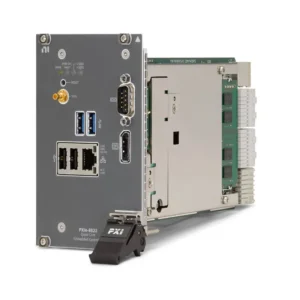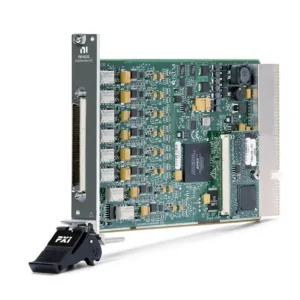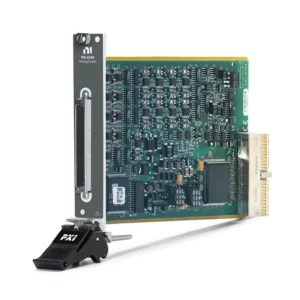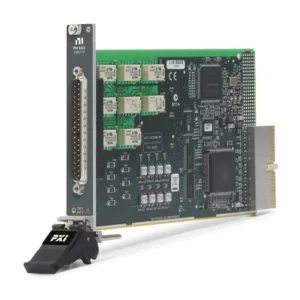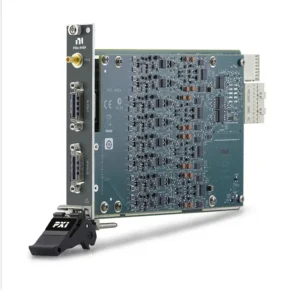




PXI-8431/2 2-Port RS-485/RS-422 PXI Serial Interface Module
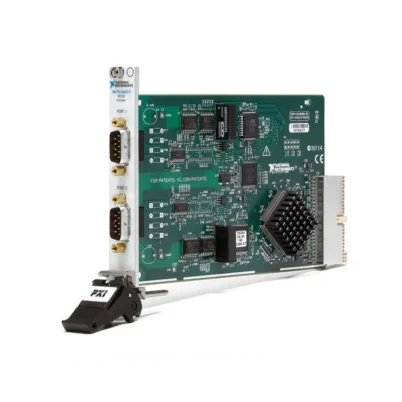
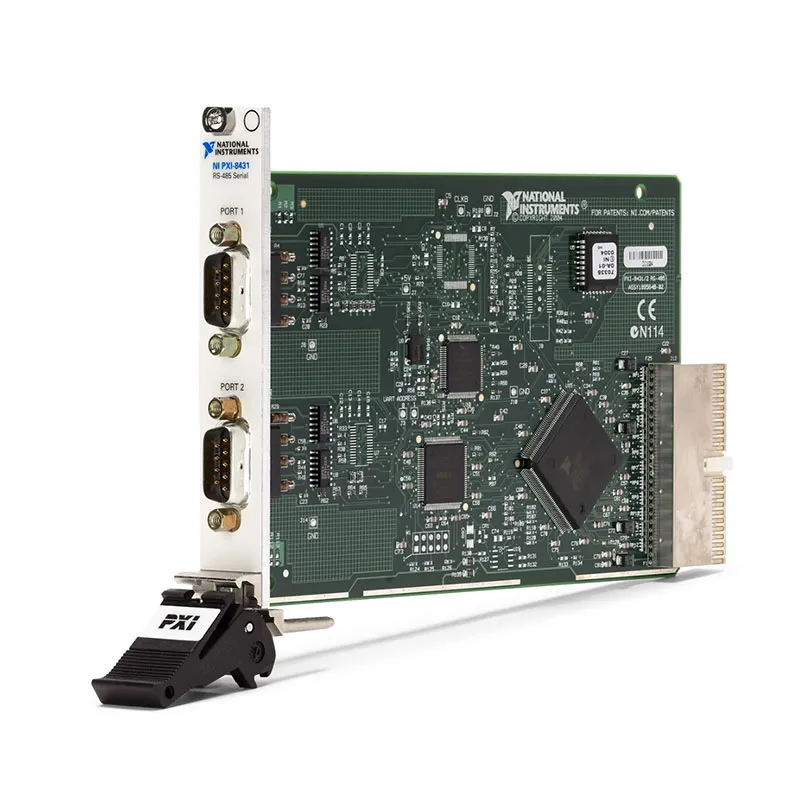
Земля PXI-8431/2 is a two-port PXI serial instrument-control module designed for high-speed communication with RS-485 and RS-422 devices. It provides two independent male DB-9 connections in a single-slot PXI module.
The module supports baud rates from 2 baud to 3 Mbps and can operate with two-wire or four-wire transceiver configurations. This allows the PXI-8431/2 to support half-duplex RS-485 networks, full-duplex RS-422 links and compatible four-wire RS-485 devices.
High-performance DMA transfers, 128-byte FIFOs, multithreaded software support and standard COM-port compatibility make the PXI-8431/2 suitable for automated test systems, industrial communication, embedded-device validation and laboratory instrument control.
Key Features of the PXI-8431/2
- Two independent serial communication ports
- Supports RS-485 and RS-422 protocols
- Up to 3 Mbps maximum baud rate
- Supports programmable baud rates from 2 baud
- Selects between two-wire and four-wire transceiver modes
- Supports half-duplex and full-duplex communication
- Two-wire automatic transceiver control
- Up to 2 Mbps in two-wire automatic-control mode
- 128-byte FIFO for each port
- Two male DB-9 front-panel connectors
- Nonisolated serial interface
- High-performance DMA transfers
- Multithreaded and multiprocessor support
- Appears as standard COM ports
- NI-Serial and NI-VISA compatibility
- LabVIEW Real-Time support
- Single-slot 3U PXI module
PXI-8431/2 Technical Specifications
| Product Model | PXI-8431/2 |
|---|---|
| Part Number | 778984-01 |
| Product Type | PXI serial instrument-control module |
| Supported Serial Protocols | RS-485 and RS-422 |
| Number of Serial Ports | 2 |
| Изоляция | Nonisolated |
| Transceiver Modes | Two-wire and four-wire |
| Duplex Modes | Half-duplex and full-duplex |
| Minimum Programmable Baud Rate | 2 baud |
| Maximum Baud Rate | 3 Mbps |
| Maximum Two-Wire Auto-Control Baud Rate | 2 Mbps |
| Standard Baud Rates | Supported |
| Custom Baud Rates | Supported from 2 baud to the applicable maximum |
| Baud-Rate Accuracy | UART operates within 1.3% of supported baud rates |
| FIFO Size | 128 bytes per port |
| Data Transfer Architecture | High-performance DMA |
| Operating-System Interface | Standard COM ports |
| Front-Panel Connectors | 2 × male DB-9 |
| Bus Connection | PXI Hybrid |
| Typical Power Requirement | 500 mA from +5 VDC PXI supply |
| Maximum Power Requirement | 750 mA from +5 VDC PXI supply |
| Operating Temperature | 0°C to 55°C |
| Dimensions | 100 × 160 mm |
| Weight | 134 g |
| Module Format | 3U, single-slot PXI module |
| Primary Driver | NI-Serial |
| Instrument-Control Software | NI-VISA |
| Programming Support | LabVIEW, LabWindows/CVI and compatible text-based languages |
PXI-8431/2 Part Number and Connectivity
| Item | Part Number | Описание |
|---|---|---|
| PXI-8431/2 | 778984-01 | Two-port, nonisolated RS-485/RS-422 PXI serial interface |
| Shielded DB-9 Serial Cable | Application dependent | Cable for connecting compatible RS-485 or RS-422 equipment |
| DB-9 Breakout Adapter | Application dependent | Provides access to differential signal pairs for custom wiring |
| RS-485 Termination Resistor | Network dependent | Termination selected according to cable impedance and network design |
The PXI-8431/2 provides two male DB-9 connectors directly on its front panel. RS-485 and RS-422 pinouts are not interchangeable with conventional RS-232 connections, even when both devices use DB-9 connectors.
Two Independent RS-485/RS-422 Ports
The PXI-8431/2 provides two independently configurable serial ports. Each port can communicate with a separate network or device and can use its own baud rate, data format and transceiver-control settings.
One port can operate in two-wire RS-485 mode while the second operates in four-wire RS-422 or RS-485 mode. This allows the module to support equipment with different communication requirements simultaneously.
RS-485 Communication
RS-485 uses differential signaling to improve noise immunity and support longer cable distances than typical single-ended RS-232 connections. It is widely used by industrial controllers, automation equipment, sensors, drives and embedded systems.
Two-wire RS-485 uses one differential pair for both transmitting and receiving. Only one transmitter should normally drive the bus at a time, making transceiver-direction control an important part of reliable communication.
RS-422 Communication
RS-422 also uses differential signaling but is commonly configured with separate transmit and receive pairs. This four-wire arrangement supports simultaneous full-duplex communication.
RS-422 is frequently used for point-to-point or limited multidrop communication where long cable distances, high speed and improved noise immunity are required.
Two-Wire Half-Duplex Mode
In two-wire mode, transmitting and receiving share one differential pair. The PXI-8431/2 enables its transmitter when sending data and releases the bus so other devices can respond.
Half-duplex systems require a communication protocol that prevents multiple devices from transmitting at the same time. A master-and-slave or request-and-response structure is commonly used.
Automatic Transceiver Control
The PXI-8431/2 supports automatic transceiver-direction control for two-wire RS-485 networks. The hardware manages transmitter enable and disable timing without requiring the application to toggle a separate control signal for every message.
The maximum baud rate in two-wire automatic-control mode is 2 Mbps. Other supported configurations can operate at rates up to the module’s 3 Mbps maximum.
Four-Wire Full-Duplex Mode
Four-wire mode uses separate differential pairs for transmitting and receiving. This allows both devices to transmit simultaneously and eliminates the need to reverse a shared data pair.
The connected device’s transmit pair must connect to the PXI-8431/2 receive pair, and the device’s receive pair must connect to the module’s transmit pair. Incorrect pair direction is a common cause of communication failure.
3 Mbps Maximum Baud Rate
The PXI-8431/2 supports maximum serial communication speeds up to 3 Mbps. This enables faster data transfer than conventional serial interfaces limited to lower standard baud rates.
Actual reliable speed depends on cable length, cable impedance, network topology, termination, device capability and electrical noise. Longer networks may require lower baud rates.
Flexible Programmable Baud Rates
The module supports standard baud rates and programmable rates beginning at 2 baud. Its UART can generate supported baud rates within approximately 1.3% of the requested value.
This capability is useful for devices that communicate with proprietary or uncommon baud rates. Both ends of the connection must tolerate the resulting baud-rate accuracy.
128-Byte FIFO Architecture
Each port includes a 128-byte FIFO for transmitted and received data. The FIFO reduces the number of processor service operations and provides buffering during periods of high system activity.
Application software must still process incoming data at an adequate rate. Continuous traffic can eventually overflow the receive buffer if the application stops reading the port.
High-Performance DMA Transfers
The PXI-8431/2 supports DMA transfers between the serial interface and system memory. DMA reduces processor overhead and helps sustain communication while the controller performs other measurement and automation tasks.
This architecture is useful in systems that log continuous serial data while simultaneously controlling PXI instruments or processing measurement results.
Standard COM-Port Compatibility
After installation of the NI-Serial driver, each PXI-8431/2 channel appears as a standard COM port in supported operating systems.
Existing serial applications can communicate with the module using conventional COM-port APIs. NI-VISA applications can also assign descriptive resource aliases to avoid depending on changeable COM numbers.
Nonisolated Interface Design
The PXI-8431/2 does not provide electrical isolation between its ports and the PXI system. It is appropriate where connected devices share a compatible ground reference and isolation is not required.
For equipment exposed to ground-potential differences, electrical transients or substantial common-mode noise, consider the isolated PXI-8433/2.
Differential Cable Wiring
Use twisted-pair cable for RS-485 and RS-422 differential signals. Each positive and negative signal pair should remain twisted throughout the cable to preserve noise rejection.
Shielding can improve performance in electrically noisy environments. Connect the shield according to the grounding requirements of the complete installation to avoid creating unwanted ground-current paths.
Network Termination
High-speed or long-distance RS-485 networks typically require termination at the physical ends of the main bus. The termination resistance should match the characteristic impedance of the cable.
Excessive termination can overload the transmitters, while missing or incorrectly placed termination can produce reflections and data errors. Avoid installing termination at every intermediate node.
Biasing and Idle-State Control
A two-wire RS-485 bus can enter an undefined state when no transmitter is active. Bias resistors may be used to maintain a known logic state during idle periods.
Before adding external biasing, check whether another network device already provides it. Multiple strong bias networks can unnecessarily load the bus.
Multidrop RS-485 Networks
RS-485 allows multiple devices to share a differential bus. The network should normally use a linear daisy-chain layout with short device stubs rather than a star configuration.
Every device must use a unique protocol address when required by the application. The serial electrical standard defines the physical layer but does not assign device addresses or message formats.
Typical PXI-8431/2 Applications
- Industrial controller communication
- RS-485 multidrop networks
- RS-422 point-to-point links
- Automated instrument control
- Embedded system validation
- Motor drive and motion-system communication
- Environmental chamber control
- Remote sensor communication
- Production functional testing
- Serial data acquisition and logging
- Hardware-in-the-loop testing
- LabVIEW Real-Time communication
Industrial Automation Systems
The PXI-8431/2 can communicate with industrial controllers, motor drives, sensors and other equipment using RS-485 or RS-422 interfaces.
Its two independent ports allow one PXI system to operate two separate networks or connect simultaneously to a device under test and supporting automation equipment.
Automated Production Testing
In a production test system, the module can communicate with embedded controllers and devices while other PXI instruments perform electrical or functional measurements.
DMA transfers and independent FIFOs help maintain serial traffic while the controller handles test execution, measurement processing and report generation.
Embedded Device Validation
The PXI-8431/2 can send commands, receive diagnostic messages and validate serial protocols implemented by embedded devices. Custom baud-rate support accommodates products that do not use conventional communication rates.
Test software can intentionally vary baud rate, data format and timing to confirm that the device handles valid and invalid serial traffic correctly.
LabVIEW Real-Time Integration
The module can be used with compatible LabVIEW Real-Time PXI controllers. A real-time application can coordinate serial communication with data acquisition, stimulus generation and control-system simulation.
The response timing of an external serial device is not inherently deterministic. Test sequences should include suitable timeouts and message-completion checks.
NI-Serial Driver Support
The NI-Serial driver provides hardware support, COM-port integration and configuration utilities for the PXI-8431/2. Installed interfaces can be inspected and configured through NI Measurement & Automation Explorer.
Verify compatibility between the NI-Serial version, controller operating system and application-development software before adding the module to an existing test system.
NI-VISA Integration
NI-VISA offers a common programming interface for serial and other instrument-control connections. Applications can use VISA functions to configure baud rate, data format, timeouts and termination behavior.
VISA aliases allow descriptive resource names such as DRIVE_CONTROLLER or DUT_SERIAL to replace system-dependent COM-port numbers.
PXI Chassis Integration
The PXI-8431/2 occupies one slot in a compatible 3U PXI or PXI hybrid-slot chassis. It can operate alongside data acquisition modules, controllers, digitizers and other PXI instruments.
Before installation, verify chassis compatibility, available slot space, controller support and NI-Serial driver compatibility.
PXI-8431/2 Troubleshooting
The PXI-8431/2 Is Not Detected in NI MAX
Confirm that the module is fully installed in a compatible PXI slot. Check chassis power, controller communication and NI-Serial installation, then restart NI Measurement & Automation Explorer.
The Serial Ports Do Not Appear as COM Ports
Verify that the installed NI-Serial driver supports the operating system and module. Rescan the hardware in NI MAX or Device Manager and restart the system if necessary.
No Data Is Received
Check the baud rate, parity, data bits and stop bits. Verify the DB-9 pinout, differential-pair polarity and whether the application requires two-wire or four-wire operation.
Communication Works Only in One Direction
In four-wire mode, confirm that each transmitter connects to the opposite device’s receiver. In two-wire mode, verify transceiver-control settings and make sure the other device releases the bus.
Data Is Corrupted at Higher Baud Rates
Shorten the cable, verify the twisted-pair wiring and install appropriate termination at the physical ends of the network. Reduce the baud rate if the cable or connected equipment cannot support 3 Mbps.
Some Devices on a Multidrop Network Do Not Respond
Check device addresses, bus topology, termination and biasing. Avoid long stubs and confirm that only one device transmits at a time.
The Two-Wire Bus Remains Busy
Verify automatic transceiver-control configuration and confirm that no other node holds its transmitter enabled continuously. Review the protocol timing between request and response messages.
Communication Fails Above 2 Mbps in Auto Mode
The two-wire automatic-control mode has a maximum baud rate of 2 Mbps. Use a different transceiver-control mode or reduce the configured baud rate.
Communication Is Affected by Ground-Potential Differences
The PXI-8431/2 is nonisolated. Correct the grounding problem or select the isolated PXI-8433/2 for systems requiring electrical isolation.
PXI-8431/2 Comparison with Similar Serial Modules
| Модель | Конфигурация | Best Suited For |
|---|---|---|
| PXI-8430/2 | 2-port RS-232, nonisolated, 1 Mbps | Point-to-point RS-232 instrument control |
| PXI-8431/2 | 2-port RS-485/RS-422, nonisolated, 3 Mbps | Differential and multidrop serial communication |
| PXI-8431/4 | 4-port RS-485/RS-422, nonisolated, 3 Mbps | Additional differential serial channels |
| PXI-8431/8 | 8-port RS-485/RS-422, nonisolated, 3 Mbps | High-channel-count industrial communication |
| PXI-8433/2 | 2-port RS-485/RS-422, isolated, 3 Mbps | Differential communication requiring isolation |
PXI-8431/2 vs PXI-8430/2
Земля PXI-8430/2 provides two RS-232 ports with maximum baud rates of 1 Mbps. The PXI-8431/2 provides two RS-485/RS-422 ports with speeds up to 3 Mbps.
Choose the PXI-8430/2 for conventional point-to-point RS-232 instruments. Choose the PXI-8431/2 for differential signaling, longer cable distances or multidrop RS-485 networks.
PXI-8431/2 vs PXI-8433/2
The PXI-8431/2 and PXI-8433/2 both provide two RS-485/RS-422 ports. The primary difference is that the PXI-8431/2 is nonisolated, while the PXI-8433/2 includes electrical isolation.
Select the PXI-8431/2 for systems with compatible grounding. Select the PXI-8433/2 when connected equipment may have ground-potential differences or requires additional electrical protection.
PXI-8431/2 vs PXI-8431/4
The PXI-8431/2 provides two direct DB-9 serial ports. The PXI-8431/4 provides four RS-485/RS-422 channels through 10-position modular connectors and adapter cables.
Choose the PXI-8431/2 for direct DB-9 connectivity and two networks. Choose the PXI-8431/4 when additional port density is required.
Recommended Related Products
- PXI-8430/2 2-Port RS-232 Serial Module
- PXI-8431/4 4-Port RS-485/RS-422 Module
- PXI-8431/8 8-Port RS-485/RS-422 Module
- PXI-8433/2 2-Port Isolated RS-485/RS-422 Module
- PXI-8433/4 4-Port Isolated RS-485/RS-422 Module
- View More NI PXI and PXI Express Modules
Selecting the Right PXI Serial Interface
Choose the PXI-8431/2 when the application requires two nonisolated RS-485 or RS-422 ports, direct DB-9 connections, selectable two-wire or four-wire operation and communication speeds up to 3 Mbps.
Select a higher-port-count PXI-8431 model when more networks are required. Choose the PXI-8433/2 when isolation is necessary or the PXI-8430/2 when the connected equipment uses RS-232.
Why Choose the PXI-8431/2?
- Provides two independent RS-485/RS-422 ports
- Supports baud rates through 3 Mbps
- Supports custom baud rates from 2 baud
- Provides two-wire and four-wire transceiver modes
- Supports half-duplex and full-duplex communication
- Includes automatic two-wire transceiver control
- Provides direct DB-9 front-panel connections
- Includes 128-byte FIFOs
- Uses DMA to reduce processor overhead
- Integrates with NI-Serial and NI-VISA
Frequently Asked Questions
What Is the PXI-8431/2?
The PXI-8431/2 is a two-port, nonisolated RS-485/RS-422 serial interface module for PXI test and control systems.
What Is the PXI-8431/2 Part Number?
The standard NI part number for the PXI-8431/2 is 778984-01.
How Many Serial Ports Does It Provide?
The module provides two independent RS-485/RS-422 ports.
What Is the Maximum Baud Rate?
The maximum supported baud rate is 3 Mbps. Two-wire automatic transceiver-control mode is limited to 2 Mbps.
Does It Support Two-Wire RS-485?
Yes. The module supports two-wire half-duplex RS-485 with automatic transceiver-direction control.
Does It Support Four-Wire Communication?
Yes. It supports four-wire full-duplex RS-422 and compatible RS-485 configurations.
What Connectors Does It Use?
The PXI-8431/2 provides two male DB-9 connectors directly on its front panel.
Is the PXI-8431/2 Isolated?
No. It is a nonisolated interface. Choose the PXI-8433/2 when isolated RS-485 or RS-422 ports are required.
What Is the FIFO Size?
Each serial port includes a 128-byte FIFO.
Does It Appear as Standard COM Ports?
Yes. After installation of the NI-Serial driver, the two channels appear as standard COM ports in supported operating systems.
Can the PXI-8431/2 Communicate with RS-232 Devices?
No. RS-232 uses different electrical signaling. Use a PXI-8430 or PXI-8432 model for RS-232 communication.
Which Software Controls the PXI-8431/2?
The module uses the NI-Serial driver and can be programmed through NI-VISA, LabVIEW, LabWindows/CVI and supported text-based languages.
Is the PXI-8431/2 Still Available from NI?
NI lists part number 778984-01 as no longer available for direct purchase and under limited support. Used, refurbished or new-surplus units may remain available from specialized PXI suppliers.
Request a Quote for the PXI-8431/2
Contact us for current availability, condition, lead time and project pricing for the PXI-8431/2 2-Port RS-485/RS-422 PXI Serial Interface Module. We can also help identify compatible DB-9 cables, isolated serial modules, PXI chassis and higher-channel-count interfaces for your system.