

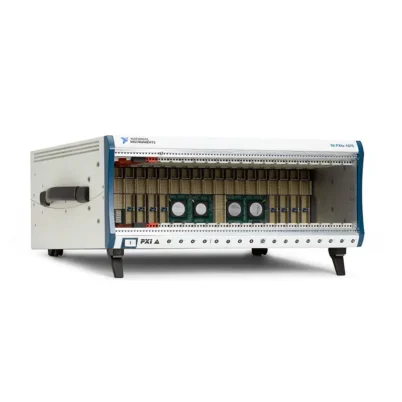
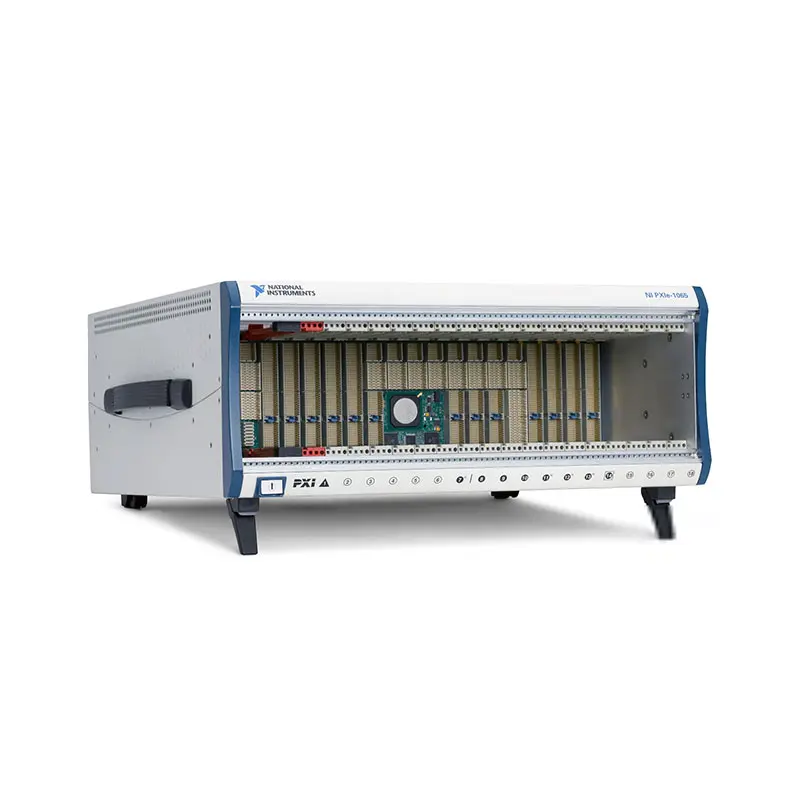
PXIe-1065 18-Slot PXI Express Chassis
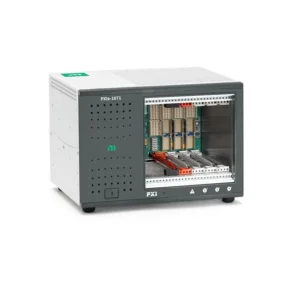
Земля NI PXIe-1065 is an 18-slot PXI Express chassis designed for automated test systems that need to combine conventional PXI instruments with PXI Express modules. It provides one system controller slot and 17 peripheral positions in a full-width rack-mountable enclosure.
The peripheral layout consists of nine conventional PXI slots, four PXI hybrid slots, three PXI Express slots and one PXI Express system timing slot. This mixed architecture makes the PXIe-1065 particularly valuable for upgrading established PXI systems without replacing every existing measurement module.
With up to 3 GB/s aggregate system bandwidth, 701.5 W of usable DC output power, 38.25 W cooling capacity per peripheral slot and advanced timing resources, the PXIe-1065 supports high-density production testing, electronic validation, multichannel data acquisition and hardware-in-the-loop applications.
Key Features of the PXIe-1065
- PXI Express шасси на 18 слотов
- One PXI Express system controller slot
- 17 peripheral instrument positions
- Nine conventional PXI peripheral slots
- Four PXI hybrid peripheral slots
- Three PXI Express peripheral slots
- One PXI Express system timing slot
- Up to 3 GB/s aggregate system bandwidth
- Supports embedded and remote controllers
- 701.5 W maximum usable DC power
- 140 W maximum system-controller dissipation
- 38.25 W cooling capacity per peripheral slot
- Three 165 CFM module-cooling fans
- Automatic and High fan-speed settings
- External 10 MHz reference input and output
- PXI star trigger support
- PXI Express differential star trigger support
- Rear-panel remote power-control connector
- Replaceable power-supply shuttle
- 0°C to 55°C operating-temperature range
18-Slot Mixed PXI and PXI Express Architecture
The PXIe-1065 contains 18 functional chassis positions. One position is reserved for the system controller, while the remaining 17 positions support peripheral and system timing modules.
The controller area includes three system expansion positions to accommodate compatible multi-slot embedded controllers and remote-control interfaces. These expansion positions belong to the controller area and are not counted as peripheral instrument slots.
The mixed backplane allows a test system to retain a large number of conventional PXI modules while adding newer PXI Express instruments where greater bandwidth is required.
Nine Conventional PXI Slots
Nine peripheral positions provide conventional PXI connections. These slots are intended for PXI and compatible CompactPCI modules that use the parallel PCI bus.
This unusually high number of conventional PXI slots makes the PXIe-1065 well suited to legacy system migration, long-life production testers and HIL systems containing validated PXI hardware.
Typical modules installed in these positions include switch matrices, relay modules, digital multimeters, serial interfaces, multifunction DAQ devices and industrial communication modules.
PXI Express-only modules cannot use a conventional PXI slot because the required PCI Express connector and electrical link are not present.
Four PXI Hybrid Slots
Four peripheral positions use PXI hybrid connectors. These slots can accept PXI Express modules and compatible conventional PXI or CompactPCI instruments.
Hybrid slots give system designers flexibility when allocating scarce PXI Express positions. A hybrid-ready conventional PXI module can use a hybrid position, or the position can be reserved for a newer PXI Express device.
Some early PXI modules use rear connectors that are incompatible with hybrid slots. Verify physical connector compatibility before installation and never force a module into the backplane.
Three PXI Express Slots
Three standard peripheral positions are designed for PXI Express modules. These slots provide PCI Express-based communication with the system controller.
They are suitable for digitizers, FPGA modules, high-speed data acquisition devices, waveform generators and communication interfaces that require greater bandwidth than the conventional PCI bus can provide.
Slot assignments should be planned before installation because only the hybrid and PXI Express positions support PXI Express modules.
PXI Express System Timing Slot
The dedicated system timing slot provides access to PXI and PXI Express timing resources. A compatible timing module can manage reference clocks, star triggers and system synchronization.
This position supports PXI_CLK10_IN, PXIe_SYNC_CTRL, PXI star triggers and PXI Express differential star trigger resources.
The timing slot is useful for applications requiring a common reference across many instruments or synchronization with another chassis, external instrument or facility timing source.
3 GB/s System Bandwidth
The PXIe-1065 provides up to 3 GB/s of aggregate system bandwidth. This supports a combination of conventional PXI instruments and moderate-bandwidth PXI Express modules.
The actual throughput available to an individual instrument depends on its slot type, interface link, controller and simultaneous activity from other modules.
When several high-speed PXI Express instruments stream continuously, calculate their combined sustained data rate. A newer high-bandwidth chassis may be preferable if the system can exceed 3 GB/s.
Embedded and Remote Control
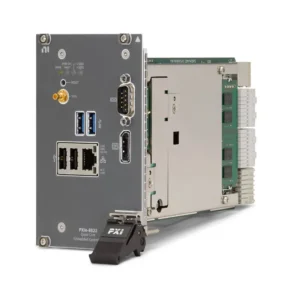
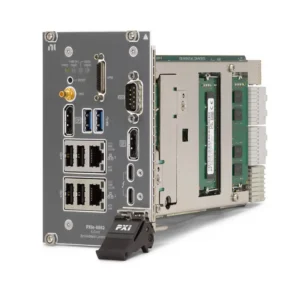
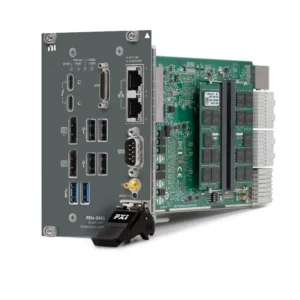
A compatible embedded controller can be installed directly in the system position, creating a self-contained PXI test platform with onboard processing, memory, storage and network interfaces.
The chassis can also use a compatible remote-control module to connect to an external computer or workstation. A remote system requires the correct chassis interface, host adapter and cable.
Controller selection should consider processing performance, operating-system support, physical width, interface bandwidth, power consumption and long-term software compatibility.
PXIe-1065 Technical Specifications
| Product Model | PXIe-1065 |
|---|---|
| Common Part Number | 779730-01 |
| Product Type | Mixed PXI and PXI Express chassis |
| Total Functional Slots | 18 |
| System Controller Slots | 1 system slot with 3 system expansion positions |
| Total Peripheral Positions | 17 |
| Conventional PXI Slots | 9 |
| PXI Hybrid Slots | 4 |
| PXI Express Peripheral Slots | 3 |
| PXI Express System Timing Slots | 1 |
| Maximum System Bandwidth | Up to 3 GB/s |
| Maximum Usable DC Power | 701.5 W |
| Maximum Combined +3.3 V, +5 V and +12 V Power | 699 W |
| Maximum System-Controller Dissipation | 140 W |
| Maximum Peripheral-Slot Dissipation | 38.25 W per slot |
| Module Cooling | 3 × 165 CFM forced-air fans |
| Power-Supply Cooling | 2 integrated fans |
| Fan Modes | Auto and High |
| Slot Airflow Direction | Bottom of module to top of module |
| Nominal AC Input | 100–240 VAC |
| Operating Voltage Range | 90–264 VAC |
| Input Current Rating | 10–5 A |
| Input Frequency | 50/60 Hz |
| Operating Frequency Range | 47–63 Hz |
| AC Overcurrent Protection | 12 A circuit breaker |
| Typical Power-Supply Efficiency | 70% |
| Power-Supply Replacement Time | Under 5 minutes specified MTTR |
| PXI_CLK10 Accuracy | ±25 ppm maximum |
| PXI_CLK10 Slot-to-Slot Skew | 1 ns maximum |
| PXI_CLK10 Maximum Jitter | 5 ps RMS phase jitter from 10 Hz to 1 MHz |
| PXIe_CLK100 Slot-to-Slot Skew | 100 ps maximum |
| PXIe_CLK100 Accuracy | ±25 ppm maximum |
| External Reference Input | 10 MHz through rear-panel BNC or timing-slot PXI_CLK10_IN |
| External Reference Output | 10 MHz through rear-panel BNC |
| Operating Temperature | 0°C to 55°C |
| Operating Humidity | 10% to 90%, noncondensing |
| Storage Temperature | -40°C to 71°C |
| Storage Humidity | 5% to 95%, noncondensing |
| Maximum Operating Altitude | 2,000 m at 25°C ambient temperature |
| Operational Shock | 30 g peak, half-sine, 11 ms pulse |
| Operating Random Vibration | 5–500 Hz, 0.3 grms |
| Auto-Fan Sound Pressure | 45.0 dBA at up to approximately 30°C ambient |
| High-Fan Sound Pressure | 63.3 dBA |
| Dimensions | 177 × 464.8 × 467.4 mm |
| Dimensions in Inches | 6.97 × 18.30 × 18.40 in. |
| Weight | 12.8 kg |
| Intended Environment | Indoor use only |
701.5 W Usable DC Power
The PXIe-1065 provides a maximum of 701.5 W of usable DC output power. The combined power available from the +3.3 V, +5 V and +12 V rails is limited to 699 W.
This power capacity supports a system controller and a large collection of conventional PXI and PXI Express peripheral modules.
Power planning must consider both total wattage and the current available from each individual voltage rail.
| DC Rail | Максимальный ток |
|---|---|
| +3.3 V | 60 A |
| +5 V | 50 A |
| +12 V | 45 A |
| -12 V | 4 A |
| +5 V Auxiliary | 2 A |
A system can remain below 701.5 W total while exceeding the current capacity of a particular rail. This is especially important in mixed-generation systems because older PXI modules often draw more power from +5 V, while newer PXI Express modules rely more heavily on +12 V and +3.3 V.
System Controller Power Capacity
The system controller position supports up to 140 W of dissipation. Total current supplied to the system position should not exceed 45 A.
High-performance embedded controllers may consume a substantial portion of the available power. Include the controller in all chassis-level and rail-level power calculations.
When using remote control, verify the chassis-side controller’s power requirement and ensure that the selected interface provides sufficient bandwidth.
38.25 W Cooling per Peripheral Slot
Each peripheral position supports a maximum module dissipation of 38.25 W. This rating applies to conventional PXI, hybrid and PXI Express positions.
Total unused power does not increase the cooling capacity of an individual slot. A module requiring more than 38.25 W should not be installed even when several other positions are empty.
Use filler panels over unused slots to preserve the intended airflow pattern and prevent warm air from bypassing populated modules.
Three 165 CFM Module-Cooling Fans
The PXIe-1065 uses three 165 CFM fans to create positive-pressure cooling for installed controllers and peripheral instruments.
Air enters through the bottom-rear section of the chassis, travels upward through the modules and exits through openings along both sides and the top.
The power supply uses two integrated fans with right-side intake and left-side exhaust. Keep all intake and exhaust areas clear of cables, rack panels and neighboring equipment.
Auto and High Fan Settings
The chassis provides automatic and maximum-speed fan modes. Auto mode adjusts fan speed according to internal thermal conditions and helps reduce acoustic noise.
High mode supplies maximum airflow continuously. It is recommended for densely populated configurations, elevated ambient temperatures and installations where maximum thermal margin is required.
The specified sound-pressure level is approximately 45.0 dBA in Auto mode at ambient temperatures up to approximately 30°C and 63.3 dBA in High mode.
Short-Circuit and Overload Protection
All power-supply outputs include short-circuit and overload protection with automatic recovery. The +3.3 V and +5 V rails include overvoltage protection clamped approximately 20% to 30% above nominal output voltage.
Protection circuitry is designed for abnormal conditions and should not be treated as a substitute for correct module selection, power planning or maintenance.
Replaceable Power-Supply Shuttle
The chassis uses a removable power-supply shuttle with a specified mean time to repair of less than five minutes.
This service-oriented design can reduce downtime in production systems and long-running validation equipment.
Disconnect the AC cable before servicing the chassis. Replacement should be performed by qualified personnel using the correct power-supply assembly for the hardware revision.
External 10 MHz Reference Input
The rear-panel BNC input accepts a 10 MHz reference clock with frequency accuracy within ±100 ppm. It supports sine-wave or square-wave input amplitudes from 200 mVpp to 5 Vpp.
A compatible timing module can also provide a 3.3 V or 5 V TTL clock through PXI_CLK10_IN in the system timing slot.
The chassis adds no more than 1 ps RMS phase jitter over the specified 10 Hz to 1 MHz range when distributing the external clock through the backplane.
External 10 MHz Reference Output
The rear-panel reference output provides a 10 MHz square wave with specified accuracy of ±25 ppm.
Output amplitude is approximately 1 Vpp ±20% into a 50 Ω load or approximately 2 Vpp when unloaded. Output impedance is 50 Ω ±5 Ω.
This signal can synchronize compatible external instruments or provide a common reference to another timing device.
PXI Star Trigger Resources
The conventional PXI star-trigger architecture provides point-to-point trigger connections between the system timing slot and peripheral positions.
Maximum PXI star-trigger slot-to-slot skew is 250 ps. This supports coordinated acquisitions and signal-generation events across compatible PXI modules.
PXI Express Differential Star Triggers
The chassis supports PXIe-DSTARA, PXIe-DSTARB and PXIe-DSTARC differential star trigger resources.
Maximum slot-to-slot skew is 150 ps, maximum differential skew is 25 ps and the specified differential impedance is 100 Ω ±10%.
Compatible timing modules and PXI Express instruments can use these resources for low-skew triggering and clock distribution.
Rear-Panel Remote Power Control
A rear-panel nine-pin D-Sub connector and power-mode switch support remote control of the internal chassis power supply.
This feature is useful in automated racks where the chassis must start or shut down as part of a coordinated system-level power sequence.
The external control circuit must follow the official connector pinout. Incorrect wiring can prevent startup or damage connected control hardware.
0°C to 55°C Operation
The PXIe-1065 has an operating-temperature range from 0°C to 55°C. This supports laboratory, production and controlled industrial installations.
Internal temperature depends on the installed module load, fan mode, filter condition, rack ventilation and heat generated by adjacent equipment.
PXIe-1065 Part Number and Accessories
| Item | Part Number or Model | Описание |
|---|---|---|
| PXIe-1065 | 779730-01 | 18-slot mixed PXI and PXI Express chassis |
| Embedded Controller | Model dependent | Installs in the system position for self-contained operation |
| Remote-Control Module | Interface dependent | Connects the chassis to an external computer or workstation |
| PXI Express Timing Module | Application dependent | Uses the system timing slot for clock and trigger management |
| Front Rack-Mount Kit | Configuration dependent | Secures the chassis to the front rails of a compatible rack |
| Rear Rack-Mount Kit | Configuration dependent | Provides rear support for the chassis in an equipment cabinet |
| Power-Supply Shuttle | Hardware-revision dependent | Service replacement for the chassis power supply |
| Replacement Fan Assembly | Hardware-revision dependent | Service replacement for the module-cooling fans |
| Slot Filler Panels | Configuration dependent | Covers unused positions and maintains correct airflow |
| AC Power Cord | Region dependent | Grounded power cord selected for the destination country |
PXIe-1065 Part Number
A common ordering part number associated with the PXIe-1065 is 779730-01. Confirm the complete model and part number printed on the chassis label when sourcing a replacement for an existing system.
Quotation contents can vary. Verify whether the offer includes only the chassis or also contains a controller, timing module, power cord, rack hardware and filler panels.
Choosing an Embedded Controller
An embedded controller creates a self-contained PXI system and reduces the number of external interface cables.
The controller must fit the available system expansion area, dissipate no more than 140 W and remain within the chassis’s electrical limits.
Selection factors include processor performance, memory, storage, operating system, network connectivity, installed software and lifecycle requirements.
Choosing a Remote-Control Interface
A remote-control module allows the chassis to use the processing, storage and graphics resources of an external desktop computer or workstation.
The complete connection requires a compatible host adapter, chassis-side interface and cable. Interface bandwidth should be evaluated against the chassis’s 3 GB/s system capability.
Selecting a Timing Module
A timing module installed in the dedicated system timing position can distribute clocks and triggers across the chassis or synchronize it with external equipment.
Select the timing device according to the required oscillator stability, external reference format, GPS, IRIG, IEEE 1588 and multi-chassis synchronization requirements.
Rack-Mounting Accessories
The chassis can use front and optional rear rack-mounting hardware. Rear support is recommended because of its approximately 467.4 mm depth and 12.8 kg weight.
Rack installation must preserve access to side, top and rear ventilation openings. Support the chassis during installation rather than relying only on the front rack ears.
Checking a Used PXIe-1065
Inspect the backplane connectors, module guides, system timing position, cooling fans, AC inlet, circuit breaker and remote power connector.
Test both conventional PXI and PXI Express positions with known-compatible modules. Confirm that the controller identifies every installed instrument correctly in NI MAX.
Ask whether the power-supply shuttle, controller, filler panels and rack hardware are included and whether the chassis has been tested under load.
PXIe-1065 Applications
- Legacy PXI system migration
- High-density automated test equipment
- Production functional testing
- Валидация электронного дизайна
- Multichannel data acquisition
- Digital multimeter and switching systems
- Симуляция с аппаратным входом
- Automotive ECU testing
- Испытания в аэрокосмической и оборонной промышленности
- Industrial controller validation
- RF and wireless test integration
- Semiconductor characterization
- Synchronized waveform acquisition
- Research and laboratory automation
- Long-lifecycle production testers
Legacy PXI System Migration
The nine conventional PXI slots are the defining advantage of the PXIe-1065. They allow an established system to retain numerous PXI instruments while adding PXI Express capability.
This can reduce migration cost when the existing modules, cables, test fixtures and software have already been validated for production use.
High-Density Automated Test Equipment
The chassis can accommodate 17 peripheral instruments covering signal generation, switching, acquisition, power control and communication.
A centralized embedded or external computer can configure each instrument and execute automated test sequences through LabVIEW, TestStand or another supported environment.
Production Functional Testing
Production testers often use conventional PXI switches, digital multimeters and communication interfaces that remain technically suitable after many years.
The PXIe-1065 allows these devices to operate in the same chassis as newer PXI Express digitizers or DAQ modules, extending the usable life of the test architecture.
Multichannel Data Acquisition
Multiple PXI and PXI Express DAQ modules can measure voltage, current, temperature, strain, pressure, vibration and digital signals.
System designers should calculate the combined acquisition rate and determine whether the 3 GB/s aggregate bandwidth is sufficient for continuous streaming.
Digital Multimeter and Switching Systems
A PXI digital multimeter combined with matrix switches and multiplexers can measure hundreds of DUT test points automatically.
Switch-heavy systems often require many physical slots while generating moderate backplane traffic, making the PXIe-1065 well suited to these applications.
Hardware-in-the-Loop Testing
The chassis can integrate analog I/O, digital I/O, vehicle networks, fault insertion switches, timing devices and FPGA modules.
Its conventional PXI capacity is useful for maintaining HIL systems built around older automotive and industrial interface cards.
RF and Wireless Testing
PXI Express RF instruments can be installed in compatible hybrid or PXIe slots, while conventional PXI switches and control modules use the parallel PCI positions.
The external 10 MHz connections and dedicated timing slot can distribute a common reference throughout the RF test system.
Aerospace and Defense Testing
Avionics interfaces, switching systems, data acquisition devices and timing modules can be combined in the chassis for aerospace subsystem testing.
The complete system must follow applicable grounding, safety, environmental and qualification requirements.
Laboratory Automation
The PXIe-1065 provides a flexible platform for laboratories with a large inventory of conventional PXI hardware.
Individual modules can be upgraded over time while the chassis continues to support established instruments and test software.
PXIe-1065 Installation Workflow
Step 1: Inventory All Modules
Identify every conventional PXI, hybrid-compatible and PXI Express module. Record each device’s connector type, physical width, power demand, cooling requirement and data-transfer rate.
Step 2: Create an Accurate Slot Map
Assign conventional PXI modules to the nine PXI positions or compatible hybrid positions. Reserve PXIe slots for instruments that require PCI Express connectivity.
Reserve the system timing slot for the timing module when advanced synchronization is required.
Step 3: Calculate the Power Budget
Add the current required on the +3.3 V, +5 V, +12 V, -12 V and auxiliary rails. Confirm that total demand remains below 701.5 W and the combined principal-rail load remains below 699 W.
Step 4: Calculate Cooling Requirements
Verify that no peripheral module requires more than 38.25 W of slot cooling and that the controller remains below its 140 W dissipation limit.
Step 5: Calculate System Bandwidth
Estimate the simultaneous sustained throughput of all PXI Express modules. Compare the total with the chassis’s 3 GB/s aggregate bandwidth.
Step 6: Prepare the Rack
Use appropriate front and rear support hardware. Preserve ventilation space around the bottom-rear intake, side vents and top exhaust.
Step 7: Disconnect AC Power
Turn off the chassis and unplug its power cord before installing or removing any module.
Step 8: Install the Controller
Insert the embedded or remote controller into the system position and required expansion positions. Fully seat its connectors and tighten the front-panel screws.
Step 9: Install the Timing Module
When required, install the compatible timing device in the dedicated system timing slot and configure the intended reference-clock and trigger sources.
Step 10: Install Peripheral Modules
Install each instrument in its assigned compatible slot. Close the injector/ejector handle and secure the module front panel.
Step 11: Install Filler Panels
Cover every unused position to maintain cooling airflow, electromagnetic shielding and backplane protection.
Step 12: Configure Fan and Power Modes
Select Auto or High fan mode according to the module load. Configure the rear power-mode switch for local or remote startup control.
Step 13: Connect External Timing
If required, connect the 10 MHz input or output using a suitable 50 Ω BNC cable. Verify signal level, termination and reference direction.
Step 14: Install Drivers and Verify Operation
Install the required NI software and instrument drivers. Use NI Measurement & Automation Explorer to confirm the controller, chassis and all installed modules.
PXIe-1065 Troubleshooting
The PXIe-1065 Does Not Power On
Check the AC supply, power cord, 12 A circuit breaker, front power switch and rear power-mode configuration.
If remote power control is enabled, verify the nine-pin D-Sub connection and external control circuit.
The Embedded Controller Does Not Start
Disconnect power and reseat the controller. Verify memory, storage, physical width and total controller power.
A Conventional PXI Module Is Not Detected
Confirm that the module is installed in one of the nine conventional PXI positions or a compatible hybrid slot. Check the driver and operating-system support.
A PXI Express Module Is Not Detected
Verify that the module is installed in one of the three PXIe positions, a compatible hybrid position or the timing position when allowed.
A PXI Express module cannot communicate through a conventional PXI-only slot.
A Module Does Not Fit in a Hybrid Slot
The module may use an older connector that is not hybrid-compatible. Do not force it into the backplane or remove connector keys.
The Chassis Reports Excessive Temperature
Inspect all three cooling fans and ventilation openings. Install filler panels and switch the fan selector to High.
Confirm that every peripheral module requires no more than 38.25 W of cooling.
The Chassis Shuts Down Under Load
Recalculate total power and each rail’s current. Pay particular attention to +5 V demand from older conventional PXI modules.
Remove modules and reinstall them individually to identify the overloaded rail or defective device.
The External 10 MHz Reference Is Not Recognized
Confirm that the reference is 10 MHz within ±100 ppm and that its amplitude remains between 200 mVpp and 5 Vpp.
Check the chassis and timing-module reference-source configuration.
The 10 MHz Output Level Is Unexpected
Verify the load termination. The output is approximately 1 Vpp into 50 Ω and approximately 2 Vpp when unloaded.
Measurements Are Not Synchronized
Review PXI_CLK10, PXIe_CLK100, PXIe_SYNC100 and star-trigger routing. Confirm that each instrument supports the selected resource.
System Bandwidth Is Lower Than Expected
Check the controller, remote interface, module slot and storage performance. The chassis provides up to 3 GB/s aggregate bandwidth, but conventional PXI slots operate through the parallel PCI architecture.
The Power Supply Requires Replacement
Use the correct power-supply shuttle for the chassis revision. Disconnect AC power and follow the official service procedure.
PXIe-1065 Comparison
| Модель | Peripheral Configuration | Пропускная способность системы | Cooling per Slot | Best Suited For |
|---|---|---|---|---|
| PXIe-1065 | 9 PXI, 4 hybrid, 3 PXIe and 1 timing slot | Up to 3 GB/s | 38.25 W | Systems requiring many conventional PXI slots |
| PXIe-1075 | 8 hybrid, 8 PXIe and 1 timing slot | Up to 4 GB/s | 38.25 W | Systems requiring more PXI Express expansion |
| PXIe-1081 | 17 гибридных периферийных слотов | Up to 2 GB/s | Up to 58 W | Broad hybrid compatibility and higher cooling |
| PXIe-1084 | 17 гибридных периферийных слотов | Up to 4 GB/s | Up to 58 W | Newer mixed PXI systems requiring higher cooling |
| PXIe-1085 | 18-slot high-performance architecture | Up to 24 GB/s | Up to 38 W | High-bandwidth acquisition and RF testing |
| PXIe-1095 | 18-slot high-performance architecture | Up to 24 GB/s | Up to 82 W | Modern high-power PXI Express instrumentation |
PXIe-1065 vs PXIe-1075
The PXIe-1065 provides nine conventional PXI positions, four hybrid slots, three PXIe slots and one timing slot. The PXIe-1075 provides eight hybrid positions, eight PXIe positions and one timing slot.
Choose the PXIe-1065 when the system contains many traditional PXI modules. Select the PXIe-1075 when additional PXI Express connectivity and higher system bandwidth are required.
PXIe-1065 vs PXIe-1081
The PXIe-1081 provides 17 hybrid peripheral slots, allowing compatible PXI and PXI Express modules to use every peripheral position.
The PXIe-1065 offers a dedicated system timing slot, external reference-clock connections and nine conventional PXI positions. Selection depends on connector compatibility, timing needs and slot-cooling requirements.
PXIe-1065 vs PXIe-1084
The PXIe-1084 offers up to 4 GB/s system bandwidth and cooling for modules requiring as much as 58 W per slot.
The PXIe-1065 is more appropriate for established systems that specifically require its nine conventional PXI slots and dedicated timing architecture.
PXIe-1065 vs PXIe-1085
The PXIe-1085 provides up to 24 GB/s system bandwidth and is better suited to high-speed PXI Express digitizers, FPGA devices and RF instruments.
The PXIe-1065 provides greater compatibility with conventional PXI modules but substantially lower aggregate bandwidth.
Recommended Related Products
- PXIe-1075 18-Slot PXI Express Chassis
- PXIe-1081 18-Slot Hybrid PXI Express Chassis
- PXIe-1084 18-Slot PXI Express Chassis
- PXIe-1085 High-Bandwidth PXI Express Chassis
- PXIe-1095 High-Power PXI Express Chassis
- PXIe-6674T Timing and Synchronization Module
- Встроенный контроллер PXIe-8822
- PXIe-8862 High-Performance Embedded Controller
- View More NI PXI and PXI Express Chassis
Selecting the Right Mixed PXI Chassis
Choose the PXIe-1065 when an application requires a large number of conventional PXI positions while still needing several PXI Express slots and a dedicated system timing slot.
Select the PXIe-1075 when more PXI Express slots and higher system bandwidth are required. Choose the PXIe-1084 when hybrid flexibility and higher per-slot cooling are more important.
Chassis selection should consider the exact connector type of every module, controller width, power-rail demand, cooling, bandwidth, timing resources and future expansion.
Why Choose the PXIe-1065?
- Provides nine conventional PXI peripheral positions
- Includes four flexible PXI hybrid slots
- Includes three PXI Express peripheral slots
- Provides a dedicated PXI Express system timing slot
- Supports up to 3 GB/s aggregate system bandwidth
- Provides 701.5 W of usable DC power
- Supports embedded and remote-control architectures
- Provides external 10 MHz reference input and output
- Supports PXI and differential star triggers
- Includes rear-panel remote power control
- Uses three 165 CFM module-cooling fans
- Provides a replaceable power-supply shuttle
- Operates at temperatures up to 55°C
PXIe-1065 Frequently Asked Questions
What is the PXIe-1065?
The PXIe-1065 is an 18-slot mixed PXI and PXI Express chassis designed for systems that require extensive conventional PXI compatibility.
What is the PXIe-1065 part number?
A common ordering part number associated with the PXIe-1065 is 779730-01. Confirm the exact product label and revision before ordering.
What is the correct slot configuration?
The chassis provides one system controller slot, nine conventional PXI slots, four hybrid slots, three PXI Express slots and one PXI Express system timing slot.
How many peripheral positions are available?
The PXIe-1065 provides 17 peripheral and timing positions in addition to the system controller slot.
What is the maximum system bandwidth?
The chassis provides up to 3 GB/s aggregate system bandwidth.
Can the PXIe-1065 accept conventional PXI modules?
Yes. It provides nine conventional PXI slots and four hybrid positions for compatible PXI modules.
Can it accept PXI Express modules?
Yes. PXI Express modules can use the three PXIe slots, four hybrid positions and the system timing slot when the device and slot function are compatible.
Does it have a dedicated system timing slot?
Yes. It provides one PXI Express system timing slot with access to clock and star-trigger resources.
Does the chassis provide external clock connections?
Yes. Rear-panel BNC connectors provide external 10 MHz reference input and output.
How much usable power does it provide?
The maximum usable DC power is 701.5 W, with a 699 W combined limit across the +3.3 V, +5 V and +12 V rails.
What is the cooling capacity per peripheral slot?
The maximum peripheral-slot cooling capacity is 38.25 W.
Can the power supply be replaced?
Yes. The power-supply shuttle has a specified replacement MTTR of less than five minutes.
Can the PXIe-1065 be powered on remotely?
Yes. A rear-panel nine-pin D-Sub connection and power-mode switch support external power control.
What is the operating-temperature range?
The specified ambient operating range is 0°C to 55°C.
Does the PXIe-1065 support 400 Hz AC power?
No 400 Hz operation is specified. The documented operating-frequency range is 47–63 Hz.
When should the PXIe-1065 be replaced with a newer chassis?
Consider a newer chassis when modules require more than 38.25 W cooling per slot, aggregate throughput above 3 GB/s or more PXI Express positions than the PXIe-1065 provides.
Request a Quote for the PXIe-1065
Contact us for current availability, lead time and project pricing for the NI PXIe-1065 18-Slot PXI Express Chassis. We can also help verify conventional PXI compatibility and select suitable embedded controllers, remote interfaces, timing modules, rack accessories and replacement power supplies.