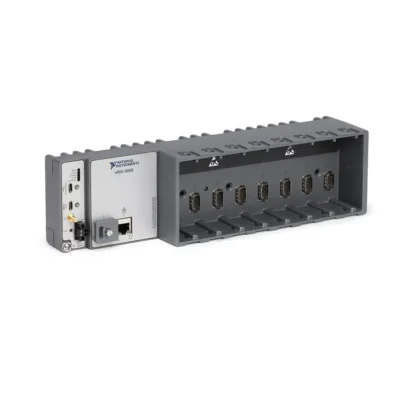
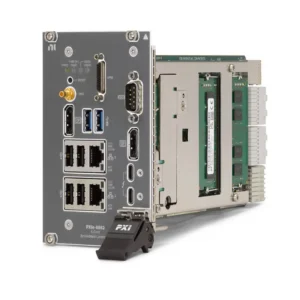
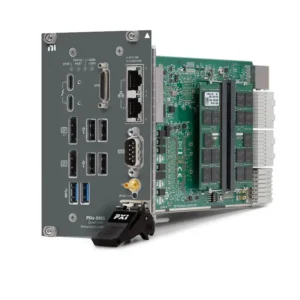
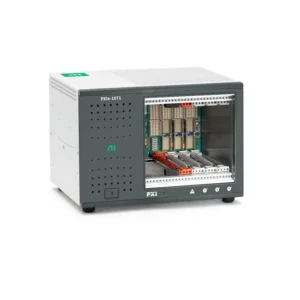
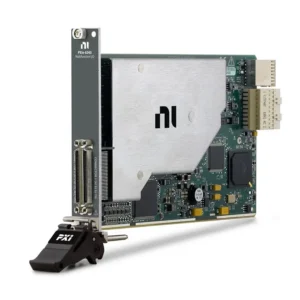
The NI cRIO-9055 is a rugged 4-slot CompactRIO embedded controller designed for distributed measurement, industrial control, embedded monitoring, and real-time automation applications. It combines an Intel Atom dual-core processor, an Artix-7 FPGA, NI Linux Real-Time, and TSN deterministic networking in a compact industrial platform.
Compared with traditional PLC systems, the cRIO-9055 provides stronger real-time flexibility through FPGA-based timing, modular C Series I/O, and deterministic network synchronization. It is especially suitable for engineers who need a compact controller for synchronized acquisition, machine monitoring, remote control, and distributed industrial systems.
Typical applications include:
- Distributed data acquisition
- Industrial automation
- Machine condition monitoring
- Remote measurement systems
- Embedded control
- Energy monitoring
- Test stand control
- Industrial IoT edge nodes
Processor and FPGA Architecture
The cRIO-9055 is built around:
- Intel Atom E3805 dual-core processor
- 1.33 GHz CPU frequency
- 2 GB DRAM
- 4 GB onboard storage
- Artix-7 A100T FPGA
- 4-slot CompactRIO architecture
- NI Linux Real-Time OS
The Artix-7 FPGA supports deterministic hardware-level timing, custom trigger logic, high-speed digital processing, and FPGA-based control functions. Compared with larger Kintex-7 or UltraScale CompactRIO controllers, the cRIO-9055 is better positioned as a cost-effective controller for medium-complexity automation and distributed measurement tasks.
TSN and Synchronization
The cRIO-9055 supports precise synchronized timing and deterministic network communication using TSN, making it useful for distributed measurement and control systems.
This is valuable for:
- Multi-node data acquisition
- Distributed machine monitoring
- Remote industrial control
- Synchronized test systems
- Industrial Ethernet-based automation
For engineers building distributed systems, TSN helps multiple controllers and measurement nodes operate with coordinated timing instead of relying only on software-level synchronization.
Modular C Series Expansion
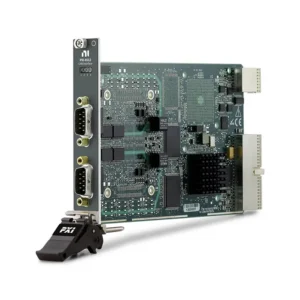
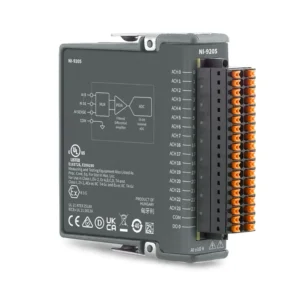
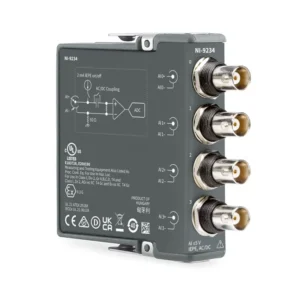
The controller supports up to 4 NI C Series modules, allowing engineers to configure I/O based on application requirements. Supported module types include:
- Analog input/output
- Digital I/O
- Temperature measurement
- Strain and bridge measurement
- Vibration and IEPE acquisition
- CAN / CAN FD communication
- LIN communication
- Industrial communication interfaces
The cRIO-9055 can function as both a compact real-time controller and a distributed acquisition node. Its 4-slot architecture is suitable when the system requires modular flexibility but does not need the larger footprint of an 8-slot CompactRIO controller.
Data Acquisition and Timing Performance
For analog input tasks, the cRIO-9055 supports up to 8 hardware-timed tasks, with sample rate determined by the installed C Series modules. Timing resolution is listed as 12.5 ns, with timing accuracy of 50 ppm.
For analog output, the controller supports hardware-timed output tasks and onboard regeneration. The listed maximum update rate is 1.6 MS/s, depending on module and system configuration.
For digital waveform applications, the cRIO-9055 supports hardware-timed digital input and output tasks, making it suitable for synchronized digital control, triggering, and event-based industrial applications.
Connectivity and Industrial Design
The cRIO-9055 provides:
- 2× Gigabit Ethernet ports
- 1× USB 3.1 host port
- 1× USB 2.0 device port
- Trigger line
- microSD card slot for local storage
Industrial features include:
- -40 °C to 70 °C operating temperature
- IP40 protection rating
- Rugged embedded design
- Compact 4-slot form factor
These features make the controller suitable for industrial cabinets, remote monitoring stations, embedded machinery, and distributed measurement installations.
Application-Oriented Use Cases
Machine Condition Monitoring
With vibration, temperature, and analog input C Series modules, the cRIO-9055 can be used for machine health monitoring, rotating equipment diagnostics, and predictive maintenance systems.
Distributed Measurement
TSN synchronization and Gigabit Ethernet connectivity make it suitable for remote data acquisition nodes in large industrial facilities, energy systems, and laboratory test networks.
Industrial Automation
The controller can run deterministic control logic through NI Linux Real-Time while using FPGA resources for low-latency timing, triggering, and digital processing.
Embedded Test Systems
The cRIO-9055 is useful for compact test stands that require analog measurement, digital control, serial communication, and deterministic test execution in one embedded platform.
Comparison with Similar Models
| Model | Main Difference | Typical Use |
|---|
| cRIO-9041 | 4-slot, Kintex-7 FPGA, stronger FPGA class | Higher-performance 4-slot control |
| cRIO-9042 | 4-slot, quad-core Atom, Kintex-7 FPGA | More CPU-intensive distributed control |
| cRIO-9053 | 4-slot, UltraScale FPGA | Advanced FPGA processing |
| cRIO-9054 | 8-slot, UltraScale FPGA | Larger distributed systems |
| cRIO-9031 | Older 4-slot CompactRIO platform | Legacy industrial systems |
Compared with cRIO-9041/9042, the cRIO-9055 is better suited for compact, cost-sensitive distributed control where Artix-7 FPGA resources are sufficient.
Compared with cRIO-9053/9054, the cRIO-9055 is not aimed at the most FPGA-intensive applications, but it provides a strong balance of ruggedness, TSN synchronization, modular I/O, and deployment cost.
Conclusion
The NI cRIO-9055 is a compact and rugged 4-slot CompactRIO controller for distributed measurement, industrial automation, embedded monitoring, and deterministic control applications.
Its combination of:
- Intel Atom dual-core processing
- Artix-7 FPGA
- TSN synchronization
- NI Linux Real-Time
- Modular C Series I/O
- Rugged -40 °C to 70 °C operation
makes it a practical choice for engineers building compact industrial control systems, remote acquisition nodes, machine monitoring platforms, and embedded test systems.



 Overview