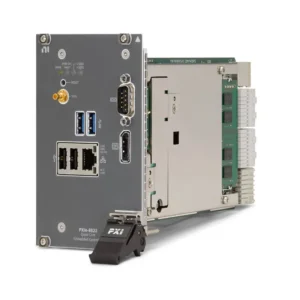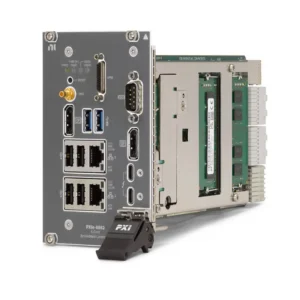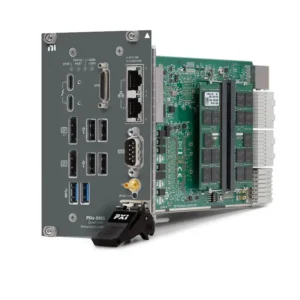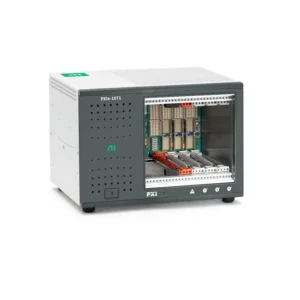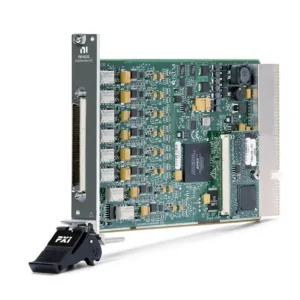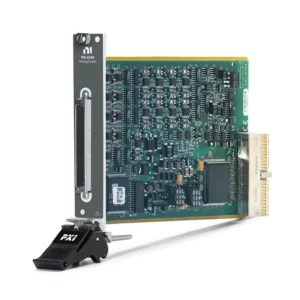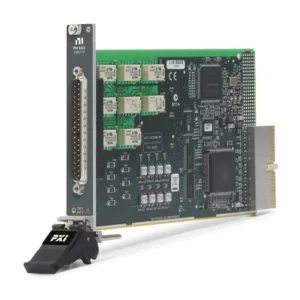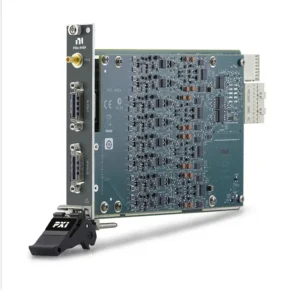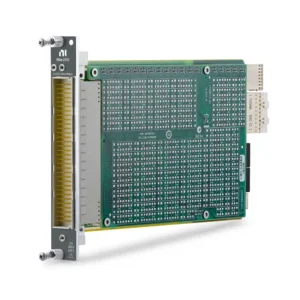




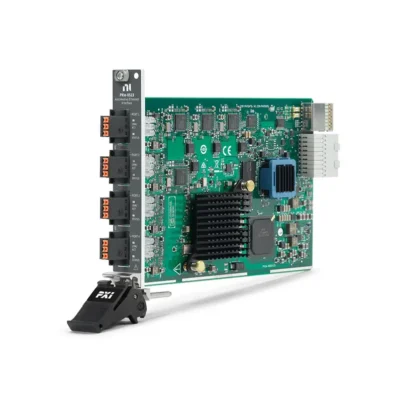
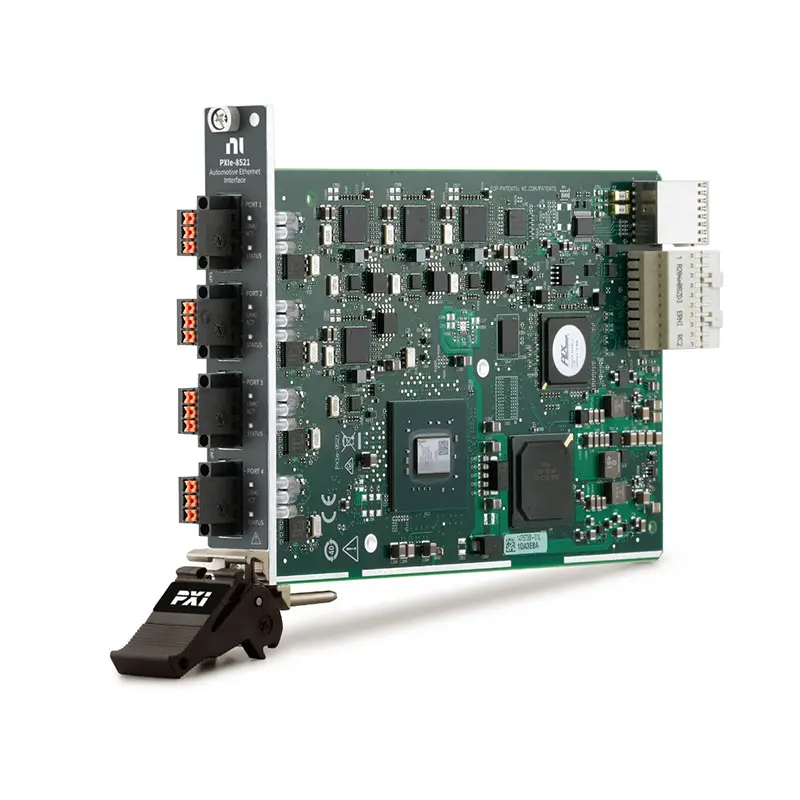
PXIe-8521 4-Port 100BASE-T1 Automotive Ethernet Interface Module
Земля PXIe-8521 is a four-port PXI Express Automotive Ethernet interface module designed for developing, testing and validating automotive electronic control units. It provides four 100BASE-T1 ports for communicating over automotive unshielded twisted-pair wiring through the NI-XNET driver.
The module can operate as four independent Automotive Ethernet endpoints or as two network terminal access points. Onboard hardware timestamping and IEEE 802.1AS time synchronization allow network traffic to be correlated with other measurements and events in a PXI test system.
Key Features of the PXIe-8521
- Four independent 100BASE-T1 Automotive Ethernet ports
- 100 Mbps full-duplex Automotive Ethernet communication
- Single unshielded twisted-pair physical interface
- Up to four independent network endpoints
- Up to two network terminal access points
- Programmable master or slave mode for each port
- Onboard hardware packet timestamping
- Module-time and IEEE 802.1AS timestamps
- Up to four independent IEEE 802.1AS masters or slaves
- Synchronization with external networks and PXI instruments
- NI-XNET support for raw Ethernet frames and AVTP
- Suitable for ECU, ADAS and infotainment validation
- Front-panel link, activity and status indicators
- External timing and triggering support
- Gen 2 ×4 PXI Express bus interface
- NI Linux Real-Time and Windows compatibility
PXIe-8521 Technical Specifications
| Product Model | PXIe-8521 |
|---|---|
| Part Number | 786771-01 |
| Product Type | PXI Automotive Ethernet interface module |
| Automotive Ethernet Standard | 100BASE-T1 |
| Number of Ports | 4 |
| Data Rate | 100 Mbps per port |
| Maximum Baud Rate | 125 MHz |
| Physical Medium | Single unshielded twisted pair |
| Operating Modes | Direct endpoint mode and network TAP mode |
| Maximum Independent Endpoints | 4 |
| Maximum Network TAPs | 2 |
| PHY Configuration | Master or slave, programmable per port |
| Packet Timestamping | Onboard hardware timestamping |
| Network Time Synchronization | IEEE 802.1AS |
| 802.1AS Roles | Up to four independent masters or slaves |
| External Timing and Triggering | Supported |
| Шинный интерфейс | Gen 2 ×4 PXI Express |
| PXI Express Compliance | PXI Express specification revision 1.0 |
| I/O Connectors | Weidmüller BLF 3.50, 3-position |
| Wire Gauge | 0.14 mm² to 1.5 mm², or 26 AWG to 16 AWG |
| Wire Strip Length | 8 mm |
| Connector Securement | Screw flanges |
| Screw-Flange Torque | 0.2 to 0.25 N·m |
| Front-Panel Indicators | One link/activity LED and one status LED per port |
| Module Format | 3U, one-slot CompactPCI/PXI Express module |
| Dimensions | 16 × 10 cm, excluding connectors |
| Weight | 170 g |
| Maximum Current at +3.3 V | 1.03 A, 0.64 A typical |
| Maximum Current at +12 V | 1.32 A, 1.10 A typical |
| Operating Temperature | 0°C to 55°C |
| Software Driver | NI-XNET |
| Supported Operating Systems | Windows and supported NI Linux Real-Time systems |
PXIe-8521 Part Number and Accessories
| Item | Part Number | Описание |
|---|---|---|
| PXIe-8521 | 786771-01 | Four-port 100BASE-T1 PXI Automotive Ethernet interface module |
| NI-9962 Terminal Block | 787104-01 | 3-position, 3.5 mm push-in terminal connector |
| B2CF3M-to-Pigtail Cable | 787108-01 | 1 m unshielded Automotive Ethernet cable assembly |
| B2CF3M-to-Pigtail Cable | 787108-05 | 5 m unshielded Automotive Ethernet cable assembly |
| Pigtail-to-Pigtail Cable | 787109-15 | 15 m unshielded Automotive Ethernet cable assembly |
| Insulated Ferrules | Included | Twenty 26 AWG ferrules with 8 mm barrel length |
The standard PXIe-8521 package includes the module, a flat-head screwdriver, twenty insulated 26 AWG ferrules and safety documentation. Verify the required cable length, connector arrangement and ECU pinout before ordering additional accessories.
Four 100BASE-T1 Ports
The PXIe-8521 provides four independently configurable 100BASE-T1 ports. Each port communicates at 100 Mbps over a single unshielded twisted pair rather than the multiple wire pairs used by conventional office Ethernet.
Automotive Ethernet reduces harness weight and supports higher data throughput than many traditional automotive networks. It is commonly used for cameras, radar, infotainment, domain controllers, gateways and advanced driver-assistance systems.
100BASE-T1 Automotive Ethernet
100BASE-T1 is an automotive Ethernet physical-layer standard designed for full-duplex communication over one balanced twisted pair. The PXIe-8521 allows PXI test systems to communicate directly with compatible automotive ECUs and network devices.
The connected wiring must provide the required differential impedance, twist and signal integrity. Ordinary unqualified hookup wire may cause link instability, packet errors or failure to establish communication.
Independent Endpoint Mode
In endpoint mode, each PXIe-8521 port operates as a separate Automotive Ethernet interface. The module can therefore provide as many as four independent endpoints in one PXI Express slot.
Endpoint mode is useful for emulating network nodes, communicating directly with multiple ECUs or creating separate test networks for different devices under test.
Network TAP Mode
Two adjacent ports can form a network terminal access point. With four ports, the module can provide as many as two TAPs for observing communication between devices already connected to an Automotive Ethernet network.
TAP mode allows test software to monitor traffic without configuring the PXIe-8521 as a conventional endpoint in the communication path. This is useful for diagnostics, protocol analysis and time-correlated network capture.
Four Endpoints or Two TAPs
The selected configuration determines how the four physical ports are used. Four endpoint interfaces maximize the number of directly connected devices, while two TAP pairs allow two existing network links to be observed.
Plan the test architecture before wiring the module because TAP mode uses two physical ports for each monitored connection.
Master and Slave PHY Configuration
Each 100BASE-T1 link requires compatible master and slave PHY roles. The PXIe-8521 allows the role of each port to be configured through software.
When connecting to an ECU, verify the ECU’s physical-layer role and configure the PXIe-8521 port for the complementary setting. Incorrect master and slave configuration can prevent the link from becoming active.
Onboard Hardware Timestamping
The module timestamps Ethernet packets in hardware, reducing the timing uncertainty associated with software-only timestamping. Hardware timestamps can use module time or synchronized IEEE 802.1AS network time.
Accurate timestamps help engineers determine when a packet was transmitted or received and correlate communication with sensor measurements, ECU outputs, fault insertion events and simulated vehicle states.
IEEE 802.1AS Time Synchronization
The PXIe-8521 supports IEEE 802.1AS time synchronization and can act as as many as four separate 802.1AS masters or slaves. Each port can participate in network synchronization according to the configured test architecture.
This capability allows the module to synchronize with an external Automotive Ethernet network while maintaining timing relationships with the rest of the PXI measurement system.
PXI System Synchronization
PXI timing and trigger resources allow Automotive Ethernet activity to be coordinated with other modular instruments. The PXIe-8521 can be used alongside analog input modules, digital I/O, CAN interfaces, FlexRay interfaces and fault-insertion hardware.
This synchronization is useful when a test must compare an Ethernet message with a precisely timed electrical signal, simulated sensor value or physical ECU response.
NI-XNET Driver Support
The PXIe-8521 is programmed through the NI-XNET driver. NI-XNET provides an application programming interface for configuring Automotive Ethernet interfaces, transmitting and receiving traffic and working with hardware timestamps.
The module supports raw Ethernet-frame communication and Audio Video Transport Protocol traffic. Developers can use NI-XNET functions in LabVIEW and compatible programming environments to create ECU test and validation applications.
Raw Ethernet Frame Communication
Raw-frame access allows applications to construct, transmit and receive Ethernet frames according to the requirements of the device or protocol under test.
This is useful when validating proprietary messages, developing protocol implementations or testing behavior that is not available through a higher-level standardized interface.
AVTP and Audio/Video Testing
Automotive Audio Video Transport Protocol applications can use synchronized Ethernet communication to transport time-sensitive audio and video streams. This is relevant to infotainment, camera and advanced driver-assistance systems.
The PXIe-8521 can support development of AVTP and Automotive Audio Video Bridging test applications through NI-XNET. Complete system capability depends on the software architecture and required stream format.
SOME/IP Application Development
SOME/IP is widely used for service-oriented communication between automotive ECUs. Developers can use the PXIe-8521 as the 100BASE-T1 hardware interface for creating and validating SOME/IP communication applications.
Test applications can verify service discovery, message exchange, timing behavior and ECU responses under normal and abnormal network conditions.
DoIP and UDS Diagnostics
Diagnostics over Internet Protocol allows automotive diagnostic communication to operate over Ethernet. When used with suitable diagnostic software, the PXIe-8521 can support DoIP-based ECU diagnostic and validation systems.
The NI Automotive Diagnostic Command Set Toolkit can help developers implement diagnostic services such as Unified Diagnostic Services. Confirm the required toolkit version and protocol support for the intended application.
XCP Measurement and Calibration
The PXIe-8521 can provide the Automotive Ethernet connection for ECU measurement and calibration applications using XCP over Ethernet.
When combined with suitable ECU measurement and calibration software, engineers can access internal ECU variables, collect measurement data and modify calibration parameters during development.
Валидация электронных блоков управления автомобилями
The module allows test systems to communicate directly with 100BASE-T1 ECUs. Engineers can transmit expected traffic, capture ECU responses and determine whether the device meets functional, timing and protocol requirements.
Multiple ports allow several ECUs or network segments to be tested within the same PXI system without repeatedly moving cables.
ADAS and Camera Testing
Automotive Ethernet is frequently used by cameras, radar sensors, domain controllers and advanced driver-assistance systems. The PXIe-8521 can provide synchronized network access for validating data exchange and control behavior.
Hardware packet timestamps allow communication to be correlated with simulated sensor inputs, captured video events and ECU output signals.
Infotainment Validation
The PXIe-8521 is suitable for validating Ethernet communication in head units, displays, amplifiers and other infotainment components. It can support testing of service-oriented messages and synchronized audio or video traffic.
Test software can verify connection establishment, message timing, packet contents, error handling and recovery after network interruptions.
Gateway and Domain Controller Testing
Automotive gateways and domain controllers connect multiple networks and protocols. The PXIe-8521 can provide as many as four Ethernet interfaces for testing routing, message conversion and communication between network domains.
The module can be combined with NI CAN, LIN and FlexRay interfaces when a gateway test system must exercise both Ethernet and legacy in-vehicle networks.
Hardware-in-the-Loop Testing
In a hardware-in-the-loop system, the PXIe-8521 can exchange Automotive Ethernet traffic with a physical ECU while the PXI controller executes vehicle or environment simulation models.
Hardware timing and timestamping help coordinate Ethernet traffic with analog, digital and vehicle-network signals. When using NI VeriStand, Automotive Ethernet normally requires an appropriate custom device because these modules are not supported as native VeriStand interfaces.
Network Monitoring and Diagnostics
Front-panel indicators provide visual information for each port. Every port includes one link/activity LED and one status LED, helping engineers identify link establishment, network traffic and interface conditions.
LEDs are useful during wiring and troubleshooting, but software status and packet-level diagnostics should be used for detailed analysis.
Spring-Terminal Connections
The module uses three-position Weidmüller BLF 3.50 connectors. Spring-terminal connections accept conductors from 26 AWG to 16 AWG when prepared according to the published wiring requirements.
Strip approximately 8 mm of insulation and use suitable ferrules for fine-stranded conductors. Secure the connectors with the provided screw flanges using the specified torque.
Automotive Ethernet Cabling
Use an unshielded twisted-pair cable designed for 100BASE-T1 communication. Preserve the twist as close as practical to the connector and avoid unnecessary splices or untwisted wire length.
Cable length, differential impedance, connector transitions and routing near high-current wiring can affect link quality. Follow the requirements of the connected ECU and applicable Automotive Ethernet standards.
PXI Express Interface
The PXIe-8521 uses a Gen 2 ×4 PXI Express interface and occupies one 3U chassis slot. The PXI Express connection provides communication with the host controller and access to PXI timing resources.
Before installation, verify that a compatible PXI Express peripheral or hybrid slot is available and that the controller operating system supports the required NI-XNET version.
Operating-System Compatibility
The PXIe-8521 can be used with supported Windows and NI Linux Real-Time systems. It is not supported on PXI controllers running the discontinued Phar Lap ETS real-time operating system.
If the module does not appear in NI MAX, verify the controller operating system before replacing hardware or changing chassis slots.
Typical PXIe-8521 Applications
- 100BASE-T1 Automotive Ethernet development
- Automotive ECU validation
- Four-port endpoint emulation
- Two-link network TAP monitoring
- Gateway and domain controller testing
- ADAS controller validation
- Automotive camera testing
- Radar and sensor communication testing
- Infotainment system validation
- AVTP and audio/video communication testing
- SOME/IP application development
- DoIP and UDS diagnostics
- XCP measurement and calibration
- Hardware-in-the-loop testing
- Production end-of-line testing
Production Test Systems
The PXIe-8521 can be used in production systems to establish a 100BASE-T1 connection with an ECU, execute communication tests, perform diagnostics and record results.
Four ports allow one test station to support several network connections or different product configurations. Correct fixture wiring and connector retention are important for consistent high-volume operation.
PXIe-8521 Troubleshooting
The PXIe-8521 is not detected in NI MAX
Confirm that the module is fully installed in a compatible PXI Express slot. Check chassis power, PXI Platform Services and NI-XNET installation. Verify that the controller runs Windows or a supported NI Linux Real-Time version rather than Phar Lap ETS.
A 100BASE-T1 link does not become active
Check the twisted-pair wiring, connector pinout and cable continuity. Confirm that one link partner is configured as master and the other as slave. Two devices configured with incompatible PHY roles may not establish a link.
The link is active but frames are not received
Verify the NI-XNET session configuration, selected interface, Ethernet frame filters and application receive logic. Confirm that the ECU is transmitting the expected destination MAC address and protocol traffic.
Packet errors occur intermittently
Inspect cable quality, differential impedance, connector termination and the amount of untwisted wire near the terminal. Keep Automotive Ethernet wiring separated from motors, ignition components and high-current switching circuits.
TAP mode does not capture network traffic
Confirm that the two ports are configured as a TAP pair and connected in the correct direction. Check NI-XNET support for the selected configuration and verify that traffic is present on the monitored link.
IEEE 802.1AS synchronization does not lock
Verify the master and slave time roles, network topology and synchronization configuration. Confirm that the connected devices support compatible IEEE 802.1AS behavior and that required synchronization messages are not blocked.
Hardware timestamps do not match other PXI measurements
Check the selected timebase and whether timestamps use module time or synchronized 802.1AS time. Confirm that all participating PXI devices are synchronized to the intended system reference.
The module does not work in NI VeriStand
NI VeriStand does not provide native support for PXIe Automotive Ethernet modules. Use an appropriate VeriStand custom device or third-party integration designed for NI-XNET Automotive Ethernet hardware.
Front-panel LEDs remain off
Confirm chassis power and verify that the module is recognized in NI MAX. Check the physical wiring, complementary master and slave settings and whether the connected ECU is powered and configured for 100BASE-T1 communication.
PXIe-8521 Comparison with Similar Automotive Ethernet Modules
| Модель | Port Configuration | Supported Physical Layer | Best Suited For |
|---|---|---|---|
| PXIe-8521 | 4 ports | 100BASE-T1 | Four-port 100 Mbps Automotive Ethernet testing |
| PXIe-8522 | 4 ports | 1000BASE-T1 | Four-port Gigabit Automotive Ethernet testing |
| PXIe-8523 | 4 ports | 100BASE-T1 and 1000BASE-T1 | Systems requiring both 100 Mbps and 1 Gbps operation |
| PXIe-8520 | 4 ports | 100M/1GBASE-T1 | Newer applications requiring MACsec and TC10 support |
| PXIe-8510 | Vehicle multiprotocol interface | CAN, LIN and other supported vehicle buses | Testing traditional in-vehicle communication networks |
PXIe-8521 vs PXIe-8522
The PXIe-8521 provides four 100BASE-T1 ports operating at 100 Mbps. The PXIe-8522 provides four 1000BASE-T1 ports for Gigabit Automotive Ethernet applications.
Choose the PXIe-8521 for ECUs and networks using 100BASE-T1. Choose the PXIe-8522 when the device requires a fixed 1000BASE-T1 physical interface.
PXIe-8521 vs PXIe-8523
The PXIe-8521 supports 100BASE-T1 only, while the PXIe-8523 supports both 100BASE-T1 and 1000BASE-T1. Both provide four ports, endpoint and TAP modes, hardware timestamping and IEEE 802.1AS synchronization.
Select the PXIe-8521 for dedicated 100 Mbps test systems. Select the PXIe-8523 when one system must test devices using either 100 Mbps or Gigabit Automotive Ethernet.
PXIe-8521 vs PXIe-8520
The PXIe-8520 is a newer four-port interface supporting 100M/1GBASE-T1 together with features such as MACsec network security and OPEN Alliance TC10 sleep and wake functionality.
Choose the PXIe-8521 when established 100BASE-T1 endpoint or TAP testing meets the application requirements. Consider the PXIe-8520 for newer automotive networks requiring advanced security or power-management protocol validation.
Recommended Related Products
- PXIe-8522 4-Port 1000BASE-T1 Automotive Ethernet Module
- PXIe-8523 4-Port 100/1000BASE-T1 Automotive Ethernet Module
- PXIe-8520 4-Port 100M/1GBASE-T1 Automotive Ethernet Module
- PXIe-8510 Vehicle Multiprotocol Interface Module
- PXI-8512 High-Speed CAN Interface Module
- PXI-8517 FlexRay Interface Module
- View More NI PXI and PXI Express Modules
Selecting the Right Automotive Ethernet Interface
Choose the PXIe-8521 when the test application requires four 100BASE-T1 ports, endpoint or TAP operation, hardware packet timestamping and IEEE 802.1AS network synchronization.
Select the PXIe-8522 for fixed 1000BASE-T1 networks or the PXIe-8523 when both 100BASE-T1 and 1000BASE-T1 support are required. Consider the PXIe-8520 for newer applications requiring MACsec or TC10 sleep and wake testing.
Why Choose the PXIe-8521?
- Provides four independent 100BASE-T1 interfaces
- Operates as four endpoints or two network TAPs
- Supports programmable master and slave PHY roles
- Provides onboard hardware packet timestamping
- Supports IEEE 802.1AS network synchronization
- Integrates Automotive Ethernet with PXI measurements
- Supports raw frames and AVTP through NI-XNET
- Works with ECU diagnostic and calibration software
- Includes per-port link, activity and status indicators
- Occupies one PXI Express chassis slot
Frequently Asked Questions
What is the PXIe-8521?
The PXIe-8521 is a four-port 100BASE-T1 PXI Automotive Ethernet interface module for ECU development, communication testing and network validation.
What is the PXIe-8521 part number?
The standard NI part number for the PXIe-8521 is 786771-01.
How many Automotive Ethernet ports does it provide?
The module provides four independent 100BASE-T1 ports.
What is the data rate?
Each port supports 100 Mbps 100BASE-T1 Automotive Ethernet communication.
Can it operate as a network TAP?
Yes. The four ports can provide as many as two network terminal access points, with two ports used for each TAP.
Can all four ports operate as endpoints?
Yes. The module can provide as many as four independent 100BASE-T1 endpoints.
Does the module support master and slave configuration?
Yes. The Automotive Ethernet PHY role can be configured as master or slave independently for each port.
Does the PXIe-8521 support hardware timestamping?
Yes. It provides onboard hardware packet timestamping using module time or synchronized IEEE 802.1AS time.
Does it support IEEE 802.1AS?
Yes. The module can operate as as many as four independent IEEE 802.1AS masters or slaves.
Which driver controls the PXIe-8521?
The PXIe-8521 is controlled through the NI-XNET instrument driver.
Can the PXIe-8521 run on Phar Lap ETS?
No. NI states that the PXIe-8521 is not supported on PXI controllers running Phar Lap ETS. Use a supported Windows or NI Linux Real-Time system.
Which connectors does it use?
The module uses four Weidmüller BLF 3.50 three-position spring-terminal connectors for its Automotive Ethernet ports.
Which cables are available?
Compatible options include the 787108-01 1 m and 787108-05 5 m B2CF3M-to-pigtail cables, as well as the 787109-15 15 m pigtail-to-pigtail cable.
Request a Quote for the PXIe-8521
Contact us for current availability, lead time and project pricing for the PXIe-8521 4-Port 100BASE-T1 Automotive Ethernet Interface Module. We can also help identify compatible terminal blocks, Automotive Ethernet cables, PXI Express chassis and related NI vehicle-network interface modules for your ECU test system.