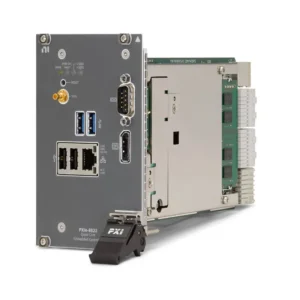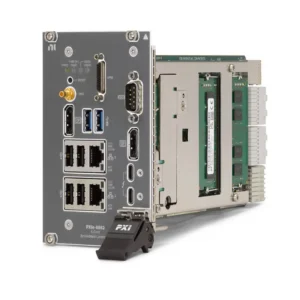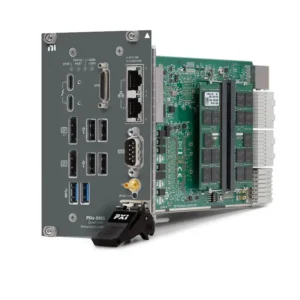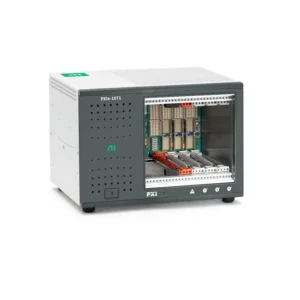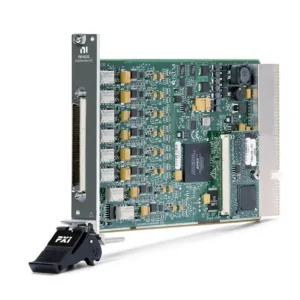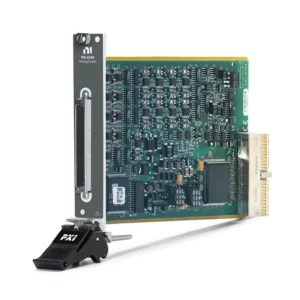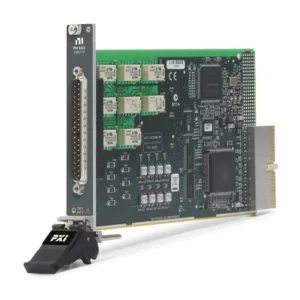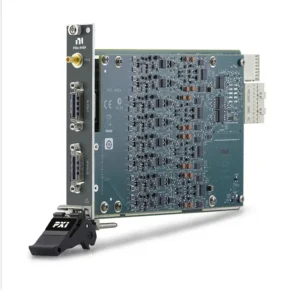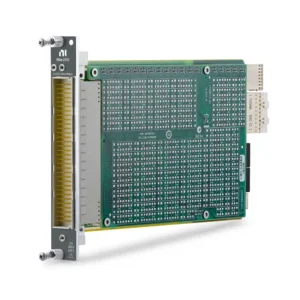




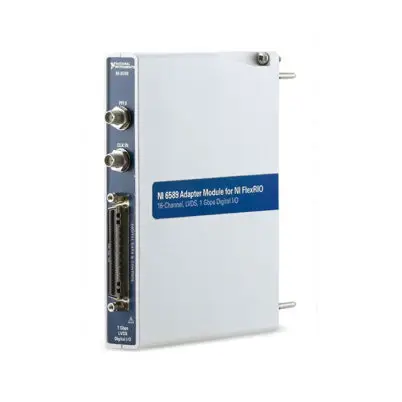
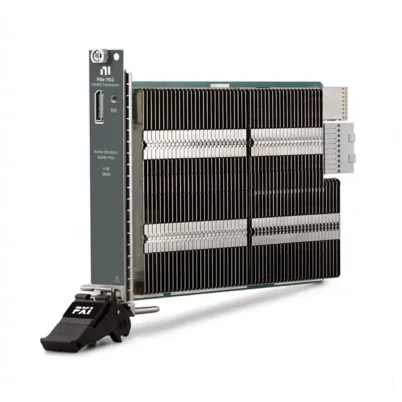

PXIe-7911 KU035 FPGA PXI FlexRIO Coprocessor Module
Земля PXIe-7911 is a PXI Express FlexRIO coprocessor module designed to add user-programmable, real-time signal-processing capability to modular test systems. It combines a Xilinx Kintex UltraScale KU035 FPGA with a PCI Express Gen 3 ×8 backplane interface and peer-to-peer streaming rates up to 7 GB/s.
The PXIe-7911 can receive data directly from compatible PXI instruments, process it in the FPGA and return the results without routing every transfer through the host controller. It is suitable for real-time RF processing, data reduction, hardware acceleration, custom triggering and low-latency measurement applications.
Key Features of the PXIe-7911
- Xilinx Kintex UltraScale KU035 FPGA
- 50,780 FPGA slices
- Approximately 203,120 lookup tables
- 1,700 DSP48E2 slices
- Approximately 19 Mbit of FPGA block RAM
- PCI Express Gen 3 ×8 backplane interface
- Up to 7 GB/s peer-to-peer streaming
- Low-latency instrument-to-FPGA data transfer
- Up to 60 DMA channels
- PXI trigger and star-trigger support
- PXIe_DStar and PXIe_Sync100 timing resources
- Programmable with LabVIEW FPGA
- Can also be programmed using Xilinx Vivado workflows
- No user DRAM for large waveform storage
- No auxiliary front-panel digital I/O connector
- Designed as a dedicated FPGA coprocessor
PXIe-7911 Technical Specifications
| Product Model | PXIe-7911 |
|---|---|
| Part Number | 785172-01 |
| Product Type | PXI FlexRIO coprocessor module |
| ФПГА | Xilinx Kintex UltraScale KU035 |
| FPGA Slices | 50,780 |
| DSP Slices | 1,700 |
| Block RAM | Approximately 19 Mbit |
| User DRAM | Ничего |
| Auxiliary Front-Panel I/O | Ничего |
| PXI Backplane Interface | PCI Express Gen 3 ×8 |
| Maximum Peer-to-Peer Streaming Rate | Up to 7 GB/s |
| Maximum Bidirectional P2P Rate | Approximately 6.75 GB/s aggregate in supported configurations |
| Peer-to-Peer Latency | Less than 1 µs in supported Gen 3 ×8 systems |
| DMA Channels | Up to 60 |
| Peer-to-Peer Streams | Up to 16 in supported configurations |
| Default FPGA Timebase | 80 MHz |
| Reference Clock | PXI Express 100 MHz reference clock, PXIe_CLK100 |
| Trigger and Timing Resources | PXI triggers, PXI_CLK10, PXI star trigger, PXIe_DStarB, PXIe_DStarC and PXIe_Sync100 |
| Programming Options | LabVIEW FPGA or supported Xilinx Vivado workflows |
| Device Driver | NI FlexRIO |
| Recommended Slot Cooling | At least 58 W for maximum FPGA capability |
| Dimensions | Approximately 7.4 in. × 5.1 in. |
| Weight | Approximately 190 g |
| Module Format | 3U PXI Express module |
| Product Status | Discontinued |
PXIe-7911 Part Number and Identification
| Identifier Type | Number | Описание |
|---|---|---|
| Orderable Part Number | 785172-01 | PXIe-7911 KU035 FPGA, PCI Express Gen 3 ×8 FlexRIO coprocessor |
| Assembly Family | 159043B-11L or later | PXIe-7911 circuit-card assembly identification |
Use 785172-01 when requesting a quotation for the complete PXIe-7911 module. The assembly number identifies the internal circuit-card revision and is not normally used as the commercial ordering number.
Dedicated FlexRIO Coprocessor Architecture
The PXIe-7911 is a dedicated FPGA coprocessor rather than a conventional FlexRIO adapter carrier. It is designed to add programmable signal processing to data produced by other PXI Express instruments.
A compatible oscilloscope, digitizer, vector signal transceiver or other module can stream data through the PXI backplane to the PXIe-7911. FPGA algorithms then process the data with deterministic hardware timing.
No FlexRIO Adapter Interface
The PXIe-7911 should not be confused with modular-I/O FPGA carriers such as the PXIe-7976R. It does not accept the traditional NI-57xx or NI-65xx FlexRIO adapter modules.
It also does not provide fixed analog inputs, analog outputs or general-purpose front-panel digital I/O. Signal data normally reaches the FPGA through the PXI Express backplane.
Kintex UltraScale KU035 FPGA
The PXIe-7911 uses a Xilinx Kintex UltraScale KU035 FPGA. This architecture provides substantially more processing resources and higher-performance PCI Express integration than older Virtex-5 FlexRIO modules.
The FPGA can implement real-time filters, transforms, channelizers, trigger algorithms, packet processing and custom mathematical functions.
50,780 FPGA Slices
The KU035 FPGA provides approximately 50,780 slices for building custom logic, state machines, data-routing architectures and parallel processing pipelines.
A portion of the FPGA is used by board-interface IP, PCI Express communication and device configuration. The resources available to the user are therefore slightly lower than the total physical FPGA capacity.
1,700 DSP Slices
The module provides approximately 1,700 DSP48E2 slices for multiply-accumulate and other arithmetic operations. These resources support parallel filtering, digital downconversion, fast Fourier transforms and matrix calculations.
DSP-intensive algorithms can operate directly on data received from another PXI instrument, reducing dependence on the controller CPU.
Approximately 19 Mbit of Block RAM
The KU035 includes approximately 19 Mbit of embedded block RAM. FPGA block RAM provides low-latency storage for FIFOs, coefficient tables, packet buffers, delay lines and intermediate processing data.
The PXIe-7911 has no large user-accessible external DRAM. Algorithms requiring very large FPGA-side buffers should consider the PXIe-7912 or PXIe-7915.
No User DRAM
The PXIe-7911 does not include the 4 GB of user DRAM found on the PXIe-7912 and PXIe-7915. This makes the PXIe-7911 best suited to continuous streaming and pipeline-processing applications.
Applications requiring large waveform retention, frame buffering or extensive intermediate storage should select a coprocessor with external DRAM or continuously move data through peer-to-peer and DMA channels.
PCI Express Gen 3 ×8 Interface
The PXIe-7911 uses a PCI Express Gen 3 ×8 backplane connection. This interface supports substantially greater data throughput than earlier Gen 1 and Gen 2 FlexRIO FPGA modules.
The chassis slot must provide the required PCI Express link width and cooling. Installing the module in a slot with a narrower data path can limit performance.
7 GB/s Peer-to-Peer Streaming
In a supported PXI Express system, the PXIe-7911 can stream data to or from compatible instruments at up to 7 GB/s without routing the transfer through the host controller.
NI peer-to-peer technology allows an instrument to write directly to an FPGA endpoint. This reduces CPU usage and can lower data-transfer latency.
Low-Latency Processing
Supported Gen 3 ×8 peer-to-peer configurations can provide latency below 1 µs. Low transfer latency is valuable for real-time feedback, custom triggering and rapid decision-making.
Complete system latency also includes the source instrument, FPGA algorithm, buffering, return path and destination-instrument response.
Bidirectional Data Transfer
The module can participate in simultaneous bidirectional peer-to-peer transfer. Supported benchmark configurations can provide aggregate bidirectional throughput of approximately 6.75 GB/s.
Actual throughput depends on the chassis topology, instrument endpoints, record structure, FPGA code and the number of concurrent streams.
60 DMA Channels
The PXIe-7911 provides as many as 60 DMA channels for moving data and control information between the FPGA and system resources.
DMA channels can separate raw input data, processed output, status information and application control. The total physical PCI Express bandwidth is shared by all active transfers.
Peer-to-Peer Stream Configuration
Supported PXIe-7911 applications can use multiple peer-to-peer streams to receive data from or send data to compatible instruments. NI system examples describe as many as 16 peer-to-peer streams per FPGA.
Endpoint compatibility, chassis routing and data-type configuration must be verified for every writer and reader pair.
PXI Timing and Synchronization
The PXIe-7911 provides access to PXI trigger lines, PXI_CLK10, PXI star trigger, PXIe_DStarB, PXIe_DStarC and PXIe_Sync100 resources.
These connections allow FPGA processing to be coordinated with signal acquisition, generation and other system events.
80 MHz Default FPGA Timebase
The module uses an 80 MHz default FPGA timebase and can reference the PXIe_CLK100 backplane clock. Additional FPGA clock domains can be created for processing algorithms where supported.
Clock selection affects FPGA timing closure, data-path throughput and synchronization with other instruments.
LabVIEW FPGA Programming
The PXIe-7911 can be programmed using the LabVIEW FPGA Module. Developers create parallel processing logic graphically, compile the application and download the resulting FPGA bitfile to the module.
LabVIEW FPGA supports hardware-timed loops, FIFOs, DMA communication, peer-to-peer endpoints and fixed-point signal-processing functions.
Xilinx Vivado Programming
The Kintex UltraScale FPGA can also be programmed through supported Xilinx Vivado workflows. This option is useful for teams with established VHDL, Verilog or Vivado IP-development processes.
Software versions, driver compatibility and the required NI integration workflow should be verified before beginning development.
FPGA Bitstream Storage
The PXIe-7911 includes nonvolatile storage for FPGA configuration images and volatile SDRAM used for FPGA bitstream handling. User measurement data is not retained after power is removed.
Preserve the original project, source code, compilation reports and validated bitfiles when maintaining a discontinued PXIe-7911 system.
Chassis Power and Cooling Requirements
NI recommends a PXI Express chassis with at least 58 W of slot cooling capacity to obtain full capability from the PXIe-7911, especially for FPGA designs that use substantial resources at clock rates above 150 MHz.
Insufficient power or cooling can cause the module to issue warnings or revert to a default FPGA personality to protect the hardware.
Typical PXIe-7911 Applications
- Real-time RF signal processing
- Vector signal transceiver coprocessing
- Digital filtering and channelization
- Fast Fourier transform processing
- Custom triggering and event detection
- Data reduction and compression
- Low-latency closed-loop testing
- Protocol and packet processing
- FPGA hardware acceleration
- Валидация полупроводников
- Испытания в аэрокосмической и оборонной промышленности
- Research instrumentation
Vector Signal Transceiver Coprocessing
The PXIe-7911 can be paired with a compatible PXI vector signal transceiver to add FPGA resources for real-time RF algorithms. The VST streams measurement data to the coprocessor through the PXI Express backplane.
The FPGA can implement filtering, detection, demodulation or custom analysis before sending results to the host or returning data to another instrument.
Real-Time RF Signal Processing
The KU035 FPGA’s DSP resources can implement digital downconversion, channel filtering, power detection and frequency-domain processing.
Peer-to-peer streaming reduces host intervention, allowing the processing chain to operate continuously at high data rates.
Custom Triggering and Event Detection
The PXIe-7911 can analyze incoming data and generate decisions based on custom thresholds, spectral content, protocol fields or multi-stage logic.
Detected events can be reported to the host or used to control another compatible PXI module through peer-to-peer or trigger resources.
Data Reduction and Compression
High-speed instruments can produce more raw data than the host needs to store. The PXIe-7911 can filter, decimate, average or extract features from the incoming stream.
Transferring only the required results can reduce controller workload, storage requirements and analysis time.
FPGA Hardware Acceleration
Algorithms involving parallel arithmetic can be moved from the CPU to the KU035 FPGA. This can improve deterministic performance and free controller resources for test sequencing, visualization and reporting.
Suitable workloads include filters, correlators, transforms, channelizers and repetitive mathematical operations.
PXIe-7911 Troubleshooting
The PXIe-7911 Is Not Detected in NI MAX
Confirm that the module is fully installed in a compatible PXI Express slot. Check chassis power, controller communication and the installed NI FlexRIO driver, then rescan the system in NI Measurement & Automation Explorer.
The Module Reports an Insufficient Cooling Warning
Verify that the selected slot provides at least 58 W of cooling capacity. Check chassis fan settings, airflow and adjacent-module placement.
The FPGA Bitfile Will Not Download
Confirm that the bitfile was compiled specifically for the PXIe-7911 KU035 target. Check the NI FlexRIO, LabVIEW FPGA and compilation-tool versions.
The Application Expects Onboard DRAM
The PXIe-7911 does not provide user DRAM. Redesign the application to use block RAM and streaming, or migrate to the PXIe-7912 or PXIe-7915.
A FlexRIO Adapter Module Cannot Be Installed
The PXIe-7911 is a dedicated coprocessor and does not accept traditional FlexRIO adapter modules. Use a compatible integrated-I/O instrument or a modular-I/O FPGA carrier for direct signal connectivity.
Peer-to-Peer Streaming Does Not Start
Confirm that the source and destination instruments support compatible peer-to-peer endpoints. Verify chassis routing, slot topology, data type, FIFO configuration and driver support.
Peer-to-Peer Throughput Is Lower Than Expected
Check whether the slot provides a full PCI Express Gen 3 ×8 link. Review packet size, buffer configuration, FPGA timing and the capabilities of the connected instrument.
FPGA Timing Closure Fails
Review the critical paths in the compilation report. Add pipelining, reduce combinational logic or lower the affected clock rate.
The FPGA Reverts to Its Default Personality
The module may protect itself when an FPGA design exceeds available power or thermal limits. Verify chassis cooling, FPGA resource utilization and clock rate.
The Module Works in Windows but Not Linux
Confirm that the installed Linux distribution and FlexRIO release support the PXIe-7911. Use a supported 64-bit operating system and matching driver version.
PXIe-7911 Comparison with Similar FlexRIO Processing Modules
| Модель | FPGA and Memory | Best Suited For |
|---|---|---|
| PXIe-7911 | Kintex UltraScale KU035, no user DRAM, no auxiliary I/O | Continuous moderate-complexity backplane processing |
| PXIe-7912 | Kintex UltraScale KU040, 4 GB DRAM, auxiliary I/O | Buffered processing and moderate FPGA workloads |
| PXIe-7915 | Kintex UltraScale KU060, 4 GB DRAM, auxiliary I/O | Large RF and signal-processing algorithms |
| PXIe-7976R | Kintex-7 K410T, 2 GB DRAM, modular-I/O interface | Applications requiring a separate FlexRIO adapter module |
PXIe-7911 vs PXIe-7912
Земля PXIe-7912 uses a larger Kintex UltraScale KU040 FPGA with 60,600 slices, 1,920 DSP slices and approximately 21 Mbit of block RAM. It also includes 4 GB of DRAM.
The PXIe-7911 uses a KU035 FPGA, has no user DRAM and does not provide auxiliary front-panel I/O. Choose the PXIe-7912 when large buffers, greater FPGA resources or auxiliary digital connectivity are required.
PXIe-7911 vs PXIe-7915
Земля PXIe-7915 provides a Kintex UltraScale KU060 FPGA with 82,920 slices, 2,760 DSP slices, approximately 38 Mbit of block RAM and 4 GB of DRAM.
Select the PXIe-7915 for large RF, channelization and signal-processing designs. Choose the PXIe-7911 for moderate continuous-processing applications that do not need external DRAM.
PXIe-7911 vs PXIe-7976R
Земля PXIe-7976R is a modular-I/O FlexRIO FPGA carrier designed to accept compatible adapter modules. The PXIe-7911 is a dedicated backplane coprocessor and does not accept these adapters.
Choose the PXIe-7976R when the FPGA must connect to application-specific analog or digital I/O through a FlexRIO adapter. Choose the PXIe-7911 when the FPGA primarily processes data from another PXI Express instrument.
Recommended Related Products
- PXIe-7912 KU040 FlexRIO Coprocessor Module
- PXIe-7915 KU060 FlexRIO Coprocessor Module
- PXIe-7976R Kintex-7 FlexRIO FPGA Module
- PXIe-5785 FlexRIO IF Transceiver Module
- PXIe-5840 Vector Signal Transceiver
- PXIe-5764 FlexRIO Digitizer Module
- View More NI PXI and PXI Express Modules
Selecting the Right FlexRIO Coprocessor
Choose the PXIe-7911 when the application requires a KU035 FPGA, PCI Express Gen 3 ×8 throughput and real-time backplane processing without large onboard buffers or auxiliary I/O.
Select the PXIe-7912 when 4 GB of DRAM and moderate additional FPGA capacity are required. Choose the PXIe-7915 for the largest FPGA and DSP resource requirements in this coprocessor family.
Purchasing a Discontinued PXIe-7911
NI lists the PXIe-7911 as no longer available. Inventory may therefore consist of unused surplus, previously installed or refurbished modules.
Before ordering, verify the 785172-01 part number, serial number, FPGA condition and software compatibility. A used module should be tested for PXI enumeration, FPGA bitfile download, DMA communication, trigger resources and peer-to-peer streaming.
Why Choose the PXIe-7911?
- Adds programmable FPGA processing to PXI Express systems
- Provides a Kintex UltraScale KU035 FPGA
- Supports PCI Express Gen 3 ×8 data transfer
- Streams peer-to-peer data at up to 7 GB/s
- Offers less than 1 µs transfer latency in supported configurations
- Provides 1,700 DSP resources for parallel signal processing
- Supports up to 60 DMA channels
- Works with LabVIEW FPGA and Xilinx Vivado workflows
- Integrates with compatible PXI instruments and timing resources
Frequently Asked Questions
What Is the PXIe-7911?
The PXIe-7911 is a PXI Express FlexRIO coprocessor module with a user-programmable Xilinx Kintex UltraScale KU035 FPGA.
What Is the PXIe-7911 Part Number?
The standard orderable part number is 785172-01.
Which FPGA Does It Use?
The PXIe-7911 uses a Xilinx Kintex UltraScale KU035 FPGA with approximately 50,780 slices, 1,700 DSP slices and 19 Mbit of block RAM.
Does the PXIe-7911 Have User DRAM?
No. The PXIe-7911 does not provide large user-accessible DRAM. The PXIe-7912 and PXIe-7915 each provide 4 GB.
What Is the Maximum Streaming Rate?
The module supports peer-to-peer streaming at up to 7 GB/s in a compatible PCI Express Gen 3 ×8 system.
Does It Support Peer-to-Peer Streaming?
Yes. The PXIe-7911 can exchange data directly with compatible PXI Express instruments without routing every transfer through the host controller.
Can FlexRIO Adapter Modules Be Attached?
No. The PXIe-7911 is a dedicated coprocessor and does not accept traditional modular-I/O FlexRIO adapters.
Does It Have Front-Panel Digital I/O?
No. Unlike the PXIe-7912 and PXIe-7915, the PXIe-7911 does not provide an auxiliary front-panel DIO connector.
How Many DMA Channels Are Available?
The PXIe-7911 supports up to 60 DMA channels.
Which Chassis Cooling Capacity Is Recommended?
NI recommends at least 58 W of cooling capacity per slot for full FPGA performance, especially with resource-intensive designs operating above 150 MHz.
Which Software Can Program the PXIe-7911?
The FPGA can be programmed through supported LabVIEW FPGA or Xilinx Vivado development workflows using compatible NI FlexRIO software.
What Is the Difference Between PXIe-7911 and PXIe-7912?
The PXIe-7912 provides a larger KU040 FPGA, 4 GB of DRAM and auxiliary digital I/O. The PXIe-7911 uses a KU035 FPGA and has neither user DRAM nor auxiliary I/O.
Is the PXIe-7911 Still Manufactured?
No. NI lists the PXIe-7911 as no longer available, although surplus and previously installed modules may still be obtainable.
Request a Quote for the PXIe-7911
Contact us for current availability, condition and project pricing for the PXIe-7911 KU035 FlexRIO Coprocessor Module. We can also help verify the 785172-01 part number, chassis cooling, software compatibility and alternative PXIe-7912 or PXIe-7915 configurations for your system.