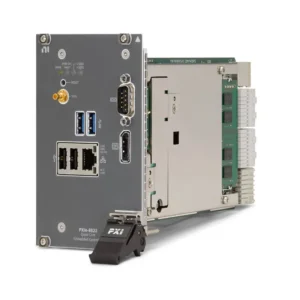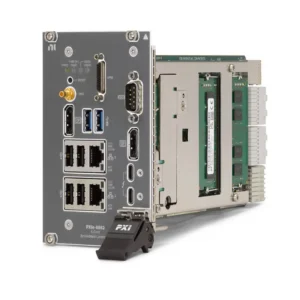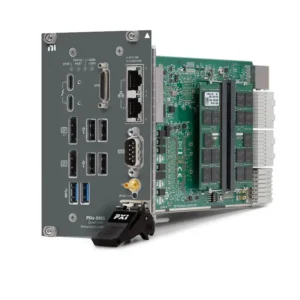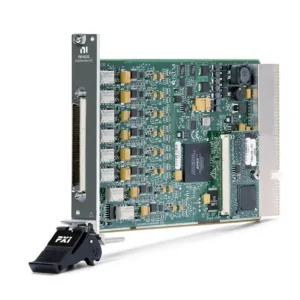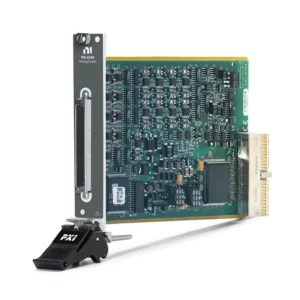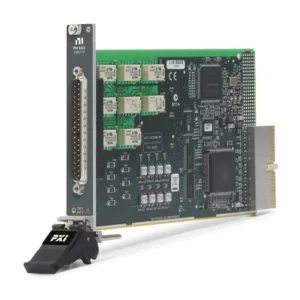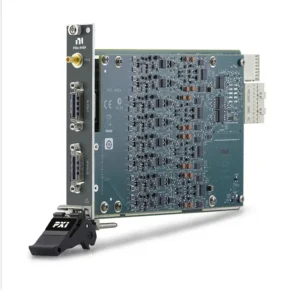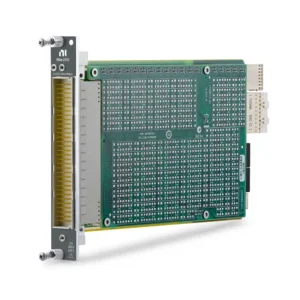




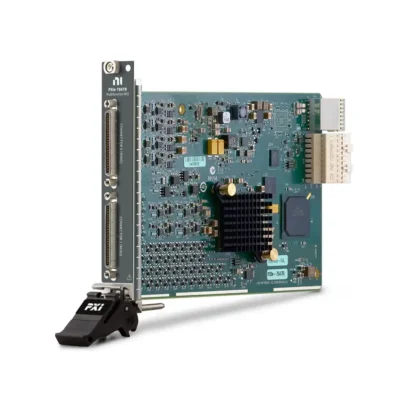
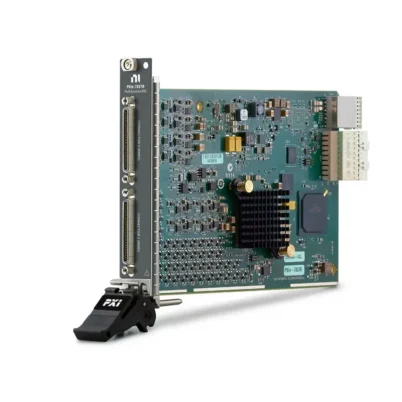
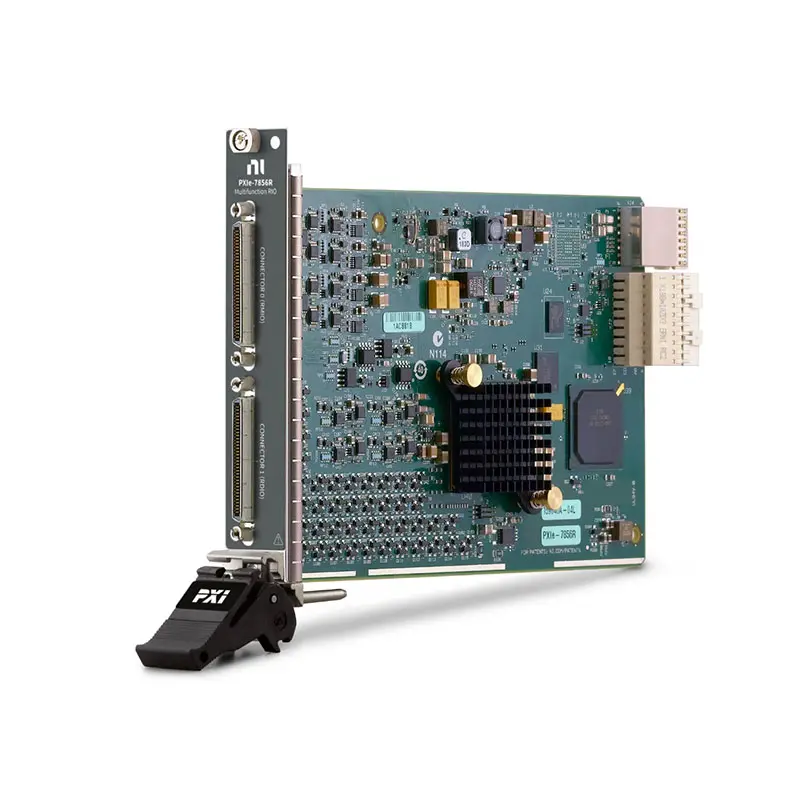
PXIe-7856 Multifunction Reconfigurable I/O Module
Земля PXIe-7856, also known as the PXIe-7856R, is a multifunction R Series reconfigurable I/O module featuring a user-programmable Xilinx Kintex-7 160T FPGA. It combines analog input, analog output and digital I/O resources with deterministic FPGA-based processing.
The module provides eight 16-bit analog inputs with sampling rates up to 1 MS/s per channel, eight 16-bit analog outputs, and 48 bidirectional digital I/O lines. It is designed for hardware-in-the-loop testing, high-speed control, sensor simulation and custom protocol applications.
Key Features of the PXIe-7856
- Xilinx Kintex-7 160T user-programmable FPGA
- Eight 16-bit analog input channels
- Maximum analog input rate of 1 MS/s per channel
- Dedicated ADC for every analog input
- Eight 16-bit analog output channels
- Maximum analog output rate of 1 MS/s per channel
- Software-selectable ±1 V, ±2 V, ±5 V and ±10 V input ranges
- ±10 V analog output range
- 48 bidirectional digital I/O lines
- Selectable 1.2 V, 1.5 V, 1.8 V, 2.5 V and 3.3 V digital logic
- Up to 80 MHz high-speed digital I/O
- Independent analog input timing and triggering
- Peer-to-peer data streaming
- Programmable with the LabVIEW FPGA Module
PXIe-7856 Technical Specifications
| Product Model | PXIe-7856 / PXIe-7856R |
|---|---|
| Part Number | 784145-01 |
| Product Type | Multifunction Reconfigurable I/O Module |
| Product Family | NI R Series Multifunction RIO |
| Шинный интерфейс | PXI Express |
| ФПГА | Xilinx Kintex-7 160T |
| Analog Input Channels | 8 |
| Analog Input Resolution | 16 bits |
| ADC Type | Successive approximation register |
| Maximum Analog Input Rate | 1 Мвыб/с на канал |
| Analog Input Ranges | ±1 V, ±2 V, ±5 V and ±10 V |
| Analog Input Modes | Differential, RSE or NRSE |
| Analog Input Coupling | DC |
| Analog Output Channels | 8 |
| Analog Output Resolution | 16 bits |
| Maximum Analog Output Rate | 1 Мвыб/с на канал |
| Analog Output Range | ±10 V |
| Digital I/O Channels | 48 bidirectional lines |
| High-Speed Digital Channels | 32 lines at up to 80 MHz |
| Low-Speed Digital Channels | 16 lines at up to 10 MHz |
| Digital Logic Levels | 1.2 V, 1.5 V, 1.8 V, 2.5 V or 3.3 V |
| Maximum Clock Rate | 80 MHz |
| Onboard DRAM | Ничего |
| I/O Connectors | 2 × 68-pin VHDCI |
| Peer-to-Peer Streaming | Supported |
| Form Factor | Single-slot 3U PXI Express |
PXIe-7856 Part Number and Accessories
| Model or Accessory | Part Number | Описание |
|---|---|---|
| PXIe-7856 | 784145-01 | Kintex-7 160T multifunction reconfigurable I/O module |
| SCB-68 HSDIO | 782914-01 | Shielded connector block for high-speed digital I/O |
| SCB-68A | 782536-01 | Shielded connector block for multifunction analog and digital I/O |
| SHC68-C68-RDIO2 | 156166-01 | 1 m shielded R Series high-speed digital cable |
| SHC68-C68-RDIO2 | 156166-02 | 2 m shielded R Series high-speed digital cable |
| SHC68-68-RMIO | 189588-01 | 1 m shielded RMIO cable |
| SHC68-68-RMIO | 189588-02 | 2 m shielded RMIO cable |
User-Programmable Kintex-7 FPGA
The PXIe-7856 uses a Xilinx Kintex-7 160T FPGA to execute custom processing, timing and control logic directly in hardware. The FPGA can be programmed with the LabVIEW FPGA Module without developing a traditional hardware-description-language design.
FPGA execution provides deterministic response independent of the host operating system. Engineers can implement custom triggers, digital protocols, filters, control algorithms and safety interlocks on the module.
Eight Independent Analog Inputs
The PXIe-7856 provides eight 16-bit analog input channels. Each channel has a dedicated ADC capable of sampling at up to 1 MS/s, allowing independent channel timing, multirate acquisition and individual triggering.
Input ranges of ±1 V, ±2 V, ±5 V and ±10 V can be selected through FPGA configuration. The narrower ranges provide improved effective voltage resolution when measuring smaller signals.
Analog Input Connection Modes
The analog input channels support differential, referenced single-ended and nonreferenced single-ended modes. The terminal mode selection applies across the analog input channels.
- Differential: Provides better rejection of common-mode interference and is recommended for low-level or noisy signals.
- RSE: References the measured signal to the module’s analog ground.
- NRSE: Uses a shared remote reference through the AISENSE connection.
Signal plus common-mode voltage must remain within the module’s specified working-voltage limits.
Eight Analog Outputs
The PXIe-7856 provides eight 16-bit analog output channels with a ±10 V range and update rates up to 1 MS/s per channel. Each output can be controlled directly by FPGA logic.
The outputs can generate simulated sensor signals, actuator commands, control voltages and custom waveforms. This capability is useful for closed-loop testing where the same module must acquire system responses and generate real-time stimuli.
48 Configurable Digital I/O Lines
The digital interface is divided into 32 high-speed lines and 16 lower-speed lines. The high-speed group can operate at signal frequencies up to 80 MHz, while the remaining 16 lines support frequencies up to 10 MHz.
Each connector supports selectable logic levels of 1.2 V, 1.5 V, 1.8 V, 2.5 V or 3.3 V. Individual channels can be configured as inputs or outputs, providing flexibility when interfacing with modern digital devices.
Multirate Sampling and Individual Triggers
A dedicated ADC on every analog input allows the PXIe-7856 to acquire channels using independently defined timing. Fast signals can be sampled at high rates while slower signals are acquired less frequently.
FPGA logic can also implement individual channel triggers, threshold detection and custom acquisition conditions that are not normally available from fixed-function DAQ timing engines.
Peer-to-Peer Data Streaming
The PXIe-7856 supports peer-to-peer streaming for direct data transfer to compatible PXI Express modules. Data can move between instruments without first passing through the host controller’s application memory.
This architecture can reduce latency and host CPU load in systems combining FPGA I/O with digitizers, RF instruments or other peer-to-peer-capable modules.
Typical PXIe-7856 Applications
- Симуляция с аппаратным входом
- Electronic control unit testing
- High-speed closed-loop control
- Sensor and actuator simulation
- Custom digital protocol implementation
- Power electronics testing
- Motor and inverter control
- Aerospace system validation
- Automotive component testing
- Custom data acquisition systems
- Rapid control prototyping
- Semiconductor and electronic device testing
LabVIEW FPGA Programming
The PXIe-7856 is customized with the LabVIEW FPGA Module and supported NI R Series drivers. Engineers can create FPGA personalities that define analog acquisition, waveform generation, digital I/O, timing, triggering and onboard processing.
A host application communicates with the compiled FPGA design through registers, interrupts and DMA FIFOs. The design should account for FPGA resource usage, data-transfer requirements and the absence of onboard DRAM.
SCB-68A and SCB-68 HSDIO Connectivity
The multifunction I/O connector can connect to an SCB-68A shielded terminal block through an SHC68-68-RMIO cable. This combination provides accessible terminals for analog inputs, analog outputs and the lower-speed digital channels.
The dedicated digital connector can connect to the SCB-68 HSDIO through an SHC68-C68-RDIO2 cable. This connection preserves the pinout and signal integrity required by the 32 high-speed digital lines.
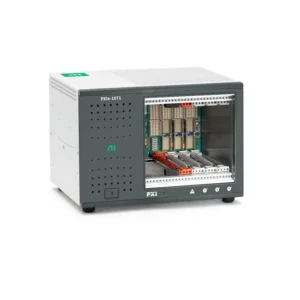
PXI Express Chassis Integration
The PXIe-7856 installs in a compatible PXI Express or PXI Express Hybrid slot. It can use PXI timing and trigger resources to synchronize with other instruments in the chassis.
Multiple R Series devices can be combined with digitizers, signal generators and additional I/O modules to create deterministic modular test platforms.
PXIe-7856 Troubleshooting
The module is not detected in NI MAX
Confirm that the PXIe-7856 is fully seated in a compatible PXI Express slot. Verify the chassis, controller, NI R Series driver and LabVIEW FPGA support, then refresh the device list in NI Measurement & Automation Explorer.
The FPGA VI does not compile
Verify that the installed LabVIEW FPGA and compilation tools support the Kintex-7 160T target. Review resource utilization if the design exceeds the available FPGA logic, memory or DSP resources.
The analog input uses the wrong measurement range
Check the configured Voltage Range property for the channel. The PXIe-7856 supports ±1 V, ±2 V, ±5 V and ±10 V ranges, and the FPGA configuration can override the project setting.
The analog output generates only ±1 V instead of ±10 V
Verify that the raw FPGA value is correctly converted using the output calibration coefficients. The physical output supports ±10 V, but an incorrectly scaled integer value can generate a smaller voltage than expected.
A digital device does not recognize the output
Confirm that the selected digital logic level matches the connected device. Check whether the signal uses the 80 MHz high-speed connector or the 10 MHz multifunction connector and verify that both devices share an appropriate ground reference.
High-speed digital communication is unreliable
Use the recommended SHC68-C68-RDIO2 shielded cable and SCB-68 HSDIO connector block. Reduce cable length, verify signal termination and confirm that the FPGA timing meets the external device requirements.
PXIe-7856 Compared with Related R Series Modules
| Модель | ФПГА | Maximum AI Rate | I/O Configuration | Best Suited For |
|---|---|---|---|---|
| PXIe-7856 | Кинтекс-7 160Т | 1 MS/s | 8 AI, 8 AO, 48 DIO | High-speed multifunction FPGA control |
| PXIe-7846 | Кинтекс-7 160Т | 500 kS/s | 8 AI, 8 AO, 48 DIO | Lower-speed multifunction applications |
| PXI-7851 | Virtex-5 LX30 | 750 kS/s | 8 AI, 8 AO, 96 DIO | Maintaining legacy PXI R Series systems |
| PXIe-7820 | Кинтекс-7 160Т | Digital I/O only | High-density digital I/O | Custom digital protocols and interfaces |
| PCIe-7856 | Кинтекс-7 160Т | 1 MS/s | 8 AI, 8 AO, 48 DIO | Desktop PCI Express installations |
Recommended Related Products
- PXIe-7846 Multifunction RIO Module – A Kintex-7 160T alternative with a 500 kS/s analog input rate.
- PXI-7851 Multifunction RIO Module – A Virtex-5-based module for maintaining older PXI R Series systems.
- PXIe-7820 Digital Reconfigurable I/O Module – A Kintex-7 module for applications requiring FPGA-controlled digital I/O.
- PCIe-7856 Multifunction RIO Module – A PCI Express card version for desktop computer integration.
- PXIe-1092 PXI Express Chassis – A modular chassis for synchronized FPGA-based test systems.
Additional FPGA, data acquisition and control products are available in the NI PXI Modules category.
Selecting the PXIe-7856
Choose the PXIe-7856 when an application requires deterministic FPGA control, eight 1 MS/s analog inputs, eight analog outputs and digital interfaces with selectable logic levels.
The PXIe-7846 may be suitable when 500 kS/s analog acquisition is sufficient. Choose the PXIe-7820 when the application requires FPGA-controlled digital I/O but does not need onboard analog channels.
Why Choose the PXIe-7856?
- Combines analog input, analog output and digital I/O
- Provides a dedicated ADC for every analog input channel
- Supports deterministic Kintex-7 FPGA processing
- Offers software-selectable analog input ranges
- Supports several modern digital logic levels
- Provides high-speed digital operation up to 80 MHz
- Supports direct peer-to-peer PXI Express streaming
Frequently Asked Questions
What is the PXIe-7856 used for?
The PXIe-7856 is used for FPGA-based data acquisition, hardware-in-the-loop testing, sensor simulation, custom digital protocols and deterministic control.
How many analog channels does it provide?
The module provides eight 16-bit analog inputs and eight 16-bit analog outputs.
What is the maximum analog input sampling rate?
Each analog input supports sampling rates up to 1 MS/s using its dedicated ADC.
Which analog input ranges are available?
The PXIe-7856 supports software-selectable ±1 V, ±2 V, ±5 V and ±10 V analog input ranges.
How many digital I/O lines are available?
The module provides 48 bidirectional digital I/O lines, including 32 high-speed lines and 16 lower-speed lines.
Which digital voltage levels are supported?
The digital interfaces can be configured for 1.2 V, 1.5 V, 1.8 V, 2.5 V or 3.3 V logic.
Does the PXIe-7856 support peer-to-peer streaming?
Yes. It can transfer data directly to compatible PXI Express modules without first routing the data through host application memory.
Does the PXIe-7856 include onboard DRAM?
No. Data buffering must use FPGA memory, DMA FIFOs or host-system memory.
What is the part number for the PXIe-7856?
The standard NI part number for the PXIe-7856 is 784145-01.
Request a Quote for the PXIe-7856
Contact us for current availability, lead time and project pricing for the PXIe-7856 Kintex-7 Multifunction Reconfigurable I/O Module. We can also help identify compatible cables, SCB-68 connector blocks, PXI Express chassis and related R Series modules.