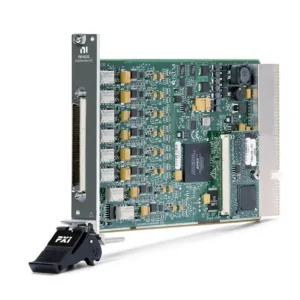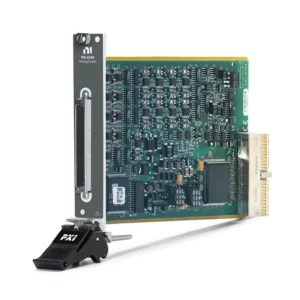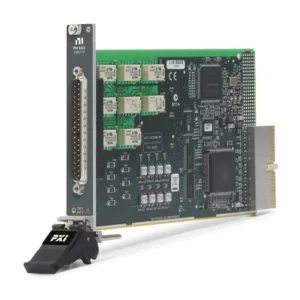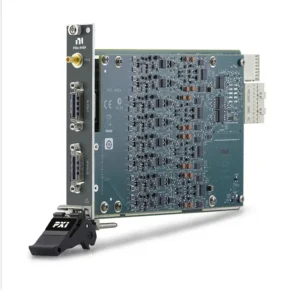




Product Introduction
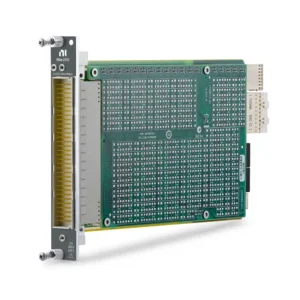
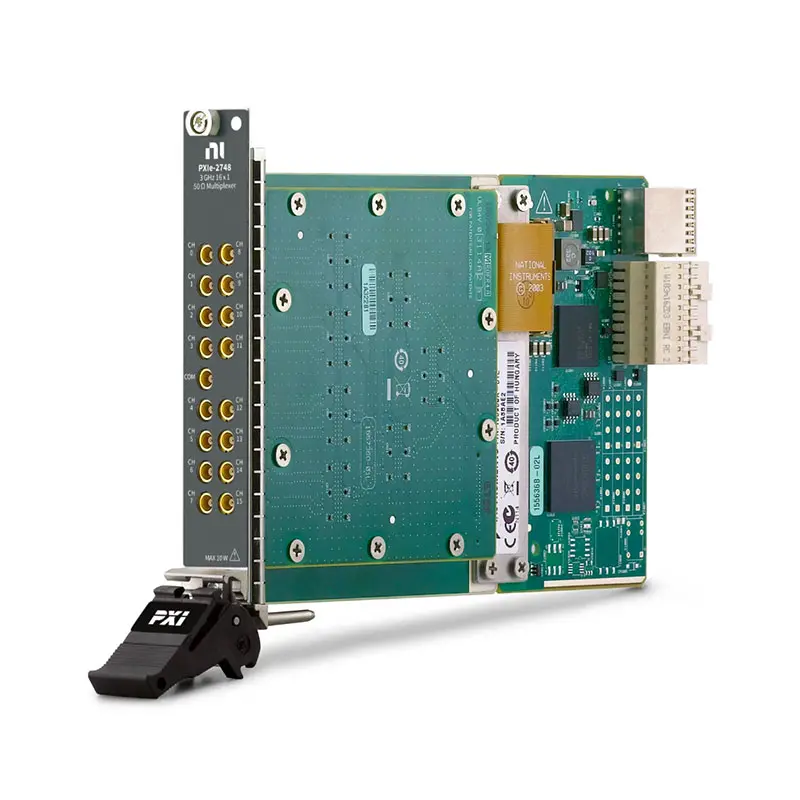
Земля NI PXIe-2748 is a 3 GHz, 16×1 PXI Express RF multiplexer switch module designed for automated RF test, wireless device validation, RF production test, and other applications requiring high-density RF signal routing.
The PXIe-2748 provides 16 RF input channels routed to one common channel, allowing multiple RF signals or devices under test to share a single RF measurement instrument. With a switching bandwidth up to 3 GHz и а 50 Ω characteristic impedance, the module is well suited for many RF and wireless test systems.
The module uses electromechanical latching relays and includes onboard relay counting to help monitor relay usage and support preventive maintenance in automated production environments.
Product Overview
Земля National Instruments PXIe-2748 is a high-channel-count RF multiplexer designed for PXI Express automated test systems.
Its 16×1 topology allows one RF instrument to be connected sequentially to as many as 16 RF signal paths.
A typical configuration is:
DUT 1 ─┐
DUT 2 ─┤
DUT 3 ─┤
… ├→ PXIe-2748 → RF Analyzer
DUT 16 ─┘
Test software controls the PXIe-2748 to select the required DUT, route its RF signal to the measurement instrument, perform the measurement, and then switch to the next device.
Key Features
16×1 RF Multiplexer Architecture
The PXIe-2748 provides a 16×1 RF multiplexer topology.
This architecture allows one common RF port to be connected to one of 16 RF channels under software control.
The configuration is particularly useful when multiple DUTs or RF signal paths need to share one expensive RF measurement instrument.
3 GHz RF Switching Bandwidth
The PXIe-2748 supports RF signal switching up to 3 GHz.
This bandwidth makes the module suitable for a broad range of RF test applications operating below 3 GHz.
Typical applications can include:
- RF component testing
- Wireless device testing
- RF production test
- RF module validation
- Automated RF signal routing
- Multi-DUT RF testing
50 Ω Characteristic Impedance
The PXIe-2748 uses a 50 Ω characteristic impedance, which is standard for many RF measurement systems.
This allows the module to integrate with compatible 50 Ω RF instruments, cables, fixtures, and devices under test.
17 MCX RF Connectors
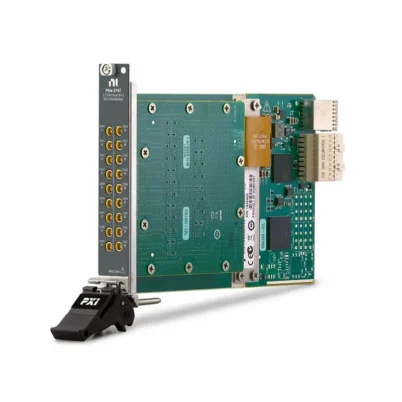
The PXIe-2748 provides 17 gold-plated MCX jacks on the module.
These connections support the 16 RF multiplexer channels plus the common RF connection.
Compatible MCX-based coaxial cables can be used to connect the module to RF instruments, fixtures, and DUT interfaces.
Electromechanical Latching Relays
The PXIe-2748 uses electromechanical latching relays for RF signal switching.
Electromechanical RF relays provide physical signal-path switching and are widely used in automated RF test systems.
Important characteristics include:
- RF signal isolation
- Repeatable switching
- Bidirectional RF signal paths
- Broad RF instrument compatibility
- Software-controlled operation
Onboard Relay Counting
The PXIe-2748 includes onboard relay counting for monitoring relay usage.
Electromechanical relays have a finite operating life, making relay-cycle information valuable in high-volume production environments.
Relay counting can help engineers:
- Track switching activity
- Monitor relay utilization
- Plan preventive maintenance
- Identify heavily used signal paths
- Reduce unexpected production-test downtime
30 V Maximum Switching Voltage
The PXIe-2748 supports signal switching up to approximately 30 V within its specified operating limits.
The complete RF signal path should always be verified against the module voltage, current, and power specifications before use.
500 mA Maximum Switching Current
The PXIe-2748 supports switching current up to approximately 500 mA under its specified operating conditions.
For RF applications, engineers should evaluate voltage, current, RF power, frequency, insertion loss, VSWR, and connector limitations together.
PXI Express Integration
The PXIe-2748 uses the PXI Express platform and occupies a single 3U PXI slot.
It can be integrated with other PXI RF and measurement instruments to create compact automated RF test systems.
Technical Specifications
| Параметр | Спецификация |
|---|---|
| Product Type | PXI RF Multiplexer Switch Module |
| Модель | NI PXIe-2748 |
| Part Number | 780587-48 |
| Platform | PXI Express |
| Switch Configuration | 16×1 Multiplexer |
| Number of RF Channels | 16 |
| Switch Bandwidth | 3 GHz |
| Characteristic Impedance | 50 Ω |
| Тип реле | Electromechanical, Latching |
| I/O Connectors | 17 Gold-Plated MCX Jacks |
| Maximum Switching Voltage | 30 V |
| Maximum Switching Current | 500 mA |
| Maximum Insertion Loss | 3 dB |
| Onboard Relay Counting | Supported |
| Module Size | 3U, One-Slot PXI Express |
| Dimensions | 21.6 cm × 2.0 cm × 13.0 cm |
| Weight | Approximately 330 g |
| Operating Temperature | от 0 °C до 55 °C |
| Primary Applications | RF Production Test, Multi-DUT RF Test, Wireless Test and Automated RF Signal Routing |
What Is an RF Multiplexer Switch?
An RF multiplexer is a switching device that connects one of several RF signal paths to a common RF connection.
For a 16×1 multiplexer:
16 RF Channels → 1 Common RF Port
Only the required channel is connected to the common port according to the test sequence.
This architecture allows multiple DUTs, antennas, RF modules, or signal paths to share a common RF measurement instrument.
How Does the PXIe-2748 Work?
The PXIe-2748 uses software-controlled electromechanical relays to route one of 16 RF channels to the common connection.
A typical automated test sequence is:
- Configure the PXIe-2748.
- Select RF Channel 1.
- Connect Channel 1 to the common RF port.
- Perform the RF measurement.
- Disconnect Channel 1.
- Select Channel 2.
- Perform the next RF measurement.
- Continue through the required channels.
This eliminates the need for manual RF cable changes during automated testing.
PXIe-2748 for RF Production Test
RF production test is one of the primary applications for the PXIe-2748.
Production systems frequently need to test many devices while minimizing the number of expensive RF measurement instruments.
The PXIe-2748 allows multiple DUTs to share a common RF analyzer or other compatible RF instrument.
A simplified architecture is:
16 DUT RF Outputs → PXIe-2748 → RF Analyzer
The test system automatically selects each DUT and performs the required RF measurements.
Multi-DUT RF Testing
The high channel count of the PXIe-2748 makes it particularly useful for multi-DUT RF test systems.
Instead of providing a dedicated RF analyzer for every DUT, the switching system can route multiple devices sequentially to a shared instrument.
This can help:
- Reduce RF instrumentation requirements
- Increase system channel density
- Reduce rack and chassis space
- Simplify automated RF routing
- Improve production test scalability
PXIe-2748 with an RF Analyzer
A common application is connecting multiple DUT RF outputs to a single RF analyzer.
The system architecture can be represented as:
DUT 1 ─┐
DUT 2 ─┤
DUT 3 ─┤
… ├→ PXIe-2748 → RF Analyzer
DUT 16 ─┘
The switch selects the DUT to be measured while the RF analyzer remains connected to the common port.
PXIe-2748 with a Vector Signal Transceiver
The PXIe-2748 can be combined with a compatible PXI Vector Signal Transceiver in automated RF test systems.
A VST can provide RF generation and analysis while the PXIe-2748 manages RF routing between multiple compatible DUT connections.
A typical architecture is:
PXI VST → PXIe-2748 → Multiple RF DUTs
The exact switching architecture depends on whether the application requires stimulus routing, response routing, or both.
RF Device Validation
During RF device validation, engineers may need to connect a measurement instrument to several signal paths on a DUT or test fixture.
The PXIe-2748 can automate these connections for compatible signals below its 3 GHz operating bandwidth.
Typical DUTs may include:
- RF modules
- Wireless devices
- RF amplifiers
- RF filters
- RF switches
- Communication modules
- RF front-end assemblies
RF Component Testing
The PXIe-2748 can route compatible RF signals for automated component characterization.
Applications may include testing:
- RF filters
- Amplifiers
- Attenuators
- RF switches
- RF modules
- Communication components
Тестирование беспроводных устройств
Many wireless production systems require automated routing between RF instruments and multiple devices or RF ports.
The PXIe-2748 can provide this routing for compatible signals within its 3 GHz frequency range.
Its 16-channel architecture is especially useful when a large number of RF connections must be managed in a compact PXI system.
RF Signal Routing
RF switching requires more consideration than conventional low-frequency relay switching because the switch becomes part of the RF transmission path.
Important parameters include:
- Frequency range
- Characteristic impedance
- Insertion loss
- Return loss
- VSWR
- Изоляция
- RF power
- Connector type
- Cable quality
These parameters should be evaluated across the actual operating frequency range of the test system.
Insertion Loss
Insertion loss describes the reduction in signal power caused by inserting the switch into the RF signal path.
The PXIe-2748 specifies maximum insertion loss up to approximately 3 dB, depending on operating frequency and specified test conditions.
For accurate RF measurements, the total loss of the complete signal path should be considered:
Total RF Path Loss = Switch Loss + Cable Loss + Connector Loss + Fixture Loss
Where required, these losses can be characterized and incorporated into the test-system calibration or compensation process.
50 Ω RF System Design
The PXIe-2748 is designed for 50 Ω RF systems.
For best RF performance, the complete signal chain should maintain the appropriate characteristic impedance.
A typical signal path is:
50 Ω RF Instrument → 50 Ω Cable → PXIe-2748 → 50 Ω Cable → DUT
Impedance mismatches can create signal reflections and measurement errors, particularly as frequency increases.
MCX Connectivity
The PXIe-2748 uses MCX RF connectors to achieve high channel density within a compact PXI module.
NI-compatible cable options include MCX-to-MCX, MCX-to-BNC, and MCX-to-SMA coaxial cables.
The appropriate cable should be selected according to the connector type of the RF instrument, DUT, and test fixture.
PXIe-2748 vs RF Matrix Switch
| Функция | PXIe-2748 Multiplexer | RF Matrix Switch |
|---|---|---|
| Architecture | 16×1 | Multiple Rows × Multiple Columns |
| Common RF Port | 1 | Multiple |
| Routing Flexibility | High for One-to-Many Routing | Higher for Complex Routing |
| Channel Density | 16 RF Channels | Topology Dependent |
| Primary Application | Multiple DUTs Sharing One RF Instrument | Complex RF Instrument-to-DUT Routing |
PXIe-2748 vs General-Purpose Multiplexer
| Функция | PXIe-2748 | General-Purpose Multiplexer |
|---|---|---|
| Тип сигнала | RF | DC / Low Frequency |
| Пропускная способность | 3 GHz | Typically Much Lower |
| Characteristic Impedance | 50 Ω | Usually Not RF Controlled |
| Connector | MCX | Terminal Block / D-SUB / Other |
| Primary Application | RF Signal Routing | General Measurement Scanning |
PXIe-2748 in a Complete PXI RF Test System
The PXIe-2748 can serve as an RF routing component within a complete PXI system.
A typical RF automated test platform may include:
- PXI Шасси
- PXI Контроллер
- PXIe-2748 RF Multiplexer Switch
- Модули PXI
- PXI Vector Signal Transceiver
- PXI RF Signal Generator
- PXI RF Signal Analyzer
- Additional PXI RF switches
This architecture provides integrated RF stimulus, RF measurement, switching, automation, and synchronization within one modular test platform.
Software-Controlled RF Switching
The PXIe-2748 is designed for software-controlled automated test systems.
Test software can automatically:
- Connect an RF channel
- Disconnect an RF channel
- Select different DUTs
- Execute channel scans
- Coordinate switching with RF measurements
- Monitor relay counts
- Automate production test sequences
Relay Lifetime and Maintenance
Because the PXIe-2748 uses electromechanical relays, relay lifetime should be considered when designing high-volume production test systems.
Relay life depends on factors such as:
- Number of switching operations
- Signal power
- Voltage and current
- Hot switching versus cold switching
- Operating environment
The onboard relay-counting capability can help maintenance teams monitor switch utilization and plan replacement or service before relay degradation affects production testing.
PXIe-2748 Selection Considerations
Before selecting the PXIe-2748, engineers should evaluate the complete RF signal-routing requirements.
Important parameters include:
- Maximum RF frequency
- Required number of RF channels
- Multiplexer topology
- 50 Ω system compatibility
- Insertion loss
- Return loss and VSWR
- Channel isolation
- RF power level
- Switching voltage and current
- MCX cable requirements
- Relay lifetime
- PXI Express chassis compatibility
Industries
- RF and Wireless Test
- Electronic Manufacturing
- Automated Test Equipment
- Communication Equipment
- Тестирование полупроводников
- Consumer Electronics
- Automotive Electronics
- Аэрокосмическая и оборонная промышленность
- Research and Development
Applications
RF производственное тестирование
The PXIe-2748 can automatically route RF signals between multiple DUTs and a shared RF measurement instrument in high-volume production environments.
Multi-DUT RF Testing
Sixteen RF channels allow multiple devices under test to share a common RF analyzer or compatible RF instrument.
Wireless Device Validation
The 3 GHz switching bandwidth supports automated RF signal routing for compatible wireless devices and communication systems.
RF Component Testing
The PXIe-2748 can route signals for automated testing of compatible RF amplifiers, filters, switches, attenuators, and modules.
RF Analyzer Channel Expansion
A single RF analyzer can access multiple RF signal paths through the 16×1 multiplexer architecture.
Automated RF Signal Routing
Software-controlled switching eliminates manual RF cable changes and allows routing to be integrated directly into automated test sequences.
Recommended Related Products
| NI PXIe-2748 | 3 GHz, 16×1, 50 Ω PXI RF multiplexer switch for high-density automated RF signal routing. |
| NI PXIe-S5090 | PXI Vector Network Analyzer for RF network and component characterization applications. |
| NI PXIe-5668 | PXI Vector Signal Analyzer for RF spectrum, signal, and wireless measurement applications. |
| NI PXIe-2532B | High-density PXI matrix switch for DC and lower-frequency automated signal-routing applications. |
| NI PXI Modules | PXI instrumentation for RF testing, switching, data acquisition, source measurement, waveform generation, and automated test. |
Why Choose NI PXIe-2748?
- 3 GHz RF switching bandwidth
- 16×1 RF multiplexer topology
- 16 RF channels
- 50 Ω characteristic impedance
- 17 gold-plated MCX connectors
- Electromechanical latching relays
- Onboard relay counting
- Compact one-slot PXI Express architecture
- Suitable for multi-DUT RF testing
- Suitable for RF production test
- Suitable for RF analyzer channel expansion
- Software-controlled RF signal routing
Frequently Asked Questions
What is the NI PXIe-2748?
The NI PXIe-2748 is a 3 GHz, 16×1 PXI Express RF multiplexer switch module designed for automated RF signal-routing and production-test applications.
What is the part number of the PXIe-2748?
The NI ordering part number for the PXIe-2748 is 780587-48.
What is the frequency range of the PXIe-2748?
The PXIe-2748 provides RF switching bandwidth up to 3 GHz.
How many channels does the PXIe-2748 have?
The PXIe-2748 provides 16 RF multiplexer channels in a 16×1 configuration.
What does 16×1 mean on the PXIe-2748?
A 16×1 multiplexer allows one of 16 RF channels to be connected to a single common RF port under software control.
What is the characteristic impedance of the PXIe-2748?
The PXIe-2748 has a 50 Ω characteristic impedance.
What connectors does the PXIe-2748 use?
The PXIe-2748 provides 17 gold-plated MCX jacks for the 16 RF channels and common connection.
What type of relays does the PXIe-2748 use?
The PXIe-2748 uses electromechanical latching relays.
Does the PXIe-2748 support relay counting?
Yes. The PXIe-2748 includes onboard relay counting to help monitor relay utilization and support maintenance planning.
What is the maximum switching voltage of the PXIe-2748?
The PXIe-2748 supports up to approximately 30 V within its specified operating limits.
What is the maximum switching current of the PXIe-2748?
The maximum switching current is approximately 500 mA within the specified operating conditions.
Can the PXIe-2748 be used for RF production testing?
Yes. RF production testing is a primary application for the PXIe-2748. Its 16-channel architecture allows multiple DUTs to share a common RF measurement instrument.
Can the PXIe-2748 be used with an RF analyzer?
Yes. Multiple DUT RF outputs can be routed through the PXIe-2748 to a single compatible RF analyzer.
Can the PXIe-2748 be used with a Vector Signal Transceiver?
Yes. The PXIe-2748 can be combined with compatible PXI Vector Signal Transceivers for automated RF stimulus and measurement applications within its specified frequency and power limits.
Can the PXIe-2748 switch signals above 3 GHz?
The PXIe-2748 is specified for RF switching up to 3 GHz. Applications requiring higher frequencies should use an RF switch designed and specified for the required frequency range.
Is the PXIe-2748 a 50 Ω or 75 Ω switch?
The PXIe-2748 is designed for 50 Ω RF systems.
What cables can be used with the PXIe-2748?
Compatible cable options include MCX-to-MCX, MCX-to-BNC, and MCX-to-SMA 50 Ω coaxial cables. Cable selection should match the connectors used by the RF instrument, DUT, and test fixture.
What should I check before purchasing a PXIe-2748?
Before purchasing a PXIe-2748, verify the required RF frequency, 16×1 topology, 50 Ω impedance, RF power, insertion loss, isolation, VSWR, switching voltage and current, MCX connectivity, cable requirements, relay lifetime, and PXI Express chassis compatibility.
Заключение
Земля NI PXIe-2748 3 GHz 16×1 PXI RF Multiplexer Switch Module combines 16-channel RF routing, 3 GHz bandwidth, 50 Ω characteristic impedance, MCX connectivity, electromechanical latching relays, and onboard relay counting in a compact PXI Express module. It is particularly well suited for RF production test, multi-DUT testing, RF analyzer channel expansion, wireless device validation, RF component testing, and automated RF signal-routing systems.