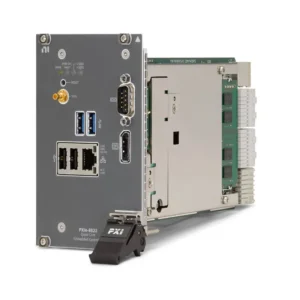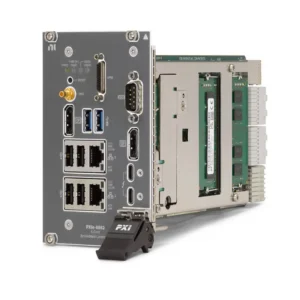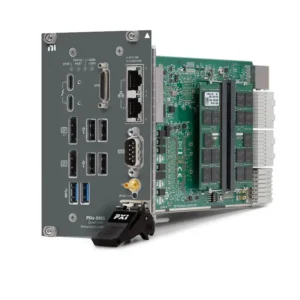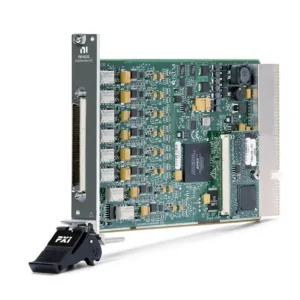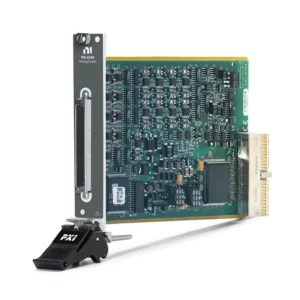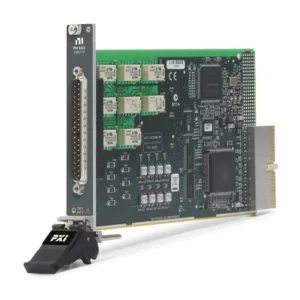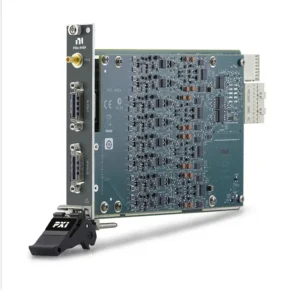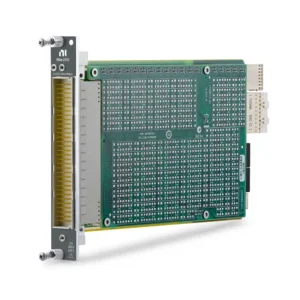




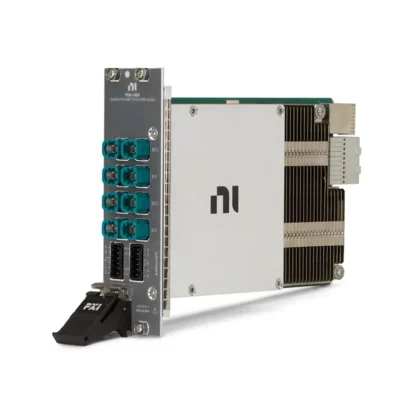
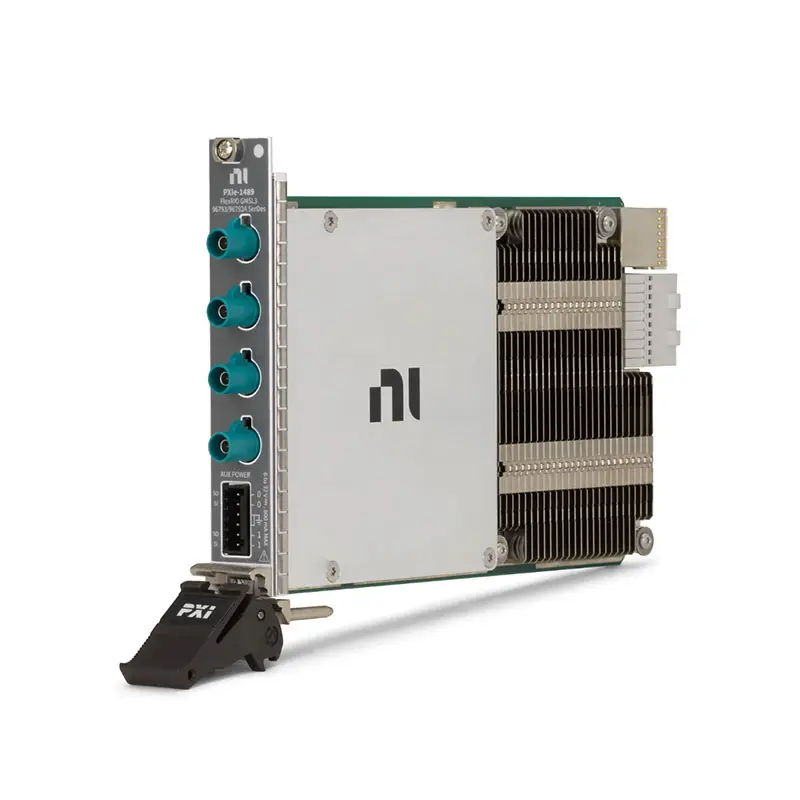
PXIe-1489 4-Channel GMSL3 PXI FlexRIO Automotive Camera Module
Земля PXIe-1489 is a four-channel PXI Express FlexRIO GMSL3 interface module designed for testing automotive cameras, electronic control units and advanced driver assistance systems. It combines GMSL3 serializers or deserializers with a user-programmable Xilinx Kintex UltraScale+ KU11P FPGA.
Three hardware variants are available: four GMSL3 inputs, four GMSL3 outputs or two inputs with two outputs. This selection allows engineers to configure the module for camera capture, ECU video injection, bidirectional testing, in-vehicle data logging, laboratory playback and hardware-in-the-loop validation.
Key Features of the PXIe-1489
- Four-channel GMSL3 automotive camera interface
- Available with 4 inputs, 4 outputs or 2 inputs and 2 outputs
- MAX96792A deserializer on input configurations
- MAX96793 serializer on output configurations
- Supports GMSL3 Pixel Mode tunneling
- User-programmable Xilinx Kintex UltraScale+ KU11P FPGA
- 298,560 FPGA lookup tables
- 2,928 DSP48 slices
- 21 Mb embedded block RAM
- 22 Mb embedded UltraRAM
- 4 GB onboard DRAM
- PCI Express Gen 3 ×8 host interface
- Up to 60 DMA channels
- Power-over-coax control and monitoring
- I²C back-channel communication
- GPIO back-channel communication
- PXI timing and synchronization resources
- FlexRIO driver and LabVIEW FPGA example support
- Suitable for ADAS, autonomous-driving and ECU validation
PXIe-1489 Models and Part Numbers
| Part Number | Конфигурация | Serializer | Deserializer | Primary Application |
|---|---|---|---|---|
| 788355-01 | 4 GMSL3 inputs | Not included | MAX96792A | Automotive camera capture and data logging |
| 788356-01 | 2 GMSL3 inputs and 2 GMSL3 outputs | MAX96793 | MAX96792A | Combined capture, playback and bidirectional testing |
| 788357-01 | 4 GMSL3 outputs | MAX96793 | Not included | Camera emulation, video injection and ECU testing |
Verify the required input and output direction before ordering. The three PXIe-1489 part numbers use different serializer and deserializer hardware and cannot be treated as identical configurations.
PXIe-1489 Technical Specifications
| Product Model | PXIe-1489 |
|---|---|
| Product Type | PXI FlexRIO automotive camera interface module |
| Automotive Video Interface | GMSL3 |
| Number of GMSL Channels | 4 |
| Available Channel Configurations | 4 input, 4 output or 2 input/2 output |
| Supported GMSL Mode | Pixel Mode tunneling |
| Input Deserializer | Analog Devices MAX96792A |
| Output Serializer | Analog Devices MAX96793 |
| ФПГА | Xilinx Kintex UltraScale+ KU11P |
| FPGA Lookup Tables | 298,560 |
| DSP48 Slices | 2,928 |
| Embedded Block RAM | 21 Mb |
| Embedded UltraRAM | 22 Mb |
| Onboard DRAM | 4 GB, two banks of 2 GB |
| Physical DRAM Bus Width | 32 bit |
| LabVIEW FPGA DRAM Bus Width | 256 bit per bank |
| Maximum Theoretical DRAM Data Rate | 17 GB/s total, 8.5 GB/s per bank |
| Host Interface | PCI Express Gen 3 ×8 |
| Data Transfer Methods | DMA, interrupts and programmed I/O |
| Maximum Number of DMA Channels | 60 |
| Timebase Reference | 100 MHz PXI Express system clock |
| Back-Channel Communication | I²C and GPIO control |
| Camera Power Support | Power over coax with control and monitoring |
| Auxiliary Power Connector | 6-pin, 2.5 mm-pitch Omnimate connector |
| Шинный интерфейс | PXI Express |
| Module Width | One PXI Express slot |
| Module Format | 3U PXI Express |
| Dimensions | 21.6 cm × 2.0 cm × 13.0 cm |
| Weight | Approximately 472 g |
| Operating Temperature | 0°C to 55°C |
| Reconfigurable | Да |
PXIe-1489 Included Items
| Item | Описание |
|---|---|
| PXIe-1489 Module | Selected 4-input, 4-output or 2-input/2-output GMSL3 hardware configuration |
| Auxiliary Power Plug | 6-pin, 2.5 mm-pitch Omnimate female plug for the AUX power connection |
| Documentation | Safety, environmental and regulatory documentation |
Automotive coaxial camera cables are application-specific and should be selected according to the camera or ECU connector, GMSL generation, cable impedance, channel direction and power-over-coax requirements.
Four-Channel GMSL3 Architecture
The PXIe-1489 provides four GMSL3 channels in a single PXI Express slot. Depending on the selected part number, the channels can receive video from automotive cameras, transmit simulated camera data to an ECU or provide two channels in each direction.
Multiple modules can be installed in one PXI Express system when an application requires additional camera channels. The PXI platform allows these interfaces to operate alongside CAN, automotive Ethernet, data acquisition, fault insertion and RF instrumentation.
PXIe-1489 Four-Input Configuration
Part number 788355-01 provides four GMSL3 inputs using MAX96792A deserializer hardware. It receives serialized camera streams and converts them into data that can be processed by the onboard FPGA and transferred to the host system.
This configuration is intended for automotive camera acquisition, in-vehicle data logging, sensor characterization and applications that need to capture as many as four GMSL3 video streams.
PXIe-1489 Four-Output Configuration
Part number 788357-01 provides four GMSL3 outputs using MAX96793 serializer hardware. It can transmit camera-format data toward an ECU, domain controller or other GMSL3 receiver.
The four-output model is suitable for laboratory playback, camera emulation and hardware-in-the-loop testing where prerecorded or generated image data must be injected into an automotive controller.
PXIe-1489 Two-Input and Two-Output Configuration
Part number 788356-01 combines two MAX96792A deserializer inputs with two MAX96793 serializer outputs. It supports applications that require video capture and transmission from the same PXI Express module.
This configuration is useful for bidirectional validation, gateway testing, video processing development and systems that must receive one set of camera streams while transmitting another set to an ECU.
GMSL3 Pixel Mode Tunneling
The PXIe-1489 supports GMSL3 Pixel Mode tunneling. The serializer and deserializer hardware transports video data and associated control information through high-speed automotive serial links.
Compatibility depends on the complete camera or ECU configuration, including serializer and deserializer pairing, pixel format, link parameters, back-channel settings and cable characteristics. Confirm these requirements before selecting the module.
Xilinx Kintex UltraScale+ KU11P FPGA
The user-programmable KU11P FPGA allows engineers to customize image handling, protocol control, triggering and data-processing behavior. FPGA processing can operate close to the GMSL interface without continuously transferring every intermediate operation to the host processor.
Possible FPGA functions include video-pattern generation, metadata handling, data filtering, image preprocessing, custom triggering and deterministic manipulation of camera streams.
4 GB Onboard DRAM
The PXIe-1489 includes 4 GB of onboard DRAM divided into two 2 GB banks. The memory can buffer high-throughput video data and support FPGA-based acquisition, playback and image-processing applications.
The maximum theoretical DRAM transfer rate is 17 GB/s across both banks. Actual application performance depends on FPGA design, memory-access patterns, image format and data-transfer configuration.
PCI Express Gen 3 ×8 Data Transfer
A PCI Express Gen 3 ×8 interface provides high-throughput communication between the PXIe-1489 and the PXI Express host controller. The module supports DMA, interrupts and programmed I/O.
Up to 60 DMA channels are available for transferring data between the FPGA and host memory. Actual throughput depends on the chassis, controller, software architecture and other modules sharing the PCI Express fabric.
Power over Coax Support
The PXIe-1489 supports power-over-coax control and monitoring, allowing compatible automotive cameras or connected devices to receive operating power through the same coaxial connection used for GMSL communication.
Camera voltage, current demand, startup behavior and protection requirements must be verified before enabling PoC. The FlexRIO driver and LabVIEW FPGA examples provide access to relevant power-control functions.
Internal and External Camera Power
Camera power can be supplied from the PXI system within the supported internal power budget or from a user-provided external supply through the auxiliary power connection. External power is useful for devices requiring voltage or current beyond the internal supply arrangement.
When using an external supply, confirm polarity, voltage, current limit, grounding and the correct auxiliary connector wiring before connecting a camera or ECU.
I²C Back-Channel Communication
The module supports I²C communication through the GMSL back channel. Test software or FPGA logic can use this interface to configure compatible serializers, deserializers, camera sensors and related devices.
Correct device addresses, register sequences and link configuration are required. Review the camera and SerDes documentation before writing configuration data because incorrect values can prevent the GMSL link from locking.
GPIO Back-Channel Control
GPIO back-channel communication can carry status, synchronization, reset or other control signals between the test system and connected automotive hardware.
GPIO behavior is application-specific and may depend on serializer and deserializer register configuration. Verify the voltage, direction and signal mapping required by the camera or ECU.
Automotive Camera Capture
The deserializer version can acquire GMSL3 streams from as many as four automotive cameras. Captured data can be processed in the FPGA, buffered in onboard DRAM or transferred to the host for storage and analysis.
This capability supports camera development, image-quality evaluation, sensor verification and the collection of representative driving data for later laboratory playback.
Camera Emulation and Video Injection
The serializer version can emulate GMSL3 camera outputs for testing ECUs and perception controllers. Recorded or generated image sequences can be transmitted through the same type of serial interface used by the production camera.
Camera emulation allows engineers to reproduce driving scenarios, corner cases and fault conditions in a controlled laboratory environment without requiring a complete vehicle or physical camera array.
In-Vehicle Data Logging
The PXIe-1489 can form part of a vehicle-based data-logging system that records video from GMSL3 cameras. Multiple input modules can be combined when more than four camera channels are required.
The storage system must provide sufficient sustained throughput and capacity for the selected image resolution, frame rate, pixel format, number of channels and recording duration.
Laboratory Playback
Captured camera streams can be reproduced in a laboratory using an output-configured PXIe-1489. Playback enables engineers to repeat identical image sequences when validating perception software and ECU behavior.
Repeatable data helps compare software versions, investigate defects and test difficult conditions that are expensive or unsafe to reproduce on public roads.
Hardware-in-the-Loop Testing
The PXIe-1489 is suitable for ADAS and autonomous-driving HIL systems. GMSL3 video streams can be coordinated with simulated vehicle dynamics, CAN communication, automotive Ethernet, sensor signals and fault insertion hardware.
PXI timing resources and FPGA processing allow camera data and other test events to be synchronized at deterministic points within the validation sequence.
ADAS ECU Validation
Camera-processing ECUs can be tested using controlled GMSL3 input streams. Engineers can verify image reception, link diagnostics, startup behavior, frame processing and responses to abnormal or missing data.
The complete system can combine video injection with power cycling, network communication and electrical fault simulation to evaluate ECU behavior under realistic operating conditions.
FPGA-Based Image Processing
LabVIEW FPGA can be used to implement custom processing close to the camera interface. Depending on the application, the FPGA can inspect metadata, manipulate pixels, generate patterns, detect events or route selected data to the host.
FPGA resource usage and attainable throughput depend on the selected image format and processing algorithm. Designs should be validated against the required channel count, frame rate and latency.
FlexRIO Driver Support
The PXIe-1489 uses the NI FlexRIO driver. The driver provides host communication, device configuration and access to supported hardware functions.
NI includes LabVIEW FPGA examples that demonstrate control of GMSL channels, power over coax, I²C back-channel communication and GPIO operations. These examples can serve as a starting point for application-specific development.
LabVIEW FPGA Integration
LabVIEW FPGA allows developers to customize the KU11P FPGA without managing the hardware only through fixed-function software commands. Applications can implement deterministic state machines, image pipelines, triggers and data-movement logic.
Development requires a compatible LabVIEW FPGA environment, FlexRIO software and the appropriate FPGA compilation workflow. Confirm software-version compatibility before configuring a new test system.
PXI Timing and Synchronization
The PXIe-1489 can use the PXI Express 100 MHz system reference clock as an FPGA timebase reference. Other PXI timing and triggering resources can coordinate the camera interface with instruments in the same chassis.
Synchronization is important when video must align with vehicle-network messages, analog sensor signals, actuator events or real-time simulation data.
Typical PXIe-1489 Applications
- ADAS camera sensor testing
- Autonomous-driving system validation
- GMSL3 camera acquisition
- Automotive ECU video injection
- Camera emulation
- In-vehicle video data logging
- Laboratory video playback
- Hardware-in-the-loop testing
- Camera sensor characterization
- Perception-algorithm validation
- Video gateway development
- Automotive controller regression testing
- FPGA-based image processing
- Multichannel camera synchronization
PXIe-1489 Troubleshooting
The PXIe-1489 is not detected in NI MAX
Confirm that the module is fully installed in a compatible PXI Express slot. Check chassis power, controller communication and FlexRIO driver installation, then restart the system and rescan the hardware.
The GMSL3 link does not lock
Verify that the connected camera or ECU uses a compatible GMSL3 serializer or deserializer. Check the coaxial cable, connector, link configuration, reference clock and SerDes register settings.
No video frames are received
Confirm that the GMSL link is locked and the camera is powered. Check the pixel format, resolution, frame timing, virtual-channel configuration and FPGA image-processing design.
The camera does not power on
Verify the PoC configuration, selected voltage, current limit and auxiliary power wiring. Confirm that the connected camera’s startup current does not exceed the available power budget.
I²C communication fails
Check the device address, back-channel rate, serializer and deserializer configuration and required register sequence. Confirm that the GMSL link supports the intended back-channel operation.
Video contains corrupted or incomplete frames
Inspect the coaxial cable and connectors, then check link errors, image format, FPGA timing and host data-transfer throughput. Test with a shorter known-good cable to isolate signal-integrity problems.
The host cannot sustain the required data rate
Confirm that the module is operating through a PCI Express Gen 3 ×8 connection. Review DMA configuration, host-memory allocation, storage performance and the bandwidth used by other chassis modules.
The FPGA application cannot be loaded
Verify that the bitfile was compiled for the correct PXIe-1489 variant and KU11P target. Check the installed Flex FlexRIO and LabVIEW FPGA versions for compatibility.
Recorded and replayed video are not synchronized
Use PXI timing resources, shared reference clocks and deterministic triggers. Record timestamps and related vehicle-network data using a common time reference.
The wrong channel directions appear in software
Check the PXIe-1489 part number. The 788355-01, 788356-01 and 788357-01 versions have different fixed input and output configurations.
PXIe-1489 Comparison with Automotive Camera Modules
| Модель | Automotive Interface | Primary Use |
|---|---|---|
| PXIe-1489 | GMSL3 | Modern GMSL3 camera capture, playback and HIL testing |
| PXIe-1488 | FPD-Link IV | FPD-Link IV automotive camera and ECU validation |
| PXIe-1487 | GMSL2 | GMSL2 camera acquisition and emulation |
| PXIe-1486 | FPD-Link III | FPD-Link III camera capture and playback |
| PXIe-1477 | Automotive camera interface | Maintaining compatible earlier-generation camera test systems |
PXIe-1489 vs PXIe-1487
The PXIe-1489 is designed for GMSL3 links and uses MAX96793 serializer and MAX96792A deserializer hardware. The PXIe-1487 supports GMSL2 automotive camera interfaces.
Select the module according to the GMSL generation and the exact SerDes devices used by the camera or ECU. GMSL2 and GMSL3 should not be assumed to be interchangeable without verifying the complete link configuration.
PXIe-1489 vs PXIe-1488
The PXIe-1489 supports GMSL3, while the PXIe-1488 is designed for FPD-Link IV. Both provide FPGA-based automotive camera interfacing for capture, playback and HIL applications.
Choose the PXIe-1489 for GMSL3 cameras and controllers. Select the PXIe-1488 when the device uses the Texas Instruments FPD-Link IV ecosystem.
Selecting the Correct PXIe-1489 Variant
Choose part number 788355-01 when the system must receive four GMSL3 camera streams. Choose 788357-01 when four camera streams must be generated and transmitted to an ECU.
Select 788356-01 when the application requires two input and two output channels in the same slot. Before ordering, confirm the number of channels, direction, SerDes pairing, cable type, PoC requirements and software environment.
Recommended Related Products
- PXIe-1488 FPD-Link IV Automotive Camera Interface Module
- PXIe-1487 GMSL2 Automotive Camera Interface Module
- PXIe-1486 FPD-Link III Automotive Camera Interface Module
- PXIe-1477 Automotive Camera Interface Module
- View More NI PXI and PXI Express Modules
Why Choose the PXIe-1489?
- Supports current-generation GMSL3 automotive camera links
- Provides three input and output configurations
- Combines GMSL SerDes hardware with a programmable FPGA
- Supports camera capture and ECU video injection
- Provides 4 GB of onboard DRAM
- Uses a PCI Express Gen 3 ×8 host interface
- Supports power over coax and back-channel communication
- Integrates camera data with PXI timing and instrumentation
- Supports in-vehicle logging, laboratory playback and HIL testing
Frequently Asked Questions
What is the PXIe-1489?
The PXIe-1489 is a four-channel PXI FlexRIO GMSL3 interface module for automotive camera capture, playback, emulation and ECU testing.
How many PXIe-1489 versions are available?
Three versions are available: four inputs, four outputs and two inputs with two outputs.
What is the part number for the four-input version?
The four-input MAX96792A deserializer version is part number 788355-01.
What is the part number for the two-input/two-output version?
The combined MAX96793 and MAX96792A SerDes version is part number 788356-01.
What is the part number for the four-output version?
The four-output MAX96793 serializer version is part number 788357-01.
Which GMSL generation does the module support?
The PXIe-1489 is designed for GMSL3 links and supports Pixel Mode tunneling.
Which FPGA does the PXIe-1489 use?
The module uses a user-programmable Xilinx Kintex UltraScale+ KU11P FPGA.
How much onboard memory is available?
The PXIe-1489 provides 4 GB of onboard DRAM divided into two 2 GB banks.
Does the PXIe-1489 support power over coax?
Yes. It provides PoC control and monitoring for compatible automotive cameras and serial devices.
Does it support I²C back-channel communication?
Yes. The FlexRIO driver and FPGA examples provide access to I²C and GPIO back-channel communication.
Can the PXIe-1489 emulate automotive cameras?
Yes. An output-configured module can transmit recorded or generated GMSL3 camera streams to an ECU or perception controller.
Can it record camera video?
Yes. An input-configured module can receive GMSL3 camera streams for processing, host transfer and data logging.
Can several PXIe-1489 modules operate together?
Yes. Multiple modules can be installed in a compatible PXI Express system when more than four GMSL3 channels are required.
Which software is required?
The module uses the NI FlexRIO driver and can be customized with LabVIEW FPGA. The exact supported versions should be checked before system installation.
Does the module include automotive coaxial cables?
The standard included items list the module and auxiliary-power plug. Camera cables must be selected separately according to the connected camera or ECU.
Request a Quote for the PXIe-1489
Contact us for current availability, lead time and project pricing for the PXIe-1489 4-Channel GMSL3 PXI FlexRIO Automotive Camera Module. Please provide the required part number, input and output channel configuration, camera or ECU model, SerDes devices and cable requirements so we can confirm the correct hardware for your ADAS test system.