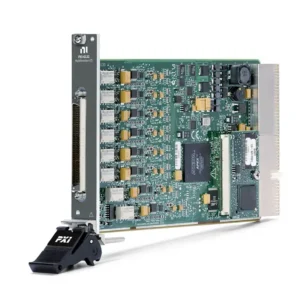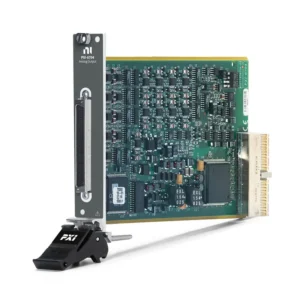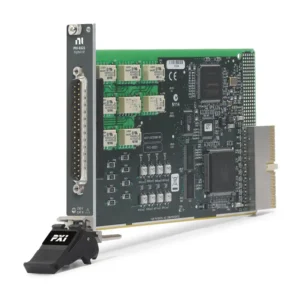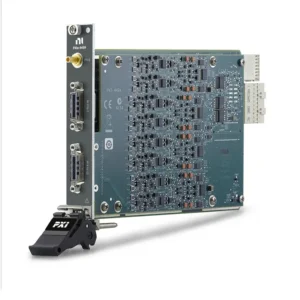


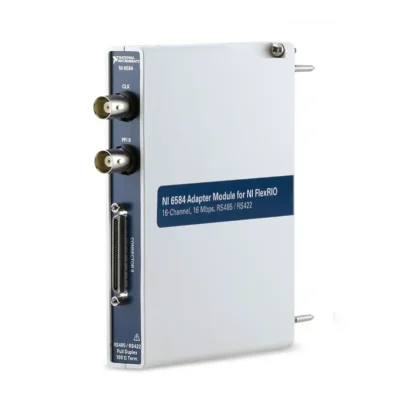
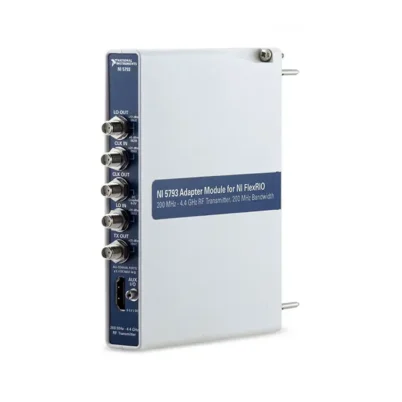
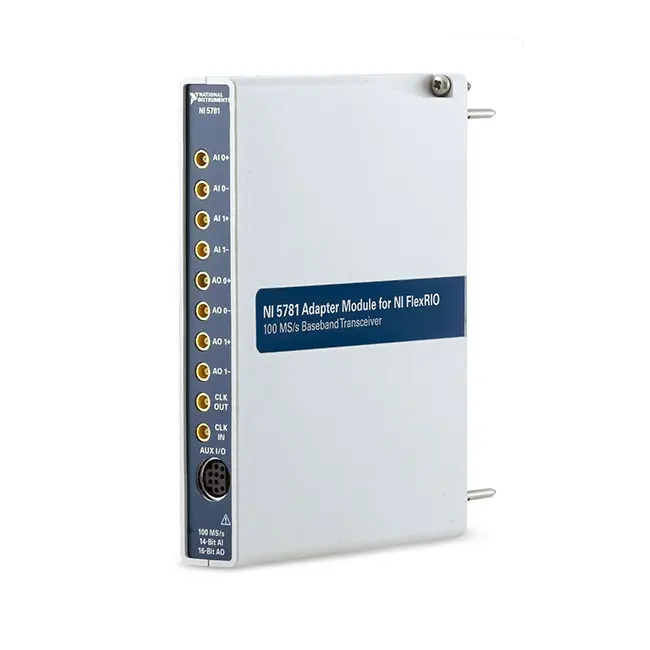
NI-5781 Baseband Transceiver Adapter Module for FlexRIO
Земля NI-5781 is a baseband transceiver adapter module designed for use with compatible NI FlexRIO FPGA modules. It combines two simultaneously sampled analog input channels with two analog output channels, enabling high-speed signal acquisition and waveform generation through a single FPGA-connected adapter.
The analog input channels use 14-bit analog-to-digital converters operating at up to 100 MS/s, while the analog outputs use 16-bit digital-to-analog converters with update rates up to 100 MS/s. Its approximately 40 MHz analog bandwidth supports baseband communication, custom signal processing and low-latency closed-loop control applications.
Key Features of the NI-5781
- Two analog input channels
- Two analog output channels
- 14-bit analog input resolution
- 16-bit analog output resolution
- 100 MS/s analog input sampling rate
- 100 MS/s analog output update rate
- 40 MHz analog bandwidth
- Simultaneous dual-channel analog acquisition
- Fixed 100 MHz internal VCXO
- MCX analog signal connectors
- 50 Ω input and output architecture
- FPGA-based real-time signal processing
- Suitable for baseband communication experiments
- Compatible with selected NI FlexRIO FPGA modules
NI-5781 Technical Specifications
| Product Model | NI-5781 |
|---|---|
| Product Type | Baseband transceiver adapter module for FlexRIO |
| Analog Input Channels | 2 differential, simultaneously sampled channels |
| Analog Output Channels | 2 channels |
| Analog Input Resolution | 14 bits |
| Analog Output Resolution | 16 bits |
| Maximum Input Sample Rate | 100 MS/s |
| Maximum Output Update Rate | 100 MS/s |
| Analog Bandwidth | Approximately 40 MHz |
| Differential Input Range | 2 Vpk-pk fixed |
| Single-Ended Input Range | 1 Vpk-pk fixed |
| Input Coupling | DC coupled |
| Input Impedance | 50 Ω |
| Internal Clock | 100 MHz fixed VCXO |
| Analog Connectors | MCX |
| Software | NI-RIO, FlexRIO Adapter Module Support and LabVIEW FPGA |
| Required Hardware | Compatible NI FlexRIO FPGA module |
The NI-5781 is not a standalone digitizer or waveform generator. Its converters and signal connections are controlled through a compatible FlexRIO FPGA module, which provides the programmable logic, host interface and data-transfer resources.
NI-5781 Part Number and Accessories
| Item | Part Number | Описание |
|---|---|---|
| NI-5781 | 781267-01 | Dual-input, dual-output 100 MS/s FlexRIO transceiver adapter |
| FlexRIO FPGA Module | Model dependent | Provides FPGA processing and the PXI host-system interface |
| MCX Signal Cable | Configuration dependent | Connects the analog inputs and outputs to the DUT or RF hardware |
| MCX-to-SMA Adapter Cable | Configuration dependent | Allows connection to commonly used SMA-equipped test hardware |
| Шасси PXI Express | Model dependent | Hosts the selected FlexRIO FPGA module and system controller |
Before ordering, verify the specific FlexRIO FPGA carrier, required MCX cables, signal voltage range and external termination. The adapter’s fixed input ranges must be considered when connecting external amplifiers, converters or RF baseband equipment.
Dual-Channel Analog Input Architecture
The two analog inputs are sampled simultaneously, preserving timing and phase relationships between channels. This architecture is useful for acquiring in-phase and quadrature signals, comparing stimulus and response waveforms or measuring two related control signals.
The 14-bit ADCs use a multistage differential pipeline architecture. Acquired samples can be processed immediately in the FPGA without first passing through a nondeterministic host-software loop.
Dual Analog Outputs
Two 16-bit DAC channels allow the FPGA system to generate baseband stimulus signals at update rates up to 100 MS/s. Output waveforms can be generated from host-supplied data or calculated directly in the FPGA.
Using input and output channels together creates a low-latency stimulus-and-response platform for control, communications and hardware simulation.
40 MHz Baseband Bandwidth
The NI-5781 provides an analog bandwidth of approximately 40 MHz. It can be connected to external RF upconverters and downconverters when a project requires RF-frequency operation beyond the baseband range.
Actual system bandwidth and waveform fidelity depend on cables, adapters, impedance matching, external circuitry and FPGA processing.
Реальное время на основе FPGA
The associated FlexRIO FPGA can implement filtering, modulation, demodulation, triggering, feedback control and custom communication functions. Processing data in hardware reduces latency and enables deterministic reactions to acquired signals.
NI-5781 Applications
- Baseband communication testing
- Software-defined radio research
- I/Q waveform acquisition and generation
- Digital modulation and demodulation
- Low-latency closed-loop control
- Custom signal-processing systems
- RF upconverter and downconverter interfacing
- Channel-emulation research
- Hardware-in-the-loop testing
- Electronic device validation
- Radar and communications prototyping
- Laboratory waveform generation and acquisition
Baseband I/Q Testing
The dual-input and dual-output architecture can represent the I and Q paths of a complex signal. FPGA logic can process both channels in parallel for modulation, demodulation and impairment analysis.
Closed-Loop Control
The NI-5781 can acquire a response, process it in the FPGA and generate a corresponding analog output with low and predictable latency. This makes it useful for experimental control and real-time hardware simulation.
Communication-System Prototyping
Researchers can implement custom baseband communication algorithms in FPGA logic and connect the module to external RF conversion hardware. This provides a flexible alternative to fixed-function communication instruments.
NI-5781 Installation Workflow
Step 1: Select a Compatible FlexRIO FPGA Module
Confirm that the selected FPGA carrier supports the NI-5781 and provides sufficient logic, memory and host-streaming bandwidth for the application.
Step 2: Power Down the PXI System
Turn off the chassis before attaching or removing the adapter module. Disconnect external analog signals during hardware installation.
Step 3: Install the Adapter
Attach the NI-5781 to the FlexRIO FPGA module according to the official mechanical installation procedure, then install the complete assembly in the chassis.
Step 4: Connect the Analog Signals
Use correctly rated MCX cables and verify the 50 Ω signal environment. Confirm that the applied input amplitude remains within the fixed range.
Step 5: Configure the LabVIEW FPGA Project
Add the FPGA target and NI-5781 adapter interface to the project. Configure clocks, converter operation and data-transfer resources.
Step 6: Test at a Reduced Signal Level
Apply a known low-amplitude waveform, verify acquisition and then test the output channels before connecting the final DUT.
Step 7: Implement the Processing Algorithm
Add the required filters, waveform generation, triggering or feedback functions and confirm that FPGA timing constraints are met.
NI-5781 Troubleshooting
The NI-5781 is not recognized
Verify that the adapter is correctly attached to a supported FlexRIO FPGA module. Check NI-RIO, FlexRIO Adapter Module Support and LabVIEW FPGA installation.
The acquired waveform is clipped
Check the fixed input range and measure the signal at the module connector. Add attenuation or adjust the external source when the signal exceeds the permitted range.
The waveform contains reflections or distortion
Confirm 50 Ω impedance matching and inspect the MCX cables, adapters and fixture. Avoid unterminated branches and unnecessarily long high-frequency signal paths.
Input and output timing is not aligned
Review the FPGA clock domains, pipeline delay and converter synchronization. Account for filter and data-conversion latency in the control algorithm.
FPGA data cannot stream continuously to the host
Check DMA FIFO size, PXI bandwidth, host processing and storage performance. Implement FPGA-side buffering or processing when the full data stream exceeds host capacity.
NI-5781 Comparison
| Модель | Конфигурация | Best Suited For |
|---|---|---|
| NI-5781 | 2 AI, 2 AO, 100 MS/s, 40 MHz bandwidth | Baseband transceiver and low-latency control applications |
| NI-5782 | High-speed analog transceiver adapter | Applications requiring an alternative bandwidth or converter configuration |
| NI-5783 | Four-channel high-speed analog input and output architecture | Systems requiring additional analog channel density |
| NI-5791 | 200 MHz to 4.4 GHz RF transceiver | Direct RF acquisition and generation |
Recommended Related Products
- NI-5783 FlexRIO Transceiver Adapter
- NI-5791 RF Transceiver Adapter
- PXIe-7962R FlexRIO FPGA Module
- PXIe-7966R FlexRIO FPGA Module
- View More NI PXI and FlexRIO Modules
Frequently Asked Questions
What is the NI-5781?
The NI-5781 is a dual-input, dual-output baseband transceiver adapter for compatible NI FlexRIO FPGA modules.
What are its converter resolutions?
The analog inputs use 14-bit ADCs, while the analog outputs use 16-bit DACs.
What is the maximum sampling rate?
The maximum input sampling and output update rates are 100 MS/s.
Can the NI-5781 directly acquire a 2 GHz RF signal?
No. It is a baseband adapter with approximately 40 MHz analog bandwidth. External RF conversion hardware is required for higher-frequency carrier signals.
Is an FPGA module included?
The NI-5781 is normally identified as the adapter module only. A compatible FlexRIO FPGA carrier must be selected separately unless the offered configuration explicitly includes one.
What is the NI-5781 part number?
The standard ordering part number is 781267-01.
Request a Quote for the NI-5781
Contact us for availability, lead time and pricing for the NI-5781 Baseband Transceiver Adapter Module. We can also help verify the compatible FlexRIO FPGA carrier, PXI chassis and MCX cable configuration.