



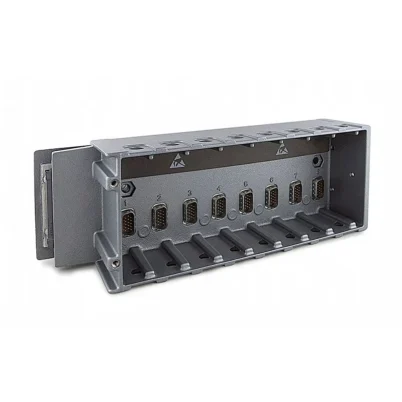
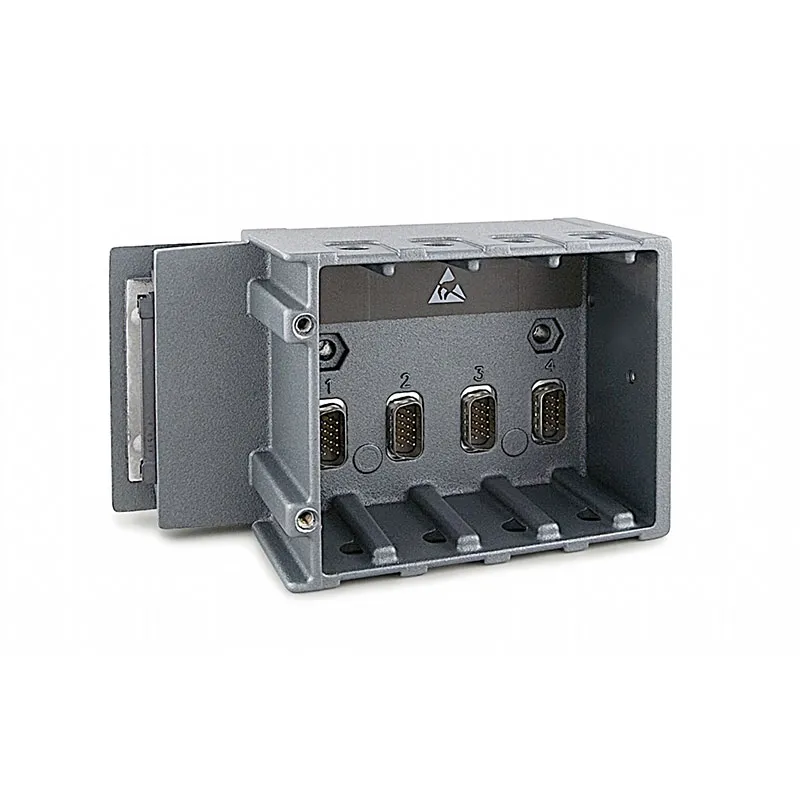
cRIO-9111 4-Slot CompactRIO Reconfigurable Chassis
Земля cRIO-9111 is a four-slot CompactRIO reconfigurable embedded chassis designed for deterministic measurement and control applications. It connects a compatible legacy CompactRIO real-time controller to as many as four C Series I/O modules.
A Xilinx Virtex-5 LX30 FPGA in the chassis backplane provides direct hardware access to installed I/O modules. Engineers can use LabVIEW FPGA to implement custom timing, signal processing, triggering, digital protocols and closed-loop control.
Key Features of the cRIO-9111
- Four C Series I/O slots
- Xilinx Virtex-5 LX30 FPGA
- 40 MHz default FPGA clock
- 25 ns FPGA clock period
- LabVIEW FPGA Interface mode
- CompactRIO Scan Interface support
- Direct FPGA access to C Series I/O
- Compact footprint for smaller embedded systems
- Compatible with selected legacy CompactRIO controllers
- -40°C to 70°C operating range
- DIN-rail and panel-mounting options
- Rugged shock and vibration construction
- Suitable for distributed industrial deployment
cRIO-9111 Technical Specifications
| Product Model | cRIO-9111 |
|---|---|
| Product Type | CompactRIO reconfigurable embedded chassis |
| Number of C Series Slots | 4 |
| ФПГА | Xilinx Virtex-5 LX30 |
| FPGA Block RAM | 1,152 kbits |
| Default FPGA Clock | 40 MHz |
| FPGA Clock Period | 25 ns |
| I/O Interface Modes | LabVIEW FPGA Interface and Scan Interface |
| Supported I/O | Compatible NI C Series modules |
| Controller Requirement | Compatible legacy CompactRIO real-time controller |
| Operating Temperature | -40°C to 70°C |
| Storage Temperature | -40°C to 85°C |
| Mounting | Panel or DIN rail with appropriate accessories |
| Software | LabVIEW, LabVIEW Real-Time, LabVIEW FPGA and NI-RIO |
| Product Status | Legacy/discontinued CompactRIO platform |
The cRIO-9111 is not an integrated CompactRIO controller. It does not independently provide the processor, storage, Ethernet, serial or USB interfaces normally found on the attached real-time controller.
cRIO-9111 Part Number and Accessories
| Item | Part Number | Описание |
|---|---|---|
| cRIO-9111 | 780915-01 | Four-slot Virtex-5 LX30 CompactRIO chassis |
| Compatible CompactRIO Controller | Model dependent | Provides the real-time processor and communication interfaces |
| C Series I/O Modules | Model dependent | Provide analog, digital, sensor or communication functions |
| DIN-Rail Mounting Kit | Configuration dependent | Mounts the complete CompactRIO assembly on a DIN rail |
| Panel-Mounting Kit | Configuration dependent | Secures the system to a flat equipment panel |
| Industrial DC Power Supply | System dependent | Powers the connected CompactRIO controller and chassis assembly |
Before ordering a replacement chassis, compare the controller connector, FPGA requirements, software version and module compatibility. Newer integrated CompactRIO controllers do not necessarily replace a cRIO-9111 without application and wiring changes.
Compact Four-Slot Architecture
The four-slot design is suited to applications that need a focused set of I/O functions. For example, a system can combine analog input, analog output, digital I/O and communication modules in a compact embedded assembly.
If future expansion is expected to exceed four modules, an eight-slot chassis such as the cRIO-9114 may provide a more suitable legacy configuration.
Virtex-5 LX30 FPGA Processing
The FPGA operates independently from the real-time processor and can execute multiple functions in parallel. It is suited to deterministic tasks such as event capture, encoder processing, pulse generation and hardware interlocking.
The LX30 has fewer logic resources than the LX50 device used by the cRIO-9114. Complex FPGA applications should be evaluated for logic, memory and timing utilization before the chassis is selected.
Deterministic I/O Control
LabVIEW FPGA Interface mode allows the developer to define how and when the system communicates with C Series modules. Hardware-timed control can continue even if the real-time processor is handling networking or file operations.
Scan Interface Operation
Scan Interface mode automatically updates supported I/O values and exposes them to the real-time application as variables. It reduces development effort for monitoring and control loops that do not need specialized FPGA behavior.
cRIO-9111 Applications
- Compact industrial control systems
- Distributed sensor monitoring
- Machine-condition monitoring
- Small data-logging systems
- Embedded laboratory automation
- Motor and actuator control
- Renewable-energy monitoring
- Remote equipment diagnostics
- Custom digital protocol implementation
- Hardware-in-the-loop testing
- Mobile and field measurement systems
- Research and educational control projects
Compact Machine Control
The four-slot chassis can host the analog and digital modules required for smaller machine-control systems while the FPGA manages deterministic timing and safety-related interlocks.
Remote Monitoring
A connected real-time controller can process and transmit measurements collected through the chassis. The rugged temperature rating supports deployment outside conventional laboratory environments.
Custom Timing and Triggering
The FPGA can detect input events and generate output actions with deterministic timing. This capability is useful for test sequencing, synchronization and specialized measurement systems.
cRIO-9111 Installation Workflow
Step 1: Check Controller Compatibility
Verify that the selected modular CompactRIO controller supports the cRIO-9111 hardware and required NI-RIO software version.
Step 2: Join the Controller and Chassis
Power down the system and connect the controller to the chassis using the documented mechanical procedure.
Step 3: Mount the System
Install the combined assembly on a DIN rail or equipment panel with the appropriate mounting kit and required ventilation clearance.
Step 4: Install C Series Modules
Insert the required modules into slots 1 through 4 and secure their retaining screws.
Step 5: Connect Field Wiring
Follow each C Series module’s pinout, isolation and safety instructions. Keep sensitive measurement wiring separated from high-current conductors.
Step 6: Configure the Controller
Use NI MAX to configure the controller, network connection and software environment.
Step 7: Add the Chassis and Modules
Create a LabVIEW project containing the controller, cRIO-9111 and the correct module assignments.
Step 8: Select Scan or FPGA Interface
Choose the interface mode based on the required control rate, timing and customization.
Step 9: Validate Each Channel
Test the installed modules with known signals before deploying the complete embedded application.
cRIO-9111 Troubleshooting
The chassis is not recognized
Check the physical connection between the controller and chassis. Verify controller support and install the appropriate NI-RIO driver.
A module appears in the wrong slot
Compare the physical module arrangement with the LabVIEW project. Remove incorrect offline module definitions and rediscover the hardware when necessary.
The FPGA VI does not compile
Review resource utilization and timing errors. The Virtex-5 LX30 may require a smaller or more efficient FPGA design than higher-capacity chassis models.
The I/O update rate is too slow
Determine whether the application is using Scan Interface. Move time-critical processing to a LabVIEW FPGA design when the scan rate is insufficient.
The system cannot deploy after a software upgrade
Check compatibility between LabVIEW, LabVIEW Real-Time, LabVIEW FPGA, NI-RIO, the controller and the legacy chassis. Older systems may require a matched software generation.
The chassis overheats inside an enclosure
Verify cabinet temperature, ventilation and equipment spacing. Do not assume the -40°C to 70°C device rating applies when installation requirements are not met.
cRIO-9111 Comparison
| Модель | FPGA and Slots | Best Suited For |
|---|---|---|
| cRIO-9111 | Virtex-5 LX30, 4 slots | Compact legacy systems with moderate FPGA requirements |
| cRIO-9112 | Virtex-5 LX30, 8 slots | More I/O slots with similar FPGA capacity |
| cRIO-9113 | Virtex-5 LX50, 4 slots | Compact systems requiring additional FPGA resources |
| cRIO-9114 | Virtex-5 LX50, 8 slots | Expanded I/O and larger FPGA applications |
| Modern Integrated cRIO | Integrated processor and FPGA | New designs requiring current software and hardware support |
Recommended Related Products
- cRIO-9114 8-Slot FPGA Chassis
- cRIO-9111 4-Slot FPGA Chassis
- NI-9251 Analog Input Module
- NI-9852 CAN Interface Module
- View More NI CompactRIO Products
- View More NI C Series Modules
Frequently Asked Questions
What is the cRIO-9111?
The cRIO-9111 is a four-slot CompactRIO reconfigurable chassis containing a Xilinx Virtex-5 LX30 FPGA.
Is the cRIO-9111 a CompactRIO controller?
No. It is a separate FPGA chassis that must be connected to a compatible modular CompactRIO real-time controller.
How many C Series modules can it hold?
The cRIO-9111 provides four C Series I/O slots.
Does it support LabVIEW FPGA?
Yes. Its Virtex-5 LX30 FPGA can be programmed using a compatible LabVIEW FPGA and NI-RIO software environment.
Can the chassis operate in Scan Interface mode?
Yes. Supported C Series modules can be accessed through Scan Interface mode when used with a compatible controller and software configuration.
What is the difference between the cRIO-9111 and cRIO-9114?
The cRIO-9111 has four slots and a Virtex-5 LX30 FPGA. The cRIO-9114 has eight slots and a larger Virtex-5 LX50 FPGA.
What is the cRIO-9111 part number?
The standard ordering part number is 780915-01.
Request a Quote for the cRIO-9111
Contact us for current availability and pricing for the cRIO-9111 4-Slot CompactRIO FPGA Chassis. We can also help verify the controller, C Series modules, mounting hardware and legacy software compatibility.