






Quick Answer: PXI is a modular, PC-based test and measurement platform that combines a chassis, controller, instrument modules, timing resources, drivers, and application software. It is widely used for automated testing, data acquisition, RF validation, semiconductor test, electronic verification, aerospace, automotive, and industrial measurement. This guide answers the most common questions about PXI and PXI Express systems, including architecture, compatibility, bandwidth, software, synchronization, selection, and purchasing.
Basic Questions About PXI
1. What does PXI stand for?
PXI stands for PCI eXtensions for Instrumentation. It is an open modular instrumentation standard based on PC bus technology and the rugged CompactPCI mechanical form factor. PXI adds test-specific timing, triggering, synchronization, environmental, and software requirements.
2. What is a PXI system?
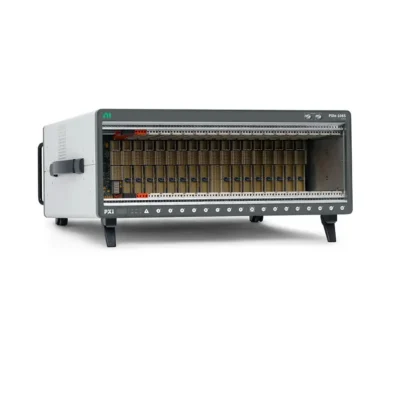
A PXI system is a modular test platform consisting of a PXI or PXIe chassis, an embedded or remote controller, instrument modules, drivers, and test software. Users select the components needed to build a custom measurement or automated test system.
3. Who developed the PXI standard?
National Instruments introduced the PXI platform in the 1990s. The PXI Systems Alliance, an industry consortium, now maintains and promotes the specifications to support interoperability among compliant products from multiple manufacturers.
4. Is PXI a product or an industry standard?
PXI is an industry standard rather than one individual product. Multiple manufacturers offer PXI chassis, controllers, instruments, switches, timing modules, and software. Compatibility still needs to be checked because not every module exposes the same drivers, functions, connectors, or timing resources.
5. What is PXI used for?
PXI is used for automated functional test, high-channel-count data acquisition, electronic validation, RF and wireless test, semiconductor test, hardware-in-the-loop systems, production testing, aerospace and defense validation, automotive electronics, research, and industrial monitoring.
6. Why do engineers use PXI instead of separate instruments?
PXI provides a compact, software-controlled platform with high channel density, integrated timing, fast data transfer, centralized control, and flexible expansion. It can replace multiple benchtop instruments in repetitive, synchronized, or highly automated test systems.
7. Is PXI only for automated testing?
No. Automation is a major strength, but PXI can also be used for laboratory measurement, design validation, data recording, research, prototyping, and interactive troubleshooting. Software front panels can provide manual control when needed.
8. Is PXI suitable for production environments?
Yes. PXI systems are frequently used in production because they can reduce test time, standardize procedures, log results, and scale across multiple test stations. The chassis, cooling, fixture, cable, software, and maintenance plan should be designed for the intended duty cycle.
PXI vs. PXIe Questions
9. What is PXIe?
PXIe, or PXI Express, is the PCI Express-based evolution of PXI. It replaces the primary parallel PCI data architecture with high-speed point-to-point PCI Express links while retaining and expanding the timing and synchronization features required by modular instruments.
10. What is the main difference between PXI and PXIe?
The main difference is the data bus. Traditional PXI uses parallel PCI, while PXIe uses PCI Express lanes and switches. PXIe also adds a 100 MHz differential reference clock and differential star-trigger connections for higher-performance synchronization.
11. Is PXIe always better than PXI?
Not for every application. PXIe offers higher bandwidth and advanced timing, making it preferable for digitizers, RF instruments, FPGA modules, and intensive streaming. Traditional PXI may still be sufficient for switches, digital multimeters, serial interfaces, relays, and other low-data-rate functions.
12. Is PXIe backward compatible with PXI?
PXIe chassis can support compatible PXI modules when they include suitable hybrid-compatible or PXI peripheral slots. Compatibility depends on the physical connector, electrical interface, chassis slot, power, cooling, driver, and operating system.
13. Can a PXIe module work in a traditional PXI chassis?
No. A PXIe module requires PCI Express connectors and signaling that a traditional PXI-only backplane does not provide.
14. Can a traditional PXI module work in any PXIe slot?
No. It requires a compatible hybrid or PXI slot. A PXIe-only peripheral slot does not provide the parallel PCI interface needed by a PXI module. Some older PXI modules also have connector features that prevent insertion into a hybrid slot.
| Функция | PXI | PXIe |
|---|---|---|
| Primary bus | Parallel PCI | PCI Express |
| Пропускная способность | Suitable for moderate data rates | Higher per-slot and system bandwidth |
| Reference clock | 10 MHz PXI clock | Retains 10 MHz and adds 100 MHz differential clock |
| Advanced triggering | Trigger bus and PXI Star | Retains PXI resources and adds differential star |
| Typical applications | DMM, switching, I/O, interfaces | RF, digitizers, FPGA, high-speed streaming |
PXI System Component Questions
15. What are the main components of a PXI system?
The main components are a chassis, controller, instrument modules, software drivers, application or test-management software, and required accessories such as terminal blocks, cables, adapters, fixtures, and synchronization connections.
16. What does the PXI chassis do?
Земля Шасси PXI houses the modules and provides the backplane, power supply, cooling, data bus, clocks, trigger lines, and mechanical support. Chassis differ in slot count, slot type, bandwidth, power, cooling, noise, and timing features.
17. What does a PXI controller do?
Земля PXI controller runs the operating system, drivers, and application software. It communicates with the modules through the chassis backplane and manages data processing, storage, network access, and user interfaces.
18. What types of PXI controllers are available?
A system can use an embedded controller installed in the chassis or a remote controller that connects the chassis to an external desktop, workstation, server, or laptop through a supported interface such as MXI-Express or another vendor-defined connection.
19. Does every PXI system need an embedded controller?
No. An embedded controller is convenient and compact, but remote control may provide more processing power, easier maintenance, or access to specialized computer hardware. The chassis and remote interface must be compatible.
20. What is a PXI module?
A PXI module is a plug-in instrument or interface card designed for a PXI chassis. Examples include oscilloscopes, digitizers, DMMs, signal generators, SMUs, switches, DAQ modules, FPGA devices, RF instruments, digital I/O, CAN, LIN, Ethernet, and serial interfaces.
21. What is the PXI backplane?
Земля PXI backplane is the internal electrical infrastructure behind the chassis slots. It distributes power, carries PCI or PCI Express data, and provides shared clocks and trigger signals between the controller and modules.
22. What is the system controller slot?
It is the designated chassis position for an embedded controller or compatible remote-control interface. It connects the host system to the backplane bus and normally occupies the leftmost controller area.
23. What is the system timing slot?
The system timing slot provides dedicated access to the chassis clock and star-trigger resources. A compatible timing module can distribute precise clocks, synchronize modules, timestamp events, or connect the chassis to external time references.
24. What is a hybrid-compatible slot?
A hybrid-compatible slot is designed to accept PXIe modules and compatible PXI hybrid modules. It helps users combine newer PXIe instruments with selected legacy PXI hardware in one chassis.
Compatibility and Configuration Questions
25. How do I know whether a module fits a chassis?
Check the module bus type, connector, form factor, slot width, power, cooling, and required slot features against the chassis manual. Physical fit alone is not proof of electrical or software compatibility.
26. Can PXI modules from different manufacturers work together?
Yes, compliant modules can often share the same chassis and controller. Each module may require its own driver and API. Verify operating-system support, software versions, trigger routing, and any vendor-specific requirements.
27. Can CompactPCI cards work in a PXI chassis?
Some CompactPCI and PXI products share mechanical and electrical foundations, but instrumentation signals, software identification, cooling, power, and compatibility requirements differ. Use only combinations explicitly supported by the manufacturers.
28. Can 3U and 6U modules be used together?
Only if the chassis supports the required form factors and slot arrangement. Most modern PXI systems use 3U modules. A 6U module requires a compatible 6U chassis or appropriate configuration.
29. Can one module occupy more than one slot?
Yes. Some high-performance RF, switching, processing, or specialized instruments are wider than one slot. Reserve all required adjacent slots and verify that connectors, cooling, and slot resources are available.
30. How many modules can a PXI chassis hold?
It depends on chassis slot count, controller occupancy, system timing slot use, and module width. Usable capacity may also be limited by compatible slot types, total power, cooling, and bandwidth rather than physical slots alone.
31. Can I install modules in any order?
Not always. High-bandwidth modules may need particular PXIe slots, wide modules require adjacent space, timing modules use the timing slot, and local-bus products may require specific neighboring positions. Review the chassis block diagram and module manuals.
32. What should I check before powering on a PXI system?
- Controller and module slot compatibility
- Modules are fully seated and secured
- Total power and cooling requirements
- External cables and terminal blocks
- Chassis input voltage and grounding
- Driver and operating-system compatibility
- Air inlets and outlets are unobstructed
Compatibility warning: Never force a module into a slot. Similar front-panel dimensions do not guarantee compatible connectors, electrical signaling, power, cooling, or drivers.
Performance, Timing, and Synchronization Questions
33. What determines PXI system bandwidth?
Bandwidth depends on bus generation, per-slot lane width, backplane switch topology, upstream links, controller interface, memory, storage, drivers, and simultaneous traffic. Sustained application throughput is usually lower than the theoretical bus maximum.
34. Does every PXIe slot have the same bandwidth?
No. Different slots may have different PCI Express generations, lane widths, or switch paths. Several slots may share one upstream link. Review the chassis backplane block diagram when planning high-speed streaming.
35. What is PXI timing and synchronization?
PXI timing and synchronization use backplane clocks, hardware triggers, star connections, and timing modules to coordinate instruments. These resources improve timing repeatability and reduce external cabling.
36. What is the PXI Trigger Bus?
Земля PXI Триггерная шина consists of eight shared lines, PXI_TRIG0 through PXI_TRIG7. Modules can use them to exchange start, reference, pause, clock, or handshake signals.
37. What is PXI_CLK10?
PXI_CLK10 is a 10 MHz reference clock distributed through the backplane. Compatible modules can use it to derive or phase-lock their internal timing, reducing frequency drift between devices.
38. What is PXIe_CLK100?
PXIe_CLK100 is a 100 MHz differential reference clock provided by PXI Express. It offers low-skew point-to-point distribution and improved noise immunity for compatible PXIe instruments.
39. What is a PXI Star Trigger?
PXI Star uses dedicated, closely matched point-to-point routes from the system timing slot to peripheral slots. It provides lower slot-to-slot skew than the shared trigger bus.
40. What is PXIe Differential Star?
PXIe Differential Star, or PXIe_DSTAR, provides dedicated differential connections between the system timing slot and compatible peripheral slots. It is designed for high-integrity, low-skew clocks and triggers.
41. Does a shared trigger keep devices synchronized?
A shared trigger aligns the starting event, but devices using independent clocks may drift during acquisition. Long-term synchronization normally requires a common reference or shared sample clock.
42. Can multiple PXI chassis be synchronized?
Yes. Multiple chassis can share external clocks and triggers or use timing modules with technologies such as GPS, IRIG-B, PPS, IEEE 1588, or vendor-specific synchronization links. Accuracy depends on the chosen architecture.
43. What is the difference between skew and jitter?
Skew is the timing difference between channels or devices. Jitter is short-term variation in the timing of repeated clock edges or events. Both can affect phase measurements and high-speed sampling.
44. Why do synchronized modules still show a time offset?
Backplane propagation, cable length, trigger-input delay, sample-clock phase, ADC pipelines, digital filters, and group delay can create offsets. Critical systems should measure and compensate actual end-to-end delay.
PXI Software Questions
45. What software controls PXI instruments?
PXI instruments can be controlled through LabVIEW, TestStand, C/C++, C#, Python, MATLAB, and other environments when compatible drivers or APIs are available. The correct software depends on the module manufacturer and test requirements.
46. Is LabVIEW required for PXI?
No. LabVIEW is widely used because it integrates well with test hardware, but it is not mandatory. Many modules offer C, .NET, Python, IVI, VISA, or other programming interfaces.
47. What is TestStand used for?
TestStand is test-management software used to sequence tests, call code modules, handle limits, log results, manage reports, and control production workflows. It complements instrument drivers and measurement code rather than replacing them.
48. What are PXI drivers?
Drivers provide the software interface between the application and hardware. They expose configuration, measurement, generation, timing, triggering, calibration, and diagnostic functions. Examples include NI-DAQmx, NI-SCOPE, NI-RFSA, NI-RFSG, and vendor-specific IVI drivers.
49. Can Python control PXI modules?
Yes, when the manufacturer provides a Python package, supported C API wrapper, .NET interface, or other compatible method. Confirm feature coverage and supported driver versions because Python support varies by product family.
50. How does the controller recognize installed modules?
The controller enumerates compatible devices through the PCI or PCI Express bus. Platform services and individual instrument drivers then identify, configure, and expose the modules to applications.
51. What is NI MAX?
NI Measurement & Automation Explorer is a configuration utility used to identify hardware, confirm chassis and slot assignments, test devices, create aliases, configure routes, and inspect driver information for supported NI systems.
52. Can PXI run real-time applications?
Yes, supported controllers and software can run real-time operating systems for deterministic control, hardware-in-the-loop testing, and reliable standalone operation. Hardware and driver compatibility must be verified for the selected real-time environment.
53. Can a PXI system run without a monitor?
Yes. An embedded or remote controller can run a startup application and operate headlessly. Remote management, logging, error recovery, and safe shutdown should be designed into unattended systems.
Selection and Purchasing Questions
54. How do I choose a PXI chassis?
Evaluate slot count, slot types, controller compatibility, per-slot and system bandwidth, power, cooling, timing resources, acoustic requirements, rack size, operating temperature, and future expansion.
55. How do I choose a PXI controller?
Consider processor performance, memory, storage, operating system, software support, network interfaces, display requirements, remote-management functions, and expected data throughput. Confirm support for the chassis generation.
56. How do I choose PXI modules?
Start from the required measurement or generation function, signal range, bandwidth, sample rate, resolution, accuracy, channel count, isolation, triggering, synchronization, connectors, software, and calibration requirements.
57. What information should I provide for a PXI quotation?
- Exact manufacturer and model numbers
- Required quantity and condition
- Measurement functions and signal ranges
- Channel count, sample rate, and bandwidth
- Preferred chassis and controller
- Software and operating system
- Cables, terminal blocks, and accessories
- Delivery location and required date
- Calibration or traceability requirements
58. Should I buy a complete system or individual modules?
A complete system reduces compatibility risk and can include integrated configuration and testing. Individual modules are suitable when expanding a verified system or replacing known hardware. For new designs, evaluate the chassis, controller, modules, accessories, and software together.
59. What accessories are commonly forgotten?
Commonly missed items include terminal blocks, breakout boxes, front connectors, shielded cables, RF cables, adapters, attenuators, probes, synchronization cables, rack kits, filler panels, software licenses, calibration certificates, and test fixtures.
60. Is a higher-slot-count chassis always better?
No. A larger chassis offers expansion but may cost more, occupy more rack space, consume more power, and produce more acoustic noise. Select enough compatible slots and resources for the planned system plus reasonable growth.
61. Should I choose an embedded or remote controller?
Choose embedded control for a compact, integrated system with fewer external connections. Choose remote control when you need workstation-class processing, specialized storage, easier computer upgrades, or centralized control of several chassis.
62. Can used PXI equipment be used in a professional system?
Yes, but inspect condition, calibration status, serial number, connector wear, fan and power-supply health, driver support, and return terms. Safety-critical, regulated, or customer-specified projects may require new, traceable, factory-authorized equipment.
63. What is the difference between new, refurbished, and used PXI hardware?
New hardware is unused and normally supplied in original packaging with manufacturer warranty terms. Refurbished hardware has been inspected, repaired, cleaned, or tested under a defined process. Used hardware was previously operated and may have varying cosmetic, calibration, warranty, and service history.
64. Why is the exact part number important?
One model family may include different bandwidths, channel counts, connector options, memory sizes, regional versions, or accessory bundles. The exact part number helps verify the correct configuration and prevents quotation or compatibility errors.
Maintenance and Troubleshooting Questions
65. How should a PXI chassis be maintained?
Keep air inlets clean, maintain required clearance, inspect fans and filters, monitor temperature, verify power and grounding, secure modules and cables, and follow manufacturer service intervals. Avoid operating the chassis with blocked airflow.
66. Can PXI modules be hot-swapped?
Do not assume that standard PXI or PXIe modules are hot-swappable. Unless the chassis and module documentation explicitly support hot-swap operation, power down the system before installing or removing hardware.
67. Why is a PXI module not detected?
Possible causes include an incompatible slot, incomplete insertion, missing driver, unsupported operating system, chassis identification problems, damaged connectors, insufficient power, controller BIOS settings, or failed hardware.
68. Why does the controller fail to boot?
Check chassis power, controller seating, memory and storage, display output, BIOS state, boot order, external devices, and status LEDs. Remove nonessential modules only according to safe troubleshooting procedures and consult the controller manual for LED meanings.
69. Why does the system overheat or shut down?
Blocked vents, dirty filters, failed fans, high ambient temperature, excessive module power, missing filler panels, or incorrect rack airflow may cause overheating. Verify the chassis cooling specification and module loading.
70. How often should PXI instruments be calibrated?
Follow the interval specified by the manufacturer and your quality system. Required frequency depends on instrument type, accuracy, environment, usage, regulation, and measurement uncertainty. Some applications require shorter intervals or calibration before each project.
71. Can an older PXI system use current software?
Possibly, but driver and operating-system support may have ended. Check the compatibility matrix for the controller, module, driver version, application software, and operating system before upgrading.
72. What should be documented for a PXI test system?
Document model and serial numbers, slot locations, driver and firmware versions, cable connections, trigger routes, clock sources, calibration records, software revisions, test limits, fixtures, spare parts, and recovery procedures.
Recommended PXI selection process:
- Define all measurement, generation, switching, and interface functions.
- Specify signal ranges, channel counts, sample rates, bandwidth, and accuracy.
- Select compatible modules and required accessories.
- Calculate slot, power, cooling, and bandwidth requirements.
- Choose the chassis and controller.
- Design the timing, triggering, and synchronization architecture.
- Verify driver, software, and operating-system compatibility.
- Allow capacity for future expansion and maintenance.
Заключение
PXI is a modular test and measurement platform that combines PC technology with instrumentation-specific timing, triggering, synchronization, power, cooling, and mechanical features. Its flexibility allows engineers to create systems ranging from simple switch-and-measure platforms to advanced RF, semiconductor, aerospace, and high-speed data acquisition systems.
The most important purchasing principle is to evaluate the system as a whole. A module model number alone does not confirm chassis compatibility, controller performance, software support, bandwidth, synchronization, connectors, or required accessories.
Before selecting equipment, define the measurement functions, signal ranges, channel count, sampling requirements, accuracy, timing, software environment, operating conditions, delivery schedule, and future expansion. This information makes it possible to build a reliable and scalable PXI system.
Categories
Latest Articles
Products on Sale


Need Help Choosing a Product?
Contact our sales team for product selection, pricing, availability and lead-time information.
sales@pxisource.com