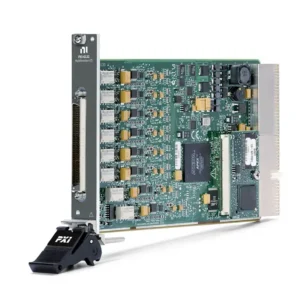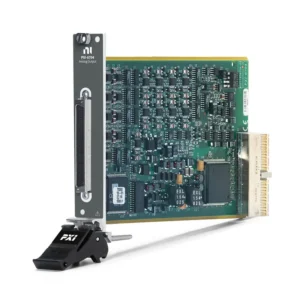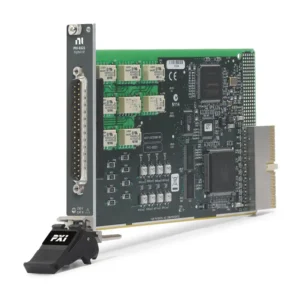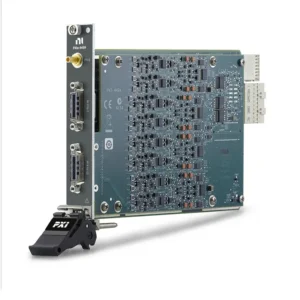


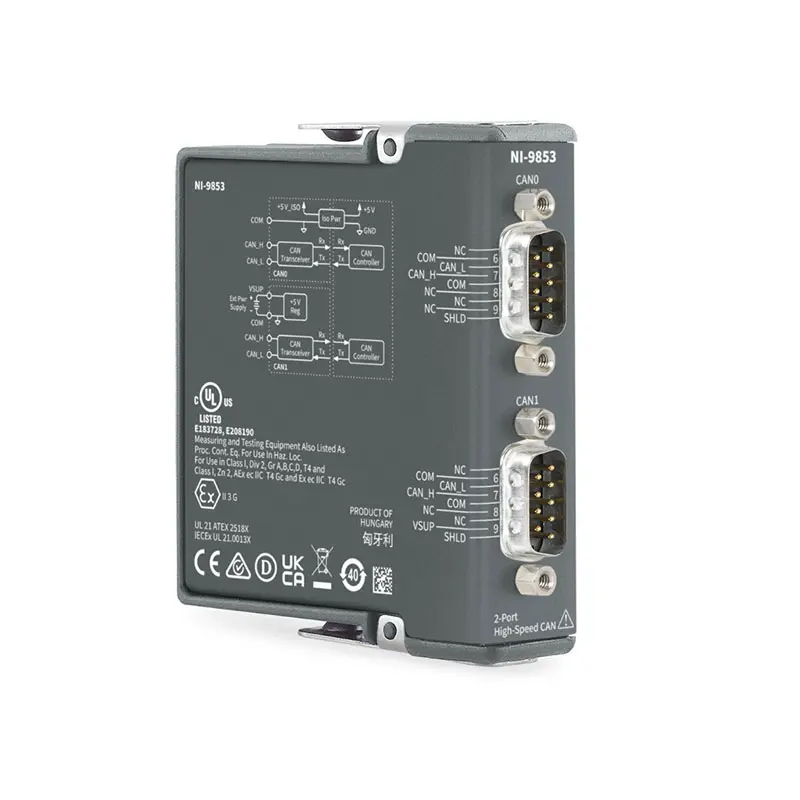
NI-9853 2-Port High-Speed CAN Interface Module
Земля NI-9853 is a two-port high-speed CAN interface module for CompactRIO and supported C Series systems. Each port includes an independent CAN controller and transceiver, allowing the module to communicate with two separate CAN networks.
The module supports CAN 2.0B communication, standard 11-bit identifiers, extended 29-bit identifiers and baud rates up to 1 Mb/s. Both ports are isolated from each other and from the remaining system hardware.
Key Features of the NI-9853
- Two independent high-speed CAN ports
- CAN 2.0B protocol compatibility
- 11-bit standard identifiers
- 29-bit extended identifiers
- ISO 11898-compatible transceivers
- Baud rates up to 1 Mb/s
- Port-to-port electrical isolation
- Isolation from other system modules
- Two 9-pin male D-Sub connectors
- Internally powered CAN0 interface
- Externally powered CAN1 interface
- CompactRIO and NI-RIO software support
- Conformal-coated version available
NI-9853 Technical Specifications
| Product Model | NI-9853 |
|---|---|
| Product Type | C Series high-speed CAN interface module |
| Number of CAN Ports | 2 |
| CAN Standard | CAN 2.0B |
| Physical Layer | High-speed CAN, ISO 11898 compatible |
| Maximum Baud Rate | 1 Mb/s |
| Identifier Support | 11-bit and 29-bit |
| CAN Controllers | Independent controller for each port |
| CAN Transceivers | Independent high-speed transceiver for each port |
| Port Isolation | Ports isolated from one another and the system |
| CAN0 Power | Internally powered |
| CAN1 Power | Requires external 8 VDC to 25 VDC supply |
| Front Connectors | 2 × 9-pin male D-Sub |
| Recommended Cable Impedance | 120 Ω nominal |
| Termination | 120 Ω nominal at both physical ends of each CAN bus |
| Software | CompactRIO and NI-RIO |
Two Independent CAN Networks
Each CAN port contains its own CAN controller and high-speed transceiver. The two ports can operate at different baud rates and communicate with independent networks.
Port isolation helps prevent unwanted ground-current paths between separate CAN networks and the CompactRIO system. It does not eliminate the need for correct CAN reference, shielding and termination practices.
CAN0 and CAN1 Power Differences
CAN0 is powered internally and does not require an external transceiver supply. CAN1 requires an external supply between 8 VDC and 25 VDC through its Vsup connection.
If CAN0 operates correctly while CAN1 remains inactive, the external CAN1 transceiver supply should be one of the first items checked.
CAN 2.0B Frame Support
The module supports CAN frames with both standard 11-bit and extended 29-bit identifiers. Higher-layer protocols such as CANopen, DeviceNet or SAE J1939 require suitable application software and message-handling logic.
The NI-9853 is an FPGA-oriented CAN interface and is not an NI-XNET interface. Software architecture and API compatibility should be checked before substituting it for an NI-XNET CAN module.
CAN Bus Topology
CAN_H and CAN_L should be routed as a twisted pair along a linear main bus. Only the two physical ends of the bus should normally contain termination resistors.
At 1 Mb/s, ISO 11898 guidance specifies approximately 40 m of total cable with short stubs. Longer distances generally require a lower baud rate and careful signal-integrity analysis.
NI-9853 Part Number and Accessories
| Item | Описание |
|---|---|
| NI-9853 | Two-port high-speed CAN C Series module |
| NI-9853 Conformal Coated | Version offering additional protection in harsh environments |
| 781233-02 | Clamp-on ferrite used for applicable EMC-compliant cable installation |
| 9-Pin CAN Cable | Connects the D-Sub ports to an ISO 11898 CAN network |
| 120 Ω Termination Resistor | Terminates each physical end of the CAN bus |
| 8 VDC to 25 VDC Supply | Required to operate the CAN1 transceiver |
Verify whether the supplied cable includes termination and whether its D-Sub pinout matches the NI-9853. CAN cables with the same connector can use different power and ground assignments.
NI-9853 Applications
- Automotive CAN communication
- SAE J1939 development
- CANopen device testing
- Industrial controller communication
- Embedded CAN-node validation
- Vehicle subsystem testing
- Симуляция с аппаратным входом
- CAN frame logging
- Protocol gateway development
- Dual-network CompactRIO systems
Automotive and J1939 Testing
The NI-9853 can transmit and receive the underlying CAN frames used by automotive and J1939 systems. Multi-frame transport, signal scaling and diagnostic services must be implemented in the application or an appropriate protocol library.
Системы аппаратно-программного моделирования
FPGA-based CAN access can coordinate messages with real-time I/O and simulation logic. Developers must manage message FIFOs, timing and error handling in the CompactRIO application.
NI-9853 Installation Workflow
Step 1: Install NI-RIO
Install compatible CompactRIO and NI-RIO software before adding the module to the LabVIEW project.
Step 2: Add the Module
Install the NI-9853 in a supported CompactRIO chassis and add it beneath the FPGA target in the project.
Step 3: Configure the Baud Rate
Open the module properties and configure each port for the baud rate used by its CAN network.
Step 4: Wire CAN_H and CAN_L
Use a 120 Ω twisted-pair cable and maintain consistent CAN_H and CAN_L polarity throughout the network.
Step 5: Power CAN1
Apply an 8 VDC to 25 VDC supply to the CAN1 Vsup connection when the second port is used.
Step 6: Verify Termination
With power removed, a correctly terminated bus commonly measures approximately 60 Ω between CAN_H and CAN_L because two 120 Ω terminations are connected in parallel.
NI-9853 Troubleshooting
CAN0 works but CAN1 does not
Verify that CAN1 receives the required external 8 VDC to 25 VDC transceiver supply.
The module receives repeated error frames
Check baud rate, termination, CAN_H/CAN_L polarity and whether another node is available to acknowledge transmitted frames.
Communication fails at 1 Mb/s
Shorten the main cable and stubs, verify 120 Ω termination and inspect signal quality with an oscilloscope.
The NI-9853 does not appear as an NI-XNET device
The NI-9853 uses the CompactRIO/NI-RIO FPGA architecture and is not an NI-XNET interface. Configure it beneath the appropriate FPGA target.
Only one device can communicate reliably
Check duplicate node identifiers, network termination and whether higher-layer protocol settings conflict between nodes.
NI-9853 Comparison
| Модель | Конфигурация | Best Suited For |
|---|---|---|
| NI-9853 | 2-port high-speed CAN, FPGA-oriented | Custom CompactRIO CAN applications |
| NI-9862 | 1-port high-speed CAN | NI-XNET-based CAN applications |
| NI-9861 | 1-port low-speed/fault-tolerant CAN | Low-speed fault-tolerant networks |
| NI-9866 | LIN interface | Automotive LIN communication |
NI-9853 Frequently Asked Questions
How many CAN ports does the NI-9853 provide?
It provides two independent high-speed CAN ports.
What is the maximum baud rate?
Both interfaces support CAN rates up to 1 Mb/s.
Does it support extended CAN identifiers?
Yes. It supports standard 11-bit and extended 29-bit identifiers.
Does CAN1 require external power?
Yes. CAN1 requires an external supply between 8 VDC and 25 VDC.
Is termination built into the module?
The CAN network must be terminated according to its topology, normally with 120 Ω at each physical end. Verify the actual cable and fixture configuration.
Does it use NI-XNET?
No. The NI-9853 is normally programmed through the CompactRIO FPGA and NI-RIO architecture.
Request a Quote for the NI-9853
Contact us for availability and project pricing for the NI-9853 two-port CAN interface module. We can also help select CAN cables, termination accessories, CompactRIO controllers and newer NI-XNET interfaces.