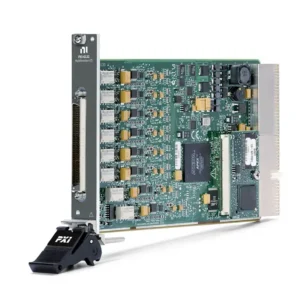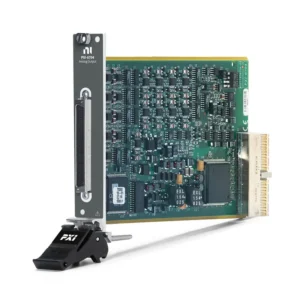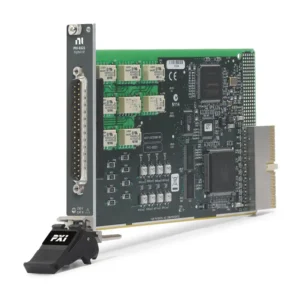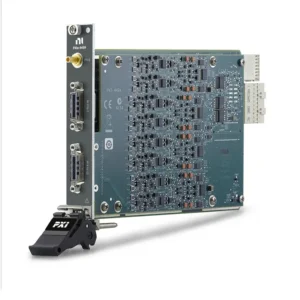


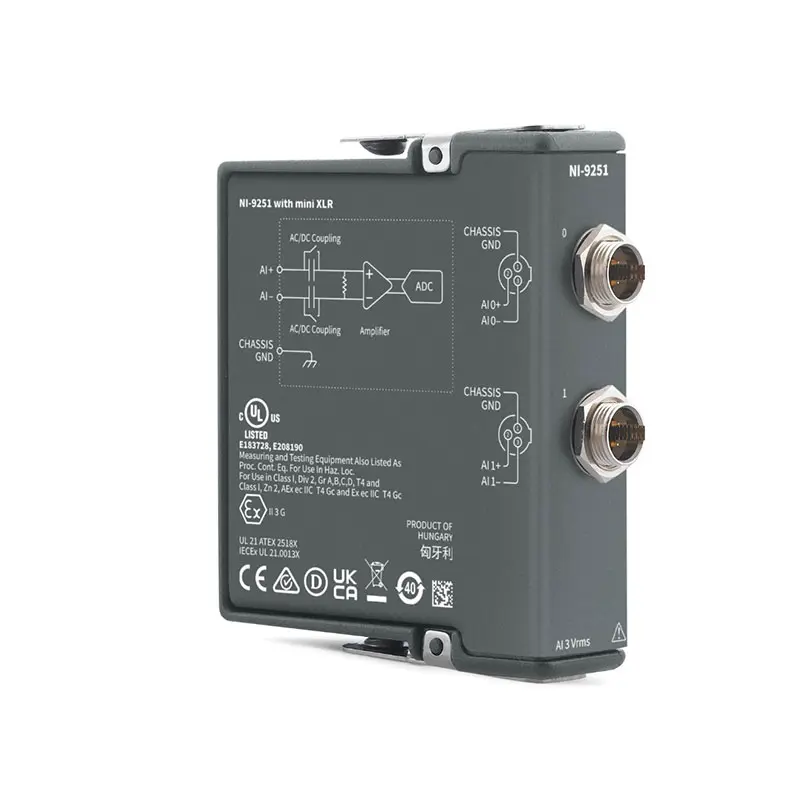
NI-9251 2-Channel Sound and Vibration Input Module
Земля NI-9251 is a two-channel C Series analog input module designed for audio, acoustic, noise and vibration measurements. It combines 24-bit delta-sigma analog-to-digital conversion with simultaneous sampling at rates up to 102.4 kS/s per channel.
Each differential input supports a nominal 3 Vrms measurement range and software-selectable AC or DC coupling. The mini-XLR front-panel connections make the module suitable for microphones, acoustic sensors, vibration transducers and other low-level dynamic signals.
Key Features of the NI-9251
- Two differential analog input channels
- 24-bit delta-sigma ADC resolution
- 102.4 kS/s maximum simultaneous sampling rate
- 3 Vrms nominal differential input range
- Software-selectable AC and DC coupling
- Mini-XLR front-panel connectors
- Analog and digital anti-alias filtering
- ±30 V input overvoltage protection
- Low-noise input architecture
- Extended -40°C to 70°C operating range
- CompactDAQ and CompactRIO compatibility
- Suitable for audio, noise and vibration measurements
NI-9251 Technical Specifications
| Product Model | NI-9251 |
|---|---|
| Product Type | C Series sound and vibration input module |
| Number of Channels | 2 differential analog input channels |
| ADC Resolution | 24 bits |
| ADC Type | Delta-sigma with analog prefiltering |
| Sampling Mode | Синхронный |
| Maximum Internal Sample Rate | 102.4 kS/s per channel |
| Internal Sample-Rate Range | 267 S/s to 102.4 kS/s |
| Nominal Input Range | 3 Vrms differential |
| Input Coupling | Software-selectable AC or DC |
| AC-Coupling Cutoff | 0.4 Hz at -3 dB |
| Overvoltage Protection | ±30 V |
| Input Resistance | 4 MΩ differential; 2 MΩ single-ended |
| Input Connectors | 2 mini-XLR connectors |
| Operating Temperature | -40°C to 70°C |
| Calibration Interval | 2 years |
| Weight | Approximately 140 g |
NI-9251 Part Number and Accessories
| Item | Part Number | Описание |
|---|---|---|
| NI-9251 with mini-XLR | 783814-01 | 2-channel, 24-bit C Series analog input module |
| Компактный шасси DAQ | Model dependent | USB, Ethernet or Thunderbolt chassis for PC-based measurements |
| CompactRIO System | Model dependent | FPGA and real-time platform for embedded monitoring |
| Mini-XLR Signal Cable | Configuration dependent | Connects compatible sensors and signal sources to the module |
Verify sensor output level, cable wiring, connector type and excitation requirements before ordering. The NI-9251 does not replace any external conditioning required by sensors that need specialized power or charge amplification.
Simultaneous 24-Bit Acquisition
The two channels are sampled simultaneously, preserving the time relationship between signals. This is important when comparing phase, calculating transfer functions or measuring sound and vibration events at multiple locations.
The delta-sigma conversion architecture combines high resolution with filtering suited to dynamic signals. Actual measurement performance also depends on the selected sample rate, sensor noise and grounding arrangement.
Software-Selectable AC and DC Coupling
DC coupling retains both the static and dynamic portions of the input signal. It is useful when the measurement requires waveform offset, slow variation and transient information.
AC coupling blocks the DC component and is useful for isolating vibration, acoustic or ripple information superimposed on a steady offset. Coupling can be selected independently according to the application configuration.
Mini-XLR Sensor Connections
The mini-XLR connections provide compact, locking input interfaces. Correct pin assignment must be confirmed when connecting third-party microphones, preamplifiers or custom sensor cables.
Shielded cables should be used in electrically noisy environments. Cable routing should keep low-level measurement signals separated from motors, switching power supplies and high-current conductors.
NI-9251 Applications
- Audio waveform acquisition
- Acoustic research and development
- Noise and vibration analysis
- Machine-condition monitoring
- Rotating-equipment diagnostics
- Automotive noise, vibration and harshness testing
- Structural vibration measurements
- Product sound-quality testing
- Frequency-response measurements
- Laboratory data acquisition
Noise and Vibration Measurements
The NI-9251 can acquire vibration or acoustic signals from two measurement points at the same time. Engineers can compare amplitude, phase and frequency content to identify resonances, imbalance and unwanted mechanical noise.
Audio Testing
Its 24-bit architecture and 102.4 kS/s sampling rate make the module suitable for capturing audio-band signals. It can be used for waveform recording, spectrum analysis, frequency-response testing and product sound evaluation.
NI-9251 Installation Workflow
Step 1: Select the Measurement Platform
Install the NI-9251 in a supported CompactDAQ or CompactRIO chassis. Confirm module support in the selected chassis and software version.
Step 2: Connect the Sensors
Connect the signal sources using correctly wired mini-XLR cables. Verify signal amplitude, grounding and any external conditioning requirements.
Step 3: Configure the Channels
Select the sample rate and AC or DC coupling for each channel. Confirm that the expected signal remains inside the module’s input range.
Step 4: Test the Signal Path
Acquire a known signal and inspect amplitude, noise and frequency content before beginning the full measurement sequence.
Step 5: Run and Record the Measurement
Acquire both channels simultaneously and save the waveform data with the appropriate calibration, channel and sensor information.
NI-9251 Troubleshooting
The NI-9251 is not detected
Confirm that the module is fully installed in a supported chassis. Check chassis communication and install the applicable NI-DAQmx or CompactRIO software.
No signal is measured
Check the mini-XLR pinout, cable continuity, sensor power and configured input channel. Confirm that the sensor does not require an unavailable excitation source.
The waveform has an unexpected offset
Review the selected coupling mode. Use AC coupling when the DC component should be removed, or DC coupling when the complete waveform must be retained.
The measurement contains excessive noise
Inspect grounding and cable shielding. Separate sensor cables from power conductors and switching equipment, and confirm that unused connections are not acting as noise pickup paths.
Signals appear clipped
Verify that the input amplitude remains within the 3 Vrms nominal range. Add attenuation or adjust the upstream signal conditioning when necessary.
NI-9251 Comparison
| Модель | Конфигурация | Best Suited For |
|---|---|---|
| NI-9251 | 2 channels, 24 bit, 102.4 kS/s/ch, 3 Vrms | Compact two-channel audio and vibration acquisition |
| NI-9230 | 3-channel dynamic signal acquisition | Three-channel sound and vibration systems |
| NI-9234 | 4-channel dynamic signal acquisition with IEPE support | IEPE accelerometers and microphones |
| NI-9250 | Two-channel dynamic analog input architecture | Alternative connector and signal-conditioning requirements |
Recommended Related Products
- NI-9230 Sound and Vibration Input Module
- NI-9234 Dynamic Signal Acquisition Module
- NI-9260 Audio Output Module
- View More NI CompactDAQ Products
Frequently Asked Questions
What is the NI-9251?
The NI-9251 is a two-channel, 24-bit C Series analog input module for audio, acoustic and vibration measurements.
What is its maximum sample rate?
The maximum internal sample rate is 102.4 kS/s per channel with simultaneous acquisition.
Does it support AC coupling?
Yes. Input coupling is software-selectable between AC and DC modes.
Does it provide channel-to-channel isolation?
No. The official specifications identify no channel-to-channel isolation, so system grounding must be designed accordingly.
What is the NI-9251 part number?
The mini-XLR NI-9251 ordering part number is 783814-01.
Request a Quote for the NI-9251
Contact us for current availability, lead time and pricing for the NI-9251 2-Channel Sound and Vibration Input Module. We can also help identify compatible chassis, cables and related dynamic-signal modules.