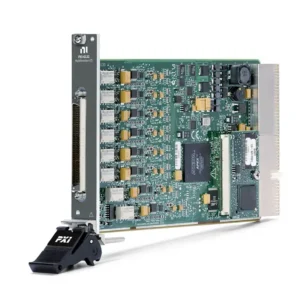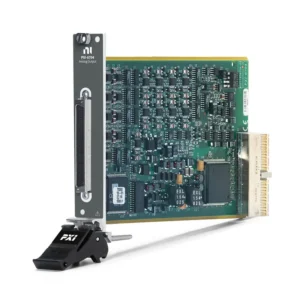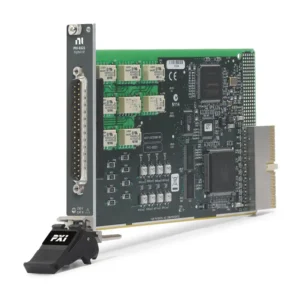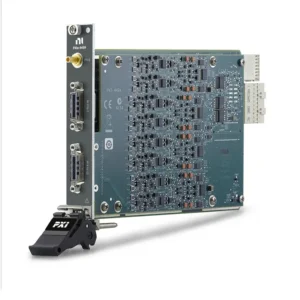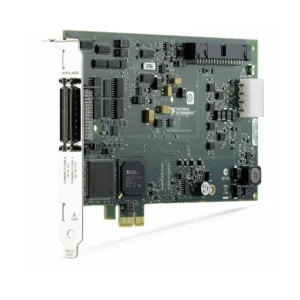


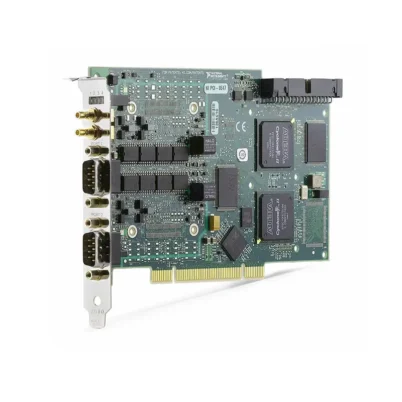
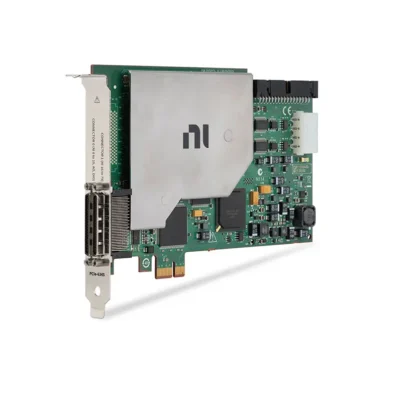
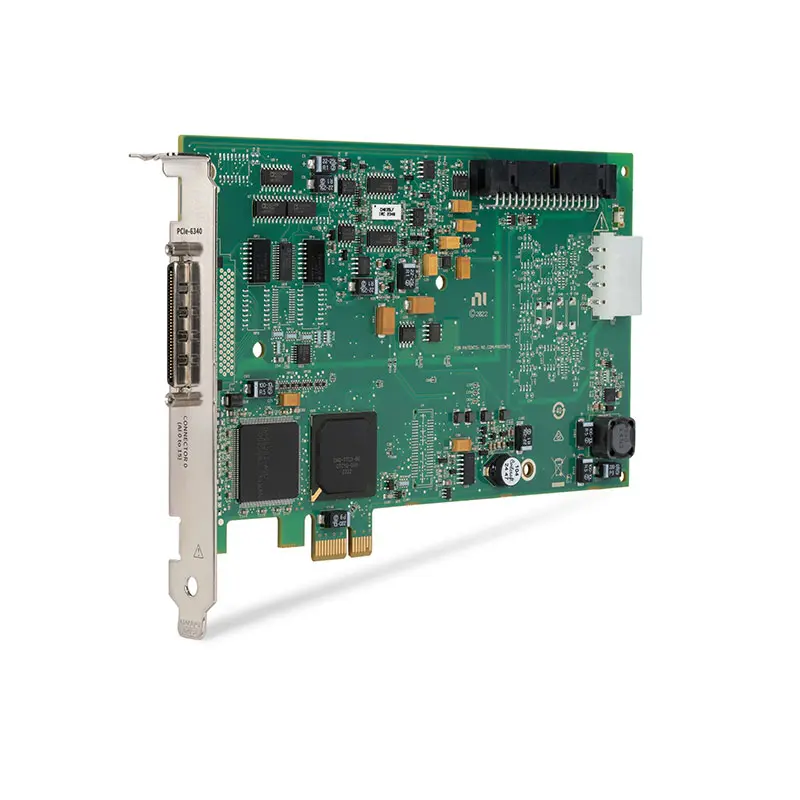
PCIe-6340 16-Bit 500 kS/s Multifunction DAQ Device
Земля NI PCIe-6340 is a PCI Express X Series multifunction data acquisition device designed for voltage measurement, digital control, counter/timer operations and automated test applications. It provides 16 single-ended or eight differential analog input channels, 24 bidirectional digital I/O lines and four 32-bit counters/timers.
Its 16-bit analog-to-digital converter supports an aggregate sampling rate of up to 500 kS/s. Multiple programmable input ranges allow the device to measure signals from ±0.2 V to ±10 V, making it suitable for acquiring sensor outputs, process signals, electronic test points and other low-voltage signals.
The PCIe-6340 incorporates NI-STC3 timing and synchronization technology, which provides independent timing engines, flexible signal routing and retriggerable measurement tasks. Combined with the high-throughput PCI Express bus and NI-DAQmx driver, the device supports laboratory automation, production testing, data logging and machine-monitoring systems.
Key Features of the PCIe-6340
- 16 single-ended or eight differential analog input channels
- 16-bit analog input resolution
- 500 kS/s maximum aggregate sampling rate
- ±0.2 V, ±1 V, ±5 V and ±10 V input ranges
- 24 bidirectional 5 V digital I/O channels
- 10 MHz maximum digital clock rate
- Four 32-bit general-purpose counters/timers
- PWM and pulse generation capability
- Frequency, period and event measurements
- Quadrature encoder measurement support
- NI-STC3 timing and synchronization technology
- Independent analog and digital timing engines
- Retriggerable acquisition and counter tasks
- PCI Express host interface
- 68-pin VHDCI front-panel connector
- NI-DAQmx driver software support
PCIe-6340 Technical Specifications
| Product Model | PCIe-6340 |
|---|---|
| Part Number | 790586-01 |
| Product Type | PCI Express X Series multifunction data acquisition device |
| Host Interface | PCI Express |
| Analog Input Channels | 16 single-ended or eight differential |
| ADC Resolution | 16 bits |
| Maximum Sample Rate | 500 kS/s, single-channel or multichannel aggregate |
| Analog Input Ranges | ±0.2 V, ±1 V, ±5 V and ±10 V |
| Maximum Analog Input Working Voltage | ±11 V relative to AI GND, including signal and common-mode voltage |
| Input Coupling | DC |
| Analog Input Timing Resolution | 10 ns |
| Analog Input Timing Accuracy | 50 ppm of sample rate |
| Analog Input FIFO | 2,047 samples |
| Simultaneous Sampling | No; multiplexed analog input architecture |
| Analog Output Channels | 0 |
| Digital I/O Channels | 24 bidirectional channels |
| Digital Logic Level | 5 V TTL-compatible |
| Maximum Digital Clock Rate | 10 MHz |
| Maximum Digital Update Period | 1 мкс |
| Counters/Timers | Four 32-bit counters/timers |
| Counter Functions | Event counting, frequency, period, pulse width, PWM, encoder and pulse generation |
| Timing Technology | NI-STC3 |
| External Clock Inputs | Eight |
| Front Connector | One 68-pin VHDCI connector |
| Driver Software | НИ-DAQmx |
| Operating Temperature | 0°C to 50°C |
| Bus Power | Powered through the PCI Express bus |
The 500 kS/s rating is shared across all enabled analog input channels. For example, a task scanning several channels divides the aggregate conversion capacity among those channels, subject to settling-time and source-impedance requirements.
The PCIe-6340 does not provide analog output channels and does not use simultaneous-sampling ADCs. Applications requiring waveform generation or simultaneous channel acquisition should be compared with other X Series models before ordering.
PCIe-6340 Part Number and Accessories
| Item | Part Number | Описание |
|---|---|---|
| PCIe-6340 | 790586-01 | 16 AI, 500 kS/s, 24 DIO PCI Express multifunction DAQ device |
| SHC68-68-EPM Cable | 192061-02 | 2 m shielded 68-pin D-Type to 68-pin VHDCI multifunction cable |
| SHC68-68 Cable | 191945-02 | 2 m twisted-pair cable with basic shielding |
| SCB-68A | 782536-01 | Shielded, noise-rejecting screw-terminal block with temperature sensor |
| BNC-2110 | 777643-01 | Shielded BNC terminal block for multifunction DAQ signal access |
| BNC-2120 | 777960-01 | Shielded BNC terminal block with function generator and encoder connections |
| BNC-2090A | 779556-01 | Rackmount BNC terminal accessory for 68-pin multifunction DAQ devices |
| CB-68LP | 777145-01 | Low-cost, unshielded vertical-mount screw-terminal block |
| CB-68LPR | 777145-02 | Unshielded right-angle screw-terminal block |
| TBX-68 | 777141-01 | DIN-rail-mount 68-pin screw-terminal block |
The PCIe-6340 has one 68-pin VHDCI connector. A cable and terminal block are normally required to connect field signals, sensors and test fixtures to the board.
NI recommends the SHC68-68-EPM shielded cable for applications requiring improved noise rejection and EMC performance. Verify cable length, terminal-block compatibility, shielding and fixture wiring before ordering.
16-Bit Analog Input Architecture
The PCIe-6340 uses a 16-bit ADC to digitize analog voltage signals. Sixteen-bit resolution divides the configured input span into 65,536 digital levels, allowing relatively small signal changes to be represented in the acquired data.
The effective measurement resolution also depends on electrical noise, source impedance, input range, wiring, grounding and environmental conditions. Selecting the smallest input range that safely contains the expected signal generally provides better voltage resolution.
16 Single-Ended or Eight Differential Inputs
The analog input channels can be configured as 16 single-ended inputs or eight differential inputs. Single-ended wiring provides the highest channel count, while differential wiring provides better rejection of common-mode interference.
Differential measurement is normally preferred for low-level signals, remote sensors, electrically noisy environments and sources that are not referenced directly to the DAQ ground.
Referenced Single-Ended Measurement
Referenced single-ended mode measures each signal relative to AI GND. It is suitable for grounded sources with short wiring and a compatible ground reference.
Nonreferenced Single-Ended Measurement
Nonreferenced single-ended mode measures channels relative to the AI SENSE terminal. This configuration can reduce some ground-potential errors when several signals share a remote reference.
Differential Measurement
Differential mode measures the voltage difference between paired positive and negative input terminals. It is useful when improved noise rejection is more important than maximum channel density.
500 kS/s Aggregate Sampling
The PCIe-6340 supports analog input sampling at up to 500 kS/s. Because the device uses a multiplexed ADC, the maximum rate is shared across the channels included in the acquisition task.
A single-channel task can operate at up to the maximum rate. When multiple channels are scanned, the achievable per-channel rate is lower and depends on the number of channels, source impedance and required settling accuracy.
For signals with high source impedance, the multiplexer and ADC input may require additional settling time. A voltage follower, buffer amplifier or appropriately designed signal-conditioning circuit may improve measurement accuracy.
Programmable Analog Input Ranges
The PCIe-6340 supports bipolar input ranges of ±0.2 V, ±1 V, ±5 V and ±10 V. This flexibility allows the input stage to be matched to different sensor and circuit voltage levels.
The ±10 V range is useful for general industrial and electronic measurements. The narrower ranges provide improved code width for smaller signals, provided the input remains inside the configured limits.
The maximum working voltage is not the same as the selected measurement range. Both the signal voltage and common-mode voltage must remain within the device’s specified limits.
24 Bidirectional Digital I/O Channels
The PCIe-6340 provides 24 bidirectional 5 V digital I/O lines. Each line can be configured as an input or output, allowing the board to monitor digital states and control external circuits.
Port 0 provides eight digital channels, while the remaining lines can operate as digital I/O or programmable function interface terminals. These terminals can also route timing, trigger and counter signals.
External buffering or isolation may be required when controlling relays, solenoids, motors or industrial devices. The digital terminals should not be connected directly to loads that exceed the specified voltage or current ratings.
Four 32-Bit Counters and Timers
Four 32-bit counters/timers provide hardware resources for event counting, frequency measurement, period measurement, pulse-width measurement, pulse generation and encoder applications.
Counter measurements are performed in hardware, which provides more deterministic timing than software polling. The counters can also work with external gates, sources and auxiliary timing signals routed through PFI terminals.
PWM Generation
A counter can generate pulse-width-modulated signals with programmable frequency and duty cycle. PWM output is useful for test stimulus, basic actuator commands and timing-system development.
Frequency and Period Measurement
The counters can measure the frequency or period of signals produced by sensors, oscillators, tachometers and digital circuits.
Encoder Measurement
Quadrature encoder signals can be decoded to measure position and direction. Depending on the encoder and application, additional signal conditioning may be required.
Event Counting
Digital pulses produced by proximity sensors, switches, flow meters or production equipment can be counted without requiring the host software to detect every transition individually.
NI-STC3 Timing and Synchronization
NI-STC3 timing technology provides independent timing engines for analog input, digital I/O and counter operations. Independent engines allow several hardware-timed tasks to operate concurrently.
The device supports flexible internal routing between counters, triggers, sample clocks and programmable function interface terminals. This enables a measurement task to be synchronized with external machinery or other compatible DAQ hardware.
Retriggerable tasks allow a configured acquisition or generation operation to execute again each time a valid trigger is received without requiring the complete task to be recreated in software.
PCI Express Data Transfer
The PCI Express interface provides a high-throughput, low-latency connection between the PCIe-6340 and the host computer. This is useful for continuous data acquisition, buffered digital tasks and counter measurements.
Overall system performance depends on the computer, PCI Express architecture, driver configuration, storage system and other devices sharing system resources.
NI-DAQmx Software Support
The PCIe-6340 is controlled with the NI-DAQmx driver. NI-DAQmx provides configuration, calibration, acquisition, triggering and timing functions for compatible development environments.
The driver includes NI Measurement & Automation Explorer for detecting the device, viewing pinouts, creating test panels and configuring named virtual channels.
Applications can be developed in LabVIEW, LabWindows/CVI and supported C, C++, .NET or Python environments. Verify the development environment and operating-system compatibility against the selected NI-DAQmx version.
PCIe-6340 Applications
- General-purpose voltage measurement
- Automated production testing
- Electronic device validation
- Laboratory data acquisition
- Machine monitoring
- Process monitoring and control
- Digital state monitoring
- Encoder and position measurement
- Измерение частоты и периода
- Pulse and event counting
- PWM and pulse generation
- Test-fixture control
- Research and development
- Educational measurement systems
Automated Production Testing
The PCIe-6340 can measure analog test points, monitor fixture switches, detect digital status signals and count events during an automated test sequence. Combining several measurement functions on one device can reduce the number of separate interface boards required by a test station.
NI-DAQmx tasks can be integrated into production software to configure channels, acquire results, apply pass/fail limits and store test records.
Electronic Device Validation
Design and validation engineers can use the analog inputs to measure supply rails, sensor signals, control voltages and circuit responses. Digital I/O channels can monitor logic states or control fixture components.
External signal conditioning, attenuation and protection must be added when a test point exceeds the device’s direct input limits.
Machine and Process Monitoring
The PCIe-6340 can acquire conditioned voltage signals from pressure, position, force, flow and other industrial sensors. Counters can monitor encoders, tachometers and pulse-output transducers.
Because the analog inputs are not isolated, industrial installations may require isolated signal conditioning to protect the computer and prevent ground loops.
Data Logging
With 16 single-ended analog inputs and a 500 kS/s aggregate sampling rate, the PCIe-6340 can support multichannel data logging for laboratory experiments, equipment monitoring and product testing.
Long-duration logging software should include buffer monitoring, file management, timestamps and recovery procedures for unexpected communication or power interruptions.
Encoder and Rotational Measurement
The 32-bit counters can interface with compatible quadrature encoders to measure position, direction and rotational movement. Encoder signals should meet the digital voltage and timing requirements of the selected PFI terminals.
Differential industrial encoders generally require an external receiver or conversion circuit before connection to the single-ended PCIe-6340 inputs.
PCIe-6340 Installation Workflow
Step 1: Verify Computer Compatibility
Confirm that the computer has an available PCI Express slot, adequate cooling and a supported operating system. Review the NI-DAQmx compatibility requirements before installation.
Step 2: Select the Cable and Terminal Block
Choose a compatible 68-pin cable and terminal accessory according to the required signal connections. The SHC68-68-EPM and SCB-68A provide a shielded connection suitable for many measurement applications.
Step 3: Install NI-DAQmx
Install a compatible NI-DAQmx version and the required development-environment support. Installing the driver before the board can simplify device recognition.
Step 4: Power Down the Computer
Shut down the computer, disconnect power and use appropriate electrostatic-discharge precautions before handling the board.
Step 5: Install the PCIe-6340
Insert the device into an available compatible PCI Express slot. Make sure the edge connector is fully seated and secure the mounting bracket.
Step 6: Connect the Accessory
Attach the selected cable to the 68-pin VHDCI connector and secure it correctly. Connect the opposite end to the terminal block or custom fixture.
Step 7: Wire the Signals
Connect analog signals using the appropriate RSE, NRSE or differential configuration. Keep analog wiring separated from high-current, switching and digital signal paths.
Step 8: Detect the Device
Start the computer and open NI Measurement & Automation Explorer. Verify that the PCIe-6340 appears under Devices and Interfaces.
Step 9: Run Self-Test and Test Panels
Run the device self-test and use a test panel to verify analog input, digital I/O and counter functions before integrating the board into the final application.
Step 10: Create the Measurement Task
Configure physical channels, terminal mode, input range, sample rate, clock source, trigger and buffer size. Confirm that every connected signal remains within the specified electrical limits.
PCIe-6340 Troubleshooting
The PCIe-6340 is not detected in NI MAX
Confirm that the board is fully seated in the PCI Express slot and that the slot is enabled. Check the NI-DAQmx installation and verify that the selected driver version supports the operating system and device.
Analog readings are noisy
Use shielded twisted-pair wiring, select differential measurement mode and keep analog cables away from switching power supplies, motors and digital wiring. Connect shields according to the signal-source grounding arrangement.
The measured value is incorrect
Verify the input range, terminal configuration and wiring reference. A channel configured for RSE will produce incorrect results if the source requires differential or NRSE measurement.
Unused channels show unexpected voltages
Open analog inputs can float and display changing values. Connect unused channels to AI GND when appropriate or exclude them from the acquisition task.
The per-channel sample rate is lower than expected
The 500 kS/s specification is an aggregate rate shared by all channels in the scan. Reduce the number of enabled channels or select a faster device when a higher rate is required on every channel.
The first sample after changing channels is inaccurate
High source impedance can prevent the multiplexed input from settling fully. Reduce the scan rate, add channel delay or buffer the source with a low-output-impedance amplifier.
A digital output cannot operate a relay
The digital output is intended for logic-level signals and may not provide sufficient voltage or current for a relay coil. Use an external transistor, driver, flyback diode and power supply.
A counter does not detect encoder pulses
Verify the PFI terminal assignment, logic voltage, grounding and signal quality. Confirm that the encoder outputs are compatible with the board’s single-ended 5 V digital inputs.
The device returns an overrun or overflow error
Reduce the sampling rate, increase the buffer size and verify that the application reads data frequently enough. Check computer performance and avoid blocking operations in the acquisition loop.
Measurements change when equipment is connected
Review the grounding arrangement for ground loops and common-mode voltage. Differential measurements or isolated external signal conditioning may be required.
PCIe-6340 Comparison
| Модель | Analog Inputs | Maximum AI Rate | Analog Outputs | Цифровой ввод-вывод |
|---|---|---|---|---|
| PCIe-6320 | 16 single-ended or eight differential | 250 kS/s aggregate | 0 | 24 |
| PCIe-6340 | 16 single-ended or eight differential | 500 kS/s aggregate | 0 | 24 |
| PCIe-6341 | 16 single-ended or eight differential | 500 kS/s aggregate | 2 | 24 |
| PCIe-6342 | 32 single-ended or 16 differential | 500 kS/s aggregate | 0 | 48 |
| PCIe-6350 | 16 single-ended or eight differential | 1.25 MS/s aggregate | 0 | 24 |
PCIe-6340 vs PCIe-6320
Both models provide 16 single-ended analog inputs, 24 digital I/O lines and four counters. The PCIe-6340 increases the maximum aggregate analog input rate from 250 kS/s to 500 kS/s.
Select the PCIe-6340 when the application requires higher analog acquisition speed. The PCIe-6320 may be sufficient for slower monitoring and data-logging applications.
PCIe-6340 vs PCIe-6341
The PCIe-6340 and PCIe-6341 provide similar analog input, digital I/O and counter capabilities. The PCIe-6341 additionally provides two analog output channels.
Choose the PCIe-6340 when the system only needs measurement, digital control and counters. Choose the PCIe-6341 when the application must also generate analog voltages or waveforms.
PCIe-6340 vs PCIe-6342
The PCIe-6342 increases the analog input count to 32 single-ended or 16 differential channels and provides 48 digital I/O lines. Both models support 16-bit, 500 kS/s aggregate analog input.
The PCIe-6340 is appropriate for smaller systems, while the PCIe-6342 is better suited to applications requiring additional channel density.
PCIe-6340 vs PCIe-6350
The PCIe-6350 offers the same basic channel arrangement but increases the maximum analog input rate to 1.25 MS/s. The PCIe-6340 provides a cost-effective option for applications that remain within 500 kS/s.
Selecting the Right X Series DAQ Device
Choose the PCIe-6340 when the application requires 16 analog input channels, 500 kS/s aggregate sampling, 24 digital I/O lines and four hardware counters without analog output.
Consider the PCIe-6341 when analog output is required, the PCIe-6342 when more analog and digital channels are needed or the PCIe-6350 when a higher input sampling rate is necessary.
Why Choose the PCIe-6340?
- Combines analog input, digital I/O and counters on one PCI Express board
- Provides 16-bit voltage measurement at up to 500 kS/s
- Supports both single-ended and differential measurements
- Offers four programmable bipolar input ranges
- Provides 24 bidirectional digital I/O channels
- Includes four 32-bit counters for timing and encoder applications
- Supports advanced NI-STC3 timing and synchronization
- Integrates with NI-DAQmx and multiple programming environments
- Supports shielded cables and several terminal-block options
- Fits laboratory, production and industrial test systems
PCIe-6340 Frequently Asked Questions
What is the PCIe-6340?
The PCIe-6340 is a PCI Express X Series multifunction DAQ device that provides analog input, digital I/O and hardware counter/timer functions.
What is the PCIe-6340 part number?
The standard NI part number is 790586-01.
How many analog input channels does it provide?
It provides 16 single-ended analog input channels or eight differential channels.
What is the maximum sampling rate?
The maximum analog input sampling rate is 500 kS/s. This is an aggregate rate shared across all channels included in a multichannel task.
What is the analog input resolution?
The PCIe-6340 uses a 16-bit analog-to-digital converter.
Does the PCIe-6340 provide analog outputs?
No. The PCIe-6340 has no analog output channels. Consider the PCIe-6341 when two analog outputs are required.
How many digital I/O lines are available?
The device provides 24 bidirectional 5 V digital I/O lines.
How many counters does it provide?
It provides four 32-bit hardware counters/timers for frequency, period, pulse, PWM, encoder and event-counting applications.
Does the PCIe-6340 use simultaneous sampling?
No. It uses a multiplexed analog input architecture. Applications requiring simultaneous sampling should use an appropriate simultaneous-sampling DAQ device.
Which connector does the PCIe-6340 use?
The board uses one 68-pin VHDCI front-panel connector.
Which cable is recommended?
The SHC68-68-EPM shielded cable is recommended for connecting the device to compatible 68-pin terminal accessories.
Which software controls the PCIe-6340?
The PCIe-6340 is controlled through NI-DAQmx and can be programmed using LabVIEW and supported text-based development environments.
Can the PCIe-6340 measure industrial sensors directly?
It can directly measure compatible voltage-output sensors. Sensors requiring excitation, isolation, amplification, bridge completion or current input need appropriate external signal conditioning.
Can it measure temperature?
Temperature can be measured when a suitable temperature sensor and required signal conditioning are used. For direct thermocouple or RTD measurements, a dedicated temperature measurement device may be more convenient.
Can it control motors or solenoids directly?
No. Its digital outputs are logic-level signals. Motors, solenoids and other power loads require external drivers, protection circuits and power supplies.
Recommended Related Products
- PCIe-6320 16-Bit Multifunction DAQ Device
- PCIe-6341 Multifunction DAQ with Analog Output
- PCIe-6342 32-Channel Multifunction DAQ Device
- PCIe-6350 1.25 MS/s Multifunction DAQ Device
- PCIe-6351 X Series Multifunction DAQ Device
- SCB-68A Shielded Connector Block
- BNC-2110 Shielded BNC Connector Block
- View More NI PCI Express Data Acquisition Devices
Request a Quote for the PCIe-6340
Contact us for current availability, lead time and project pricing for the NI PCIe-6340 16-Bit 500 kS/s Multifunction DAQ Device. We can also help identify compatible SHC68 cables, SCB-68A terminal blocks, BNC accessories and alternative X Series DAQ models for your application.