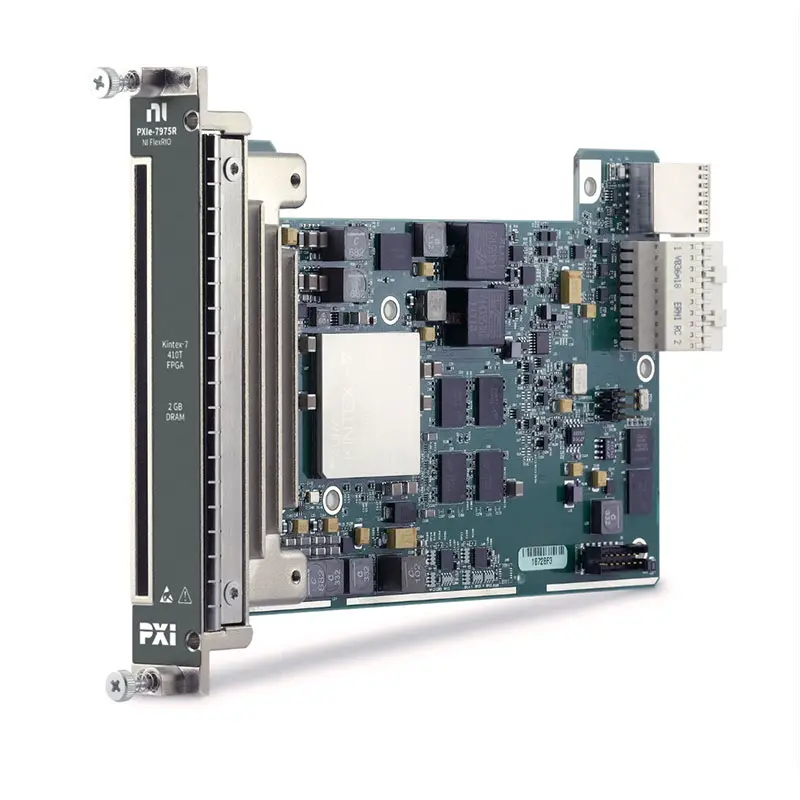
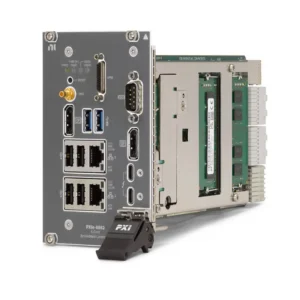
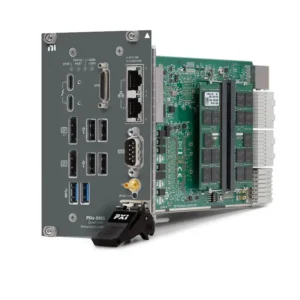
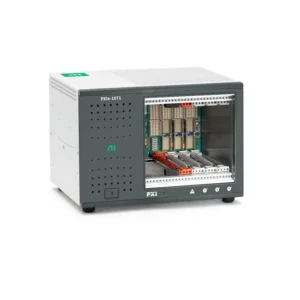
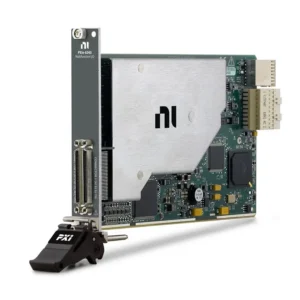
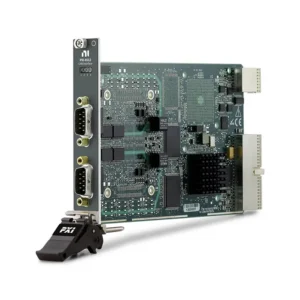
National Instruments NI PXIe-7975 FPGA Module for FlexRIO
The PXIe‑7975 provides flexible, customizable I/O for LabVIEW FPGA. It includes 136 single-ended I/O lines configurable as 68 differential pairs. You can pair the PXIe‑7975 with FlexRIO adapter modules that offer high-performance analog and digital I/O. Together, the two modules create a reconfigurable instrument that you can program with LabVIEW FPGA software. The PXIe‑7975 supports peer‑to‑peer streaming, which directly transfers data among multiple FPGA modules or select PXI Express modules without sending data to the host processor. With this feature, you can add FPGA capabilities to high-performance NI digitizers with NIST‑traceable calibration or expand your FPGA algorithms across multiple FPGAs for computationally demanding applications.
Applications and Use Cases of PXIe-7975
The PXIe-7975 FlexRIO FPGA Module is a high-performance FPGA module for PXI Express systems, designed for custom data acquisition, real-time processing, and deterministic control applications. It provides user-programmable FPGA resources, enabling flexible implementation of high-speed signal processing and system-level control.
1. FPGA-Based Custom Measurement Systems PXIe-7975 allows engineers to build tailored measurement solutions by programming the FPGA for specific acquisition, timing, and processing requirements.
2. High-Speed Data Processing The module supports real-time processing of high-throughput data streams, including filtering, triggering, and data reduction with low latency.
3. Hardware-in-the-Loop (HIL) Simulation Widely used in HIL systems for deterministic real-time simulation and control of complex systems.
4. RF & Communication System Development Used in communication applications for real-time signal processing, protocol implementation, and system validation when paired with FlexRIO adapter modules.
5. Industrial Automation & Real-Time Control Enables high-speed and deterministic control of industrial processes and equipment.
6. Automated Test Equipment (ATE) Integrated into advanced test systems for customized test sequences, high-speed data acquisition, and real-time analysis.
7. Research & Advanced Prototyping Used in R&D environments for FPGA-based system development, algorithm validation, and prototyping of high-performance systems.
$1,417.00Original price was: $1,417.00.$1,350.00Current price is: $1,350.00.
FAQ
Yes, all products we supply are 100% original from National Instruments and Keysight. Most popular models are in stock and ready for fast shipment.
Yes, we offer special project pricing and bulk discounts. Please send us your required model numbers and quantity to get the best quotation.
For in-stock items, we can arrange shipment within 5–7 working days. Tracking number will be provided immediately after shipment.
We accept T/T (bank transfer), PayPal, and Alibaba Trade Assurance for secure transactions.
Yes, we have many National Instruments and Keysight Technologies products that are not yet listed online. Simply provide the model number, and we will offer you a fast and competitive quotation.
All products are carefully inspected before shipment and packed securely to prevent damage during transportation
We offer warranty support for all products. Please contact us if there are any issues, and we will provide a suitable solution.