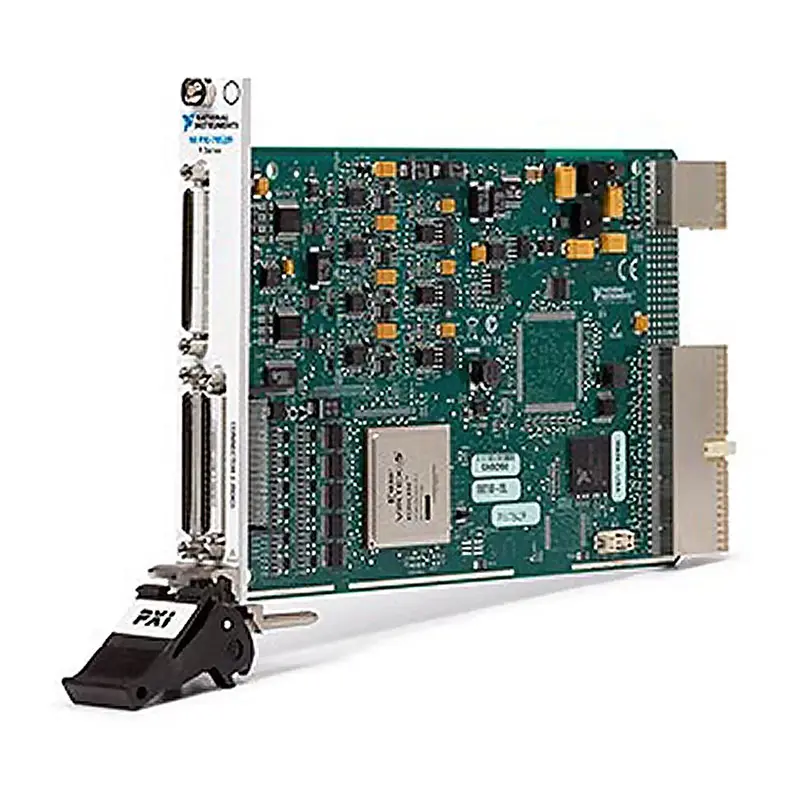
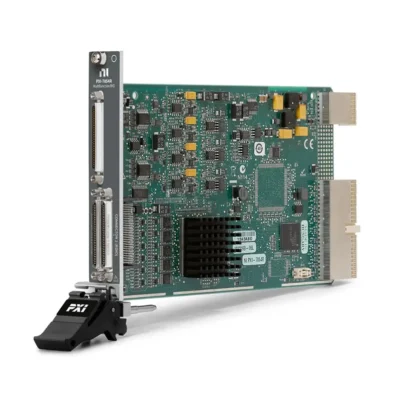
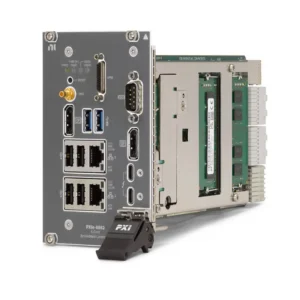
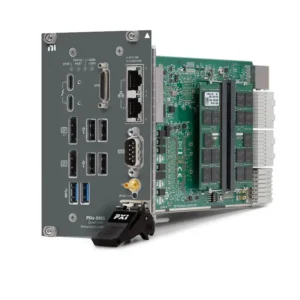
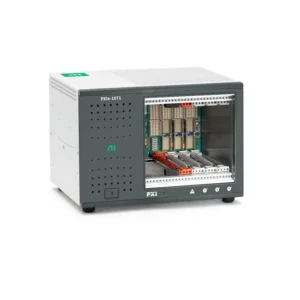
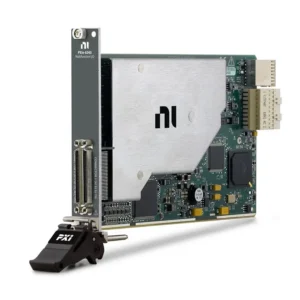
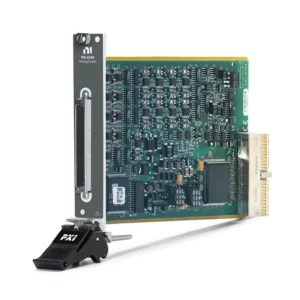
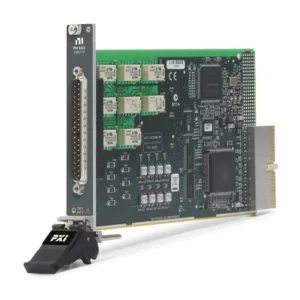
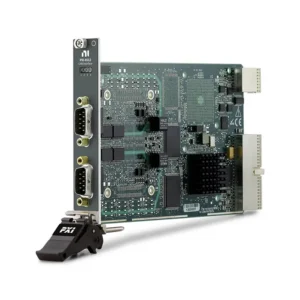
National Instruments NI PXI-7852 PXI Multifunction Reconfigurable I/O Module
The PXI‑7852 features a user-programmable FPGA for high-performance onboard processing and direct control over I/O signals to ensure complete flexibility of system timing and synchronization. You can customize these devices with the LabVIEW FPGA Module to develop applications requiring precise timing and control such as hardware‑in‑the‑loop testing, custom protocol communication, sensor simulation, and high-speed control. The PXI‑7852 features a dedicated A/D converter (ADC) per channel for independent timing and triggering. This design offers specialized functionality such as multirate sampling and individual channel triggering, which are outside the capabilities of typical data acquisition hardware.
Applications and Use Cases of PXI-7852
The PXI-7852 R Series Multifunction RIO Module is a PXI-based R Series multifunction reconfigurable I/O (RIO) module that integrates analog I/O, digital I/O, counters, and a user-programmable FPGA. It is designed for custom measurement, high-speed control, and deterministic real-time applications, making it suitable for flexible and scalable test systems.
1. FPGA-Based Custom Measurement Systems PXI-7852 allows users to implement custom acquisition, triggering, and signal processing directly on the FPGA, enabling tailored measurement solutions.
2. Real-Time Control & Deterministic I/O Provides hardware-timed I/O with deterministic behavior, suitable for applications requiring precise timing and low latency.
3. Mixed-Signal Data Acquisition (Analog + Digital) Supports simultaneous acquisition and control of analog and digital signals, enabling comprehensive system monitoring and control.
4. Hardware-in-the-Loop (HIL) Simulation Widely used in HIL systems for real-time simulation and interaction with embedded controllers.
5. Industrial Automation & Machine Control Used to control machinery, read sensor inputs, and execute control logic in industrial environments.
6. Automated Test Equipment (ATE) Integrated into test systems for synchronized measurement, control, and real-time decision making.
7. Research & Advanced Prototyping Used in laboratories for FPGA development, algorithm validation, and rapid system prototyping.
Part Number(s): 780340-01
Specifications
Maximum Sample Rate: 75 kS/s
Bus Connector: PXI Hybrid
Maximum Clock Rate: 4 MHz
Number of Bidirectional Digital Channels: 96
Digital I/O Logic Levels: 3.3 V, 5 V
Dynamic RAM (DRAM): MB
FPGA: Virtex-5 LX50
Analog Input Voltage Range: -1 V to 1 V
Supports Peer To Peer Streaming: No
Number of Analog Input Channels: 8
Number of Analog Output Channels: 8
$1,417.00Original price was: $1,417.00.$1,350.00Current price is: $1,350.00.
FAQ
Yes, all products we supply are 100% original from National Instruments and Keysight. Most popular models are in stock and ready for fast shipment.
Yes, we offer special project pricing and bulk discounts. Please send us your required model numbers and quantity to get the best quotation.
For in-stock items, we can arrange shipment within 5–7 working days. Tracking number will be provided immediately after shipment.
We accept T/T (bank transfer), PayPal, and Alibaba Trade Assurance for secure transactions.
Yes, we have many National Instruments and Keysight Technologies products that are not yet listed online. Simply provide the model number, and we will offer you a fast and competitive quotation.
All products are carefully inspected before shipment and packed securely to prevent damage during transportation
We offer warranty support for all products. Please contact us if there are any issues, and we will provide a suitable solution.