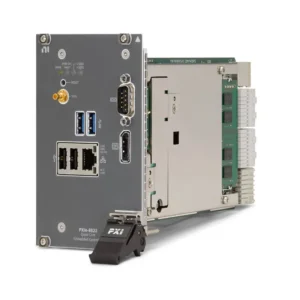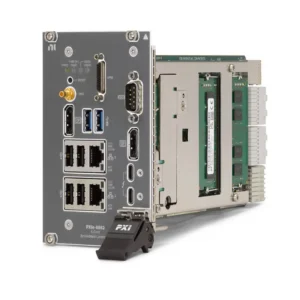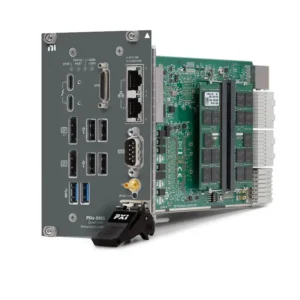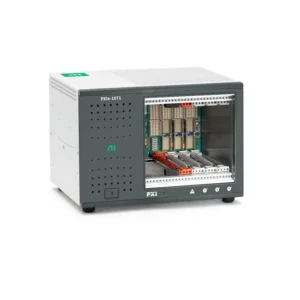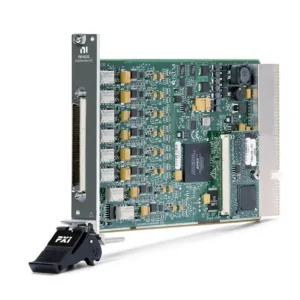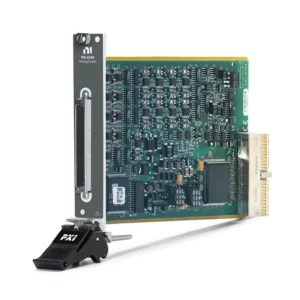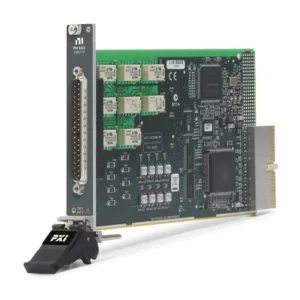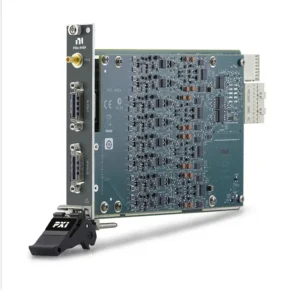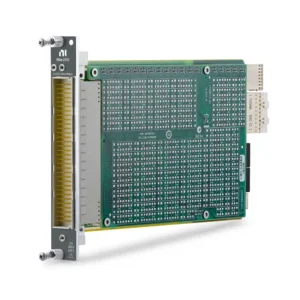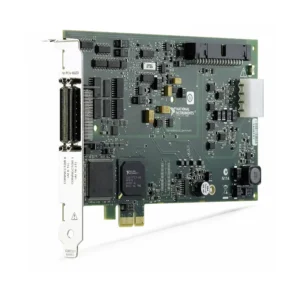




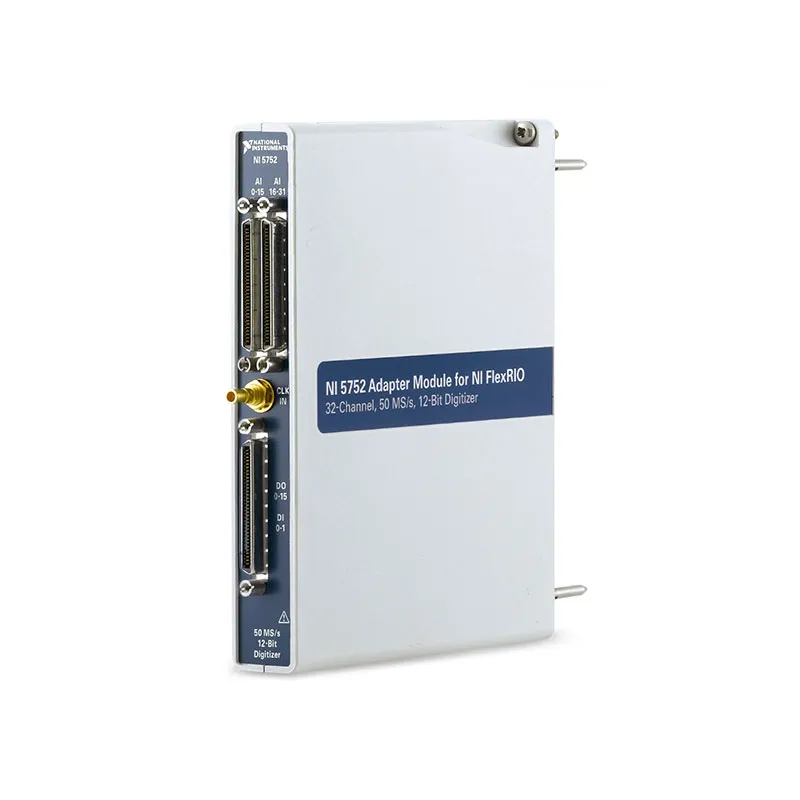
NI-5752B 32-Channel 50 MS/s FlexRIO Digitizer Adapter Module
Земля NI-5752B is a high-density FlexRIO digitizer adapter module designed for applications requiring simultaneous acquisition from many analog channels. It provides 32 differential analog inputs, 12-bit resolution and a maximum sample rate of 50 MS/s per channel.
When combined with a compatible FlexRIO FPGA module, the NI-5752B creates a programmable high-speed digitizer capable of FPGA-based signal processing, triggering, data reduction and real-time streaming. Its AC-coupled inputs, programmable gain and selectable antialiasing filters make it suitable for ultrasonic imaging, nondestructive testing, multichannel sensor acquisition and scientific instrumentation.
Key Features of the NI-5752B
- 32 simultaneously sampled analog input channels
- 12-bit analog-to-digital conversion
- 50 MS/s maximum sample rate per channel
- Up to 1.6 GS/s aggregate sampling throughput
- Differential analog input architecture
- 2 Vpk-pk maximum differential input swing
- 1 Vpk-pk maximum single-ended input swing
- AC-coupled analog inputs
- 100 Ω differential input impedance
- Programmable gain from -5 dB to 31 dB
- 0.125 dB gain resolution
- Selectable 7.5 MHz, 10 MHz and 14 MHz antialiasing filters
- Onboard, external and PXI Express sample-clock options
- 25 MHz to 50 MHz external sample-clock range
- Two digital input lines
- 16 digital output lines
- Two analog-input VHDCI connectors
- One digital I/O VHDCI connector
- SMB external clock input
- Kintex-7 FlexRIO FPGA support
- LabVIEW FPGA integration
NI-5752B Technical Specifications
| Product Model | NI-5752B |
|---|---|
| Part Number | 784062-01 |
| Product Type | Digitizer adapter module for FlexRIO |
| Number of Analog Inputs | 32 |
| Input Configuration | Differential, simultaneously sampled |
| Single-Ended Operation | Supported by configuring the variable-gain amplifier for 6 dB gain |
| ADC Resolution | 12 bits |
| Maximum Sample Rate | 50 MS/s per channel |
| Aggregate Sample Rate | Up to 1.6 GS/s across 32 channels |
| Maximum Differential Input Swing | 2 Vpk-pk |
| Maximum Single-Ended Input Swing | 1 Vpk-pk |
| Common-Mode Range | ±1 VDC |
| Input Impedance | 100 Ω differential |
| Input Coupling | AC |
| Programmable Gain Range | -5 dB to 31 dB |
| Gain Resolution | 0.125 dB |
| Antialiasing Filter Options | 7.5 MHz, 10 MHz or 14 MHz at -3 dB |
| ADC Architecture | 12-bit differential pipelined ADC |
| Analog Front End | AFE5801 monolithic analog front end with variable-gain amplifier |
| Onboard Sample Clock | 50 MHz |
| External Sample-Clock Range | 25 MHz to 50 MHz |
| Sample-Clock Sources | Onboard clock, CLK IN or supported PXI Express synchronization clock |
| External Clock Connector | СМБ |
| External Clock Logic Level | 3.3 V CMOS |
| External Clock Coupling | DC |
| External Clock Input Impedance | Greater than 50 kΩ |
| External Clock Duty Cycle | 45% to 55% |
| Digital Inputs | 2 |
| Digital Outputs | 16 |
| Maximum Digital Output Toggle Rate | 1 MHz with all outputs toggling |
| Analog Input Connectors | 2 × 68-pin VHDCI |
| Digital I/O Connector | 1 × 68-pin VHDCI |
| Total Power Requirement | 5.3 W maximum from the FlexRIO FPGA device |
| Operating Temperature | 0°C to 55°C |
| Operating Humidity | 10% to 90% RH, noncondensing |
| Maximum Altitude | 2,000 m at 25°C |
| Dimensions | 12.9 × 2.0 × 12.1 cm |
| Weight | 284 g |
NI-5752B Part Number and Compatible Cables
| Item | Part Number | Описание |
|---|---|---|
| NI-5752B | 784062-01 | 32-channel, 12-bit, 50 MS/s digitizer adapter module for FlexRIO |
| SHC68-C68-D3 | 188143B-01 | 1 m shielded single-ended cable recommended for the analog input connectors |
| SHC68-C68-D4 | 196275A-01 | 1 m shielded cable recommended for the digital I/O connector |
The analog and digital connectors use physically similar 68-pin VHDCI interfaces but require different cables and signal assignments. Do not exchange the analog and digital cables because an incorrect connection can short digital output terminals to ground and damage the module.
32 Simultaneously Sampled Analog Inputs
The NI-5752B samples all 32 analog input channels simultaneously. Each channel has its own analog signal path within the multichannel analog front end, allowing signals from every input to be captured at the same instant.
Simultaneous sampling is important when phase, propagation delay and channel-to-channel timing relationships must be preserved. This capability is particularly useful for sensor arrays, ultrasound systems, acoustic imaging and multichannel scientific measurements.
50 MS/s Sampling per Channel
Each analog input can operate at up to 50 MS/s. With all 32 channels active, the ADC architecture produces an aggregate sampling rate of as much as 1.6 billion samples per second before FPGA processing or data reduction.
The connected FlexRIO FPGA can process the data before it is transferred to the host. Applications can implement channel selection, filtering, averaging, threshold detection, decimation and other algorithms to reduce the amount of information that must cross the PXI Express bus.
12-Bit Analog-to-Digital Conversion
The NI-5752B uses 12-bit pipelined analog-to-digital converters. This resolution provides 4,096 theoretical quantization levels across the configured full-scale input range.
The combination of 12-bit resolution, 32-channel density and 50 MS/s sampling is intended for applications that prioritize a large number of simultaneous high-speed channels. Applications requiring greater amplitude resolution with fewer channels may benefit from another FlexRIO digitizer adapter.
AC-Coupled Analog Inputs
All analog inputs are AC-coupled. AC coupling removes the steady DC component of an incoming waveform and allows the module to acquire changing signals centered within the analog front-end operating range.
This architecture is well suited to ultrasonic transducers, vibration signals, pulsed measurements and other applications in which the dynamic waveform is more important than its DC level. The NI-5752B is not intended for measuring static DC voltage.
Differential and Single-Ended Acquisition
The 32 channels are designed for differential acquisition with a 100 Ω differential input impedance. Differential measurement helps reject noise that appears in common on both conductors and is preferred for many high-speed sensor connections.
Single-ended acquisition can be implemented by setting the variable-gain amplifier to 6 dB and following the official wiring requirements. The maximum input swing is 2 Vpk-pk in differential mode and 1 Vpk-pk in single-ended mode.
Programmable Variable Gain
The NI-5752B provides programmable analog gain from -5 dB to 31 dB in increments of 0.125 dB. Gain can be adjusted to make better use of the ADC input range when acquiring signals with different amplitudes.
Low gain is appropriate for larger input signals, while higher gain can improve the digitized amplitude of smaller signals. The correct setting should maintain adequate signal level without clipping the ADC during expected input peaks.
Selectable Antialiasing Filters
The module includes selectable low-pass antialiasing filter settings with characteristic -3 dB frequencies of 7.5 MHz, 10 MHz and 14 MHz. These filters restrict out-of-band signal energy before analog-to-digital conversion.
Selecting the filter should be based on the useful signal bandwidth, noise environment and sample rate. A lower cutoff can reduce high-frequency noise, while the 14 MHz option preserves the widest supported measurement bandwidth.
External and Onboard Sample Clocks
The NI-5752B provides a 50 MHz onboard sample clock and supports an external sample clock through the front-panel SMB connector. The supported external sample-clock frequency range is 25 MHz to 50 MHz.
External clocking allows acquisition to be synchronized with a signal source, experimental system or other measurement hardware. The input uses 3.3 V CMOS logic, DC coupling and an input impedance greater than 50 kΩ.
PXI Express Synchronization
When installed with a supported PXI Express FlexRIO FPGA module, the NI-5752B can use the available PXI Express synchronization clock resources. This helps coordinate acquisition with other compatible PXI Express instruments.
Available clocking and synchronization functions depend on the selected FPGA carrier. Confirm the clock-source support of both the adapter module and FPGA module before finalizing the system architecture.
Digital Input and Output Lines
In addition to its analog channels, the NI-5752B provides two digital inputs and 16 digital outputs through a dedicated VHDCI connector. These lines can be used for custom triggers, status signals, synchronization and application-specific FPGA control.
The digital outputs support a minimum pulse width of 10 ns and a maximum toggle rate of 1 MHz when all outputs are toggling. They are low-current logic signals and should not be used to drive industrial loads directly.
Реальное время на основе FPGA
The NI-5752B sends digitized samples directly to the FPGA on the associated FlexRIO module. Engineers can create application-specific signal-processing pipelines that execute independently of the host operating system.
Typical FPGA functions include digital filtering, channel summation, peak detection, pulse timing, event qualification, data compression and closed-loop decisions. Processing data on the FPGA can reduce latency and limit host data-transfer requirements.
High-Throughput Data Streaming
Acquiring 32 channels at 50 MS/s creates a very high raw data rate. Continuous transfer of every sample to the host may exceed the sustainable throughput of some system configurations.
The FPGA can decimate, average or selectively capture the input data before streaming. System designers should evaluate FPGA resources, PXI Express bandwidth, controller performance and storage speed according to the required acquisition duration and channel count.
Compatible FlexRIO FPGA Modules
The NI-5752B is the updated version intended for compatible Kintex-7-based FlexRIO hardware. Common PXI Express FlexRIO FPGA carriers include the PXIe-7971, PXIe-7972, PXIe-7975 и PXIe-7976.
The selected FPGA module determines the available logic resources, onboard DRAM, PXI Express data bandwidth and synchronization features. Always verify the current NI compatibility table and required software version before ordering a complete system.
NI-5752B Installation Requirements
The NI-5752B is an adapter module rather than a complete standalone digitizer. It must be mechanically and electrically connected to a compatible FlexRIO FPGA module or supported FlexRIO controller before operation.
Install the FPGA carrier according to its getting-started guide, then attach the NI-5752B using the specified adapter-module interface. The system should be powered off during installation or removal.
Signal Connection Precautions
NI recommends disconnecting all external signals before powering down the module. Signals should be connected only after the NI-5752B has been powered by its associated FlexRIO device.
The absolute maximum analog input rating is ±2.1 V between the positive and negative input terminals. Exceeding this limit can permanently damage the analog front end even if the overvoltage occurs briefly.
Typical NI-5752B Applications
- Ultrasonic imaging
- Nondestructive testing
- Phased-array acquisition
- Multichannel acoustic measurement
- Sonar signal acquisition
- Medical imaging research
- Particle-physics instrumentation
- Scientific detector arrays
- High-channel-count sensor acquisition
- Real-time spectrum processing
- FPGA-based pulse detection
- Inline signal analysis
- Custom high-speed instrumentation
Ultrasonic and Phased-Array Acquisition
The 32 simultaneous channels make the NI-5752B suitable for acquiring signals from ultrasonic and phased-array transducers. Programmable gain can compensate for differences in signal amplitude, while the FPGA can implement delay, summation and event-detection algorithms.
Multiple channels can be analyzed without losing the timing relationship between transducer elements. This is valuable for experimental imaging, material inspection and research systems.
Nondestructive Testing
In nondestructive testing systems, the module can digitize reflected pulses from multiple sensors or transducer elements. FPGA processing can identify echoes, calculate peak values and select relevant data before transfer to the controller.
The appropriate input protection, transducer interface and signal conditioning must be provided externally. High-voltage excitation signals must never be connected directly to the analog inputs.
Scientific Instrumentation
The NI-5752B can acquire synchronized signals from detector arrays and laboratory instrumentation. Custom FPGA logic can timestamp events, compare channels and trigger data capture when a defined experimental condition occurs.
Its high channel density can reduce the number of PXI slots required for experiments involving many moderate-bandwidth signals.
LabVIEW FPGA Integration
The NI-5752B is programmed as part of a FlexRIO target using the LabVIEW FPGA Module and the appropriate FlexRIO software support. Engineers can access analog samples, digital lines, clock configuration and adapter-module control from FPGA code.
FPGA programming requires compilation for the selected FlexRIO target. Compilation time and available resources depend on the carrier FPGA, processing design and interface requirements.
NI-5752B Troubleshooting
The NI-5752B is not detected
Confirm that the adapter is correctly attached to a compatible FlexRIO FPGA module. Verify that the carrier is recognized in NI Measurement & Automation Explorer and that the required FlexRIO and LabVIEW FPGA software versions are installed.
All analog channels return invalid data
Check that the FPGA bitfile was compiled for the correct carrier and adapter module. Verify sample-clock initialization, FPGA reset state and analog front-end configuration.
The input waveform is clipped
Reduce the programmable gain or the external signal amplitude. Confirm that the differential signal does not exceed 2 Vpk-pk and that its common-mode voltage remains within the permitted range.
A DC signal cannot be measured
The analog inputs are AC-coupled and therefore block steady DC signals. Select a DC-coupled digitizer adapter such as the NI-5751B when measurement of the DC component is required.
The acquired waveform has excessive noise
Check cable shielding, differential wiring, source impedance and grounding. Select a lower antialiasing-filter frequency if the useful signal bandwidth permits it, and adjust the gain to use more of the ADC range without clipping.
External clocking does not work
Verify that the external clock is between 25 MHz and 50 MHz, uses compatible 3.3 V CMOS levels and has a 45% to 55% duty cycle. Confirm that the FPGA design selects CLK IN as the sample-clock source and reinitializes the interface after a clock-frequency change.
Continuous streaming loses data
Calculate the total data rate for the active channels and sample rate. Use FPGA-based decimation, channel selection, averaging or triggered acquisition when the controller or storage device cannot sustain the complete raw data stream.
The digital outputs do not drive the connected device
The digital outputs are low-current logic signals with a maximum specified output current of 1 mA. Use an external buffer, line driver or isolated interface for loads requiring more current.
The module becomes unstable after changing cables
Immediately power down the system and verify that SHC68-C68-D3 cables are connected to the analog interfaces and the SHC68-C68-D4 cable is connected to the digital interface. Swapping these cable types can create damaging short circuits.
NI-5752B Comparison with Similar FlexRIO Digitizer Adapters
| Модель | Разрешение | Каналы | Maximum Sample Rate | Maximum Bandwidth | Coupling | Best Suited For |
|---|---|---|---|---|---|---|
| НИ-5751Б | 14 bits | 16 | 50 Мвыб/с | 26 MHz | DC | Higher resolution and DC-coupled multichannel acquisition |
| NI-5752B | 12 bits | 32 | 50 Мвыб/с | 14 MHz | AC | Maximum channel density with simultaneous acquisition |
| НИ-5734 | 16 bits | 4 | 120 MS/s | 117 MHz | AC and DC | High-resolution, wider-bandwidth acquisition |
| НИ-5771 | 8 bits | 2 | 3 GS/s | 900 MHz | DC | Very-high-speed waveform acquisition |
| НИ-5772 | 12 bits | 2 | 1.6 GS/s | Up to 2.2 GHz | AC or DC, depending on version | Wideband RF and transient acquisition |
NI-5752B vs NI-5751B
Земля НИ-5751Б provides 16 channels with 14-bit resolution, 50 MS/s sampling, 26 MHz bandwidth and DC coupling. The NI-5752B doubles the channel count to 32 but uses 12-bit converters, AC coupling and a maximum 14 MHz bandwidth.
Choose the NI-5752B when channel density and simultaneous acquisition are the main requirements. Choose the NI-5751B when higher resolution, wider bandwidth or DC response is more important.
NI-5752B vs NI-5734
Земля НИ-5734 provides four 16-bit channels at up to 120 MS/s with approximately 117 MHz bandwidth. The NI-5752B provides eight times as many channels but has lower resolution, sample rate and analog bandwidth.
The NI-5752B is better suited to large sensor arrays, while the NI-5734 is appropriate for applications requiring fewer high-resolution, wider-bandwidth inputs.
NI-5752B vs NI-5772
Земля НИ-5772 provides two 12-bit channels at up to 1.6 GS/s and is designed for wideband signal acquisition. The NI-5752B provides 32 channels at 50 MS/s for applications where channel density is more important than gigasample-speed performance.
Select the NI-5772 for RF, communications and fast transient measurements. Select the NI-5752B for ultrasonic, array-based and synchronized multichannel acquisition.
Recommended Related Products
- NI-5751B 16-Channel 14-Bit FlexRIO Digitizer Adapter
- NI-5734 4-Channel 16-Bit FlexRIO Digitizer Adapter
- NI-5771 2-Channel 3 GS/s FlexRIO Digitizer Adapter
- NI-5772 2-Channel 1.6 GS/s FlexRIO Digitizer Adapter
- PXIe-7972 FlexRIO FPGA Module
- PXIe-7975 FlexRIO FPGA Module
- PXIe-7976 FlexRIO FPGA Module
- View More NI PXI and FlexRIO Modules
Selecting the Right FlexRIO Digitizer Adapter
Choose the NI-5752B when the application requires 32 simultaneous analog inputs, 50 MS/s sampling, FPGA-based processing and AC-coupled measurement bandwidth up to 14 MHz. It is particularly well suited to array-based measurement systems where channel-to-channel timing is essential.
Choose the NI-5751B for 16 channels with higher resolution and DC coupling. Consider the NI-5734 for fewer 16-bit channels with wider bandwidth, or the NI-5771 and NI-5772 for applications requiring substantially higher sample rates.
Why Choose the NI-5752B?
- Provides 32 simultaneous analog input channels
- Samples every channel at up to 50 MS/s
- Offers high channel density in one FlexRIO adapter
- Includes programmable gain from -5 dB to 31 dB
- Provides three selectable antialiasing filters
- Supports external and onboard sample clocks
- Includes digital I/O for triggers and custom control
- Enables FPGA-based real-time signal processing
- Supports high-throughput data reduction and streaming
- Integrates with compatible Kintex-7 FlexRIO FPGA modules
Frequently Asked Questions
What is the NI-5752B?
The NI-5752B is a 32-channel, 12-bit, 50 MS/s digitizer adapter module designed for use with compatible NI FlexRIO FPGA hardware.
What is the NI-5752B part number?
The standard NI part number for the NI-5752B is 784062-01.
How many analog channels does the NI-5752B provide?
It provides 32 differential analog input channels that are sampled simultaneously.
What is the maximum sample rate?
The maximum sample rate is 50 MS/s per channel. When all 32 channels operate at this rate, the aggregate sampling throughput is 1.6 GS/s.
What is the resolution of the NI-5752B?
The module uses 12-bit analog-to-digital converters, providing 4,096 theoretical quantization levels.
What is the maximum analog bandwidth?
The widest selectable antialiasing filter has a characteristic -3 dB frequency of 14 MHz. Additional 7.5 MHz and 10 MHz filter settings are available.
Does the NI-5752B measure DC signals?
No. Its analog inputs are AC-coupled and block the steady DC component of an input signal.
What is the maximum input range?
The maximum input swing is 2 Vpk-pk for differential signals and 1 Vpk-pk for single-ended operation.
Does the NI-5752B have programmable gain?
Yes. The analog front end provides a gain range from -5 dB to 31 dB with 0.125 dB adjustment resolution.
Can the NI-5752B use an external sample clock?
Yes. It accepts a 25 MHz to 50 MHz external sample clock through a front-panel SMB connector using compatible 3.3 V CMOS logic levels.
Can the NI-5752B operate by itself?
No. It is an adapter module and must be paired with a compatible FlexRIO FPGA module or supported FlexRIO controller.
Which cables are recommended?
NI recommends the SHC68-C68-D3 cable for analog signals and the SHC68-C68-D4 cable for digital I/O. The analog and digital cable types must not be exchanged.
What is the difference between the NI-5752 and NI-5752B?
The NI-5752B is the updated variant intended for newer FlexRIO systems, including compatible Kintex-7 FPGA hardware. Compatibility should be confirmed for the selected carrier before ordering.
Request a Quote for the NI-5752B
Contact us for current availability, lead time and project pricing for the NI-5752B 32-Channel 12-Bit 50 MS/s FlexRIO Digitizer Adapter Module. We can also help identify compatible FlexRIO FPGA modules, SHC68 cables, PXI Express chassis and alternative high-speed digitizer adapters for your application.