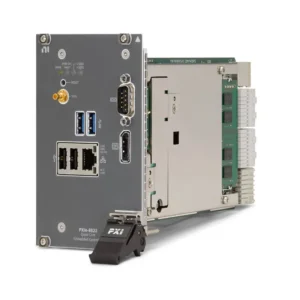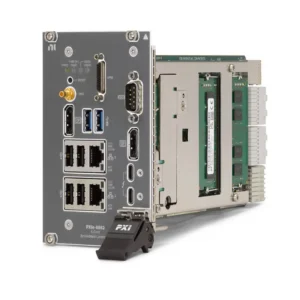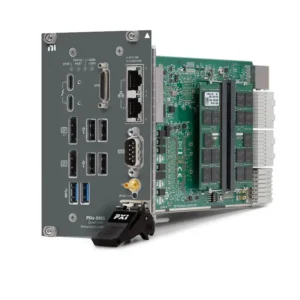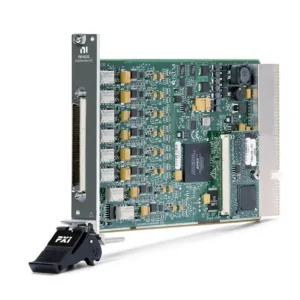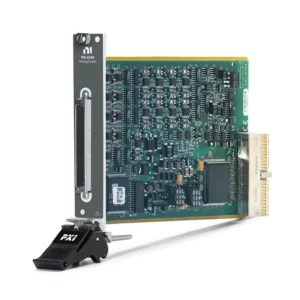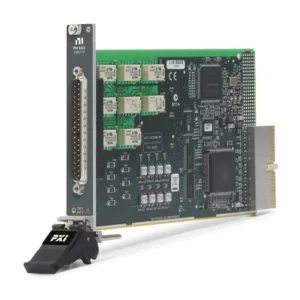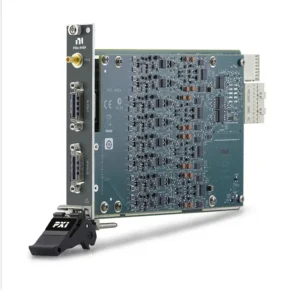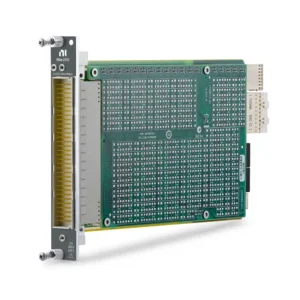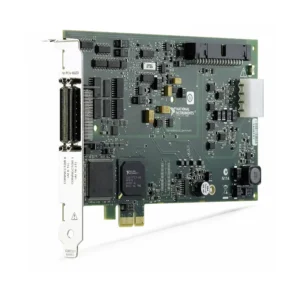




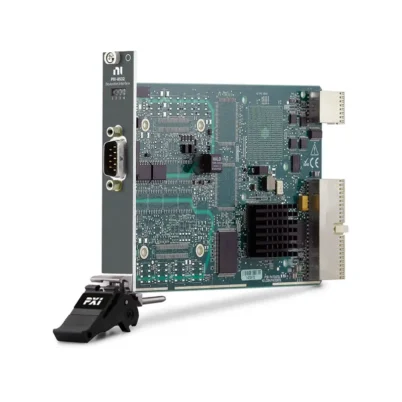
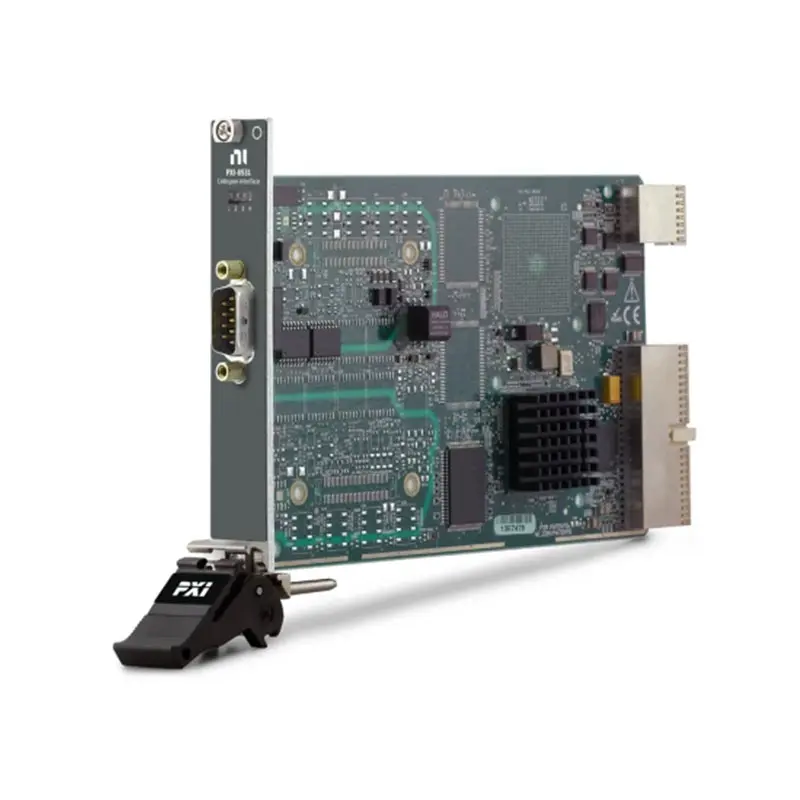
PXI-8531 1-Port PXI CANopen Interface Module
Земля PXI-8531 is a one-port PXI CANopen interface module designed for industrial automation, motion-oriented machine control and automated equipment testing. It provides a high-speed, isolated CAN physical interface and communicates with CANopen devices through the NI-Industrial Communications for CANopen driver.
The module supports process data objects and service data objects according to CiA DS301. It also provides electronic data sheet integration, a batch SDO editor and Layer Setting Services for configuring compatible CANopen slave nodes.
Key Features of the PXI-8531
- One high-speed CANopen communication port
- CANopen communication according to CiA DS301
- Process data object transmission and reception
- Service data object communication
- Network Management command support
- Electronic data sheet file integration
- Batch SDO configuration editor
- Layer Setting Services support
- 10 kbit/s to 1 Mbit/s CANopen baud rates
- NXP PCA82C251 high-speed CAN transceiver
- ISO 11898-compatible physical layer
- Galvanically isolated CAN interface
- 500 Vrms dielectric withstand isolation
- 60 VDC continuous isolation rating
- 9-pin male D-Sub connector
- PXI hybrid-bus interface
- Suitable for industrial, medical and transportation equipment
- NI-Industrial Communications for CANopen software support
PXI-8531 Technical Specifications
| Product Model | PXI-8531 |
|---|---|
| Part Number | 781061-01 |
| Product Type | PXI CANopen interface module |
| Number of CANopen Ports | 1 |
| CANopen Standard | CiA DS301 |
| Supported Communication Objects | PDO, SDO, NMT and supported CANopen services |
| Physical Layer | High-speed CAN |
| CAN Transceiver | NXP PCA82C251 |
| CAN Compatibility | ISO 11898 |
| Minimum Baud Rate | 10 kbit/s |
| Maximum Baud Rate | 1 Mbit/s |
| Supported CANopen Baud Rates | 10, 20, 50, 125, 250, 500, 800 kbit/s and 1 Mbit/s |
| CAN Bus-Line Range | −36 to +36 VDC |
| I/O Connector | 9-pin male D-Sub |
| Network Cable Impedance | 120 Ω nominal |
| Network Termination | 120 Ω resistor at each physical end of the bus |
| Port-to-Ground Withstand Isolation | 500 Vrms for 5 seconds |
| Port-to-Ground Continuous Isolation | 60 VDC, Measurement Category I |
| PXI Power Requirement at +5 V | 640 mA typical |
| PXI Power Requirement at +3.3 V | 940 mA typical |
| Шинный интерфейс | PXI hybrid |
| Enclosed Module | Да |
| Module Format | 3U, one-slot PXI module |
| Dimensions | 10.0 × 16.0 cm |
| Operating Temperature | 0°C to 55°C |
| Storage Temperature | −20°C to 70°C |
| Operating Humidity | 10% to 90%, noncondensing |
| Storage Humidity | 5% to 95%, noncondensing |
| Maximum Operating Altitude | 2,000 m |
| Operating Shock | 30 g peak, half-sine, 11 ms pulse |
| Operating Random Vibration | 5 to 500 Hz, 0.3 grms |
| Nonoperating Random Vibration | 5 to 500 Hz, 2.4 grms |
| Software Driver | NI-Industrial Communications for CANopen |
PXI-8531 Supported CANopen Baud Rates
| Baud Rate | Типичное использование |
|---|---|
| 10 kbit/s | Long-distance, low-speed industrial networks |
| 20 kbit/s | Extended-distance CANopen communication |
| 50 kbit/s | Long industrial bus segments |
| 125 kbit/s | General industrial automation |
| 250 kbit/s | Balanced distance and communication speed |
| 500 kbit/s | Machine control and faster process-data exchange |
| 800 kbit/s | Shorter, high-speed CANopen networks |
| 1 Mbit/s | High-speed communication over short bus lengths |
Maximum network length decreases as the communication rate increases. Determine the permitted bus length using the applicable CANopen and CAN physical-layer requirements for the selected cable and baud rate.
PXI-8531 Part Number and Accessories
| Item | Part Number | Описание |
|---|---|---|
| PXI-8531 | 781061-01 | One-port PXI CANopen interface module |
| DB9F-to-DB9F CAN Cable | 192017-02 | 2 m high-speed CAN cable with single termination |
| DB9F-to-DB9F CAN Cable | 193128-01 | 1 m unterminated cable for compatible CAN interfaces |
| DB9F-to-DB9F CAN Cable | 193128-02 | 2 m unterminated cable for compatible CAN interfaces |
| CAN Terminal Block | 780041-01 | Terminal accessory for CAN, CANopen and DeviceNet wiring |
| CANopen Network Cable | Application dependent | 120 Ω twisted-pair cable rated for the required baud rate and environment |
Select accessories according to the required cable length, connector gender, termination arrangement and CANopen network topology. Verify every cable pinout before connecting third-party equipment.
What Is CANopen?
CANopen is an application-layer communication protocol built on the CAN physical and data-link layers. It defines communication objects, network-management services, device configuration methods and standardized device profiles.
CANopen was originally developed for motion-oriented machine control but is also used in medical devices, mobile machinery, maritime electronics, public transportation, building automation and other embedded systems.
PXI-8531 CANopen Architecture
The PXI-8531 combines a high-speed CAN physical interface with firmware and software designed specifically for CANopen communication. The driver provides higher-level access to PDOs, SDOs, Network Management and node-configuration services.
This eliminates the need to manually construct every CAN frame when communicating with compliant CANopen devices.
CANopen Manager and Node Communication
The PXI-8531 is normally used by a CANopen application to manage and communicate with other nodes. It can configure remote devices, control network states and exchange process data with multiple nodes.
NI states that the PXI-8531 cannot itself be configured as a CANopen slave through the supported CANopen driver. LSS slave-node configuration means the module configures compatible external slave nodes; it does not turn the PXI-8531 into a slave device.
Process Data Objects
Process data objects provide efficient transfer of real-time process information. A transmit PDO sends data from a CANopen node, while a receive PDO delivers data to a node.
The PXI-8531 can transmit and receive PDO communication according to the CANopen configuration. Typical data includes position, velocity, control words, status words, sensor values and digital I/O states.
TPDO and RPDO Communication
| Object Type | Meaning | Typical Function |
|---|---|---|
| TPDO | Transmit Process Data Object | Data transmitted by a CANopen node |
| RPDO | Receive Process Data Object | Data received and processed by a CANopen node |
PDOs are designed for efficient process-data exchange and normally avoid the request-and-response overhead associated with configuration communication.
Service Data Objects
Service data objects provide access to entries in a CANopen node’s object dictionary. SDO communication is commonly used to read or write configuration values and diagnostic information.
Applications can use the PXI-8531 to access supported object indexes and subindexes in a connected device.
PDO vs SDO Communication
| Communication Type | Primary Purpose | Typical Data |
|---|---|---|
| PDO | Fast process-data exchange | Measurements, commands, status and control values |
| SDO | Configuration and object-dictionary access | Parameters, identity, calibration and diagnostic values |
Batch SDO Editor
The NI CANopen software includes a batch SDO editor for configuring multiple object-dictionary entries. Engineers can organize several SDO write or read operations rather than configuring each parameter separately in application code.
This is useful during device commissioning, production setup and restoration of known configuration values.
Electronic Data Sheet Integration
An electronic data sheet describes a CANopen device’s identity, communication features, object dictionary and supported parameters. The PXI-8531 software can integrate EDS information into the device-configuration workflow.
Using the correct EDS file makes parameter selection easier and reduces errors caused by manually entering object indexes, subindexes and data types.
EDS File Selection
Use an EDS file that matches the exact device model and firmware revision whenever possible. An incorrect or outdated file may omit supported objects or define values that do not match the connected device.
If communication works but configuration parameters are missing, compare the device identity and firmware against the EDS file supplied by the manufacturer.
Layer Setting Services
Layer Setting Services allow a CANopen manager to configure supported node parameters such as the node ID and communication rate. This can simplify commissioning when a device supports LSS.
LSS functionality depends on the connected slave device. Not every CANopen node implements all Layer Setting Services.
Network Management
CANopen Network Management controls node states such as initialization, pre-operational, operational and stopped. The PXI-8531 application can issue supported NMT commands to manage connected nodes.
A common commissioning sequence configures a node while it is pre-operational and then changes it to operational mode for normal PDO communication.
CANopen Node States
| Node State | Typical Purpose |
|---|---|
| Initialization | Node startup and internal initialization |
| Pre-operational | Configuration and SDO communication before process operation |
| Operational | Normal PDO and process-data communication |
| Stopped | Process communication disabled while limited management remains available |
High-Speed CAN Physical Layer
The module uses an NXP PCA82C251 high-speed CAN transceiver compatible with ISO 11898. It supports CANopen communication rates from 10 kbit/s through 1 Mbit/s.
The transceiver uses differential CAN_H and CAN_L signals for noise-resistant communication in industrial and mobile environments.
Galvanic Isolation
The PXI-8531 CANopen port is isolated from the PXI system to help protect connected computers and instruments from ground-potential differences and electrical transients.
The interface provides 500 Vrms dielectric withstand isolation verified by a five-second test and a 60 VDC continuous isolation rating for Measurement Category I circuits.
Isolation improves protection but does not replace correct grounding, shielding, surge suppression and equipment bonding.
CANopen Network Termination
A high-speed CANopen bus normally requires one 120 Ω termination resistor at each physical end of the main bus. The termination is connected across CAN_H and CAN_L.
Do not terminate every device on the network. Excessive termination reduces bus impedance and may prevent nodes from communicating.
Bus Topology
CANopen networks should use a linear bus with short branches to individual nodes. Avoid uncontrolled star wiring and long unterminated stubs because these can create signal reflections.
Higher communication rates require shorter bus lengths and shorter node branches. Review CANopen cabling requirements when selecting the network rate.
9-Pin D-Sub Interface
The PXI-8531 provides one male 9-pin D-Sub front-panel connector. The interface carries CAN_H, CAN_L, common and other supported CAN-related signals.
The same connector type is used by many CAN products, but pin assignments and termination arrangements can differ. Confirm compatibility before connecting third-party cables.
Motion-Control Applications
CANopen is widely used for drives, motor controllers and handling equipment. The PXI-8531 can configure drive parameters through SDO communication and exchange real-time command and status information through PDOs.
The PXI system can combine CANopen communication with position measurements, analog signals, digital I/O and automated test sequencing.
Drive and Motor Validation
The module can communicate with compatible servo drives, variable-frequency drives and motor controllers during development or production testing.
Test software can verify identity, operating modes, control words, status words, position values and fault behavior according to the connected device’s CANopen profile.
Industrial Machine Control
The PXI-8531 can integrate CANopen devices into a PC-based industrial control or monitoring system. Applicable devices may include sensors, actuators, remote I/O, encoders and machine-control components.
Critical safety functions should remain implemented using properly rated independent safety hardware rather than relying solely on a general-purpose PXI application.
Medical Equipment Testing
CANopen is used in certain medical and laboratory devices for communication between embedded components. The PXI-8531 can support automated configuration, functional validation and process-data monitoring.
The complete test system must follow all applicable safety, isolation and regulatory requirements for the equipment being tested.
Off-Road Vehicle Testing
Mobile machinery, construction equipment and agricultural vehicles may use CANopen for communication with drives, controllers and sensors. The PXI-8531 can communicate with these devices during subsystem or controller testing.
For applications using J1939, raw CAN databases or other automotive protocols instead of CANopen, select an NI-XNET CAN interface rather than assuming protocol compatibility.
Maritime Electronics
CANopen-based communication can be found in maritime control, propulsion and auxiliary systems. The PXI-8531 can support laboratory testing and validation of compatible nodes.
Environmental, electrical-isolation and marine-certification requirements apply to the complete system and are not determined solely by the interface module.
Public Transportation Systems
CANopen is used in some public transportation, railway and vehicle subsystems. The PXI-8531 can automate communication testing, parameter configuration and diagnostic data collection.
Test applications can compare network values with physical electrical measurements collected by other PXI modules.
Building Automation
The module can communicate with compatible CANopen building-automation devices, including controllers, drives, actuators and I/O modules.
A PXI test station can verify device configuration, communication behavior and field I/O response before installation or during product manufacturing.
Multiple CANopen Nodes
The PXI-8531 can communicate with multiple CANopen nodes on one properly designed bus. NI CANopen functions include a node ID input for selecting the destination device.
Every node must have a unique node ID and use the same baud rate. Duplicate addresses or mismatched speeds prevent reliable communication.
NI-Industrial Communications for CANopen
The required software driver is NI-Industrial Communications for CANopen. It provides LabVIEW VIs for PDO, SDO, NMT, EDS and LSS operations.
Confirm compatibility between the selected driver, LabVIEW version, controller operating system and PXI-8531 before installation.
NI Linux Real-Time Support
Support for the PXI-8531 on NI Linux Real-Time depends on the installed LabVIEW and CANopen driver versions. For example, later driver releases added Linux Real-Time support for compatible PXI controllers.
Verify the official compatibility table before upgrading an existing controller or deploying a new real-time system.
Free-Running Module Clock
The CANopen driver obtains system time during session initialization. After initialization, the PXI-8531 uses its own free-running clock rather than remaining continuously synchronized with the host or PXI chassis clock.
Long-duration tests may therefore show timestamp drift between the module and host computer. If precise time correlation is required, use another timestamp source or periodically restart the CANopen session according to the application design.
PXI Hybrid Chassis Integration
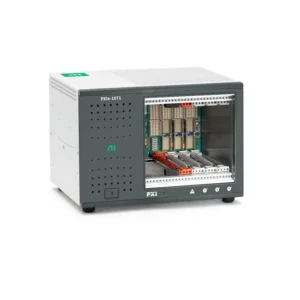
The PXI-8531 uses a PXI hybrid bus interface and occupies one 3U chassis slot. It can operate alongside measurement, motion, digital I/O and switching modules.
Before installation, verify chassis slot compatibility, cooling, controller communication and the required software versions.
PXI-8531 Is Not a Basic NI-XNET CAN Interface
The PXI-8531 is designed for CANopen and does not use the NI-XNET driver. NI states that it cannot be used for ordinary DBC-based CAN communication through NI-XNET.
Select a module such as the PXI-8512 CAN interface или PXI-8513 software-selectable CAN interface when the application requires raw CAN, CAN FD or DBC database support.
Typical PXI-8531 Applications
- CANopen network development
- Motion-control system testing
- Servo-drive validation
- Motor-controller testing
- Промышленная автоматизация
- Handling-system control
- Remote I/O validation
- CANopen sensor testing
- Embedded controller development
- Medical equipment testing
- Off-road vehicle validation
- Maritime electronics testing
- Public transportation systems
- Building-automation testing
- Production end-of-line testing
Production Test Systems
In production systems, the PXI-8531 can identify a CANopen device, load configuration parameters, exchange process data and confirm diagnostic behavior.
PXI instrumentation can simultaneously measure analog, digital or power signals, allowing network behavior and physical device performance to be verified in one test sequence.
PXI-8531 Troubleshooting
The PXI-8531 is not detected in NI MAX
Confirm that the module is fully installed in a compatible PXI or hybrid slot. Check chassis power, controller communication and installation of NI-Industrial Communications for CANopen.
The CANopen network does not become operational
Verify CAN_H and CAN_L wiring, cable continuity, bus termination and the selected baud rate. Confirm that every node has a unique ID and that the devices are powered.
PDO data is not received
Check the PDO communication parameters, COB-ID, mapping, transmission type and node state. Many nodes must be placed in operational mode before PDO communication begins.
SDO communication fails
Verify the node ID, object index, subindex and data type. Confirm that the object is supported and that the node permits the requested read or write operation.
The EDS file does not match the device
Check the vendor ID, product code, revision and firmware version. Obtain a matching EDS file from the device manufacturer and import it again.
LSS cannot change the node ID
Confirm that the slave device supports the required LSS service and is in the correct state. Some devices use hardware switches or manufacturer-specific configuration instead of LSS.
The module cannot be configured as a CANopen slave
This is expected behavior. NI does not support operating the PXI-8531 itself as a CANopen slave through NI-Industrial Communications for CANopen.
Basic CAN or DBC communication does not work
The PXI-8531 is a CANopen-specific interface and does not support basic DBC-based CAN communication through NI-XNET. Use a compatible NI-XNET CAN module for that application.
Timestamps drift during a long test
The module clock runs independently after CANopen session initialization. Use a separate synchronized timestamp source or periodically restart the session if the application requires closer host-time correlation.
The module appears as the wrong model in NI MAX
The PXI-8531 and certain NI-XNET CAN modules use similar hardware but different firmware. If the displayed model does not match the installed hardware, contact NI regarding firmware verification or service.
PXI-8531 Comparison with Similar Communication Modules
| Модель | Interface | Primary Software | Best Suited For |
|---|---|---|---|
| PXI-8531 | One-port CANopen | NI-Industrial Communications for CANopen | PDO, SDO, EDS and LSS-based CANopen applications |
| PCI-8531 | One-port CANopen | NI-Industrial Communications for CANopen | CANopen communication from a desktop or industrial PC |
| PXI-8532 | One-port DeviceNet | NI-Industrial Communications for DeviceNet | DeviceNet scanner and slave applications |
| PXI-8512 | High-speed CAN and CAN FD | NI-XNET | Raw CAN, CAN FD and DBC database applications |
| PXI-8513 | Software-selectable CAN and CAN FD | NI-XNET | Systems requiring flexible CAN transceiver support |
| NI-9881 | One-port CANopen | NI-Industrial Communications for CANopen | CompactRIO and C Series CANopen applications |
PXI-8531 vs PXI-8532
The PXI-8531 is designed for CANopen, while the PXI-8532 is designed for DeviceNet. Both protocols use a CAN-based physical layer, but their application layers, configuration methods and drivers are different.
Choose the PXI-8531 for CANopen PDO, SDO, EDS and LSS workflows. Choose the PXI-8532 DeviceNet interface for DeviceNet master/scanner or slave applications.
PXI-8531 vs PXI-8512
The PXI-8531 provides a higher-level CANopen interface through NI-Industrial Communications for CANopen. The PXI-8512 supports general CAN and CAN FD communication through NI-XNET.
Select the PXI-8531 when the device uses CANopen object dictionaries, PDOs and SDOs. Select the PXI-8512 when the application uses raw CAN frames, DBC databases or CAN FD.
PXI-8531 vs PCI-8531
The PXI-8531 and PCI-8531 provide similar one-port CANopen functions. Their primary difference is the computer bus and physical format.
Choose the PXI-8531 for a modular PXI test or automation platform. Choose the PCI-8531 for a compatible desktop or industrial PC with a conventional PCI slot.
Recommended Related Products
- PCI-8531 1-Port CANopen Interface Device
- PXI-8532 1-Port DeviceNet Interface Module
- PXI-8512 High-Speed CAN Interface Module
- PXI-8513 Software-Selectable CAN Interface Module
- NI-9881 C Series CANopen Interface Module
- PXIe-8510 Vehicle Multiprotocol Interface Module
- View More NI PXI and PXI Express Modules
Selecting the Right CAN Interface
Choose the PXI-8531 when the application specifically requires CANopen communication, including PDO, SDO, EDS and LSS services in a PXI system.
Select a general-purpose NI-XNET CAN module when the application requires raw CAN frames, DBC files, CAN FD or development of a custom CAN-based protocol. Choose the PXI-8532 when the industrial network uses DeviceNet rather than CANopen.
Why Choose the PXI-8531?
- Adds CANopen communication to a PXI platform
- Supports PDO and SDO communication
- Operates according to CiA DS301
- Integrates EDS files into device configuration
- Provides batch SDO editing
- Supports LSS configuration of compatible nodes
- Supports rates from 10 kbit/s to 1 Mbit/s
- Provides an isolated high-speed CAN interface
- Supports industrial and motion-control applications
- Integrates network data with PXI measurements
Frequently Asked Questions
What is the PXI-8531?
The PXI-8531 is a one-port PXI CANopen interface module for industrial automation, motion control and CANopen device testing.
What is the PXI-8531 part number?
The standard NI part number for the PXI-8531 is 781061-01.
Which CANopen standard does it support?
The module supports PDO and SDO communication according to CiA DS301.
Which baud rates are supported?
The PXI-8531 supports 10, 20, 50, 125, 250, 500 and 800 kbit/s as well as 1 Mbit/s.
Does it support PDO communication?
Yes. The module can transmit and receive process data objects for efficient process-data exchange.
Does it support SDO communication?
Yes. SDO functions provide access to supported entries in a CANopen node’s object dictionary.
Does the PXI-8531 support EDS files?
Yes. NI-Industrial Communications for CANopen provides EDS integration and a batch SDO editor for device configuration.
Does it support Layer Setting Services?
Yes. The module can use LSS to configure supported external slave nodes, including parameters such as node ID and baud rate.
Can the PXI-8531 operate as a CANopen slave?
No. NI states that the PXI-8531 cannot itself operate as a CANopen slave through the supported CANopen driver.
Can it be used for basic CAN communication?
No. The PXI-8531 does not support ordinary DBC-based CAN communication through NI-XNET. Use an NI-XNET CAN interface for basic CAN or CAN FD applications.
Which driver controls the PXI-8531?
The required driver is NI-Industrial Communications for CANopen.
What connector does the module use?
The PXI-8531 provides one male 9-pin D-Sub connector for its isolated high-speed CANopen interface.
Does the module clock remain synchronized with the PXI controller?
No. After initialization, the PXI-8531 uses a free-running clock. Long-duration tests may show timestamp drift relative to the host computer.
Request a Quote for the PXI-8531
Contact us for current availability, lead time and project pricing for the PXI-8531 1-Port PXI CANopen Interface Module. We can also help identify compatible CAN cables, terminal accessories, PXI chassis and related NI industrial communication modules for your automation or test system.