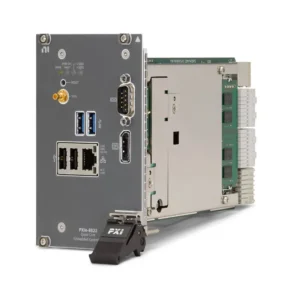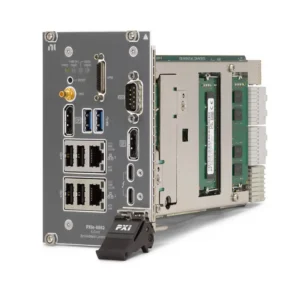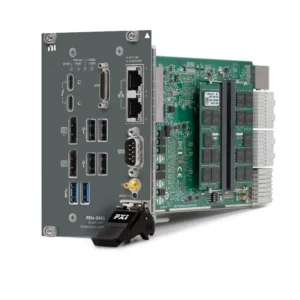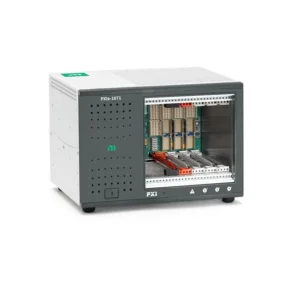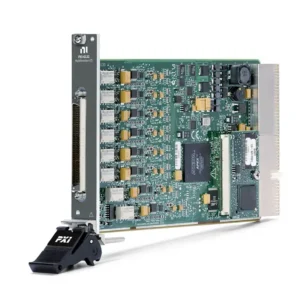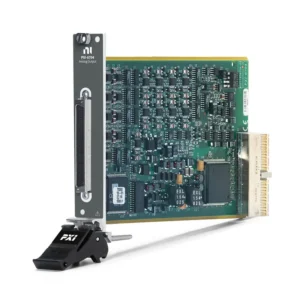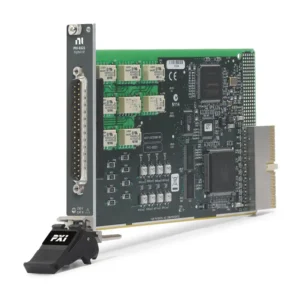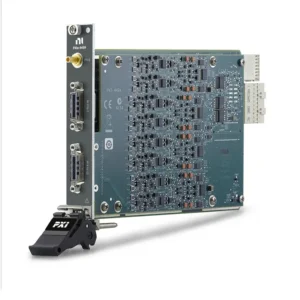


NI-5791 4.4 GHz RF Transceiver Adapter Module
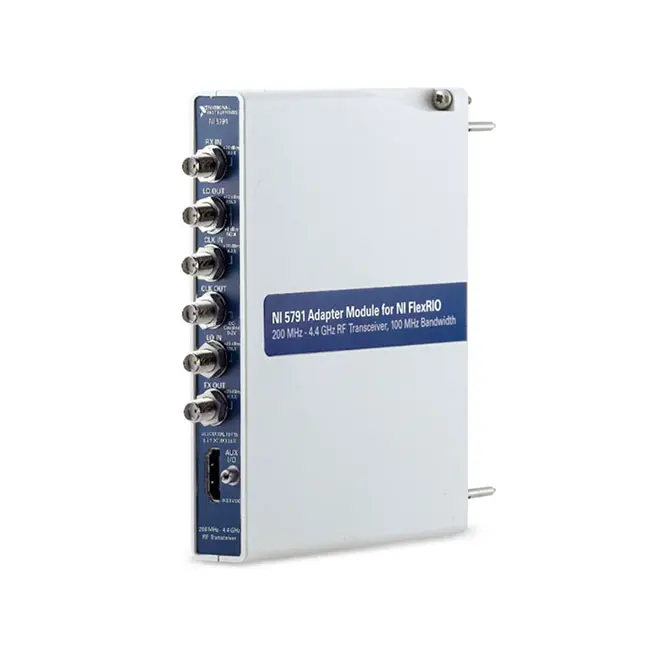
Земля NI-5791 is a radio-frequency transceiver adapter module for FlexRIO that provides continuous frequency coverage from 200 MHz to 4.4 GHz. It combines RF upconversion and downconversion with 100 MHz instantaneous bandwidth for custom wireless, radar and spectrum-processing applications.
A single-stage direct-conversion architecture provides wide bandwidth in the compact FlexRIO adapter format. The onboard local oscillator can tune acquisition and generation frequency or be imported and exported for synchronization across multiple modules.
Key Features of the NI-5791
- 200 MHz to 4.4 GHz RF frequency coverage
- RF generation and analysis
- 100 MHz instantaneous receive bandwidth
- 100 MHz instantaneous transmit bandwidth
- Single-stage direct-conversion architecture
- +20 dBm maximum analyzer input-power specification
- +8 dBm maximum RF output power
- -148 dBm/Hz input noise density
- Onboard local oscillator synthesizer
- External LO input and LO output
- Synchronization of as many as eight modules
- FPGA-based signal processing through FlexRIO
- Compatible with Kintex-7 FlexRIO FPGA modules
NI-5791 Technical Specifications
| Product Model | NI-5791 |
|---|---|
| Part Number | 782510-01 |
| Product Type | RF transceiver adapter module for FlexRIO |
| RF Frequency Range | 200 MHz to 4.4 GHz |
| Receive Instantaneous Bandwidth | 100 MHz |
| Transmit Instantaneous Bandwidth | 100 MHz |
| Conversion Architecture | Single-stage direct conversion |
| Maximum Input Power | +20 dBm |
| Maximum Output Power | +8 dBm |
| Input Noise Density | -148 dBm/Hz |
| Local Oscillator | Onboard synthesizer with import and export capability |
| Maximum Directly Synchronized Modules | Up to 8 with supported LO configuration |
| Compatible FPGA Architecture | Kintex-7 FlexRIO |
| RF Connectors | SMA, function dependent |
| System Platform | PXI FlexRIO |
Direct-Conversion RF Architecture
The direct-conversion design translates RF signals directly between the selected carrier frequency and complex baseband I/Q data. This architecture provides wide instantaneous bandwidth with a relatively compact analog signal path.
Direct-conversion systems require correction for effects such as LO leakage, DC offset, I/Q gain imbalance and quadrature error. The applicable NI software and calibration process provide correction mechanisms for supported configurations.
RF Generation and Acquisition
The receive path downconverts RF signals for digitization and FPGA processing, while the transmit path converts FPGA-generated complex waveforms to the selected RF frequency.
Developers can implement custom modulation, demodulation, channelization, pulse detection, spectral processing and closed-loop RF algorithms inside the paired FPGA.
100 MHz Instantaneous Bandwidth
The 100 MHz instantaneous bandwidth supports wideband communication signals, radar pulses and spectrum-monitoring applications. It allows the system to acquire or generate a continuous span without repeatedly retuning across narrower segments.
Local Oscillator Synchronization
The onboard synthesizer determines the transmit and receive center frequency. Its LO can be exported to other NI-5791 modules, or an external LO can be imported to create a shared phase-coherent frequency reference.
Up to eight modules can be synchronized through supported LO connections. Systems with additional modules or longer distribution paths may require an external LO distribution amplifier.
NI-5791 Part Number and Accessories
| Item | Part Number | Описание |
|---|---|---|
| NI-5791 | 782510-01 | 4.4 GHz, 100 MHz bandwidth FlexRIO RF transceiver adapter |
| High-Performance SMA Cable | Included cable, configuration dependent | Approximately 7-inch SMA-to-SMA RF cable assembly |
| PXIe-7971R | 782953-01 | Kintex-7 K325T FlexRIO FPGA module |
| PXIe-7972R | 782954-01 | Kintex-7 FlexRIO module with onboard memory |
| PXIe-7975R | 782955-01 | Kintex-7 K410T FlexRIO FPGA module |
| PXIe-7976R | 783625-01 | Kintex-7 K410T FlexRIO module with 2 GB DRAM |
| External Attenuator | Application dependent | Protects the RF input and sets the appropriate measurement level |
NI-5791 Applications
- Software-defined radio
- Радарное прототипирование
- Electronic warfare research
- Wireless communications research
- Мониторинг спектра
- MIMO prototyping
- Custom modulation and demodulation
- RF record and playback
- Direction-finding research
- Real-time RF signal processing
Software-Defined Radio
The paired FPGA can perform modulation, filtering, channelization and demodulation with deterministic timing. The host computer can manage higher-level control, visualization and data storage.
MIMO and Phase-Coherent Systems
LO import and export enable multiple transceivers to share a frequency reference. Phase-coherent performance also requires aligned sample clocks, synchronized triggering and appropriate calibration of the complete RF signal paths.
Radar and Electronic Warfare
The NI-5791 can generate and capture wideband pulses or modulated RF signals while the FPGA performs low-latency detection and processing. External amplification, attenuation and filtering may be needed to match the application’s power and frequency plan.
NI-5791 Installation Workflow
Step 1: Select the FPGA Module
Choose a compatible Kintex-7 FlexRIO FPGA module with adequate logic and DRAM for the required signal-processing design.
Step 2: Assemble the FlexRIO System
Power down the chassis and attach the NI-5791 adapter to the FPGA module according to the hardware instructions.
Step 3: Install the Software
Install compatible FlexRIO support, LabVIEW FPGA and the required NI-579x component-level IP or host libraries.
Step 4: Connect RF and LO Signals
Use clean, frequency-rated SMA cables and add attenuation before the receive input when the source level is uncertain.
Step 5: Configure Frequency and Reference
Select the center frequency, gain, reference level, onboard or external LO and trigger configuration.
Step 6: Align and Calibrate the Channels
Perform the required I/Q correction, LO alignment and multichannel phase calibration before making precision measurements.
NI-5791 Troubleshooting
The RF input appears overloaded
Disconnect the source and independently verify its power. Add attenuation before reconnecting and remain below the input limit.
The transmitted signal contains LO leakage
Run the applicable I/Q impairment correction and verify that the configured center frequency, gain and calibration data match the hardware.
Two modules are not phase coherent
Confirm common LO, sample-clock and trigger distribution. RF cable phase and channel alignment must also be calibrated.
The FPGA compilation does not recognize the adapter
Verify the FlexRIO support version, compatible FPGA module and correct NI-5791 component-level IP selection.
The measured bandwidth is lower than expected
Review FPGA sample-rate settings, digital filtering, RF gain, external filters and the frequency response of every cable and accessory.
NI-5791 Comparison
| Модель | Конфигурация | Best Suited For |
|---|---|---|
| NI-5791 | 200 MHz to 4.4 GHz, 100 MHz RF transceiver | Custom FPGA-based RF systems |
| NI-5792 | Related FlexRIO RF transceiver configuration | Applications requiring different RF performance |
| NI-5793 | Higher-frequency FlexRIO RF adapter | Microwave signal-processing applications |
| NI-5783 | Four-channel baseband analog transceiver | Direct analog input and output below RF frequencies |
| PXIe-5840 | Integrated PXI Vector Signal Transceiver | Standard instrument-driver-based RF testing |
NI-5791 Versus an Integrated VST
The NI-5791 is best suited to applications requiring direct access to FPGA processing and custom RF behavior. An integrated vector signal transceiver may be easier to deploy when standard RF generation, analysis and RFmx measurements are the primary requirements.
NI-5791 Frequently Asked Questions
What frequency range does the NI-5791 cover?
It provides continuous RF frequency coverage from 200 MHz to 4.4 GHz.
What is its instantaneous bandwidth?
Both the transmit and receive paths provide up to 100 MHz of instantaneous bandwidth.
What is the maximum RF output power?
The specified maximum output power is +8 dBm.
Can multiple NI-5791 modules be synchronized?
Yes. The LO can be imported or exported to synchronize up to eight modules in a supported configuration.
Does the NI-5791 work by itself?
No. It requires a compatible FlexRIO FPGA module and the appropriate software and FPGA design.
Is it suitable for MIMO development?
Yes. Its shared-LO capabilities and FPGA architecture support MIMO prototyping when clock, trigger and channel alignment are configured correctly.
Request a Quote for the NI-5791
Contact us for availability, lead time and project pricing for the NI-5791 RF transceiver adapter, part number 782510-01. We can also help select compatible FlexRIO FPGA modules, SMA cables, attenuators and PXI Express chassis.