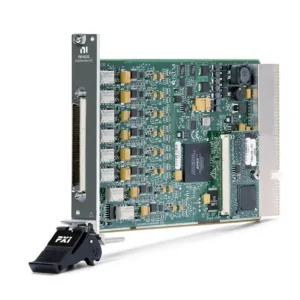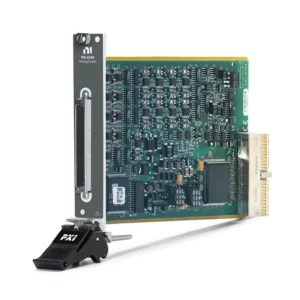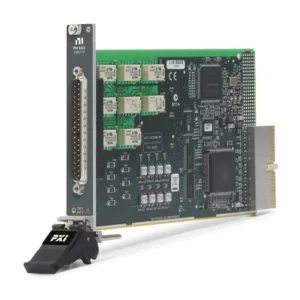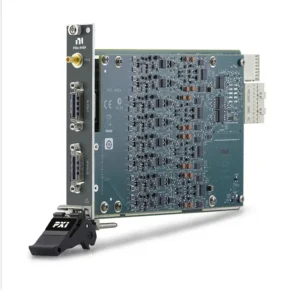




Product Introduction
Земля NI USB-7855R, also commonly referenced as USB-7855, is an R Series Multifunction Reconfigurable I/O (RIO) device designed for hardware-in-the-loop (HIL) testing, sensor simulation, custom protocol communication, high-speed control, automated test, and FPGA-based measurement applications.
The USB-7855R combines multifunction analog and digital I/O with a user-programmable Xilinx Kintex-7 70T FPGA. It supports analog input sampling rates up to 1 MS/s and provides direct FPGA control over I/O signals for deterministic timing, synchronization, triggering, and real-time processing.
Unlike conventional multifunction DAQ devices, the USB-7855R features a dedicated A/D converter per analog input channel. This architecture enables independent channel timing, individual channel triggering, and multirate sampling for advanced measurement and control systems.
Product Overview
Земля National Instruments USB-7855R belongs to the NI R Series Multifunction RIO family and connects to a host computer through Hi-Speed USB 2.0.
A typical system architecture is:
Sensors / DUT → USB-7855R I/O → Kintex-7 FPGA → USB → Host Computer
Critical measurement, timing, triggering, signal-processing, and control functions can execute directly on the FPGA rather than relying entirely on the host operating system.
This architecture makes the USB-7855R particularly useful for applications requiring deterministic hardware behavior while retaining the convenience of an external USB-connected device.
Key Features
Kintex-7 70T FPGA
The USB-7855R incorporates a user-programmable Xilinx Kintex-7 70T FPGA.
The FPGA can implement application-specific hardware functions such as:
- Custom triggering
- Детерминированные управляющие контуры
- Signal processing
- Пользовательские цифровые протоколы
- Sensor simulation
- Event detection
- Custom timing engines
- Hardware interlocks
- Parallel processing
- Data reduction
1 MS/s Analog Input Sampling
The USB-7855R supports analog input sampling rates up to 1 MS/s.
This acquisition performance is suitable for high-speed control, HIL testing, dynamic measurements, sensor simulation, and automated test applications requiring deterministic FPGA processing.
Dedicated ADC per Analog Input Channel
A major advantage of the USB-7855R is its dedicated A/D converter per analog input channel.
Unlike multiplexed DAQ hardware, individual channels do not need to share one ADC through a multiplexer.
This architecture enables:
- Independent channel timing
- Individual channel triggering
- Multirate sampling
- Parallel acquisition
- Deterministic FPGA processing
Multirate Sampling
The USB-7855R supports FPGA-based multirate sampling, allowing different measurement functions to operate at different rates according to application requirements.
Например:
High-Speed Acquisition → Critical Signals
Medium-Speed Acquisition → Control Signals
Low-Speed Acquisition → System Monitoring
This flexibility is particularly valuable in HIL and complex automated test systems.
Individual Channel Triggering
The dedicated ADC architecture allows application designs with individual channel triggering.
This provides greater flexibility than conventional DAQ devices when different signals require independent acquisition conditions.
USB 2.0 Interface
The USB-7855R connects to a host computer through USB 2.0 Hi-Speed or Full-Speed.
For maximum device performance, a Hi-Speed USB connection should be used. Operating through a Full-Speed bus can reduce performance and may prevent the device from reaching maximum sampling or update rates.
External R Series Architecture
Unlike PCI Express and PXI Express R Series devices, the USB-7855R is an external instrument.
This makes it suitable for:
- Desktop test systems
- Laboratory benches
- Prototype development
- Portable FPGA test systems
- Systems without an available PCI Express slot
Deterministic FPGA Processing
Measurement and control algorithms can execute directly in FPGA hardware.
A simplified control architecture is:
Input Signal → FPGA Algorithm → Decision Logic → Output Response
This reduces dependence on nondeterministic host operating-system timing for critical control functions.
Technical Specifications
| Параметр | Спецификация |
|---|---|
| Product Type | R Series Multifunction Reconfigurable I/O Device |
| Модель | USB-7855 / USB-7855R |
| Manufacturer | Национальные инструменты |
| ФПГА | Xilinx Kintex-7 70T |
| Maximum Analog Input Sample Rate | 1 MS/s |
| ADC Architecture | Dedicated ADC per Analog Input Channel |
| Host Interface | USB 2.0 Hi-Speed / Full-Speed |
| Data Transfer | DMA, Interrupts and Programmed I/O |
| DMA Channels | 3 |
| FPGA Programmable | Да |
| Multirate Sampling | Supported |
| Individual Channel Triggering | Supported |
| I/O Connectors | 2 × 68-Pin VHDCI |
| Input Power | 9 V to 30 V |
| Maximum Power | 20 W |
| Dimensions | 18.5 cm × 17.3 cm × 3.6 cm |
| Weight | Approximately 1,000 g |
| Primary Programming Environment | LabVIEW FPGA |
| Primary Applications | HIL Testing, Sensor Simulation, Custom Protocols, High-Speed Control and Automated Test |
How Does the USB-7855R Work?
The USB-7855R combines physical I/O with an onboard FPGA that can directly process acquired signals and control outputs.
A simplified measurement architecture is:
Physical Signal → Analog / Digital I/O → Kintex-7 FPGA → Custom Processing → USB → Host Computer
For deterministic control applications:
Sensor Input → FPGA → Control Algorithm → Output → DUT / System
Because critical logic can execute directly on the FPGA, the host computer does not need to participate in every time-critical measurement or control operation.
What Is an R Series Multifunction RIO Device?
An R Series Multifunction RIO device combines analog and digital I/O resources with a user-programmable FPGA.
Traditional DAQ devices generally provide predefined hardware functions, while R Series devices allow engineers to customize significant portions of device behavior.
Custom FPGA functionality can include:
- Measurement timing
- Trigger logic
- Control algorithms
- Signal processing
- Custom protocols
- Цифровое формирование сигналов
- Защитные блокировки
- Event detection
Why Use FPGA-Based I/O?
FPGA-based I/O is useful when an application requires deterministic response, parallel processing, or specialized hardware behavior.
A conventional software-controlled architecture may operate as:
Sensor → DAQ → USB → Operating System → Application → Decision
With the USB-7855R, time-critical processing can instead operate as:
Sensor → FPGA → Decision → Output
The host computer can then handle higher-level functions such as configuration, visualization, data logging, reporting, and user interaction.
Hardware-in-the-Loop Testing
Hardware-in-the-loop testing is one of the primary applications for the USB-7855R.
In an HIL system, FPGA-based I/O can interact with a controller or embedded device while reproducing the electrical behavior of sensors, actuators, or other parts of the simulated system.
Типичные применения включают:
- ECU testing
- Embedded controller validation
- Power electronics testing
- Industrial controller testing
- Prototype validation
- Control algorithm testing
Sensor Simulation
The USB-7855R can be used to develop deterministic sensor simulation interfaces.
FPGA logic can generate or process signals representing:
- Analog sensors
- Position sensors
- Speed sensors
- Pulse-output sensors
- Encoder-type signals
- Custom digital sensors
Actual sensor simulation capability depends on the electrical requirements of the target interface and may require additional external signal conditioning.
Custom Protocol Communication
Direct FPGA access to digital I/O allows engineers to implement application-specific communication protocols.
Typical applications can include:
- Proprietary digital protocols
- Custom serial interfaces
- Parallel communication
- Legacy equipment interfaces
- Custom command and response protocols
- FPGA-controlled digital sequences
High-Speed Control
The USB-7855R can execute control algorithms directly on its Kintex-7 FPGA.
A typical closed-loop architecture is:
Sensor → FPGA Measurement → Control Algorithm → Output → Plant / DUT
This architecture can provide predictable timing for applications where host-based software control is not sufficiently deterministic.
Parallel FPGA Processing
The FPGA can execute multiple independent hardware operations in parallel.
Например:
- Acquire analog signals
- Monitor digital inputs
- Evaluate trigger conditions
- Execute control calculations
- Generate outputs
- Communicate with the host
Parallel processing is a major advantage of FPGA-based R Series hardware compared with sequential software execution.
Custom Triggering
The programmable FPGA allows trigger conditions to be customized according to the application rather than relying only on standard fixed trigger functions.
Trigger logic can evaluate:
- Analog thresholds
- Digital states
- Multiple input conditions
- Timing relationships
- Sequential events
- Application-specific algorithms
USB-7855R vs Conventional USB DAQ
| Функция | USB-7855R | Conventional USB DAQ |
|---|---|---|
| User-Programmable FPGA | Да | Usually No |
| Custom Hardware Timing | Да | Fixed Functions |
| Custom Trigger Logic | FPGA Programmable | Predefined |
| Deterministic Processing | On FPGA | Primarily Host-Based |
| Multirate Sampling | Supported | Device Dependent |
| Individual Channel Triggering | Supported | Usually Limited |
| Custom Protocols | Supported Through FPGA | Ограниченный |
| Typical Application | HIL / FPGA Control / Simulation | General Data Acquisition |
USB-7855R vs USB-7856R
The USB-7855R and USB-7856R belong to the same generation of USB R Series Multifunction RIO devices.
The primary selection consideration is the amount of FPGA resources required by the application. The USB-7855R uses a Kintex-7 70T FPGA, while the USB-7856R provides a larger FPGA configuration for more demanding FPGA applications.
When choosing between them, consider:
- FPGA logic utilization
- DSP requirements
- Number of parallel processing functions
- Existing LabVIEW FPGA code
- Control-loop complexity
- Custom protocol complexity
- Future FPGA expansion requirements
USB-7855R vs PCIe-7856
| Функция | USB-7855R | PCIe-7856 |
|---|---|---|
| Form Factor | External | Internal Card |
| Host Interface | USB 2.0 | PCI Express |
| FPGA Family | Kintex-7 | Kintex-7 |
| User-Programmable FPGA | Да | Да |
| Typical Advantage | Easy External Connectivity | PCI Express System Integration |
| Primary Application | FPGA Measurement and Control | FPGA Measurement and Control |
USB-7855R Connectivity
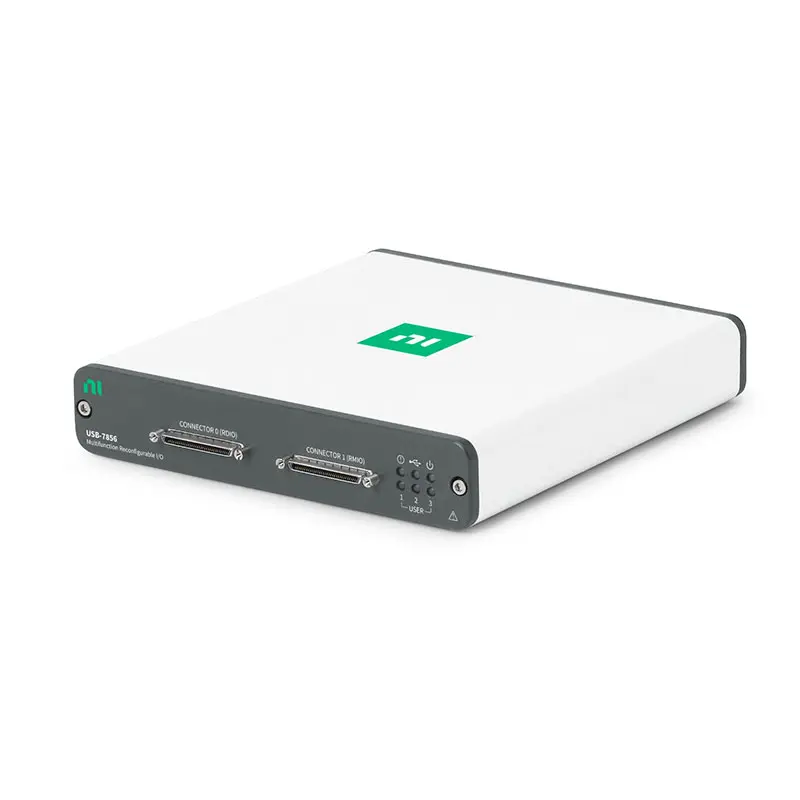
The USB-7855R provides two 68-pin VHDCI I/O connectors.
Compatible NI connectivity options include:
- SHC68-68-RMIO cable for multifunction I/O
- SHC68-C68-RDIO2 cable for digital I/O
- SHC68-NT-S unterminated cable for custom wiring
- SCB-68 / SCB-68A connector block for applicable multifunction I/O connections
- SCB-68 HSDIO connector block for applicable digital connections
The exact cable and connector configuration should always be verified before replacing or integrating the device.
USB Interface and Data Transfer
The USB-7855R supports USB 2.0 Hi-Speed and Full-Speed operation.
NI specifies support for:
- DMA transfers
- Interrupt transfers
- Programmed I/O
- Three DMA channels
A Hi-Speed USB connection should be used when maximum acquisition and update performance is required.
Power Requirements
The USB-7855R requires an external DC power source.
| Параметр | Спецификация |
|---|---|
| Входное напряжение | 9 V to 30 V |
| Maximum Power | 20 W |
| Overvoltage Protection | 40 V |
Use an appropriate power supply that meets the device requirements and applicable safety specifications.
LabVIEW FPGA Integration
The USB-7855R can be customized using the LabVIEW FPGA Module.
LabVIEW FPGA allows engineers to implement FPGA functionality including:
- Custom I/O timing
- Digital communication
- Signal processing
- Trigger logic
- Control loops
- Event detection
- Hardware interlocks
- Custom state machines
When maintaining an existing system, verify compatibility between the LabVIEW version, FPGA compilation tools, R Series driver, and USB-7855R hardware before changing the development environment.
Legacy System Replacement
The USB-7855R is now a legacy R Series device and may be encountered in existing HIL, laboratory, industrial, and automated test systems.
When replacing an existing USB-7855R, verify:
- Exact model and hardware revision
- FPGA target
- Existing FPGA bitfile
- Analog I/O requirements
- Digital I/O requirements
- Connector assignments
- SHC68 cable models
- Terminal blocks
- USB interface
- Power supply requirements
- LabVIEW version
- LabVIEW FPGA version
- FPGA compilation tools
- NI R Series driver compatibility
- Operating system compatibility
An alternative R Series model should not be treated as a drop-in replacement until hardware I/O, FPGA resources, software, cabling, timing, and application compatibility have been verified.
How to Choose an R Series Device
Before selecting the USB-7855R or a replacement R Series device, evaluate:
- Required analog I/O
- Required analog sample rate
- FPGA resource requirements
- Digital I/O requirements
- Required deterministic loop rate
- Individual channel timing requirements
- Custom triggering requirements
- Sensor simulation requirements
- Custom protocol requirements
- HIL application requirements
- USB versus PCIe or PXIe architecture
- Cable and terminal block compatibility
- Existing LabVIEW FPGA code
- Driver and operating system compatibility
Industries
- Automotive Testing
- Аэрокосмическая и оборонная промышленность
- Промышленная автоматизация
- Embedded Systems
- Power Electronics
- Automated Test
- Electronic Validation
- Research and Development
- Control-System Development
- Laboratory Automation
Applications
Hardware-in-the-Loop Testing
The USB-7855R provides FPGA-based deterministic I/O for HIL systems used to validate controllers, embedded systems, ECUs, and other electronic control hardware.
Sensor Simulation
Programmable FPGA logic can reproduce compatible analog and digital sensor behavior for controller and DUT validation.
Custom Protocol Communication
FPGA-controlled I/O can implement proprietary or application-specific communication protocols that cannot be easily implemented using conventional fixed-function DAQ hardware.
High-Speed Control
Time-critical control algorithms can execute directly on the Kintex-7 FPGA for predictable hardware response.
Automated Test
Custom FPGA logic can coordinate measurement, stimulus, triggering, digital control, and DUT response processing within an automated test system.
Research and Prototyping
The external USB form factor and reconfigurable FPGA architecture make the USB-7855R useful for laboratory development, research, and prototype test systems.
Recommended Related Products
| USB-7855R | 1 MS/s USB R Series multifunction reconfigurable I/O device with Kintex-7 70T FPGA. |
| USB-7856R | Related USB R Series device with increased FPGA resources for more complex FPGA applications. |
| USB-7846R | USB R Series multifunction RIO option for FPGA-based measurement, control, and HIL applications. |
| PCIe-7856 | PCI Express R Series multifunction RIO device for systems requiring internal computer integration. |
| PXIe-7856 | PXI Express R Series module for modular automated test, HIL, and synchronized measurement systems. |
Why Choose USB-7855R?
- Xilinx Kintex-7 70T FPGA
- User-programmable FPGA architecture
- Up to 1 MS/s analog input sampling
- Dedicated ADC per analog input channel
- Independent channel timing
- Individual channel triggering
- Multirate sampling
- Deterministic FPGA processing
- Custom hardware triggering
- Custom protocol implementation
- Hardware-in-the-loop testing
- Sensor simulation
- High-speed control
- USB 2.0 connectivity
- External desktop architecture
- LabVIEW FPGA integration
Frequently Asked Questions
What is the NI USB-7855R?
The NI USB-7855R is an R Series multifunction reconfigurable I/O device featuring a user-programmable Kintex-7 70T FPGA and up to 1 MS/s analog input sampling for deterministic measurement and control applications.
Is USB-7855 the same as USB-7855R?
NI documentation commonly refers to the hardware as USB-7855 or USB-7855R. The “R” identifies the device as part of the R Series reconfigurable I/O family.
What FPGA does USB-7855R use?
The USB-7855R uses a Xilinx Kintex-7 70T FPGA.
What is the maximum sample rate of USB-7855R?
The USB-7855R supports analog input sampling rates up to 1 MS/s.
Does USB-7855R use multiplexed analog inputs?
No. The USB-7855R features a dedicated A/D converter per analog input channel, enabling independent timing and triggering.
Does USB-7855R support multirate sampling?
Yes. Its dedicated ADC and FPGA architecture supports multirate sampling for applications requiring different acquisition rates.
Can individual channels use different trigger conditions?
The USB-7855R architecture supports individual channel triggering, providing greater flexibility than conventional multiplexed DAQ hardware.
What USB interface does USB-7855R use?
The device supports USB 2.0 Hi-Speed and Full-Speed. Hi-Speed operation should be used when maximum acquisition and update performance is required.
Does USB-7855R require an external power supply?
Yes. The device requires an external power source with an input voltage range of 9 V to 30 V.
What software is used with USB-7855R?
The USB-7855R is designed for FPGA-based applications developed with compatible NI R Series software and the LabVIEW FPGA Module.
Can USB-7855R be used for HIL testing?
Yes. Hardware-in-the-loop testing is one of the primary applications identified by NI for the USB-7855R.
Can USB-7855R be used for sensor simulation?
Yes. Its FPGA-controlled I/O can be used to implement compatible deterministic sensor simulation interfaces.
Can USB-7855R implement custom communication protocols?
Yes. The programmable FPGA allows custom digital protocol logic to be implemented according to application requirements.
Which cables are compatible with USB-7855R?
NI lists the SHC68-68-RMIO cable for multifunction I/O and the SHC68-C68-RDIO2 cable for digital I/O. Compatible connector blocks include SCB-68/SCB-68A and SCB-68 HSDIO depending on the connection.
Is the NI USB-7855R discontinued?
Yes. NI currently lists the USB-7855 as no longer available. Existing systems may therefore require replacement hardware, compatible legacy units, repair support, or migration to another R Series platform.
What should I check when replacing a USB-7855R?
Verify the FPGA target, existing FPGA bitfile, I/O requirements, connector pinout, cables, terminal blocks, USB interface, power requirements, LabVIEW and LabVIEW FPGA versions, compilation tools, R Series driver support, operating system compatibility, and deterministic timing requirements before selecting a replacement.
Заключение
Земля NI USB-7855R R Series Multifunction Reconfigurable I/O Device combines a Xilinx Kintex-7 70T FPGA, up to 1 MS/s analog input sampling, dedicated ADCs, independent channel timing and triggering, multirate acquisition, deterministic FPGA processing, and convenient USB connectivity. These capabilities make it well suited for hardware-in-the-loop testing, sensor simulation, custom protocol communication, high-speed control, automated test, research, and FPGA-based measurement systems.