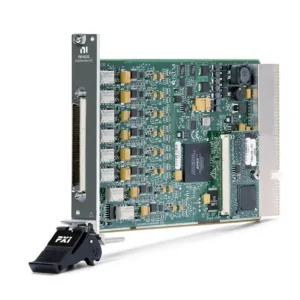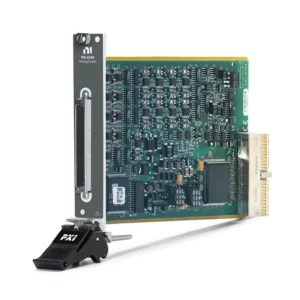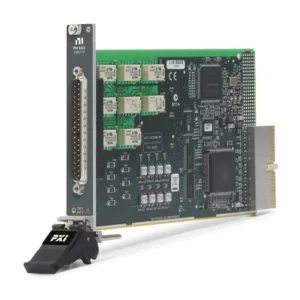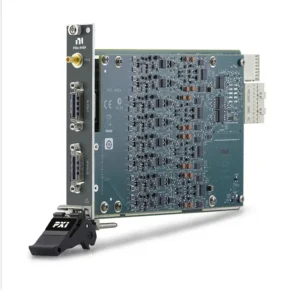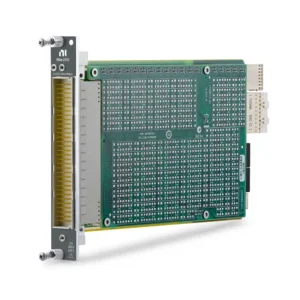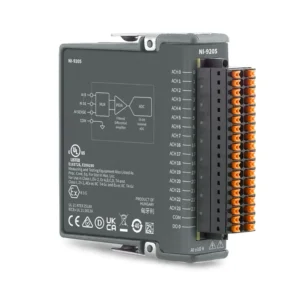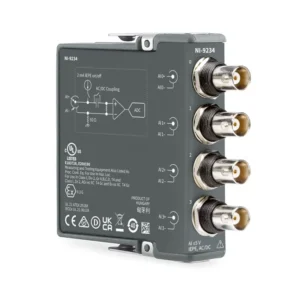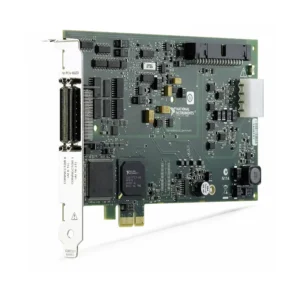




Product Introduction
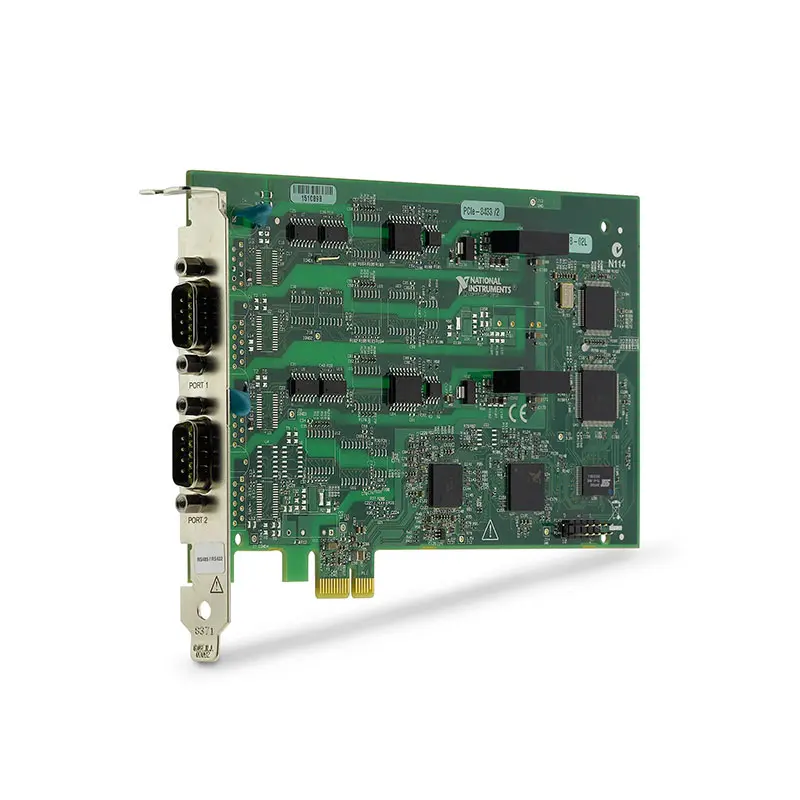
Земля NI PCIe-8433/2 высокопроизводительный 2-port isolated RS-485/RS-422 serial interface device designed for industrial automation, automated test, instrument control, production systems, laboratory automation, and communication with electrically distributed equipment.
The PCIe-8433/2 combines two independent RS-485/RS-422 serial ports с port-to-port electrical isolation and a PCI Express host interface. Its isolation architecture helps reduce problems caused by ground loops, ground-potential differences, and electrical noise between connected devices.
The device also supports 2-проводной и 4-проводной режимы приемопередатчика, full-duplex and half-duplex communication, high-performance DMA transfers, multithreaded applications, and multiprocessor systems.
Product Overview
Земля National Instruments PCIe-8433/2 belongs to the NI isolated industrial serial interface family.
A typical system architecture is:
Host Computer → PCI Express → PCIe-8433/2 → Isolated RS-485 / RS-422 → Industrial Device / Instrument / Controller
The combination of differential serial communication and electrical isolation makes the PCIe-8433/2 particularly suitable for test and industrial systems where external devices may use different ground references or operate in electrically noisy environments.
Key Features
2 Isolated Serial Ports
The PCIe-8433/2 provides two isolated serial communication ports.
Each port can communicate with compatible RS-485 or RS-422 equipment while providing isolation between the computer and serial ports as well as port-to-port isolation according to the device architecture.
RS-485 Communication
The PCIe-8433/2 supports RS-485 differential serial communication.
RS-485 is widely used in industrial systems because of its strong noise immunity and support for multi-device communication.
Типичные применения включают:
- Industrial controllers
- PLCs
- Motion systems
- Process equipment
- Distributed sensors
- Автоматизированные системы тестирования
- Machine-control equipment
RS-422 Communication
The PCIe-8433/2 also supports RS-422 communication for compatible industrial and instrumentation applications.
RS-422 uses differential signaling and is suitable for reliable communication over longer distances and in electrically noisy environments.
Port-to-Port Isolation
A key feature of the PCIe-8433/2 is port-to-port isolation.
Isolation helps reduce communication and equipment problems caused by:
- Ground loops
- Ground-potential differences
- Common-mode electrical noise
- Industrial switching transients
- Distributed power systems
- Different equipment ground references
This makes the PCIe-8433/2 more appropriate than a non-isolated serial board for many industrial installations.
2-Wire RS-485 Mode
The PCIe-8433/2 supports 2-wire RS-485 operation.
In a typical 2-wire architecture, the same differential pair is used for transmitting and receiving, resulting in half-duplex communication.
4-Wire Communication
The interface also supports 4-wire transceiver mode.
Four-wire configurations use separate transmit and receive differential pairs and can provide full-duplex communication with compatible equipment.
Half-Duplex Communication
Half-duplex mode is commonly used for 2-wire RS-485 networks where connected devices share one communication pair.
Full-Duplex Communication
The PCIe-8433/2 supports full-duplex communication when configured with an appropriate 4-wire RS-485 or RS-422 connection.
High-Performance DMA Transfers
The PCIe-8433/2 supports Direct Memory Access (DMA) for efficient transfer of serial data between the interface hardware and host computer.
DMA can reduce CPU overhead and improve performance in applications that continuously transmit and receive serial data.
Multithreading Support
The device supports multithreaded applications, allowing separate software tasks to manage different communication operations simultaneously.
Multiprocessor Support
The PCIe-8433/2 also supports multiprocessor host systems, which can be useful in complex automated test and industrial applications.
Standard COM Port Compatibility
NI serial interfaces appear as standard COM ports to compatible software.
This allows many existing serial applications to use the PCIe-8433/2 without requiring a completely proprietary communication architecture.
PCI Express Host Interface
The PCIe-8433/2 installs into a compatible PCI Express slot in a desktop, workstation, industrial, or rackmount computer.
The PCI Express interface is well suited for permanently installed industrial and automated test systems.
Technical Specifications
| Параметр | Спецификация |
|---|---|
| Product Type | Isolated Serial Interface Device |
| Модель | PCIe-8433/2 |
| Manufacturer | Национальные инструменты |
| Part Number | 781745-01 |
| Host Interface | PCI Express |
| Serial Protocols | RS-485 / RS-422 |
| Number of Serial Ports | 2 |
| Isolation Type | Port-to-Port Isolation |
| 2-Wire Mode | Supported |
| 4-Wire Mode | Supported |
| Half-Duplex | Supported |
| Full-Duplex | Supported |
| DMA | Supported |
| Multithreading | Supported |
| Multiprocessor Support | Supported |
| Software Interface | Standard COM Port / NI Serial Software |
| Primary Applications | Industrial Communication, Automated Test, Instrument Control and Isolated Serial Communication |
How Does the PCIe-8433/2 Work?
The PCIe-8433/2 provides an electrically isolated communication interface between application software running on the host computer and external RS-485 or RS-422 equipment.
For transmitted data:
Application → Serial Driver → PCIe-8433/2 → Isolation → RS-485 / RS-422 → External Device
For received data:
External Device → RS-485 / RS-422 → Isolation → PCIe-8433/2 → Serial Driver → Application
This architecture allows the host system to communicate with industrial equipment while reducing direct electrical coupling between connected systems.
What Is an Isolated Serial Interface?
An isolated serial interface uses electrical isolation barriers between sections of the communication system.
The isolation helps prevent direct current paths between equipment grounds.
This is particularly important when:
- Connected equipment uses different power supplies
- Long cables create ground-potential differences
- Industrial motors and drives generate electrical noise
- Ground loops affect communication reliability
- Additional protection between systems is desirable
Why Is Port-to-Port Isolation Important?
Port-to-port isolation allows separate serial interfaces to communicate with equipment that may not share the same ground reference.
Например:
Port 1 → Machine A Ground Domain
Port 2 → Machine B Ground Domain
This can be beneficial when the two external devices are installed in different parts of a factory or use different power systems.
RS-485 Communication
RS-485 is a differential serial standard commonly used for industrial communication.
Important advantages include:
- Differential signaling
- Good noise immunity
- Longer practical communication distance
- Support for multidrop network architectures
- Wide industrial adoption
RS-422 Communication
RS-422 also uses differential signaling and is commonly used for point-to-point or limited multidrop communication.
It is often selected when reliable full-duplex serial communication is required over longer cable distances.
RS-485 vs RS-422
| Функция | RS-485 | RS-422 |
|---|---|---|
| Signaling | Differential | Differential |
| Multi-Device Network | Strong | More Limited |
| 2-Wire Operation | Common | Typically Not Used |
| 4-Wire Operation | Supported | Common |
| Half-Duplex | Common | Less Common |
| Full-Duplex | Supported | Common |
2-Wire vs 4-Wire Communication
| Функция | 2-Wire | 4-Wire |
|---|---|---|
| Differential Pairs | 1 | 2 |
| Transmit and Receive | Shared Pair | Separate Pairs |
| Typical Mode | Half-Duplex | Full-Duplex |
| Wiring Complexity | Lower | Higher |
| Simultaneous TX / RX | No | Да |
Промышленная автоматизация
The isolated architecture makes the PCIe-8433/2 particularly suitable for industrial automation.
Compatible equipment can include:
- PLCs
- Industrial controllers
- Motor controllers
- Distributed sensors
- Process equipment
- Machine-control systems
- Production equipment
Automated Test Applications
The PCIe-8433/2 can integrate isolated RS-485 or RS-422 communication into automated test platforms.
A complete test system can combine:
- PCIe-8433/2 serial communication
- DAQ hardware
- Oscilloscopes or digitizers
- Programmable power supplies
- Electronic loads
- Цифровой ввод-вывод
- Switch systems
- Test fixtures
Test software can coordinate serial commands with electrical measurements and DUT stimulus.
Instrument Control
Compatible instruments using RS-485 or RS-422 can be controlled through the PCIe-8433/2.
Typical operations include:
- Sending configuration commands
- Starting measurements
- Reading measurement results
- Monitoring instrument status
- Changing operating parameters
- Logging serial data
Distributed Equipment Communication
Isolation can be particularly valuable when the connected devices are physically separated.
Например:
Industrial PC → PCIe-8433/2 Port 1 → Equipment Area A
Industrial PC → PCIe-8433/2 Port 2 → Equipment Area B
Port-to-port isolation reduces direct ground coupling between the two external serial systems.
Production Test
The PCIe-8433/2 can communicate with DUTs, fixtures, industrial controllers, and supporting equipment during automated production testing.
A typical test sequence can:
- Open the required serial port.
- Configure RS-485 or RS-422 mode.
- Set the baud rate and serial parameters.
- Send commands to the DUT.
- Receive serial response data.
- Perform electrical measurements.
- Analyze the results.
- Store pass/fail data.
Modbus RTU Applications
Many Modbus RTU systems use RS-485 as their physical communication interface.
The PCIe-8433/2 can provide the isolated RS-485 hardware layer for compatible Modbus RTU systems.
A typical architecture is:
Modbus Software → PCIe-8433/2 → Isolated RS-485 → Modbus Devices
The Modbus protocol itself must be implemented using compatible application software or a Modbus library.
RS-485 Network Termination
Proper termination is important for reliable RS-485 communication.
The complete network should be evaluated for:
- Termination resistance
- Cable impedance
- Baud rate
- Cable length
- Network topology
- Number of connected nodes
- Stub length
RS-485 Biasing
Some RS-485 networks require bias resistors to establish a defined bus state when no transmitter is actively driving the network.
Biasing requirements should be determined according to the connected transceivers, topology, cable, termination, and device documentation.
Isolation vs Non-Isolated Serial Interface
| Функция | PCIe-8433/2 | Non-Isolated RS-485 Interface |
|---|---|---|
| RS-485 / RS-422 | Да | Да |
| Electrical Isolation | Да | No |
| Port-to-Port Isolation | Да | No |
| Ground Loop Protection | Better | More Limited |
| Distributed Equipment | Well Suited | System Dependent |
| Industrial Noise Environment | Preferred When Isolation Is Required | Suitable When Grounds Are Controlled |
PCIe-8433/2 vs PCIe-8431/2
The PCIe-8433/2 and PCIe-8431/2 both support two-port RS-485/RS-422 communication, but isolation is the major difference.
| Функция | PCIe-8433/2 | PCIe-8431/2 |
|---|---|---|
| Serial Standard | RS-485 / RS-422 | RS-485 / RS-422 |
| Serial Ports | 2 | 2 |
| Изоляция | Port-to-Port Isolated | Non-Isolated |
| 2-Wire / 4-Wire | Да | Да |
| Primary Advantage | Electrical Isolation | Standard Serial Communication |
| Best Application | Distributed / Noisy Industrial Systems | Controlled-Ground Systems |
If ground-potential differences or electrical isolation are important, the PCIe-8433/2 is generally more appropriate than the non-isolated PCIe-8431/2.
PCIe-8433/2 vs PCIe-8432/2
Both models provide isolated serial communication but support different serial electrical standards.
| Функция | PCIe-8433/2 | PCIe-8432/2 |
|---|---|---|
| Serial Standard | RS-485 / RS-422 | РС-232 |
| Ports | 2 | 2 |
| Изоляция | Да | Да |
| Signaling | Differential | Single-Ended |
| Типичное использование | Industrial Networks | Isolated RS-232 Instrument Control |
PCIe-8433/2 vs PCI-8433/2
The PCIe-8433/2 is the PCI Express version of this isolated serial interface family, while the older PCI-8433/2 uses a conventional PCI host bus.
| Функция | PCIe-8433/2 | PCI-8433/2 |
|---|---|---|
| Host Interface | PCI Express | PCI |
| Serial Standard | RS-485 / RS-422 | RS-485 / RS-422 |
| Ports | 2 | 2 |
| Изоляция | Да | Да |
| Typical System | Newer PCI Express Computers | Legacy PCI Computers |
NI Serial Software Integration
The PCIe-8433/2 operates with compatible NI serial software.
Applications can perform functions such as:
- Open serial ports
- Configure baud rate
- Select RS-485 / RS-422 mode
- Configure 2-wire / 4-wire operation
- Transmit serial commands
- Receive serial data
- Monitor communication status
- Log data
NI-VISA Integration
Compatible applications can use NI-VISA for serial instrument communication.
A common workflow is:
VISA Open → Configure Serial Port → VISA Write → VISA Read → VISA Close
LabVIEW Integration
The PCIe-8433/2 can be incorporated into compatible ЛабВью applications for serial communication and automation.
Области применения включают:
- Industrial equipment control
- Automated testing
- Instrument communication
- Production testing
- Serial data logging
- Machine monitoring
- Laboratory automation
Legacy System Replacement
When replacing an existing PCIe-8433/2, verify more than the RS-485/RS-422 protocol.
Important compatibility factors include:
- Exact PCIe-8433/2 model
- Part number 781745-01
- Required number of ports
- Isolation requirements
- 2-wire or 4-wire configuration
- Half-duplex or full-duplex operation
- Baud rate
- Connector and cable configuration
- Termination
- Biasing
- PCI Express slot
- NI Serial driver compatibility
- NI-VISA compatibility
- Operating system
- Existing application software
Troubleshooting RS-485/RS-422 Communication
If communication is unavailable or unstable, check the complete serial link.
- Verify that the PCIe-8433/2 is detected by the host computer.
- Confirm the correct COM port.
- Verify RS-485 or RS-422 mode.
- Check 2-wire or 4-wire configuration.
- Confirm baud rate, data bits, parity, and stop bits.
- Check cable wiring and differential polarity.
- Verify network termination.
- Check RS-485 biasing.
- Confirm external device address and protocol.
- Check whether ground-potential differences or wiring issues are present.
- Reduce baud rate temporarily to diagnose signal-integrity problems.
How to Choose an Isolated RS-485/RS-422 Interface
Before selecting the PCIe-8433/2, determine:
- RS-485 or RS-422 requirement
- Required number of ports
- Need for electrical isolation
- Need for port-to-port isolation
- 2-wire or 4-wire architecture
- Half-duplex or full-duplex operation
- Required baud rate
- Communication distance
- Network topology
- Termination requirements
- Biasing requirements
- Available PCI Express slot
- Operating system compatibility
- Driver and application compatibility
Industries
- Промышленная автоматизация
- Automated Test
- Electronic Manufacturing
- Production Test
- Process Control
- Machine Automation
- Laboratory Automation
- Research and Development
- Энергетические системы
- Системная интеграция
Applications
Промышленная автоматизация
The PCIe-8433/2 provides isolated RS-485/RS-422 communication for industrial controllers, sensors, machines, and automation equipment.
Automated Test
Two isolated serial interfaces can communicate with instruments, controllers, and DUTs as part of automated test systems.
Instrument Control
Compatible RS-485 and RS-422 instruments can be configured, controlled, and monitored while maintaining electrical isolation from the host computer.
Production Test
The PCIe-8433/2 can communicate with serial DUTs, fixtures, and production equipment in environments where isolation improves system robustness.
Modbus RTU
The PCIe-8433/2 can provide an isolated RS-485 physical interface for compatible Modbus RTU systems when used with appropriate protocol software.
Distributed Equipment Communication
Port-to-port isolation makes the device particularly useful when communicating with equipment located in different electrical ground domains.
Recommended Related Products
| PCIe-8433/2 | 2-port isolated PCI Express RS-485/RS-422 interface for industrial communication and automated test. |
| PCIe-8431/2 | 2-port non-isolated PCI Express RS-485/RS-422 interface for controlled-ground systems. |
| PCIe-8432/2 | 2-port isolated PCI Express RS-232 interface for isolated RS-232 instrument communication. |
| PCI-8433/2 | Legacy PCI version for isolated RS-485/RS-422 communication. |
| PXI-8433/2 | PXI version for isolated RS-485/RS-422 communication in modular test systems. |
Why Choose PCIe-8433/2?
- 2 isolated serial ports
- RS-485 support
- RS-422 support
- Port-to-port isolation
- 2-wire transceiver mode
- 4-wire transceiver mode
- Half-duplex communication
- Full-duplex communication
- High-performance DMA transfers
- Multithreading support
- Multiprocessor support
- Standard COM port compatibility
- PCI Express host interface
- Suitable for industrial automation
- Suitable for distributed equipment
- Suitable for automated test
- Suitable for instrument control
- Suitable for Modbus RTU systems
Frequently Asked Questions
What is the NI PCIe-8433/2?
The NI PCIe-8433/2 is a two-port isolated PCI Express serial interface device designed for RS-485 and RS-422 industrial communication.
What is the part number of PCIe-8433/2?
The PCIe-8433/2 is available under part number 781745-01.
How many serial ports does PCIe-8433/2 have?
The PCIe-8433/2 provides 2 serial communication ports.
Does PCIe-8433/2 support RS-485?
Yes. The PCIe-8433/2 supports RS-485 differential serial communication.
Does PCIe-8433/2 support RS-422?
Yes. The device supports both RS-485 and RS-422.
Is PCIe-8433/2 isolated?
Yes. NI specifies port-to-port isolation for the PCIe-8433/2.
Does PCIe-8433/2 support 2-wire RS-485?
Yes. The device supports selectable 2-wire transceiver operation for compatible half-duplex RS-485 systems.
Does PCIe-8433/2 support 4-wire communication?
Yes. Four-wire mode is available for compatible full-duplex RS-485 or RS-422 communication.
Does PCIe-8433/2 support DMA?
Yes. The device supports high-performance DMA transfers for efficient serial data movement between the hardware and host computer.
Does PCIe-8433/2 appear as a COM port?
Yes. NI serial interfaces appear as standard COM ports to compatible serial communication applications.
What is the difference between PCIe-8433/2 and PCIe-8431/2?
Both provide two RS-485/RS-422 ports, but PCIe-8433/2 is isolated while PCIe-8431/2 is non-isolated. This is the most important difference when selecting between the two models.
What is the difference between PCIe-8433/2 and PCIe-8432/2?
Both are isolated two-port PCI Express serial interfaces, but PCIe-8433/2 supports RS-485/RS-422, while PCIe-8432/2 supports РС-232.
Can PCIe-8433/2 be used for Modbus RTU?
Yes. It can provide the isolated RS-485 physical interface used by many Modbus RTU systems. The Modbus protocol itself must be handled by compatible software.
Can PCIe-8433/2 be used with LabVIEW?
Yes. The PCIe-8433/2 can be integrated into compatible LabVIEW applications for serial communication, automated testing, industrial control, and data logging.
Can PCIe-8433/2 be used with NI-VISA?
Yes. Compatible NI-VISA applications can communicate with instruments and other serial devices through the PCIe-8433/2.
When should I choose PCIe-8433/2 instead of PCIe-8431/2?
Choose PCIe-8433/2 when your application requires electrical isolation, particularly in systems with different ground references, long cable runs, industrial electrical noise, or distributed equipment.
What should I check before purchasing PCIe-8433/2?
Verify the RS-485/RS-422 requirement, two-port configuration, need for port-to-port isolation, 2-wire or 4-wire wiring, half-duplex or full-duplex mode, baud rate, network termination, biasing, cable configuration, PCI Express slot, NI serial driver, NI-VISA, operating system, and application software compatibility.
Заключение
Земля NI PCIe-8433/2 Isolated RS-485/RS-422 Serial Interface Device combines two serial ports, port-to-port electrical isolation, selectable 2-wire and 4-wire operation, half- and full-duplex communication, high-performance DMA, multithreading, multiprocessor support, standard COM port compatibility, and PCI Express connectivity. These capabilities make it particularly suitable for industrial automation, distributed equipment communication, automated test, instrument control, production systems, Modbus RTU networks, and applications where electrical isolation is required.