



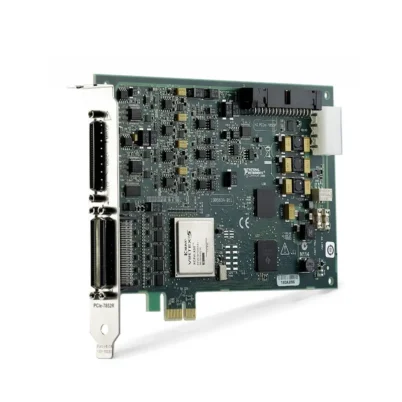
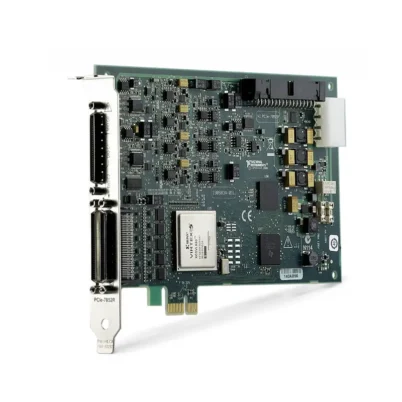
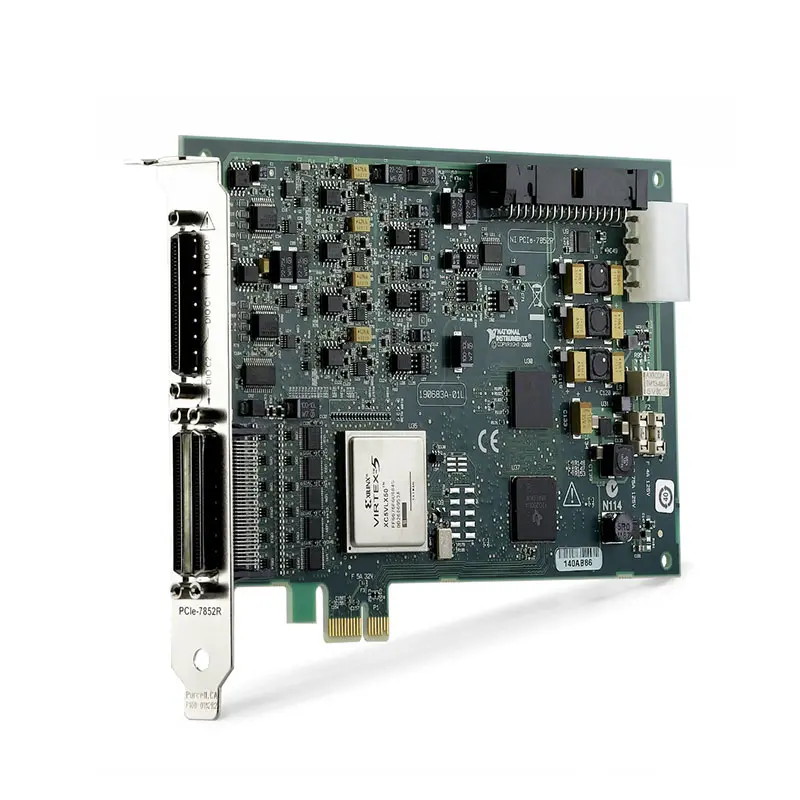
Product Introduction
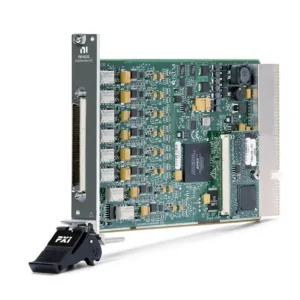
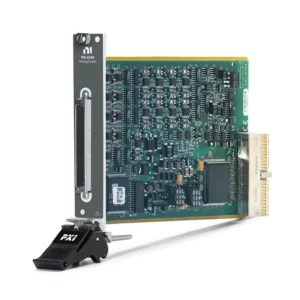
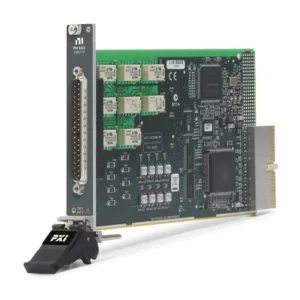
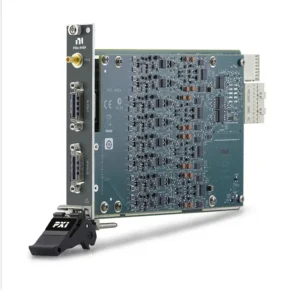
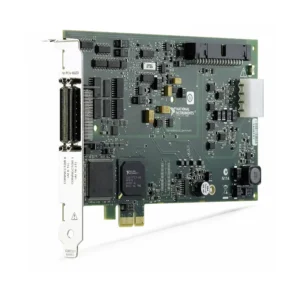
Земля NI PCIe-7841R является R Series Multifunction Reconfigurable I/O (RIO) device designed for PCI Express-based measurement, control, hardware-in-the-loop (HIL), prototyping, and custom digital interface applications.
Unlike conventional multifunction DAQ devices with primarily fixed hardware functionality, the PCIe-7841R includes a user-programmable FPGA. This FPGA architecture allows engineers to implement custom timing, triggering, signal processing, control algorithms, digital protocols, and deterministic I/O behavior directly in hardware.
The PCIe-7841R combines 8 analog inputs, 8 analog outputs, 96 digital I/O lines, and a Xilinx Virtex-5 LX30 FPGA on a single PCI Express device. Its analog inputs provide 16-bit resolution with sampling rates up to 200 kS/s per channel.
Product Overview
Земля National Instruments PCIe-7841R belongs to the NI R Series family of multifunction reconfigurable I/O devices.
A typical system architecture is:
Sensors / DUT / Digital Signals → PCIe-7841R I/O → User-Programmable FPGA → PCI Express → Host Application
Because critical I/O operations can execute directly on the FPGA, the PCIe-7841R is particularly useful for applications requiring deterministic timing, custom hardware logic, low-latency response, and synchronization between analog and digital signals.
Key Features
User-Programmable FPGA
The defining feature of the PCIe-7841R is its onboard Xilinx Virtex-5 LX30 FPGA.
The FPGA can be programmed to implement application-specific hardware functionality such as:
- Custom triggering
- Hardware-timed control loops
- Digital protocol implementation
- Signal processing
- Custom counters and timers
- High-speed decision logic
- State machines
- Обработка кодировщика
- Hardware interlocks
- Custom synchronization
Virtex-5 LX30 FPGA
The PCIe-7841R uses a Xilinx Virtex-5 LX30 FPGA for reconfigurable hardware processing.
The FPGA architecture allows portions of the measurement and control application to execute independently from the host processor, providing deterministic hardware-level operation for time-critical tasks.
8 Analog Input Channels
The PCIe-7841R provides 8 аналоговых входных каналов for acquiring voltage signals from sensors, electronic circuits, devices under test, and other compatible signal sources.
The analog inputs provide 16-битное разрешение for precision measurement applications.
200 kS/s Per Channel Analog Input
Each analog input channel supports sampling rates up to 200 тыс. отсчетов/с на канал.
The per-channel architecture is particularly valuable for applications requiring acquisition from multiple analog signals without relying on a single multiplexed ADC for all channels.
Independent Analog-to-Digital Converters
The PCIe-7841R uses dedicated analog conversion resources that support simultaneous acquisition across its analog input channels.
This architecture is useful when engineers need to preserve timing relationships between multiple signals.
8 Analog Output Channels
The PCIe-7841R provides 8 аналоговых выходных каналов with 16-bit resolution.
These outputs can be used for:
- Control signal generation
- Device stimulus
- Симуляция с аппаратным входом
- Замкнутая система управления
- Programmable setpoints
- Actuator control
- Automated device testing
96 Digital I/O Lines
The PCIe-7841R provides 96 цифровых входов/выходов, giving engineers extensive flexibility for custom digital interfacing.
Digital I/O can be used for:
- Пользовательские протоколы связи
- Digital triggering
- Device control
- Status monitoring
- Интерфейсы энкодера
- Hardware handshaking
- Pattern generation
- Custom counters
- Custom timing interfaces
TTL Digital I/O
The digital I/O architecture is compatible with TTL digital logic.
External signals should always be verified against the electrical input, output, and maximum voltage specifications of the PCIe-7841R before connection.
PCI Express Interface
The PCIe-7841R installs in a compatible PCI Express slot in a desktop, workstation, industrial, or rackmount computer.
The PCI Express architecture provides the host connection required for communication between the FPGA target and application software.
Three 68-Pin VHDCI Connectors
The PCIe-7841R uses three 68-pin female high-density VHDCI connectors for external I/O connectivity.
Compatible cables and terminal blocks should be selected according to the analog and digital I/O requirements of the application.
Technical Specifications
| Параметр | Спецификация |
|---|---|
| Product Type | R Series Multifunction Reconfigurable I/O Device |
| Модель | PCIe-7841R |
| Manufacturer | Национальные инструменты |
| Шинный интерфейс | PCI Express |
| ФПГА | Xilinx Virtex-5 LX30 |
| Analog Input Channels | 8 |
| Analog Input Resolution | 16-Bit |
| Maximum Analog Input Sample Rate | 200 kS/s per Channel |
| ADC Type | Successive Approximation |
| Analog Input Modes | DIFF, RSE, NRSE |
| Analog Output Channels | 8 |
| Analog Output Resolution | 16-Bit |
| Digital I/O Channels | 96 |
| Digital Compatibility | TTL |
| I/O Connectors | 3 × 68-Pin Female VHDCI |
| Architecture | User-Programmable FPGA |
| Product Family | NI R Series Multifunction RIO |
| Primary Applications | FPGA-Based Control, HIL, Custom I/O, Automated Test and Prototyping |
How Does the PCIe-7841R Work?
The PCIe-7841R combines analog and digital I/O with a programmable FPGA positioned directly in the I/O data path.
A simplified architecture is:
External I/O → ADC / DAC / Digital I/O → Virtex-5 FPGA → PCI Express → Host Computer
Instead of requiring every I/O operation to be controlled directly by host software, the FPGA can execute custom logic independently.
For example, the FPGA can acquire an analog signal, compare it with a programmed threshold, evaluate digital conditions, and change an output according to custom logic without waiting for the host operating system to process each individual operation.
What Is Reconfigurable I/O?
Reconfigurable I/O allows engineers to define hardware behavior using programmable FPGA logic rather than relying only on fixed-function DAQ hardware.
This gives the PCIe-7841R substantially more flexibility for specialized measurement and control applications.
Инженеры могут реализовать:
- Application-specific timing
- Custom triggering architectures
- Hardware state machines
- Parallel processing
- Digital protocols
- Custom PWM generation
- Specialized counters
- High-speed control logic
- Signal processing algorithms
FPGA-Based Processing
Traditional PC software runs under an operating system that can introduce timing variability. FPGA logic executes directly in hardware and can provide deterministic behavior for time-critical operations.
This makes the PCIe-7841R useful when an application requires predictable timing between an input event and an output response.
Parallel Processing
An FPGA does not operate in the same sequential manner as a conventional CPU. Multiple hardware operations can execute in parallel.
For example, a PCIe-7841R FPGA application can simultaneously:
- Acquire multiple analog channels
- Generate analog outputs
- Monitor digital inputs
- Generate digital outputs
- Process encoder signals
- Evaluate trigger conditions
- Execute control logic
This parallelism is one of the major advantages of FPGA-based R Series hardware.
Analog Input Architecture
The PCIe-7841R provides eight 16-bit analog input channels with sampling rates up to 200 kS/s per channel.
The device supports software-selectable analog input modes including:
- Differential (DIFF)
- Referenced Single-Ended (RSE)
- Nonreferenced Single-Ended (NRSE)
The selected configuration should be based on signal grounding, noise, common-mode voltage, and overall measurement requirements.
Simultaneous Analog Acquisition
The analog input architecture allows multiple signals to be acquired while maintaining their timing relationship.
This is important in applications such as:
- Multichannel control
- Power electronics testing
- Motor control
- Симуляция с аппаратным входом
- Dynamic system testing
- Electronic validation
Analog Output Applications
The eight analog outputs allow the PCIe-7841R to generate programmable signals directly under FPGA control.
A typical closed-loop architecture is:
Analog Input → FPGA Control Algorithm → Analog Output → Device / Plant → Analog Input
This architecture can be used for deterministic control and simulation applications.
Digital I/O Applications
The 96 digital I/O lines provide extensive resources for custom digital interfacing.
Because digital behavior can be defined in FPGA logic, the PCIe-7841R can implement functionality beyond simple static digital input and output.
Applications can include:
- Custom serial interfaces
- Digital protocol emulation
- Hardware handshaking
- Encoder decoding
- Генерация ШИМ
- Измерение пульса
- Digital pattern generation
- Custom trigger routing
Hardware-in-the-Loop Testing
The PCIe-7841R can be used in hardware-in-the-loop (HIL) and real-time simulation architectures where deterministic I/O behavior is required.
The FPGA can implement custom signal processing and I/O interfaces between the test system and the device under test.
Typical HIL applications can include:
- Electronic control unit testing
- Embedded controller validation
- Motor controller testing
- Power electronics validation
- Custom control-system simulation
Closed-Loop Control
The combination of analog inputs, analog outputs, digital I/O, and FPGA processing allows the PCIe-7841R to implement custom closed-loop control systems.
The FPGA can acquire feedback signals, execute a control algorithm, and update outputs with deterministic hardware timing.
Rapid Control Prototyping
The PCIe-7841R can be used for rapid control prototyping when engineers need to develop and validate control algorithms before implementing dedicated production hardware.
FPGA-based processing provides flexibility for testing different control strategies, timing architectures, and custom interfaces.
Custom Triggering
One advantage of reconfigurable FPGA hardware is the ability to create application-specific trigger logic.
Instead of relying only on predefined trigger functions, engineers can combine multiple conditions such as:
- Analog thresholds
- Digital states
- Timing conditions
- Counter values
- Sequence states
- External events
These conditions can be evaluated directly in FPGA hardware.
Custom Digital Protocols
The PCIe-7841R can be used to implement certain custom digital communication interfaces in FPGA logic.
This capability can be valuable when working with proprietary devices, specialized sensors, legacy hardware, or interfaces not supported by conventional fixed-function instrumentation.
Автоматизированные испытательные системы
The PCIe-7841R can provide deterministic measurement and control functionality within automated test equipment.
A typical test sequence can include:
- Initialize the FPGA application.
- Configure test parameters.
- Generate analog and digital stimulus.
- Acquire analog measurements.
- Monitor digital responses.
- Perform FPGA-based processing.
- Evaluate hardware trigger conditions.
- Transfer measurement results to the host.
- Store and analyze test data.
PCIe-7841R vs PCIe-7842R
The PCIe-7841R and PCIe-7842R provide closely related analog and digital I/O architectures. A major difference is the FPGA capacity.
| Функция | PCIe-7841R | PCIe-7842R |
|---|---|---|
| Шинный интерфейс | PCI Express | PCI Express |
| ФПГА | Virtex-5 LX30 | Virtex-5 LX50 |
| Analog Inputs | 8 | 8 |
| AI Resolution | 16-Bit | 16-Bit |
| Maximum AI Rate | 200 kS/s/ch | 200 kS/s/ch |
| Analog Outputs | 8 | 8 |
| Цифровой ввод-вывод | 96 | 96 |
| Primary Difference | Smaller FPGA | Larger FPGA |
The PCIe-7842R should be considered when the FPGA application requires additional logic resources. The PCIe-7841R can be appropriate when the Virtex-5 LX30 provides sufficient resources for the required FPGA design.
PCIe-7841R vs PCIe-7851R
The PCIe-7841R and PCIe-7851R both use a Virtex-5 LX30 FPGA, but their analog acquisition performance differs.
| Функция | PCIe-7841R | PCIe-7851R |
|---|---|---|
| ФПГА | Virtex-5 LX30 | Virtex-5 LX30 |
| Analog Inputs | 8 | 8 |
| AI Resolution | 16-Bit | 16-Bit |
| Maximum AI Rate | 200 kS/s/ch | 750 kS/s/ch |
| Analog Outputs | 8 | 8 |
| Цифровой ввод-вывод | 96 | 96 |
| Primary Advantage | General FPGA-Based Multifunction I/O | Higher Analog Acquisition Speed |
The PCIe-7851R is more appropriate when higher analog input sampling performance is required, while the PCIe-7841R can be sufficient for applications requiring up to 200 kS/s per channel.
PCIe-7841R vs PXI-7841R
The PCIe-7841R and PXI-7841R provide closely related R Series functionality but use different host platforms.
| Функция | PCIe-7841R | PXI-7841R |
|---|---|---|
| Platform | PCI Express | PXI |
| ФПГА | Virtex-5 LX30 | Virtex-5 LX30 |
| Analog Inputs | 8 | 8 |
| Analog Outputs | 8 | 8 |
| Цифровой ввод-вывод | 96 | 96 |
| Installation | PCI Express Computer | PXI Шасси |
| Типичное использование | PC-Based FPGA Systems | Modular PXI Systems |
PCIe-7841R vs Conventional DAQ Devices
| Функция | PCIe-7841R | Conventional Multifunction DAQ |
|---|---|---|
| User-Programmable FPGA | Да | Typically No |
| Custom Hardware Logic | Да | Ограниченный |
| Deterministic I/O Processing | FPGA-Based | Primarily Fixed Hardware / Driver-Based |
| Analog Input | Да | Да |
| Analog Output | Да | Model Dependent |
| Цифровой ввод-вывод | 96 Lines | Model Dependent |
| Custom Protocols | Can Be FPGA Implemented | Ограниченный |
| Primary Strength | Reconfigurable Hardware | General Data Acquisition |
68-Pin VHDCI Connectivity
The PCIe-7841R provides three 68-pin female high-density VHDCI connectors.
NI identifies compatible accessory options for the PCIe-7841R including:
- SHC68-68-RMIO cable
- SHC68-68-RDIO cable
- SHC68-NT-S unterminated cable
- SCB-68 terminal block
- SCB-68A terminal block
Cable and terminal block selection should be based on the specific connector, signal type, pinout, and application requirements.
NI 9151 Expansion
The digital I/O architecture of the PCIe-7841R can also be used with compatible NI expansion hardware such as the NI 9151 R Series Expansion Chassis.
This architecture can provide access to compatible C Series I/O modules for applications requiring additional signal conditioning or specialized sensor interfaces.
FPGA Programming
The PCIe-7841R is designed for applications in which engineers customize the onboard FPGA according to their measurement and control requirements.
Typical FPGA application development can include:
- Defining FPGA I/O operations
- Creating deterministic loops
- Implementing hardware logic
- Building state machines
- Developing custom triggers
- Performing fixed-point calculations
- Creating custom digital interfaces
- Implementing hardware-level safety logic
LabVIEW FPGA Applications
The PCIe-7841R is commonly associated with FPGA-based application development using the NI R Series software architecture and compatible LabVIEW FPGA development environments.
A typical application architecture is:
Host Application ↔ FPGA Interface ↔ FPGA VI ↔ Analog / Digital I/O
The FPGA executes time-critical hardware operations while the host application can perform user-interface functions, data storage, high-level analysis, configuration, and communication with other instruments.
Legacy System Replacement
The PCIe-7841R is also relevant for maintenance and replacement of existing R Series test and control systems.
When replacing an existing PCIe-7841R, verify:
- PCI Express slot compatibility
- FPGA bitfile compatibility
- Existing FPGA application
- Host software version
- R Series driver compatibility
- LabVIEW FPGA version
- Existing VHDCI cables
- Terminal block compatibility
- I/O pin assignments
- Analog input configuration
- Analog output requirements
- Digital I/O configuration
For an existing FPGA system, software and FPGA compatibility can be just as important as the basic electrical specifications of the replacement hardware.
How to Choose an R Series RIO Device
Before selecting the PCIe-7841R, evaluate:
- Required FPGA capacity
- Analog input channel count
- Analog input resolution
- Required sampling rate per channel
- Analog output requirements
- Digital I/O channel count
- Custom timing requirements
- Custom protocol requirements
- Control-loop requirements
- PCI Express slot compatibility
- VHDCI cable requirements
- Terminal block requirements
- FPGA development software compatibility
- Existing FPGA code or bitfile compatibility
Industries
- Automated Test
- Industrial Control
- Hardware-in-the-Loop Testing
- Automotive Test
- Аэрокосмическая и оборонная промышленность
- Power Electronics
- Motor and Drive Testing
- Electronic Validation
- Research and Development
- Rapid Control Prototyping
Applications
Hardware-in-the-Loop Testing
The FPGA architecture can provide deterministic I/O processing for compatible HIL test and simulation systems.
Custom Control Systems
Analog inputs, analog outputs, digital I/O, and FPGA processing can be combined to implement custom deterministic control architectures.
Rapid Control Prototyping
Engineers can use the PCIe-7841R to prototype FPGA-based control algorithms and custom hardware interfaces before implementing dedicated production hardware.
Custom Digital Interfaces
The 96 digital I/O lines and programmable FPGA can be used to implement application-specific digital communication, timing, triggering, and control interfaces.
Automated Test
The PCIe-7841R can provide custom measurement, stimulus, triggering, digital control, and deterministic processing functionality in automated test systems.
Power Electronics and Motor Control
Simultaneous analog acquisition, analog generation, digital I/O, and FPGA processing make the PCIe-7841R useful for compatible power electronics, motor control, and electromechanical test applications.
Recommended Related Products
| PCIe-7841R | Virtex-5 LX30 FPGA-based multifunction RIO device with 8 AI, 8 AO, and 96 DIO. |
| PCIe-7842R | Related R Series multifunction RIO device with a larger Virtex-5 LX50 FPGA. |
| PCIe-7851R | Virtex-5 LX30 R Series device offering higher analog input sampling performance. |
| PCIe-7852R | Higher-performance R Series option combining faster analog acquisition with a larger FPGA. |
| PXI-7841R | PXI form-factor version for modular FPGA-based test and measurement systems. |
| PXIe-7846R | Newer-generation PXI Express R Series architecture for FPGA-based measurement and control applications. |
Why Choose PCIe-7841R?
- User-programmable FPGA architecture
- Xilinx Virtex-5 LX30 FPGA
- 8 аналоговых входных каналов
- 16-bit analog input resolution
- Up to 200 kS/s per channel analog input
- 8 аналоговых выходных каналов
- 16-bit analog output resolution
- 96 цифровых входов/выходов
- TTL digital compatibility
- PCI Express interface
- Three 68-pin VHDCI connectors
- Настройка времени аппаратного обеспечения
- Deterministic FPGA processing
- Suitable for HIL testing
- Suitable for custom control
- Suitable for automated test
Frequently Asked Questions
What is the NI PCIe-7841R?
The NI PCIe-7841R is an R Series multifunction reconfigurable I/O device that combines analog input, analog output, digital I/O, and a user-programmable FPGA on a PCI Express platform.
What FPGA does PCIe-7841R use?
The PCIe-7841R uses a Xilinx Virtex-5 LX30 FPGA.
How many analog inputs does PCIe-7841R have?
The PCIe-7841R provides 8 аналоговых входных каналов.
What is the analog input resolution?
The PCIe-7841R provides 16-bit analog input resolution.
What is the maximum analog input sampling rate?
The PCIe-7841R supports analog input sampling rates up to 200 тыс. отсчетов/с на канал.
Does PCIe-7841R support simultaneous analog input?
Yes. Its analog input architecture supports simultaneous acquisition, which is useful for preserving timing relationships between multiple measured signals.
How many analog outputs does PCIe-7841R have?
The PCIe-7841R provides 8 аналоговых выходных каналов with 16-bit resolution.
How many digital I/O lines does PCIe-7841R provide?
The PCIe-7841R provides 96 цифровых входов/выходов.
What connectors does PCIe-7841R use?
The PCIe-7841R provides three 68-pin female high-density VHDCI connectors.
What cables are compatible with PCIe-7841R?
NI lists accessories including the SHC68-68-RMIO, SHC68-68-RDIO, and SHC68-NT-S cables for this R Series architecture. The exact cable should be selected according to the connector and I/O signals being used.
What terminal blocks can be used with PCIe-7841R?
Compatible configurations include SCB-68 and SCB-68A connector blocks. Always verify the correct R Series pinout before wiring signals.
What is the difference between PCIe-7841R and PCIe-7842R?
Both models provide closely related I/O capabilities, but the PCIe-7841R uses a Virtex-5 LX30 FPGA while the PCIe-7842R uses the larger Virtex-5 LX50 FPGA. The PCIe-7842R is therefore better suited to FPGA applications requiring additional logic resources.
What is the difference between PCIe-7841R and PCIe-7851R?
Both use a Virtex-5 LX30 FPGA and provide similar multifunction I/O architecture. A major difference is analog acquisition speed: the PCIe-7841R supports up to 200 kS/s per channel, while the PCIe-7851R provides higher analog input sampling performance.
What is the difference between PCIe-7841R and PXI-7841R?
The primary difference is the host platform. PCIe-7841R installs in a PCI Express computer, while PXI-7841R is designed for a PXI chassis.
Can PCIe-7841R be used for HIL testing?
Yes. Its user-programmable FPGA, analog I/O, and extensive digital I/O make it suitable for compatible hardware-in-the-loop testing and real-time I/O applications.
Can PCIe-7841R implement custom digital protocols?
Yes. The FPGA and reconfigurable digital I/O architecture can be used to implement application-specific digital timing and protocol logic, subject to the electrical and timing capabilities of the hardware.
Can PCIe-7841R be used for closed-loop control?
Yes. The FPGA can acquire input signals, execute custom control logic, and update outputs with deterministic hardware timing, making the device suitable for compatible closed-loop control applications.
What should I check before purchasing a PCIe-7841R?
Verify the FPGA resource requirements, 8 AI and 8 AO configuration, 200 kS/s per-channel analog input rate, 96 DIO requirement, PCI Express compatibility, VHDCI cabling, terminal blocks, FPGA software environment, driver compatibility, operating system, existing FPGA bitfiles, and application source code.
Заключение
Земля NI PCIe-7841R R Series Multifunction Reconfigurable I/O Device combines a Xilinx Virtex-5 LX30 FPGA with eight 16-bit analog inputs, eight 16-bit analog outputs, 96 digital I/O lines, and a PCI Express host interface. Its FPGA-based architecture provides deterministic timing, parallel processing, custom triggering, and reconfigurable hardware logic for HIL testing, rapid control prototyping, custom digital interfaces, automated testing, electronic validation, and advanced measurement and control systems.